"The Core of AI Hegemony is Power" - The U.S. Accelerates Data Center Efficiency and Power Facility Expansion, Heightening Competition with China Leveraging Low-Cost Electricity

As one of the youngest members of the team, Tyler Hansbrough is a rising star in financial journalism. His fresh perspective and analytical approach bring a modern edge to business reporting. Whether he’s covering stock market trends or dissecting corporate earnings, his sharp insights resonate with the new generation of investors.
Authored On
Modified
AI data center power shortages worsen; efforts continue in software optimization and power supply expansion
Anti-data center sentiment grows in U.S. local communities due to power grid and environmental burdens
China boosts AI infrastructure with cheap power, escalating US-China hegemony competition
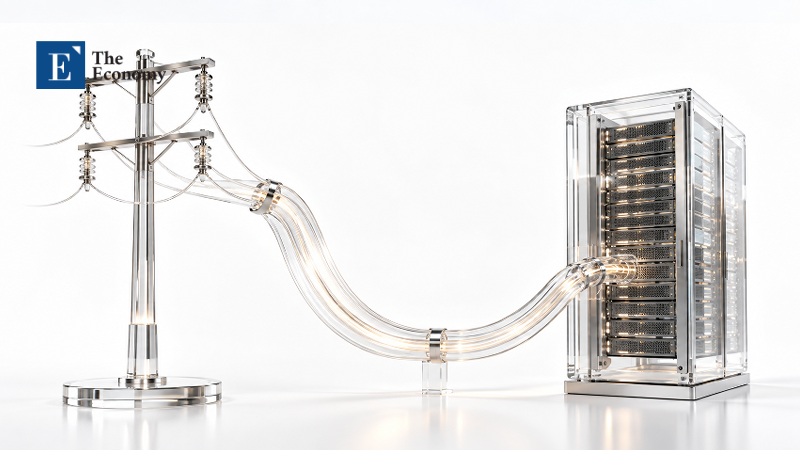
Efforts are ongoing to resolve power shortages in the artificial intelligence (AI) data center market. System software and algorithm optimization are appearing as new solutions, while big tech companies continue to expand the power supply itself, utilizing long-term power purchase agreements (PPAs) and other means. Industry experts predict this infrastructure-building pace will speed up due to the intensifying competition between the U.S. and China for AI industry leadership.
Energy savings through software
On the 8th (local time), U.S. IT media Tom's Hardware analyzed that significant energy savings can be achieved simply by modifying the operation methods of existing servers and computational tasks in AI data centers. It explained that large-scale hardware investment is not necessarily required to reduce data center power consumption, and that improving resource allocation and software operation of existing infrastructure can enhance efficiency.
A representative example is technology that adjusts the timing and location of data center power usage. Sophie Hall, a doctoral researcher at the Automatic Control Laboratory of the Swiss Federal Institute of Technology Zurich, emphasized in an interview with Tom's Hardware, "It's important not only how much power a data center consumes in total, but also when and where it uses power, and how it interacts with the power grid." AI training and deployment tasks that do not require immediate processing can be postponed to off-peak power demand times or distributed to regions with sufficient supply capacity to relieve grid burdens.
Additionally, technologies that adjust AI model computational precision and the learning process itself have been confirmed to save energy. Tom's Hardware introduced test results from the AI energy efficiency research project 'ML.ENERGY' centered at the University of Michigan, USA. When Alibaba's large language model (LLM) 'Qwen3-235B-A22B-Thinking' applied the 8-bit floating point (FP8) format, inference energy consumption decreased by about 33% compared to the conventional 16-bit floating point (BF16) method.
Industrial optimization examples
Such software-based power optimization technologies are increasingly being introduced in industrial settings. A representative example is Nvidia's power profile feature implemented in the Blackwell B200 graphics processing unit (GPU). According to Nvidia's technical documents released in December last year, this feature adjusts GPU power limits, computation/memory frequencies, and NVLink power states based on task characteristics such as AI training and inference. It reduces energy consumption by up to 15% while maintaining over 97% of existing task performance. Especially in data centers with limited power supply capacity, the saved power can be used to operate additional GPUs, increasing total facility throughput by up to 13%, Nvidia explained.
Hanwha Group is targeting the market with an AI-based energy management system. EnergyFluo, unveiled in September by TransGrid Energy, Hanwha Futureproof's U.S. subsidiary, is a system that integratively analyzes data from power grids, on-site power generation facilities, energy storage systems (ESS), and cooling facilities to optimize total power use. AI identifies cost-saving potential based on operation data and proposes detailed adjustment plans, which are implemented following operator approval. TransGrid Energy stated this system can increase the utilization of existing power infrastructure by adjusting cooling facility operation timings according to temperature changes and power prices, and by optimizing energy storage and supply.
Google accelerates expanding power supply
Meanwhile, some aim to expand power supply itself as much as possible beyond reducing consumption. Google is a representative company illustrating this trend. This month, Google announced over 6 gigawatts (GW) in power contracts consecutively. First, it signed a 20-year long-term PPA with Constellation Energy, securing 890 megawatts (MW) of new carbon-free capacity by boosting output of 11 existing nuclear reactors. The first output increase is scheduled for 2028, with Constellation investing over US$4.41 billion (4.3 trillion KRW). Separately, Google and Constellation signed a 15-year energy supply contract for existing 2.7 GW generation assets within the PJM interconnection of the U.S. Eastern power grid.
Google also contracted power supply with Black Hills for a data center under construction in Cheyenne, Wyoming. The contract runs through 2048, covering all power resources needed by the data center, including reserves, totaling 2.7 GW. Power supply will start at the end of 2027 and reach peak load by 2030. Black Hills plans to supply up to 590 MW from its own generating facilities and power market purchases, investing US$1.85 billion (about 2.4 trillion KRW) by 2027-2029 to build a new 564 MW natural gas power plant on the site of the existing Cheyenne Prairie power plant. The remaining approximately 2.1 GW consists of contracted generation resources in Wyoming with third parties.
Table 1. Recent power supply expansion contracts Google has signed
| Contract parties | Key details |
|---|---|
| Constellation Energy | Acquiring 890 MW of carbon-free power by enhancing existing nuclear plant output and signing long-term 15-year supply contract for 2.7 GW of assets in the PJM region |
| Black Hills | Securing 2.7 GW power resources for Wyoming data center; building natural gas power plant and procuring external generation |
Negative sentiment trends in U.S. communities
As AI infrastructure investment heating intensifies, opposition to data centers strengthens in U.S. communities. According to the Financial Times (FT) and others, at least 120 data center construction projects were halted or delayed due to resident opposition in the first half of this year (January–June). An August survey of 1,592 U.S. adults by The Economist and YouGov showed nearly two-thirds (63%) opposed building data centers near their homes. Core reasons for community resistance include power grid burdens, potential electricity price increases, higher water usage, noise, and environmental damage.
However, U.S. President Donald Trump continues to emphasize the need to expand AI infrastructure. At a midterm election campaign rally in Vandalia, Ohio, on November 3, he said, "Ohio has a tremendous opportunity to make money (through data center construction), and we can't just stop it," adding, "Otherwise, it will go to China." This was a warning that restraining data center construction could cause the U.S. to fall behind China in the AI hegemony competition. Ohio is a region with particularly strong opposition due to electric bill increases and farmland damage from large-scale data center investments; its Republican Senator John Husted has faced political criticism for supporting data center attraction during his previous tenure as lieutenant governor.
China's AI infrastructure expansion strategy
Trump's concerns reflect the fact that China is rapidly developing AI infrastructure. According to semiconductor analyst SemiAnalysis, the data center capacity currently operating in China is 24 GW, which is less than the U.S.'s 56 GW but exceeds the rest of Asia combined. Capacity under construction or announced for future construction reaches 50 GW. Especially in Wulanchabu, Inner Mongolia Autonomous Region, 89 data centers have been built or are planned. Major Chinese tech companies like Alibaba and Huawei are building data centers locally, and data center operator ZData is converting closed high schools into data centers.
Wulanchabu is gaining attention as an AI infrastructure hub due to its robust power supply network. According to the Financial Times, Inner Mongolia's wind power capacity stood at 117 GW as of June this year, the largest in China and about four times the total wind power capacity of the UK. Fossil fuel power capacity is about 130 GW, mostly coal-fired. This abundant power supply is a key factor in lowering the operating costs of AI data centers. Data center electricity prices in Wulanchabu are about US$0.05 per kilowatt-hour (kWh), significantly cheaper than major cities like Beijing (about US$0.11/kWh). Additionally, the use of an independent local grid and direct connections between power plants and data centers offer advantages in power supply and cost, as well as competitive advantages in construction costs and project duration. According to global investment bank Goldman Sachs, data center construction costs in this region are about 20% lower than in major metropolitan areas, with typical construction periods ranging from 12 to 18 months.
As one of the youngest members of the team, Tyler Hansbrough is a rising star in financial journalism. His fresh perspective and analytical approach bring a modern edge to business reporting. Whether he’s covering stock market trends or dissecting corporate earnings, his sharp insights resonate with the new generation of investors.