China, invited by Russia's icebreaker 'love call,' may open the market blocked for Korea in China.

Matthew Reuter is a senior economic correspondent at The Economy, where he covers global financial markets, emerging technologies, and cross-border trade dynamics. With over a decade of experience reporting from major financial hubs—including London, New York, and Hong Kong—Matthew has developed a reputation for breaking complex economic stories into sharp, accessible narratives. Before joining The Economy, he worked at a leading European financial daily, where his investigative reporting on post-crisis banking reforms earned him recognition from the European Press Association. A graduate of the London School of Economics, Matthew holds dual degrees in economics and international relations. He is particularly interested in how data science and AI are reshaping market analysis and policymaking, often blending quantitative insights into his articles. Outside journalism, Matthew frequently moderates panels at global finance summits and guest lectures on financial journalism at top universities.
Authored On
Modified
Disruptions in supply of shipbuilding technology and equipment to Russia due to Western sanctions
Negotiations underway for joint construction of vessels with China to secure Arctic route ships
A new competitive variable for Korean shipbuilders hoping to re-enter the market after the war
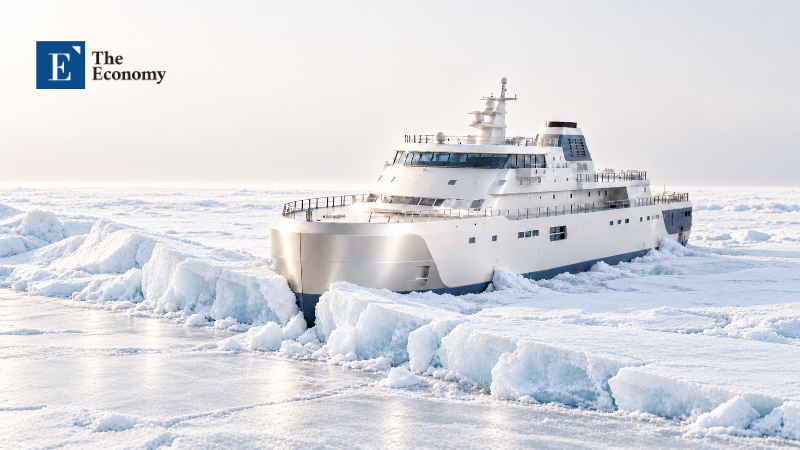
Russia is pushing plans to jointly build vessels for the Arctic route with China and to introduce Chinese technology and equipment into its own shipyards. This move aims to attract China as a new shipbuilding partner amid cooperation with South Korean shipbuilders being suspended due to Western sanctions. China is also gaining polar navigation experience and securing a fleet for the Arctic route alongside Russia, so the shipbuilding cooperation between the two countries is expected to become even closer.
Russia explores China's participation in joint construction of Arctic icebreakers
According to the South China Morning Post (SCMP) on the 12th (local time), Nikolai Patrushev, Russian presidential aide and chairman of the Maritime Commission, visited the Waigaoqiao shipyard in Shanghai on the 8th to discuss cooperation plans between Russian and Chinese shipbuilding companies with the management. This shipyard, under China State Shipbuilding Corporation (CSSC), is one of China's major large vessel construction bases. Patrushev proposed a plan to jointly build several icebreakers for Arctic navigation with China at Russian shipyards. The construction includes vessels intended for China's Arctic maritime transport, and the possibility of China independently securing an icebreaking merchant fleet was also mentioned. He introduced Russia's planned Arctic Transshipment Corridor project and referred to the possibility of joint construction of Chinese vessels that will use this route.
Along with joint ship construction, plans for cooperation in design and research were also discussed. Patrushev met with Waigaoqiao shipyard management to review the possibility of technical exchanges between Chinese shipyard design departments and Russian shipbuilding design bureaus. The plan envisions sharing engineering capabilities of design organizations from both countries, including cooperation through Russian shipbuilding research institutes. In a subsequent meeting in Beijing with Kuai Xin, vice minister of China's Ministry of Industry and Information Technology, ways for Chinese companies to participate as technology partners and equipment suppliers for new Russian shipbuilding facilities were discussed. The two sides also considered cooperation in scientific and technological research in shipbuilding, joint basic and applied marine research, and the introduction of advanced information technology into ship construction.
Russia aims to secure 17 Arctic route icebreakers by 2030
Russia is accelerating expansion of its own icebreaker fleet to be deployed on the Arctic route alongside discussions with China. State nuclear company Rosatom has proposed plans to increase the number of icebreakers supporting Arctic route navigation to 17 by 2030. Actual construction work is ongoing; in August, two RITM-US$0.15 reactors were installed on the nuclear icebreaker Leningrad, being built at the Baltic Shipyard. Leningrad belongs to Russia's next-generation nuclear icebreaker program 'Project 22220,' measuring 173 meters long and 34 meters wide, designed to operate by breaking ice up to 3 meters thick. Four other ships of the same class—Arktika, Sibir, Ural, and Yakutia—are already conducting cargo escort missions on the Arctic route. Additionally, the ultra-large nuclear icebreaker Rossiya, currently under construction aiming for service entry in 2030, will be added. Rossiya is equipped with two reactors delivering a total propulsion power of 120 megawatts (MW), capable of breaking ice up to 4.3 meters thick and securing a channel 50 meters wide.
The sea lanes opened by these icebreakers are used as export routes for Russian energy. According to an analysis released last month by the US Center for Strategic and International Studies (CSIS), the cumulative export value of Russian crude oil shipped by sea from the Arctic since February 2022 is estimated at US$18.8 billion. Transport involves ice-class oil tankers loading cargo at Arctic oil terminals and moving it to floating storage and offloading units (FSO), where conventional tankers then carry it to international markets. During this period, volumes passing through two storage tankers, Umba and Kola, accounted for about 53% of Russia's Arctic maritime crude exports. Including nearby Murmansk's ship-to-ship transfer anchorage, these three hubs handled 77% of exports, valued at approximately US$14.5 billion. Nuclear icebreakers play a role in opening ice-blocked routes and supporting tanker transit. CSIS researchers verified 110 cases since February 2022 where sanctioned 'shadow fleet' tankers received escort by Russian nuclear icebreakers for more than 6 hours.
Table 1. Expansion of Russia's Arctic icebreaker fleet and support for crude oil exports
| Category | Scale and specifications | Key contents |
|---|---|---|
| Icebreaker fleet expansion | 17 vessels by 2030 | Rosatom's plan to expand icebreakers supporting Arctic route navigation |
| Leningrad | Length 173m, width 34m Maximum icebreaking thickness 3m | Nuclear icebreaker under Project 22220 Two RITM-US$0.15 reactors installed in August |
| Active vessels of the same class | Four vessels: Arktika, Sibir, Ural, Yakutia | Conducting cargo escort tasks on Arctic route |
| Rossiya | Propulsion power 120 MW Maximum icebreaking thickness 4.3m Channel width secured 50m | Ultra-large icebreaker equipped with two reactors Scheduled for commissioning in 2030 |
| Arctic crude oil exports | Cumulative export value US$18.8 billion | Statistics since February 2022 Ice-class tanker → storage/offloading facility → conventional tanker → international market transport |
| Major transshipment hubs | 77% handled by three hubs Export value US$14.5 billion | 53% handled by storage vessels Umba and Kola 77% including Murmansk ship-to-ship transfer anchorage |
| Shadow fleet escort | 110 cases of escort over 6 hours | CSIS confirmed nuclear icebreaker escorts of sanctioned tankers since February 2022 |
China expands Arctic exploration with domestically built icebreakers
China, pursuing Arctic route cooperation with Russia, is accumulating polar navigation experience using icebreakers built domestically. A representative vessel is Xuelong 2, delivered from Shanghai Jiangnan Shipyard in 2019. It is China’s first domestically built polar icebreaker, jointly designed by China State Shipbuilding Corporation’s China Shipbuilding Marine Engineering Design Institute and Finland’s Aker Arctic, and operated by the Chinese Arctic Research Institute. Xuelong 2 engaged in China’s 13th Arctic scientific expedition in 2023, sailing over 15,500 nautical miles for 78 days conducting research near the North Pole. In July 2024, it departed Qingdao, passed through the Bering Sea into the Arctic Ocean, then sailed to Murmansk in northwest Russia. During the same summer, vessels Jidi and Zhongshan Dashiji also headed to the Arctic, marking a simultaneous deployment of three Chinese ships for polar research. While Xuelong 2 called at Russian Arctic ports, the other ships conducted navigation and exploration in adjacent seas like the Chukchi Sea.
Following increases in vessel deployments, the scope and missions of the research have diversified. In August last year, the US Coast Guard confirmed five Chinese research vessels operating near Alaska's Arctic waters: Xuelong 2, Jidi, Zhongshan Dashiji, Xunhai 1, and Tanzuo 3, including icebreakers and deep-sea research vessels. Four vessels—Xuelong, Xuelong 2, Jidi, and Tanzuo 3—participated in China’s 16th Arctic survey organized by the Ministry of Natural Resources this year. Xuelong and Xuelong 2 conducted marine environmental surveys off the Chukchi Sea continental shelf, Canadian Basin, and central Arctic Ocean before returning to Shanghai on the 30th of last month. This expedition also included field testing of unmanned ice surface observatories and marine observation buoys developed by China.
China opens export routes to Europe via the Arctic route
Besides exploration activities, China also conducted commercial transport sending Chinese-origin cargo to Europe. On September 23 last year, the container ship Istanbul Bridge departed from Ningbo Port, China, traveled via the Arctic route, and arrived at the UK’s Felixstowe Port on October 13, 20 days later. The vessel carried about 25,000 tons of cargo, mainly lithium-ion batteries and solar-related products. It entered the Arctic route on October 1, traveling along Russia’s northern coast toward Europe. Captain Zhong Desheng stated preparations for this voyage began three years before departure. The day after the ship's arrival in the UK, a China-Russia Arctic Route Cooperation Subcommittee meeting was held to approve an implementation plan encompassing logistics, technological cooperation, and infrastructure development.
China, engaging in commercial transportation via the Arctic route, is also developing a nuclear-powered icebreaker capable of carrying both cargo and passengers. A ship design institute under China State Shipbuilding Corporation unveiled the conceptual design last December for a multipurpose icebreaker intended for seasonal cargo transport and polar tourism. The vessel would measure approximately 165 meters in length, 30 meters in width, with a displacement around 30,000 tons, and accommodate up to 250 people plus 300 standard 20-foot containers. The cargo hold design allows adjustment for large or irregular cargo, targeting icebreaking capability to pass through 2.5-meter-thick ice at 3.7 km/h. Its power source is planned to be a molten salt reactor combined with supercritical CO2 power generation technology. The conceptual design received Basic Approval (AiP) from Italian classification society RINA. The approval review included assessments of hull durability against ice loads, icebreaking performance, and feasibility of propulsion systems for polar conditions.
China emerges as a potential leader in Russia’s icebreaking merchant ship market
Russia's request for Chinese cooperation in icebreaking merchant shipping is a market in which Korean shipbuilders have long built experience and track records. Samsung Heavy Industries secured orders in 2005 for three icebreaking oil tankers from Russian state shipping company Sovcomflot, and Daewoo Shipbuilding & Marine Engineering, predecessor to Hanwha Ocean, delivered 15 icebreaking LNG carriers by 2019. Businesses supplying ship blocks and equipment to Russian shipyards also followed but were hindered by the Ukraine war and sanctions against Russia. Samsung Heavy Industries disclosed contract termination in June last year for orders related to Zvezda Shipyard, comprising 10 icebreaking LNG carriers and 7 shuttle tankers worth US$3.73 billion. For Korean shipbuilders, this is a sector where they could seek orders again based on past achievements and local collaboration experience once sanctions ease after the war.
In this context, China's entry into Russia's shipbuilding industry may pose a variable to Korean companies’ plans to resume business. China is emerging as a leading candidate to secure new orders in the Russian market, where Korean shipbuilders are waiting for sanction easing. Energy intelligence firm Kpler evaluated on the 9th that should Russia place orders overseas for Arc7-class icebreaking LNG carriers, Chinese shipyards would be the most likely suppliers. The two countries’ companies have already launched joint projects to secure vessels for the Arctic route. China’s New New Shipping and Russia’s Rosatom set up a joint venture in China by the end of 2024 and last month announced plans to build five 4,800 TEU Arc7-class icebreaking container ships. Moreover, the Russian government’s request for Chinese shipbuilding industries to jointly construct ships and supply technology and equipment for new shipbuilding facilities is extending collaboration into production. With vessel fleet acquisition projects by companies and government-level shipbuilding cooperation intertwined, the atmosphere is growing that China will likely secure Russia's new shipbuilding orders first.
Matthew Reuter is a senior economic correspondent at The Economy, where he covers global financial markets, emerging technologies, and cross-border trade dynamics. With over a decade of experience reporting from major financial hubs—including London, New York, and Hong Kong—Matthew has developed a reputation for breaking complex economic stories into sharp, accessible narratives. Before joining The Economy, he worked at a leading European financial daily, where his investigative reporting on post-crisis banking reforms earned him recognition from the European Press Association. A graduate of the London School of Economics, Matthew holds dual degrees in economics and international relations. He is particularly interested in how data science and AI are reshaping market analysis and policymaking, often blending quantitative insights into his articles. Outside journalism, Matthew frequently moderates panels at global finance summits and guest lectures on financial journalism at top universities.