[AI and Workforce] "Thousands of Bankers to AI Developers" Mizuho's Experiment in Organizational Reform, Overambitious Job Transition Ahead of System Innovation

Matthew Reuter is a senior economic correspondent at The Economy, where he covers global financial markets, emerging technologies, and cross-border trade dynamics. With over a decade of experience reporting from major financial hubs—including London, New York, and Hong Kong—Matthew has developed a reputation for breaking complex economic stories into sharp, accessible narratives. Before joining The Economy, he worked at a leading European financial daily, where his investigative reporting on post-crisis banking reforms earned him recognition from the European Press Association. A graduate of the London School of Economics, Matthew holds dual degrees in economics and international relations. He is particularly interested in how data science and AI are reshaping market analysis and policymaking, often blending quantitative insights into his articles. Outside journalism, Matthew frequently moderates panels at global finance summits and guest lectures on financial journalism at top universities.
Authored On
Modified
Starting job transitions from sales and clerical roles to developer roles to alleviate manpower shortages
Targeting to acquire skills from coding to security verification within three months
AI training without system and organizational reform may only increase verification burdens
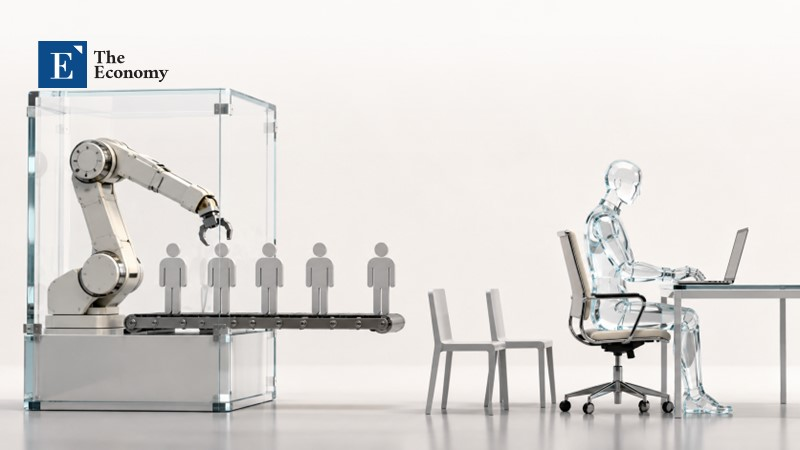
Mizuho Financial Group, Japan's third-largest bank, has launched an experiment to convert sales and clerical employees into artificial intelligence (AI) developers as a response to labor shortages. Utilizing generative AI coding tools, they aim to shorten the developer training period to three months and plan to expand the training scale starting this November. Although the plan to reduce developer training time with generative AI amid chronic recruitment difficulties is ambitious, concerns about the effectiveness of short-term training and securing expertise remain significant. If employees lack the ability to identify errors and security vulnerabilities in AI-generated code, the review burden on existing skilled personnel may increase. Experts suggest that to enhance corporate AI utilization outcomes, it is essential to overhaul IT systems and departmental workflows and strengthen practical AI application training tailored to job functions.
Transitioning sales and clerical staff into developers
According to the Nihon Keizai Shimbun (Nikkei) on the 16th, Mizuho Financial Group will officially launch the 'Mizuho AI Bootcamp' this November to train sales and clerical employees as AI developers. The idea is to teach development skills to employees familiar with financial operations so they can directly create necessary systems in the field. In a pilot training program conducted from June to August, a total of five employees participated, including four with no programming experience. All met evaluation criteria, were transferred to developer roles in September, and Mizuho plans to increase the training intake to about 20 participants in November.
The condensed three-month training period is enabled by coding support tools using generative AI. Participants spend the first month intensively learning AI-assisted development methods, followed by two months of practical work on actual projects. Tools like 'Codex' and 'Claude Code,' which generate or modify program code based on natural language instructions, are utilized in the training. The program also includes verifying whether AI-generated code suits business purposes and checking for quality and security issues. Mizuho explains that by combining foundational learning with on-the-job training, they have shortened the usual one and a half years required to develop non-developer employees into developers.
Employees who moved to developer roles apply their accumulated financial knowledge to AI application design and function review. To support such in-house development, Mizuho established a dedicated team called the 'Internal Development Lab' and a common development and operation platform named 'Mizuho Wiz Base.' The goal is to accumulate related technologies and know-how within the organization by developing programs reflecting field requirements. Initially, Mizuho plans to train 100 AI application development personnel and later expand training to staff who will conceive and develop AI agents tailored to each department's tasks.
As AI increasingly determines corporate competitiveness but developers remain scarce, such job transitions continue. Previously, Japan Railways East decided to convert about 5,000 employees, corresponding to 10% of its workforce, to AI and digital development roles. Singapore Bank DBS plans to cut about 4,000 employees, also 10% of its workforce, while increasing AI-related staff by about 1,000. Nikkei reported that "AI utilization is reducing workloads while erasing the boundaries between clerical and technical roles," indicating the need to redefine job descriptions.
Limited AI utilization among Japanese companies
The chronic labor shortage significantly influences Japanese companies’ efforts to change how they utilize existing employees. A survey by the Japanese employment information provider Mynavi of 1,600 recruitment managers at companies hiring experienced workers in the first half of this year found that 43.5% reported a shortage of regular employees. As necessary personnel cannot be secured in time, cases of business closures have increased. According to Teikoku Databank, 'labor shortage bankruptcies' caused by employee resignations, recruitment difficulties, and rising labor costs totaled 427 last year, marking three consecutive years of all-time highs. Among these, 77% were companies with fewer than 10 employees, revealing the vulnerability of small businesses that struggle to sustain operations when a few staff members leave.
Although AI attracts attention as a measure to address labor shortages, it has yet to be fully integrated into the overall work of Japanese companies. A survey conducted by Nikkei Research in cooperation with Reuters between late July and early August on 219 Japanese companies showed that about 60% use AI only in some departments or for limited purposes. Twenty-four percent of companies have not decided whether to adopt AI or have not even considered it. Only 16% report using AI as a core company-wide business tool. Some respondents indicated that even after company-wide adoption, AI is limited to document creation or the company has yet to find specific application methods, showing challenges in practical utilization.
Cautious AI usage due to concerns about errors and reputation
Analyses suggest that delayed AI adoption is influenced by organizational cultures that avoid errors and prioritize internal consensus. Parissa Haghirian, professor of International Business at Kyoto University of Advanced Science, recently told the BBC that Japanese companies are cautious about AI due to sensitivity to errors, uncertainties, and reputational risks. The process of gaining approval from various stakeholders extends the time before AI is applied in practice. Austin Hsu, co-founder of Kuse AI, which operates in the Japanese market, also pointed out that decision-making styles emphasizing procedures and consensus delay adoption. In customer service, companies tolerate almost no AI mistakes and prefer to adopt AI only after securing sufficient evidence of reliability.
Even after adopting AI, the task of reviewing and correcting output remains a burden for employees. According to a survey released on the 9th by Freee, a Japanese accounting software company, involving 1,851 small-business managers and administrative staff, 51.1% reported using AI at least once a week in their work. Among AI users, 23.7% said the effort spent on preparation, review, and corrections equals the time saved, indicating that repeated verification limits time-saving benefits. Additionally, 37.7% did not feel their clerical duties such as accounting and labor had decreased. When asked why AI usage has not advanced or showed results, 19.5% cited that human review and correction work fails to reduce their workload.
Table 1. Status of Labor Shortages and AI Utilization in Japanese Companies
| Category | Key Details | Figures and Specifics |
|---|---|---|
| Shortage of Regular Staff | Labor shortages persist even in companies hiring experienced workers | 43.5% of 1,600 recruitment managers reported shortage of regular employees |
| Labor shortage bankruptcies | Increased business sustainability pressure due to resignations, recruitment difficulties, and rising labor costs | 427 cases last year, a record high for three consecutive years 77% of cases are companies with fewer than 10 employees |
| Limited AI utilization | Centered on usage in some departments or limited purposes | Approximately 60% among 219 companies surveyed by Nikkei Research and Reuters |
| Indecision on AI adoption | Indecision or no consideration regarding adoption | 24% of 219 surveyed companies |
| Company-wide AI utilization | AI used as a core tool in company-wide operations | 16% of 219 surveyed companies Some companies limit AI to document writing or have not found practical uses despite company-wide adoption |
| Constraints from organizational culture | Concerns about errors, uncertainties, and reputational damage | Particularly sensitive to mistakes in customer service Prefer to adopt after securing proof of reliability |
| Delays in decision-making | Emphasis on procedures and internal consensus | Obtaining approval from multiple stakeholders delays practical application |
Priority on developer attributes training over validation of expertise
Considering these verification burdens, significant concerns arise over Mizuho’s short-term developer training plan. Especially, the burden of staff having to re-check AI-generated code can hinder Mizuho's developer transition efforts. Even if employees complete the three-month training and write code with AI, whether they have the ability to find and correct errors must be separately verified. Mizuho’s disclosed early results involve five trainees passing evaluation and changing roles, but it does not reveal how much support from existing specialists was required during actual development. If the number of transitions increases in this condition, experienced developers may have to shoulder both training and code review responsibilities. Thus, although developer numbers rise, experienced developers’ workloads could become heavier.
Even with coding experience, individuals may fail to properly assess the safety of AI-generated code. A study published last month by Tufts University and others involved 100 participants with C programming experience who passed a pre-assessment; they were asked to select and fix AI-generated code. The results showed no difference in choosing the most secure versus the most vulnerable code, suggesting participants could not adequately distinguish vulnerabilities. Many focused on whether code functions or its syntactic form and judged safety simply because exception-handling statements were present. If reviewers lack sufficient capability, they may miss vulnerabilities even during human validation.
Limitations of unified coding education without job distinction
Attempts to teach coding to employees and change work styles have been tried before at Hyundai Card. In 2017, Hyundai Card mandated four-week coding training for 300 team leaders and managers across subsidiaries and placed instructions written in Python in offices. Later, coding was included in new employee orientation regardless of job roles, and in the following year, even cafe menus and guidance messages inside the company were converted into coding formats to familiarize staff with programming languages in daily life. The intent was to facilitate communication with developers, but critics warned that such training risks focusing too much on imitating code structure. Learning code syntax alone is insufficient to develop skills for analyzing complex tasks and designing problem-solving processes.
Experts concur that to mitigate such risks, companies must first overhaul IT systems and organizational operating structures to integrate AI into daily tasks. A survey analysis released by McKinsey last year found that among 25 factors related to generative AI’s contribution to profits, redesigning business processes has the greatest impact. Preparing job-specific AI training programs to ensure employees appropriately use AI in their tasks was also identified as a key implementation issue. Boston Consulting Group (BCG) recommends reviewing systems and data infrastructure necessary for AI introduction and clearly separating roles between common technology infrastructure teams and those applying AI to individual duties. Training should include concretizing workplace problems and educating on interpreting AI outputs in the context of relevant work.
Matthew Reuter is a senior economic correspondent at The Economy, where he covers global financial markets, emerging technologies, and cross-border trade dynamics. With over a decade of experience reporting from major financial hubs—including London, New York, and Hong Kong—Matthew has developed a reputation for breaking complex economic stories into sharp, accessible narratives. Before joining The Economy, he worked at a leading European financial daily, where his investigative reporting on post-crisis banking reforms earned him recognition from the European Press Association. A graduate of the London School of Economics, Matthew holds dual degrees in economics and international relations. He is particularly interested in how data science and AI are reshaping market analysis and policymaking, often blending quantitative insights into his articles. Outside journalism, Matthew frequently moderates panels at global finance summits and guest lectures on financial journalism at top universities.
Similar Post