“Japanese Auto Alliance to Challenge the US and China”: Honda and Nissan Expand SDV Cooperation as Toyota Seeks Unified Parts Standards

Oliver Griffin is a policy and tech reporter at The Economy, focusing on the intersection of artificial intelligence, government regulation, and macroeconomic strategy. Based in Dublin, Oliver has reported extensively on European Union policy shifts and their ripple effects across global markets. Prior to joining The Economy, he covered technology policy for an international think tank, producing research cited by major institutions, including the OECD and IMF. Oliver studied political economy at Trinity College Dublin and later completed a master’s in data journalism at Columbia University. His reporting blends field interviews with rigorous statistical analysis, offering readers a nuanced understanding of how policy decisions shape industries and everyday lives. Beyond his newsroom work, Oliver contributes op-eds on ethics in AI and has been a guest commentator on BBC World and CNBC Europe.
Authored On
Modified
Honda and Nissan strengthen cooperation to improve competitiveness in software-defined vehicles
Global automakers compete to establish de facto standards around SDV platforms
Toyota proposes unified component standards and joint procurement across Japanese automakers
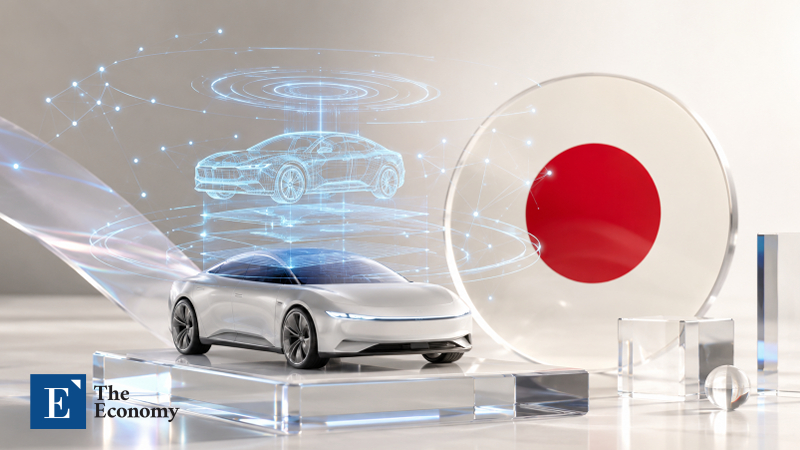
Japanese automakers Honda and Nissan are strengthening their cooperation in software-defined vehicles. By jointly developing the automotive operating systems and electronic control units that serve as the central intelligence of an SDV, the companies aim to reduce investment costs and establish a stronger position in a global technology competition currently led by American and Chinese manufacturers.
At the same time, the broader Japanese automotive industry is pursuing unified standards and joint procurement for commonly used components, expanding an alliance that seeks to integrate software and parts ecosystems beyond the traditional competition among individual companies.
Honda and Nissan’s SDV Development Strategy
According to Kyodo News on July 26, Honda and Nissan are discussing a joint technology-development framework with the aim of reaching a formal agreement in August. The initiative is intended to secure meaningful competitiveness in the emerging market for next-generation software-defined vehicles. An SDV is a vehicle whose functions can be controlled and managed through software, with most capabilities—including driving, entertainment, communications, and safety—connected to a common digital architecture. New features can be distributed and continuously updated wirelessly without requiring changes to the vehicle’s physical hardware.
The central objective of the cooperation is the development of a shared operating system. The OS functions as a command center that issues instructions to individual components and systems and has become a critical factor determining a vehicle’s convenience, functionality, and overall commercial appeal. Honda and Nissan also plan to standardize the electronic control units that manage the vehicle as a whole based on instructions delivered through the operating system. Conventional automobiles may contain dozens or even more than 100 separate ECUs assigned to individual functions such as the engine and braking system, but an SDV requires powerful centralized units capable of processing and coordinating updates across numerous functions. Developing these advanced ECUs is technically difficult and requires substantial investment, making a common development foundation an effective means of improving capital efficiency and accelerating technological progress.
Cooperation Continues Despite Failed Merger
The market has focused on the fact that Honda and Nissan are maintaining their cooperative relationship even after negotiations over a full corporate merger collapsed. In December 2024, the companies announced a proposal to establish a joint holding company under which both automakers would become subsidiaries. The proposed alliance was intended to overtake Hyundai Motor Group and create the world’s third-largest automaker based on 2023 vehicle sales. Some observers also expected Mitsubishi Motors, in which Nissan is the largest shareholder, to join the broader alliance if the merger proceeded.
Negotiations encountered difficulties from the outset because of the substantial differences between the companies’ market valuations and financial conditions. Disagreements later emerged over the speed and scale of Nissan’s restructuring. Honda subsequently revised the original holding-company proposal and suggested making Nissan a subsidiary, but Nissan’s board rejected the arrangement because of uncertainty over the company’s independence and the continued survival of its brand. The two companies formally ended their review of a management integration in February 2025, while leaving open the possibility of continued collaboration in selected technology fields.
Why SDV Development Matters
Honda and Nissan have maintained the possibility of cooperation in SDVs because the scale of a software platform can be as important as the technical capabilities of an individual automaker. Competition in the traditional automotive industry centered on hardware such as engines, transmissions, and braking systems, whereas SDVs are designed around vehicle operating systems, semiconductors, data formats, and application programming interfaces. As in the smartphone market, a service can be introduced across multiple vehicle models more easily when those vehicles share the same underlying software architecture.
If automakers establish common APIs, operating systems, and electrical and electronic architectures, outside developers and component suppliers can rapidly introduce autonomous-driving, infotainment, and energy-management functions across several brands and models. Such a structure reduces development costs and lead times while attracting more companies into the ecosystem, further increasing the platform’s commercial value. If Mitsubishi, Toyota, Japanese component suppliers, and other major industry participants eventually join the SDV ecosystem developed by Honda and Nissan, much of Japan’s automotive supply chain could become integrated into a single large software environment. Given the global market share of Japanese vehicles, overseas component manufacturers and application developers would have a strong incentive to support the resulting specifications, creating the possibility that Japanese standards could become a de facto industry standard.

Global Competition to Establish Standards Intensifies
Competition over SDV standards is spreading beyond Japan across the world’s major automotive-producing countries. In South Korea, the Korean Agency for Technology and Standards under the Ministry of Trade, Industry and Energy launched an SDV Standardization Council in November 2025 involving 65 companies and six research institutions, including Hyundai Motor, Samsung Electronics, LG Electronics, Hyundai Mobis, Naver, and KT. The initiative brings automakers together with semiconductor, telecommunications, electronics, and platform companies in an effort to establish common points of connection among technologies that had previously been developed independently. The council has set a goal of rapidly producing standards for vehicle APIs, electrical and electronic architectures, and data formats during 2026.
China’s Ministry of Industry and Information Technology is simultaneously revising national standards covering intelligent connected vehicles, automotive semiconductors, data security, in-vehicle artificial intelligence, and LTE-V2X communications. Beijing aims to expand specifications first commercialized in China into international standards and increase the adoption of Chinese automotive technologies overseas. The United States has adopted a more market-led approach, allowing private companies such as Tesla, General Motors, Nvidia, Qualcomm, and Amazon Web Services to expand ecosystems centered on their own platforms. International industry alliances such as SOAFEE, or Scalable Open Architecture for Embedded Edge, led by British semiconductor company Arm, are also developing cloud-native architectures independent of specific vehicle hardware. Under this model, automotive software is initially developed and tested in a cloud environment before being deployed across vehicles using different semiconductor platforms.
Japan Seeks Greater Independence in Common-Parts Supply Chains
As competition in SDVs intensifies, Japanese automakers are also discussing the standardization of common vehicle components to strengthen the competitiveness of their domestic ecosystem. Koji Sato, vice chairman of Toyota and chairman of the Japan Automobile Manufacturers Association, recently proposed that seven major Japanese automakers, including Honda and Nissan, adopt shared specifications and manufacturing standards for components that have limited influence on vehicle performance or brand identity, such as steel materials, wire harnesses, and resin parts. Standardizing basic component specifications would allow several automakers to purchase the same parts jointly, lowering procurement prices and substantially reducing the costs associated with design, testing, and inventory management. Smaller manufacturers such as Mazda, Subaru, and Mitsubishi could particularly benefit by using the same supply chains as Toyota, Honda, and Nissan and gaining access to greater economies of scale.
If implemented, such a system could significantly improve the self-sufficiency and resilience of Japan’s automotive ecosystem. The country’s automotive supply chain has increasingly lost independent competitiveness as inexpensive Chinese components capture a growing share of the market. The Nihon Keizai Shimbun reported on July 13 that Honda had decided to use a chassis manufactured by a Chinese supplier, effectively outsourcing a fundamental vehicle structure that strongly influences both price and performance. The exterior of Toyota’s bZ7 electric vehicle, launched in China in March, has also been found to closely resemble Guangzhou Automobile Group’s A800, with observers noting that dimensions including the distance between the front and rear wheels match at the millimeter level.
“Japanese electric vehicles sold in China are, to varying degrees, ultimately becoming Chinese vehicles in terms of their internal content,” the newspaper said, adding that Nissan and Mazda had begun exporting vehicles equipped with Chinese components to markets outside China. The proposed standardization and joint procurement strategy therefore represents more than a cost-cutting initiative. It is also an attempt to prevent Japan’s automotive industry from becoming increasingly dependent on Chinese platforms, components, and manufacturing capabilities while building a coordinated domestic ecosystem capable of competing with the larger technology networks emerging in the United States and China.
Oliver Griffin is a policy and tech reporter at The Economy, focusing on the intersection of artificial intelligence, government regulation, and macroeconomic strategy. Based in Dublin, Oliver has reported extensively on European Union policy shifts and their ripple effects across global markets. Prior to joining The Economy, he covered technology policy for an international think tank, producing research cited by major institutions, including the OECD and IMF. Oliver studied political economy at Trinity College Dublin and later completed a master’s in data journalism at Columbia University. His reporting blends field interviews with rigorous statistical analysis, offering readers a nuanced understanding of how policy decisions shape industries and everyday lives. Beyond his newsroom work, Oliver contributes op-eds on ethics in AI and has been a guest commentator on BBC World and CNBC Europe.
Similar Post