Grain Prices in Europe Risk Doubling as Shocks Converge

Working across research, policy, and data-driven analysis, the Editorial Board ensures that published pieces reflect a consistent institutional perspective grounded in quantitative reasoning and long-term structural assessment.
Authored On
Modified
Heat and war together threaten to double European grain prices
Europe's harvest shortfall collides with Argentina's shrinking export surplus
Central banks face a supply-driven case for higher interest rates

By July 2026, the grain traders' association COCERAL had already cut its estimate for total EU and UK grain production to 286.6 million tons, down from 295.5 million tons just a month earlier and 23.4 million tons below 2025. Three heat waves since late May had already hit the crop before the association decided that the usual seasonal revisions were no longer enough. At the same time, in the Black Sea, cargo crews of grain ships are learning to calculate their route around drone and missile attacks. Two developments, one climate and one military, converge on a global reserve that seemed comfortable six months ago. The question of whether grain prices will double in the next six months is no longer theoretical.
The Scale of the Shrinking European Harvest
Germany offers the clearest example of how quickly the picture has changed. The Federal Ministry of Agriculture has announced that total grain production will reach about 37.4 million tons, down 7,3 percent from 2025. Winter wheat is expected to fall about 10 percent year-on-year, while rapeseed will fall by 11 to 12 percent. Germany's agriculture minister called the situation a "crisis of national proportions", a phrase rarely used for a harvest rather than a natural disaster. In France, the damage is concentrated in corn, with the harvest expected to shrink by more than a third, the worst performance since 1980, while eight million tons below initial forecasts, the largest drop rate among all member states.
In the United Kingdom, the Energy and Climate Intelligence Unit estimates that this year's harvest will be the worst since detailed data began to be kept in 1984. Barley yields are expected to fall 15 percent, oats 14 percent and wheat 6 percent compared to last year, according to research by the Agriculture and Horticulture Development Board. June's heatwave alone is estimated to have cost about two billion euros in grain losses across the continent, with France, Germany, Hungary and Spain absorbing most of the damage. British produce group Nationwide Produce said consumers would see smaller vegetables and higher prices in the coming months, an observation that turned out to be much milder than it seemed in August.
The Black Sea Reopens as a War Front
While the European crop was shrinking, the war in Ukraine opened a second front of pressure on the grain market. In August, Ukrainian drones hit grain export terminals in the Russian port of Novorossiysk, damaging three facilities that handled a total of about 25 million tons of Russian exports annually. Consultancy SovEcon reported that more than 90 percent of Russian grain export capacity in the Azov and Black Sea basin was shut down, with Tuapse remaining the only deep port that continued to operate. Russian wheat exports in July fell about 30 percent from last year, to 1.5 million tons from 2.1 million.
Ukraine itself was not spared. According to data from the country's Ministry of Agriculture reported by Bloomberg agricultural exports may fall to about 29.6 million tons for the period 2026 to 2027, a 54 percent decrease from a previous estimate of 64.4 million tons. The Ukrainian Farmers' Council warned that up to 32.4 million tons of production may be left without a buyer in the domestic market, pushing prices below production costs. The International Food Policy Research Institute said wheat prices have risen nearly 25 percent above January 2026 levels, reaching their highest point in two years. Neither side seems willing to stop the strikes on the other's facilities first.
Why Europe Is Turning to South America
For decades, the European Union has been a net exporter of wheat, accounting for more than half of the world's exports along with other European states. This year, however, Spain and Italy, the two largest importers of wheat within the bloc, are seeking supplies beyond its borders, while restrictions on Ukrainian imports are closing one of the traditional outlets. A shift to South America seems logical on paper, but the timing is unfortunate. Argentina, which last year recorded a historic harvest of 27.8 million tons and increased its exports by 8.6 million tons, enters the 2026 to 2027 period with a smaller crop area and a harvest estimated to be 23 percent lower, according to an analysis by market service CMB News, which describes the country moving from a leading supplier of surplus to a more marginal exporter.
The problem doesn't stop there. Brazil, traditionally the largest customer of the Argentine crop, is expected to import the largest amount of wheat in its history, with consultancy Safras & Mercado estimating imports of 8.2 million tons for 2026 to 2027, surpassing the previous record of 7.1 million tons in 2006 to 2007. Domestic Brazilian production is expected to fall 16 percent to 6.6 million tons, against milling demand of 13.3 million tons, according to data from the state agency Conab. Consultancy T&F Consulting explained that the quality of Argentine wheat, with a protein of around 10.5 percent, makes it difficult to meet Brazilian standards that require at least 11.5 percent. So Europe is not just turning to a southern alternative, it is competing with Brazil for the same shrinking surplus, something it had not had to do for many decades.
What the Economic Research Teaches about Grain Prices
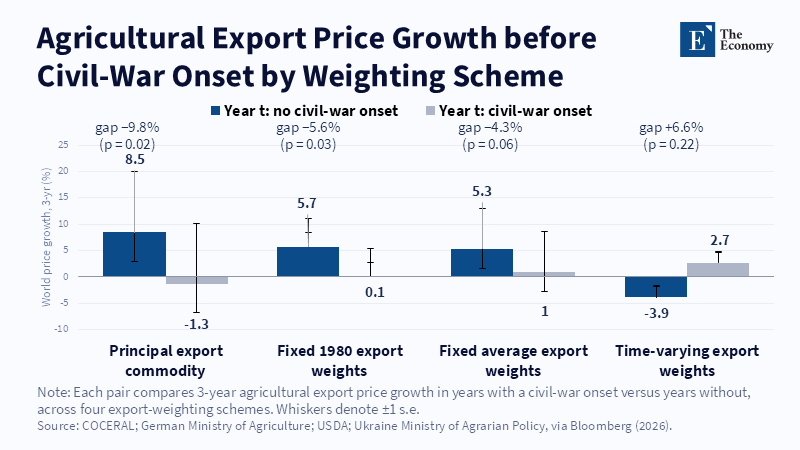
There is a body of economic research that examines how grain price shocks translate into social and political pressure, and its findings help to read the current situation correctly. Markus Brückner and Antonio Ciccone, in their study published in the Economic Journal in 2010, showed that changes in global prices of basic exports affect the risk of internal instability primarily through producers' income rather than through the prices paid by consumers. Sarah Bazzi and Christopher Blattman, in a similar study in 2014, came to a similar conclusion using a different price weighting methodology. This distinction is important now, because Europe is mainly experiencing the shock from the consumer side, while countries in North Africa and the Middle East, which are heavily dependent on wheat imports, will feel the same price increase as a direct pressure on household income, not as a simple redistribution between producers.
An argument often heard is that global grain stocks remain comfortable, and so Europe faces the loss of a crop in a world with sufficient supply, not a wider food shortage. That argument was valid in July. But it overlooks the convergence of three separate shocks in a matter of months: the contraction of the European crop, the blockade of many Black Sea ports, and the retreat of the Argentine surplus just as Brazil needs record imports. The CMB News analysis already notes that euro prices for grain from Europe and the Black Sea are strengthening, and recommends that importers lock in supplies before the reduced Argentine flow is fully reflected in forward prices. When three independent shocks hit the same sea passages and the same suppliers in the same six months, the comfort of total stocks becomes less reassuring than the first figure suggests.

What This Means for Farmers, Millers and Central Banks
For European millers and bakers, the practical consequence is an immediate need to diversify suppliers, even if it means accepting lower-protein wheat or higher transportation costs. Already American mills on the East Coast have booked shipments of Polish wheat for delivery in the fall, as Baltic wheat at $238 to $240 a ton is priced below American soft red winter wheat at $250 to $253, a sign that high prices are rearranging trade in every direction and not just to the United States. For European farmers, the picture is ambiguous. Those who saved part of their crop are benefiting from higher prices, but the reduced quantity means that many will see their overall income shrink despite rising prices, especially those in France who lost more than a third of their corn production.
For central banks, the rise in grain prices represents a classic delayed inflationary risk. Producer prices rise first, followed by a carryover to retail prices of bread, pasta and animal feed, and the final imprint on consumer inflation usually appears months behind. If grain prices continue to rise at the rate recorded since January, monetary policymakers in the eurozone, Britain and Japan will face an argument in favor of tighter policy that stems not from demand but from supply, the very kind of shock that is most difficult to deal with using traditional interest rate tools. This tension will first be measured on supermarket shelves before it shows up in central bank minutes.
COCERAL's emergency forecast was not just a technical announcement of a trade union. It was a recognition that in 2026 three independent supply chains, the European, the Black Sea and the South American, were squeezed almost simultaneously, with none of the three being able to fully cover the other. The question of whether grain prices will double within the next six months remains open, and none of the analysts monitoring Novorossiysk, Buenos Aires and the Bavarian fields yet have a clear baseline scenario. But what is already measurable is that euro prices are moving upwards, Argentine supply is shrinking, and Brazil is entering the market with its largest peacetime introductory program. Europe, an exporter of wheat for generations, is learning again what it means to expect cargoes from ports it does not control.
This article reflects the analytical judgment of The Economy Editorial Board and does not constitute policy advice or the official position of any affiliated institution.
References
Agriculture and Horticulture Development Board (2026) UK Harvest Yield Estimates 2026. Coventry: AHDB.
Bazzi, S. and Blattman, C. (2014) 'Economic Shocks and Conflict: Evidence from Commodity Prices', American Economic Journal: Macroeconomics, 6(4), pp.1-38.
Brückner, M. and Ciccone, A. (2010) 'International Commodity Prices, Growth, and the Outbreak of Civil War in Sub-Saharan Africa', The Economic Journal, 120(544), pp.519-534.
COCERAL (2026) Crop Production Forecast, EU-27 and UK, July 2026. Brussels: COCERAL.
Companhia Nacional de Abastecimento (2026) Grãos: Acompanhamento da Safra Brasileira. Brasília: Conab.
Energy and Climate Intelligence Unit (2026) UK Harvest Assessment 2026. London: ECIU.
Federal Ministry of Food and Agriculture, Germany (2026) Erntebericht 2026. Berlin: BMEL.
Kozlov, P. (2026) 'Ukraine's Agricultural Shipments Could Fall by More Than Half', Bloomberg.
Safras & Mercado (2026) Brazil Wheat Import Outlook 2026/27. Porto Alegre: Safras & Mercado.
Working across research, policy, and data-driven analysis, the Editorial Board ensures that published pieces reflect a consistent institutional perspective grounded in quantitative reasoning and long-term structural assessment.