Precarious Work In China And The Dilemma Of Consumption

Working across research, policy, and data-driven analysis, the Editorial Board ensures that published pieces reflect a consistent institutional perspective grounded in quantitative reasoning and long-term structural assessment.
Authored On
Modified
China's growth model relied on cheap, precarious labor
Consumption pivot needs secure income precarious workers lack
Ruling-class "welfare" framing blocks meaningful labor redistribution

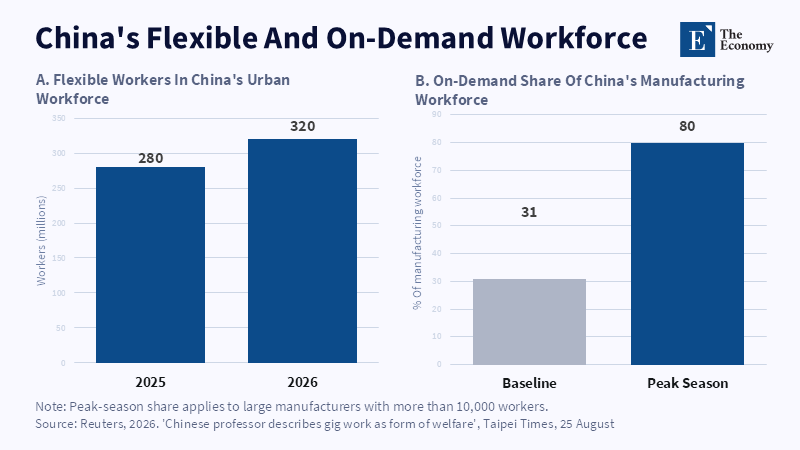
In China, almost half of urban workers no longer have a stable employment relationship. According to estimates by the China New Employment Forms Research Center, the number of workers without permanent full-time employment is expected to reach 320 million in 2026, up from 280 million last year, a number that corresponds to about 44% of the country’s urban workforce and is close to the total population of the United States. This figure is not an accidental byproduct of technological progress. It is the result of a growth recipe built on precarious work in China for three decades, based on cheap, flexible and unprotected labor. Now that Beijing is trying to shift the economy from exports to domestic consumption, it is called upon to solve a problem that it has systematically cultivated, avoiding for years to pay the real cost of the work that built its financial miracle.
The Hidden Subsidy Behind China's Economic Miracle
More than 300 million migrant workers are the backbone of Chinese industry and construction but they do not enjoy the same rights as city dwellers. Researcher Zongshuai Fan of Cambridge Industrial Innovation Policy estimates their number at 301 million for 2025 and says that together with agriculture they absorb most of the country’s low-productivity workforce. The hukou system, which was instituted in the 1950s, keeps these workers registered as rural residents even when they live and work for decades in cities such as Shanghai or Shenzhen. They built the factories, roads and apartment buildings that fueled growth. Still, the cost of housing, health and education for their children was passed on to their families, a tacit subsidy to manufacturing that no trade statistics record.
Beijing did not completely ignore the problem. Pension and health benefits for migrant workers began to expand in the 2000s, with the Social Security Law of 2010 setting a first institutional framework. The Party Plenary in July 2024 promised that registration and basic public services would now follow the place of actual residence, not origin. In May 2026, the State Council mandated local authorities to provide education, housing support and social security to residents without urban hukou but with stable employment. This is a real shift in rhetoric, although its implementation remains patchy and largely depends on the willingness of each local government to bear the fiscal costs at a time when local governments face their own revenue shortfall.
The second generation of of migrant workers, born after 1980, does not look like their parents. They are more educated, more aware of their rights and less willing to tolerate what the previous generation tolerated. She wants urban hukou so that her children can attend better schools and is looking for a job that is not governed by an algorithm or by a 996 schedule, i.e. from nine in the morning to nine in the evening six days a week. Many, however, find themselves trapped in the same circle as their parents, since the labor market has not expanded as much as their expectations have expanded. Chinese growth has made insecurity tolerable by cultivating the expectation that the next generation will join the protected middle class. The gap between this promise and what the labor market offers today is the main social rift of the current moment.
The Shift To Consumption On Unstable Foundations
The 15th Five-Year Plan is accompanied for the first time by a separate plan solely dedicated to expanding consumption, a recognition that the old investment and export model has exhausted its margins. Growth slowed to 4.3 percent in the second quarter of 2026, the worst performance since the end of 2022, while the economy is taking on an increasingly pronounced K-shape, with exports and the high-tech industry pulling upwards and domestic consumption, investment and the general labor market lagging. The official reading of the Politburo graph avoided this characterization, preferring to talk about new growth dynamics and an improving economic structure but the divergence remains visible in the figures themselves.
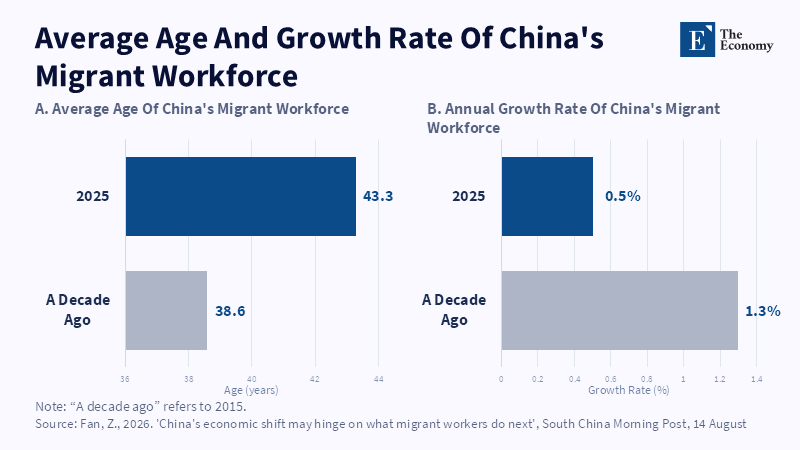
A consumption-based economy needs households with stable incomes and confidence in the future, exactly the two elements missing from the core workforce. Fan notes that the number of migrant workers increased by just 0.5 percent in 2025, compared to 1.3 percent a decade earlier, while their average age rose from 38.6 to 43.3 years between 2015 and 2025. The construction sector, despite having productivity more than three times the average, lost 17 million farm workers in a decade, while manufacturing employed 85 million in 2025, 1.4 million fewer than ten years ago. An ageing workforce, shrinking in productive sectors and remaining out of full social protection can hardly function as the consumption machine that the plan presupposes.
The direction in which these workers are moving counts as much as whether they are moving at all. Construction, labor-intensive services and manufacturing together absorbed 83 percent of migrant workers in 2025 but they are leading in opposite directions. Construction is losing staff despite its high productivity, services are absorbing labor without significantly upgrading productivity, while manufacturing, where each worker produces an average of two to three times more than their US counterpart in product volume, is attracting fewer and fewer migrants as automakers turn to humanoid robots on the assembly line. The new infrastructure program, known as the six networks and budgeted at over 7 trillion renminbi for 2026, could support construction again but official employment policy still treats the sector as a field for exploring opportunities rather than a key source of jobs.
Precarious Work In China And The First Steps Of Regulation
On April 26, 2026, the Central Committee of the Communist Party and the State Council issued the Opinion on Strengthening the Services and Management of New Employment Groups, a text aimed at distributors, transport app drivers and live broadcast content creators. Some platforms had already moved before the regulation, with Didi committing in February 2026 to driver subsidies of 1.1 billion renminbi and JD.com promising full social security and housing benefits to full-time distributors from March 2025. Work accident insurance for platform workers was expanded nationwide on July 1, 2026, following a pilot program that in 2022 covered 29.9 million workers. The two groups, migrant workers and platform workers, overlap to a large extent. Food delivery app Meituan already reported in 2019 that 77 percent of its delivery people come from rural areas, while official data identified about 84 million people in new forms of employment a few years earlier. The tolerance of migrant workers to flexible work should not be read as a preference but as a result of a narrow corridor of options, where the hukou excludes them from better positions and the platform’s algorithm is designed to pump the most hours at the lowest possible cost.
The April text, however, does not impose standardized contracts, a cap on working hours, transparency of algorithms, or full social security coverage. One could argue that the gradual approach makes sense, since it leaves room for platforms to adapt without a sharp blow to their profitability and the employment they create. This argument, however, clashes with the pace of demographic and labor realities. As long as coverage remains voluntary, the majority of precarious workers in China will continue to operate without a safety net, just when the economy needs them as consumers and not just as producers.
Surplus Of Graduates In A Market Without Enough Positions
In 2026, 12.7 million students are expected to graduate from Chinese universities, almost half a million more than in 2025, according to data from the Ministry of Education. Unemployment in the 16-to-24 age group reached 17.9 percent in July 2026, not counting students, while the increase in the retirement age in 2025, the first since the 1950s, came to put even more strain on a labor market that is already struggling to absorb new entrants. Trade barriers imposed by the United States and the European Union are also limiting the ability of Chinese industry to absorb surplus labor through new export jobs, leaving the internal market to shoulder a burden for which it has not prepared.
The language that has emerged among young bourgeois workers captures this fatigue better than any official statistic. The 996 schedule, from nine in the morning to nine in the evening six days a week, shows that even typical employment has become insecure. The term tang ping describes the quiet refusal to pursue ambitious goals in a market with declining returns, while the more radical term bai lan signifies a complete detachment from a system that is seen as rigged. This is not a resignation for no reason but an extremely reasonable reaction to a labor agreement that does not keep its promises, especially when graduates are increasingly turning to bicycle deliveries or transportation apps to fill the income gap.
Welfare Or Exploitation: The Controversy Surrounding Flexible Working
In August 2026, Peking University economics professor Zhang Dandan caused a storm of reactions when she stated on a television show that work flexibility is a form of welfare in itself, since freelancers trade stability and pensions for control of their time. The reaction on Chinese social media was immediate and sharp, with users accusing her of ignoring the reality of distributors running behind the platform’s algorithm without a break. Even the former editor-in-chief of the state-run Global Times, Hu Xijin, called her words shocking and unacceptable, calling for a public apology. Few remembered that Zhang herself had documented the plight of freelancers, estimating last year that 31 percent of the manufacturing workforce was employed in flexible relationships, a figure that rises to 80 percent in large units with more than 10,000 workers during peak periods.
This confrontation is not merely semantic. As long as part of the ruling class treats flexible work as a kind of social benefit rather than as a coincidental exploitation of a market with no alternatives, the political will for meaningful redistribution remains weak. The very argument of flexibility as welfare serves as an alibi for postponing costly reforms, just as 320 million people are being asked to prop up a new growth narrative with their wallets. The reaction to Zhang’s words revealed how close to the surface discontent is, even when the official language tries to translate it into calming terms of political economy.
The question of whether Beijing will proceed with real fiscal redistribution remains open and the history of other economies offers little consolation, since in no comparable case has the end of a period of high growth automatically improved the position of the workers who supported it. The 320 million flexible workers recorded by the China New Employment Forms Research Center are not just a statistical margin of the Chinese economy. It is its very center of gravity and as long as the majority of them remain without a stable income, without full insurance and without a voice in shaping their working conditions, the transition from exports to consumption will look more like a reformulation than a real change of direction.
This article reflects the analytical judgment of The Economy Editorial Board and does not constitute policy advice or the official position of any affiliated institution.
References
Fan, Z. (2026) ‘China’s economic shift may hinge on what migrant workers do next’, South China Morning Post, 14 August.
Maulana, I. (2026) ‘China’s precarious underclass teeter on the edge’, East Asia Forum, 30 August.
Reuters (2026) ‘Chinese professor describes gig work as form of “welfare”’, Taipei Times, 25 August.
South China Morning Post (2025) ‘China braces for record 12.7 million graduates entering tight job market in 2026’, South China Morning Post, 21 November.
Working across research, policy, and data-driven analysis, the Editorial Board ensures that published pieces reflect a consistent institutional perspective grounded in quantitative reasoning and long-term structural assessment.