

EU borrowing rose to 5.4 percent of GDP Its bonds compete with national issuers for investors Rising interest bills fall back on member states In 2020, the debt issued by the European Union on behalf of member states
Read More
AI raises productivity bars, leaving mid-ranked workers behind External hires cost more and underperform for two years In-house training of middle ranks beats hiring externally In a five-month experiment with 640 entrepreneurs in
Read More
Data centers raise household electricity prices, but unevenly across utilities Nonprofit utilities show almost no residential price effect Water impact is documented in volumes, not household bills The avera
Read More
Meetings consume substantial time but can support coordination Meeting intensity correlates with wages, revenue and learning Purpose, participation and preparation determine whether meetings pay The average wo
Read More
Minimum wages reshape firms beyond wages and employment Firms adjust through training, hierarchy, prices and work intensity Aggregate figures conceal who ultimately bears adjustment costs When the real total labour costs of
Read More







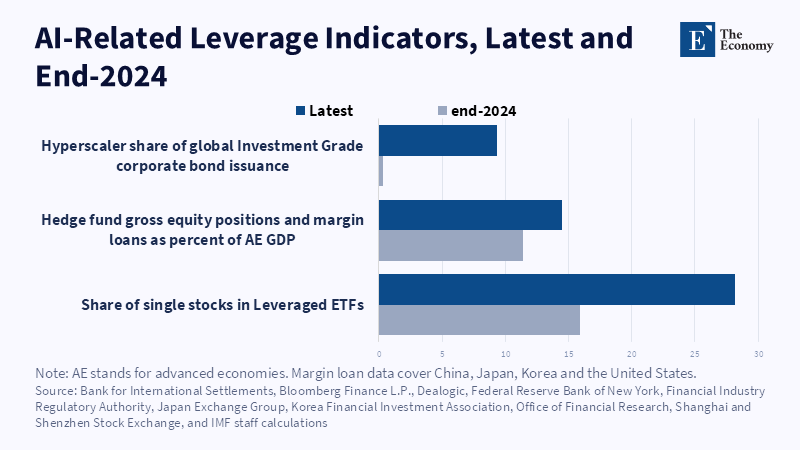
Figure 2: AI-related investment exposure has increased across several leveraged market indicators. Related article:
Read More
Europe's AI compute gap remains large despite new investment Small firms face deeper barriers to meaningful AI adoption Local demand could reinforce infrastructure, competition and productivity Three
Read More
China cut oil use without cutting mobility Renewables and coal filled the missing energy Beijing held rates while Frankfurt and Seoul hiked In the second quarter of 2026, China burned 9% less oil than a year earlier and in
Read More
Free access raises use, but school context matters Digital visits do not prove sustained reading habits Knowledge gains were strongest in disadvantaged schools A
Read More
China’s weak real exchange rate supports export competitiveness Evidence does not prove continuous deliberate yuan devaluation Persistent undervaluation can reshape manufacturing and foreign firm survival Ch
Read More

AI adoption follows different paths across worker age groups Older workers face accumulated digital barriers and lower exposure Younger workers increasingly adopt AI under labor-market pressure Age and adoption of AI initial
Read More
War destroyed capital, labor and allocation efficiency Misallocation compounds losses beyond visible physical destruction Rebuilding Ukraine’s productive base could take decade By 2024, allocative productivit
Read More

Japan needs foreign workers as its population shrinks Anti-foreigner attitudes are rising despite that dependence Economic pressure may amplify but not fully explain backlash Japan recorded
Read More
Workplace flexibility helped mothers sustain employment after COVID-19 Return-to-office mandates coincided with renewed employment retrenchment Care responsibilities make inflexible work disproportionately costly for women Bet
Read More

Teaching skill rarely decides pay or promotion Coaching-linked pay works; flat schedules don't Reward performance, not tenure or credentials In 2024, the average American teacher earned 26.9 cents less on every dollar paid
Read More
Military AI cannot be verified or controlled like nuclear arms Washington and Beijing's summit will restate intent, not create enforcement Only a middle-power coalition could impose real compliance costs On September 24, 20
Read More
Middle powers lack AI investment scale to rival US-China ASEAN's tariff failure shows coalition governance is hard Narrow bilateral deals work better than grand AI coalitions In 2025, the United State
Read More
The Economy Research Editorial*
Read More
The Economy Research Editorial*
Read More