Low-Skill Immigration Isn't the Wage Lever Washington Thinks It Is

Working across research, policy, and data-driven analysis, the Editorial Board ensures that published pieces reflect a consistent institutional perspective grounded in quantitative reasoning and long-term structural assessment.
Authored On
Modified
Immigration fell sharply but native wage gains never arrived
AI is weakening entry-level jobs as migrant labor contracts
High-skill immigration supports growth and deserves separate treatment

Net international migration to the U.S. collapsed from 2.7 million people in 2024 to something like 321,000 by mid-2026, per Census Bureau data.. Brookings researchers now say the country could see negative net migration before the year ends. If the standard political story were true, native-born wages and job prospects should be climbing fast. They are not. Unemployment among U.S.-born workers has been rising even as the immigrant labor supply shrinks and Moody's chief economist Mark Zandi has flagged a strange reversal: foreign-born unemployment fell below native-born unemployment in October 2025. The picture that mass deportation and border enforcement were supposed to produce, a tight labor market handing leverage back to American workers, has not shown up. Something else is absorbing the jobs low-wage immigrants used to fill and that something looks a lot more like software than like a native-born worker taking a construction job.
What the Landmark Study Actually Measured
The most solid recent research on immigration and wages comes from economists who went back and reexamined two decades of national labor market data with an updated statistical approach. Their finding was clear and, for some, uncomfortable: net immigration between 2000 and 2023 raised the wages of less-educated native-born workers by an estimated 2.6 to 3.4 percent. College-educated natives saw a negligible effect either way. Native workers, the researchers found, did not get pushed out of jobs. Many shifted into higher-paying, communication-heavy roles that complemented rather than competed with new arrivals. That result deserves respect. It rests on careful econometrics and two decades of consistent evidence.
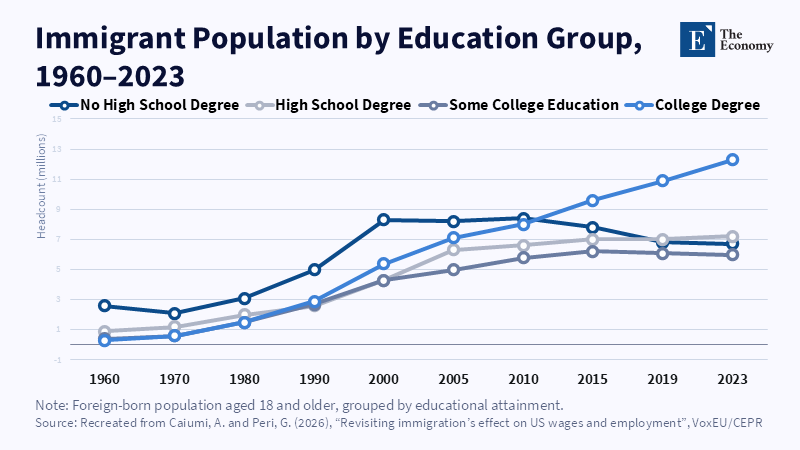
It also rests on a specific kind of immigration. The population studied was drawn from Current Population Survey data on the legally counted, working-age foreign-born population and that population became steadily more college-educated across the period in question. By 2015, college graduates had become the largest single group within the foreign-born adult population. Undocumented, low-skill labor moving through informal channels, day labor, agriculture, off-the-books construction, was never really what this study was built to isolate. Treating it as a verdict on low-skill immigration specifically stretches the evidence past where it was designed to go. A study of a mostly skilled, legally documented population cannot settle a debate about the unauthorized, low-wage segment of the labor force and pretending otherwise flattens a genuinely two-sided question into a single misleading headline.
The Missing Piece: Low-Skill Immigration and Undocumented Labor
Fill that gap with other data and the picture gets messier rather than cleaner. Economists cited in reporting on illegal immigration's wage effects have put the number somewhere between 0.4 and 7.4 percent, a huge range, honestly, that says more about how hard this population is to measure than anything else. During Donald Trump's first term, a period when illegal border crossings fell sharply, real median weekly wages for native-born workers without a bachelor's degree rose by an estimated 3.2 percent, alongside higher labor force participation. That is a real, if modest, data point in favor of the restrictionist argument. Vice President JD Vance has made the case plainly: Americans would take construction and maintenance jobs if the wages on offer reflected actual labor scarcity rather than a labor pool willing to work for less.
The 2026 data complicates that story rather than closing it. Even with net migration near zero, most industries have experienced a synchronized decline in wage growth since 2022, according to New York Federal Reserve tracking. Construction and mining wages have gone up, but mostly because of the AI data center construction boom, not because construction jobs suddenly pulled in native-born workers to replace the immigrants who left. Zandi's explanation is blunt: the jobs vacated by immigrant workers are frequently remote, physically brutal or poorly supported by housing and services and native-born workers have shown limited appetite for taking them even without competition. Foreign-born workers still earn only about 85.7 percent of what native-born full-time workers earn, concentrated in construction, trucking, natural resources and personal care. Cutting low-skill immigration did not automatically produce the wage boom the theory predicted, at least not yet and the labor gap it opened has not obviously been filled by native workers stepping into those roles.
The Machine is Already Doing the Wage Suppression
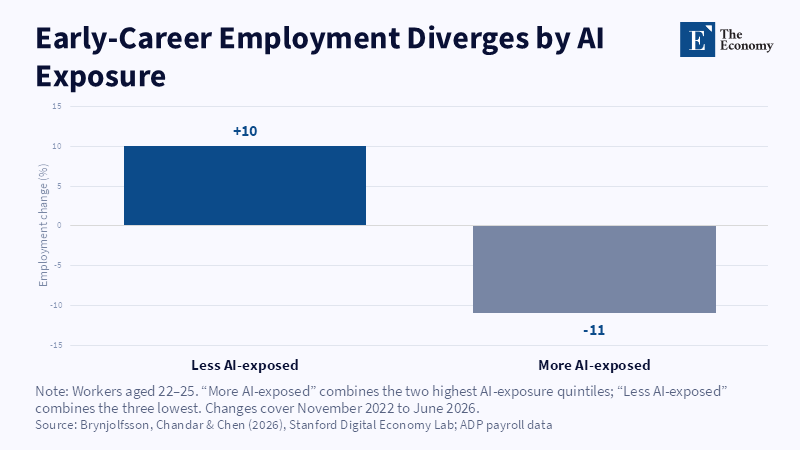
There is a more direct explanation for why the promised wage gains have been slow to arrive and it has nothing to do with immigration policy at all. Stanford researchers analyzing payroll records covering 25 million American workers found that early-career workers between the ages of 22 and 25 in the occupations most exposed to generative AI experienced a 13 percent relative decline in employment since the technology's widespread adoption in late 2022. Employment for older or less-exposed workers in the same fields stayed flat or grew. A separate analysis by the Federal Reserve Bank of Dallas, using an entirely different dataset from the Census Bureau, reached a strikingly similar figure: young workers in the most AI-exposed occupations saw employment fall by roughly the same margin over the same period, driven mainly by fewer new hires rather than by layoffs of people already employed.
This matters directly for the low-skill wage debate because entry-level and low-skill work overlap more than either side of the immigration argument likes to admit. Customer service representatives, administrative assistants and first-line retail supervisors sit among the occupations researchers rank as most exposed to AI tools. These are precisely the rungs of the labor ladder that a tighter immigration policy was supposed to hand back to native-born entrants. Instead, employers appear to be automating hiring at that rung before native-born workers ever reach it. Reducing the supply of low-wage immigrant labor doesn't bring the jobs back if the jobs are gone, absorbed by software instead of any human worker, immigrant or native. Policymakers arguing that mass deportation will refill the entry-level ladder are fighting the last labor-market war while a new one, driven by automation rather than migration, is already underway.
Why High-Skill Immigration Sits in a Different Category
The evidence looks almost opposite once the conversation shifts to skilled labor and collapsing the two categories into one immigration debate does real analytical damage. Migrants from India, China, South Korea, Japan and the Philippines rose from 3.6 percent of the U.S. college-educated workforce in 1990 to 7.3 percent by 2019, according to National Bureau of Economic Research analysis and their growth tracked rather than displaced native-born employment growth across occupations, a pattern researchers read as complementary hiring rather than substitution. These migrants accounted for 38 percent of the growth in American software developers and 25 percent of the growth in scientists and engineers over that period. More than half of doctoral degrees awarded in engineering, computer science and mathematics in the United States now go to foreign-born students, even though the foreign-born share of the overall population sits at only about 18 percent. The H-1B visa (still the main channel for this kind of talent) draws over 200,000 applications a year against a fixed cap, leaving something like a 30 to 40 percent shot at winning the lottery in any given cycle.
Restricting that pipeline carries costs with no clear parallel in the low-skill debate. Foreign-born founders were behind something like 55 percent of American billion-dollar startups as of 2022, and international students put an estimated 56 billion dollars into the U.S. current account in 2024 through tuition and fees alone. Employers facing tighter caps on skilled visas do not simply hire more native-born graduates at higher wages; they frequently offshore the work entirely, moving research and development jobs to Canada, India or elsewhere rather than filling them domestically. The asymmetry is the whole point. A policy debate that treats an H-1B engineer and an undocumented day laborer as interchangeable data points in a single wage equation is working with a category error, not a coherent theory of the labor market.
None of this settles the moral or political questions embedded in immigration policy and none of it should. What it does is narrow the empirical claims that any side can honestly make. The 2.7-million-to-321,000 collapse in net migration was supposed to be the natural experiment that proved mass immigration was suppressing native wages. It has not delivered that proof. Wage growth has stalled anyway, unemployment among native-born workers has risen anyway and the clearest documented driver of entry-level job losses over the same stretch is a 13 percent decline concentrated in the occupations most exposed to artificial intelligence, not in the occupations most associated with low-skill immigrant labor. Lawmakers chasing wage gains through immigration restriction alone are aiming at a target that has already moved. Serious labor policy has to reckon with automation as directly as it reckons with immigration, and treat high-skill and low-skill immigration as the genuinely different problems they are, instead of cramming both into one slogan the data just doesn't back up anymore.
This article reflects the analytical judgment of The Economy Editorial Board and does not constitute policy advice or the official position of any affiliated institution.
References
Atkinson, T. and Yamco, S. (2026) 'Young workers' employment drops in occupations with high AI exposure', Dallas Fed Economics, Federal Reserve Bank of Dallas, 6 January.
Brynjolfsson, E., Chandar, B. and Chen, R. (2025) Canaries in the Coal Mine? Six Facts about the Recent Employment Effects of Artificial Intelligence. Stanford Digital Economy Lab Working Paper, August.
Caiumi, A. and Peri, G. (2026) 'Revisiting immigration's effect on US wages and employment', VoxEU, CEPR, 11 August.
Frei, A. (2025) 'Cracking down on illegal immigration would raise wages for lower-income Americans', The Heritage Foundation, 28 January.
Geng, J. (2025) 'High-skilled STEM immigration in the United States: global perspectives on policy, controversy, and sustainable development', Humanities and Social Sciences Communications, 13(1), pp. 1–20.
Khanna, G. (2026) From Asia, With Skills. NBER Working Paper 34449. Cambridge, MA: National Bureau of Economic Research, January.
Pringle, E. (2026) 'Trump's grand plan to put American workers first may be backfiring as U.S.-born unemployment rises and wage growth stalls', Fortune, 16 August.
Rambaldi, M. (2019) 'China, immigrants or robots: who is "stealing" jobs in the US?', Univision News, 27 August.
Working across research, policy, and data-driven analysis, the Editorial Board ensures that published pieces reflect a consistent institutional perspective grounded in quantitative reasoning and long-term structural assessment.