Age and AI Adoption: The Curve That Hides Two Different Stories

Working across research, policy, and data-driven analysis, the Editorial Board ensures that published pieces reflect a consistent institutional perspective grounded in quantitative reasoning and long-term structural assessment.
Authored On
Modified
AI adoption follows different paths across worker age groups
Older workers face accumulated digital barriers and lower exposure
Younger workers increasingly adopt AI under labor-market pressure

Age and adoption of AI initially seem to follow a fairly clear logic. Mid-life workers have experience, a more stable position in companies and a greater ability to integrate new tools into the processes they already know. Older workers may have a harder time with yet another technological transition, while younger workers have less work experience and often less influence on how their work is organised. In European business data, this produces an inverted curve: higher adoption where 25 to 49-year-olds predominate and lower at both ends. The picture is convincing until it is compared to what young people themselves are doing. That's where the curve starts to change meaning. Younger people are among the most intensive users of AI and, for those who are just entering the job market, familiarity with it is becoming less and less a matter of preference.
Age and AI Adoption Do Not Measure the Same Thing
The first difficulty lies in the unit of measurement. A business is considered to have adopted AI when it integrates specific technologies into its operations, organizes data, changes processes, delegates responsibilities and often invests in complementary software and skills. This is a far cry from an employee's decision to use a chatbot to write code, summarize a document, or prepare a presentation. The first is an organizational decision. The second can be made in a matter of minutes and without even the company's official approval. Therefore, when an industry with many 15- to 24-year-old employees shows lower AI business adoption, this does not prove that the young people themselves are reluctant or inadequate users. It may indicate that they are working in businesses and positions where organizational investment in AI remains low.
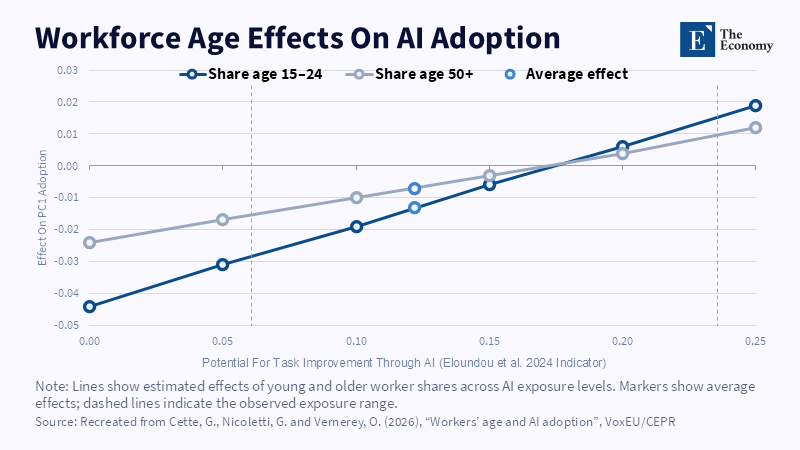
This is particularly important because the negative relationship for young people is not stable. In European data, as the exposure of an industry to tasks that can be improved through AI increases, the disadvantage associated with a high percentage of young workers weakens and in some metrics is reversed. The finding leads to a different interpretation. Being young does not act as a barrier on its own. The problem occurs more when a young employee is in an environment with limited use of AI, little organizational capacity and tasks that do not create enough motivation to invest. Age and adoption of AI are correlated, but the correlation passes through the type of job and the position of the employee within the company.
The Old Digital Divide Persists Among Older Workers
On the other side of the age distribution, the explanation is closer to what happened in the earlier phases of digitalization. The proliferation of the internet, online banking, smartphones and later digital public services did not happen simultaneously for all ages. Older users usually joined later and many only acquired the level of digital proficiency that their daily needs required. AI arrives before it completely closes this previous gap. This creates a cumulative effect. Someone who has never gained comfort with passwords, online accounts, complex interfaces, or digital search does not start the era of chatbots from the same place as an employee who has been using such systems daily for fifteen years.
But the experience of the previous digital transition also warns against an easy prediction that older people will simply refuse AI. Earlier research on technology showed that the positive attitudes of older users could outweigh the negative ones when the technology gave a clear practical benefit. The most recent data on AI shows the same pattern. In an international survey of 2,515 people aged 60 to 85, only 15 percent said they were not interested in learning more about AI. 41 percent were concerned about the use of personal data and 34 percent did not know which tools to choose. Distance is therefore not just a distance of interest. It is a distance of knowledge, trust and previous exposure.
This helps explain why employment can act as a continuous learning mechanism. In the same study, older people who remained employed used AI about three times more than those who had retired. The difference cannot be attributed to the calendar year of birth alone. Work creates daily reasons for use, colleagues who can help, employer-provided software and reasons to overcome the initial difficulty. After retirement, much of this infrastructure disappears. The same process was visible in the digital transition and may now become more intense because AI evolves with much shorter cycles of change.
For Young Workers, AI Is Becoming a Condition of Entry
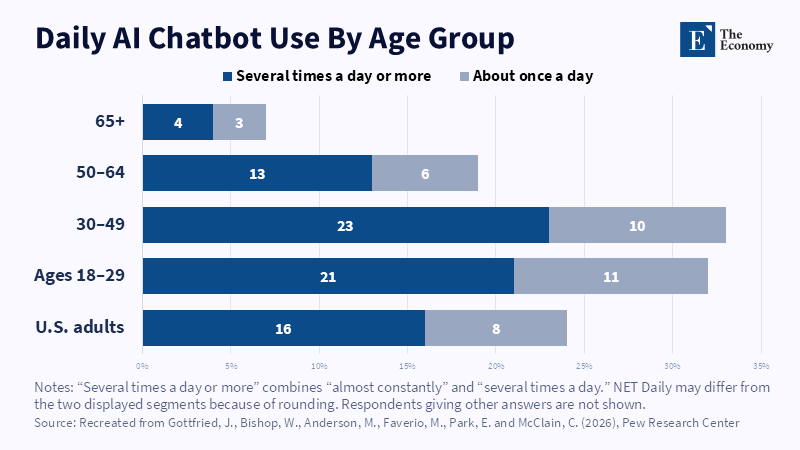
The case of younger workers is moving in the opposite direction. High usage doesn't just result from greater comfort with technology. It also reflects a different economic incentive. In a 2025 AP NORC survey, 74 percent of Americans under 30 used AI to search for information at least occasionally. About half were already using it for work activities, writing emails, creating images, or entertainment, while young people were using AI for idea generation much more often than older people. This data is difficult to reconcile with the idea of a general reluctance towards AI in the early years of professional life.
There's a stronger reason, too. The job market is starting to put greater pressure on the positions where young workers traditionally begin. Administrative payroll data of millions of US workers showed in 2026 that the employment of 22- to 25-year-olds in occupations with high exposure to AI was about 19 percent lower than it would have been if it had followed the path of peers in less exposed positions. The difference is mostly seen in hiring and is most pronounced when AI is used for automation rather than to supplement human work. This changes the motivation of the new employee. AI knowledge is not just a way to get the job done faster. It can be a way for the employee to stay competitive in a market that limits some of the traditional entry-level positions.
That's why low organizational adoption in industries with a lot of young people can be temporarily misleading. The junior employee has little power to decide whether the business will buy AI enterprise models, redesign the workflow, or create a data management policy. But they have a much greater personal motivation to learn tools that reduce the production time of a first analysis, code, presentation, or search. In this age group, adoption may precede formal organizational change. This creates a paradox: a business may be recorded as low adoption at the same time that its younger employees use generative AI daily.
What the Inverted Curve Misses About Younger Workers
Employees aged 25 to 49 have an advantage that is not only about their digital skills. They are most often in positions where experience is combined with enough organizational power. They know the process that is about to change, understand what part of the work can be automated without damaging quality and are more likely to be involved in the selection of tools or the implementation of a new process. High adoption in this group can therefore capture a combination of age, professional experience, hierarchical position and exposure to knowledge tasks. The curve is real as a statistical result, but age does not have to be the main mechanism that creates it.
This can also be seen from the fact that young workers don't just have different skills. They have different tasks. Many entry-level positions consist of work that previously functioned as a learning period: initial research, basic analysis, first version of a text, simple code, classification of information. It is precisely these tasks that are often easy to support or automate with generative AI. A more experienced employee can use the same tool with already developed professional judgment and institutional knowledge. The junior needs the tool, but at the same time risks losing some of the work through which he would acquire this judgment. The lower adoption observed in some industries with younger workforces does not fully describe this pressure.
There is, of course, a plausible counterargument. Frequent use of AI does not mean effective use. Younger people may open a chatbot more often but have less professional judgment to evaluate the answer. This is a real problem and explains part of the advantage of middle-aged workers. But it does not negate the key point. The difference is about quality and how to use it, not the lack of adoption. In fact, as AI becomes part of the process of selecting, executing and evaluating work itself, the pressure on young people to improve this ability increases.
The AI Adoption Gap Is Not Symmetric
Age and adoption of AI therefore create two different stories on the fringes of the labour market. For many older workers, the main barrier is cumulative. The previous digital transition was not completed at the same pace for everyone and new technology is being added on uneven digital foundations. The lack of daily exposure after retirement can make the gap wider, while issues of privacy, choice of tools and technical confidence increase the cost of the first step. This means that a segment of older generations may indeed remain very limited users of AI, as has been the case for years with previous digital technologies.
For young people, however, the same interpretation does not work. The pressure comes from the opposite side. AI enters the tasks that used to be the first step of professional experience at the very moment when young people are trying to gain that experience. Learning it can therefore be defensive behaviour as much as technological enthusiasm. This helps explain why the individual use of young people is high even when corporate adoption in youth industries is not. The inverted U remains a useful description of the European business structure. But it is not a symmetrical story of human adaptation. At one extreme is the risk of being excluded from a technology that is advancing rapidly. At the other is the need to learn the same technology because the labour market may not leave enough room not to do so.
This article reflects the analytical judgment of The Economy Editorial Board and does not constitute policy advice or the official position of any affiliated institution.
References
Brynjolfsson, E., Chandar, B. and Chen, R. (2026) ‘Canaries in the Coal Mine? Six Facts about the Recent Employment Effects of Artificial Intelligence’, Stanford Digital Economy Lab, revised 12 August 2026.
Cette, G., Nicoletti, G. and Vernerey, O. (2026) ‘Workers’ age and AI adoption’, VoxEU, 16 September.
Czaja, S.J., Charness, N., Fisk, A.D., Hertzog, C., Nair, S.N., Rogers, W.A. and Sharit, J. (2006) ‘Factors predicting the use of technology: Findings from the Center for Research and Education on Aging and Technology Enhancement’, Psychology and Aging, 21(2), pp. 333–352.
Hinde, G. and Depa, J. (2026) ‘How older generations are engaging with AI and why it matters’, EY, 6 April.
Mitzner, T.L., Boron, J.B., Fausset, C.B., Adams, A.E., Charness, N., Czaja, S.J., Dijkstra, K., Fisk, A.D., Rogers, W.A. and Sharit, J. (2010) ‘Older adults talk technology: Technology usage and attitudes’, Computers in Human Behavior, 26(6), pp. 1710–1721.
O’Brien, M. and Sanders, L. (2025) ‘How US adults are using AI, according to AP-NORC polling’, Associated Press, 29 July.
Rieder, E. (2025) ‘The Generational Divide in AI Adoption: How Age Shapes the Integration and Use of Intelligent Tools?’, Trends in Computer Science and Information Technology, 10(2), pp. 35–42.
Working across research, policy, and data-driven analysis, the Editorial Board ensures that published pieces reflect a consistent institutional perspective grounded in quantitative reasoning and long-term structural assessment.