Artificial Intelligence and Public Debt: Why Growth Is Not Enough

Working across research, policy, and data-driven analysis, the Editorial Board ensures that published pieces reflect a consistent institutional perspective grounded in quantitative reasoning and long-term structural assessment.
Authored On
Modified
AI may boost growth but not fix U.S. debt
Capital, not labor, captures most AI-driven income gains
Political spending risks outpacing any real AI dividend

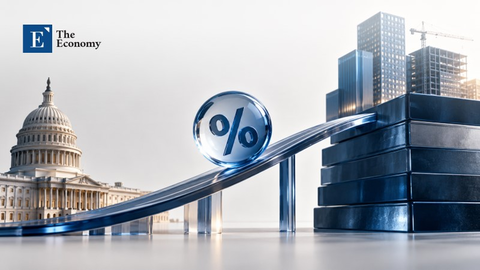
The U.S. federal debt is approaching $40 trillion, while annual deficits add about two trillion dollars a year. The interest paid by the government to service this debt now exceeds defense spending, something that had not happened for decades. Washington can still borrow without immediate problems, but its fiscal position has become more fragile as interest rates have returned to levels closer to historical averages. Against this backdrop, many see AI as a way out, a technology capable of increasing productivity, profits, and ultimately tax revenues enough to shrink debt relative to GDP. This hypothesis about AI and public debt is attractive and is repeated more and more often in statements by politicians and investors. But it is more uncertain than it seems at first glance, and the distance between technological optimism and fiscal reality is worth looking at carefully.
The Burden of Debt in an Era of Higher Interest Rates
After the financial crises of 2008 and 2009, much of the economic and political world adopted an assumption that proved dangerous: that interest rates would remain extremely low indefinitely. The theory of "long-term stagnation" became almost orthodoxy among policy economists, encouraging governments to treat rising debt as relatively harmless. Whenever needed, a new stimulus package would cover the next crisis at no particular cost, while debt ratios could rise well before it is worth worrying. This was yet another version of the belief that "this time it's different," a belief that the long history of interest rates has repeatedly punished. Interest rates, adjusted even for inflation expectations, have gone through long periods of low levels in the past, only to rise sharply when conditions changed. They are not necessarily predictable, but they are just as likely to go up as they are to go down, something that the generation of politicians who shaped the fiscal policy of the last fifteen years seems to have forgotten.
Today, interest on servicing the federal debt exceeds defense spending, a reversal that shows how much the picture has changed compared to previous decades. The debt is now much higher than it was twenty-five years ago, and the cost of servicing it is proportionately heavier, even if the interest rates themselves are not much different from then. Fiscal monitoring research centers warn that, in the coming years, the average interest rate paid by the government on its debt may exceed the growth rate of the economy. When this happens, even a stable primary deficit drives the debt to a steady rise with no physical limit, while lenders begin to demand higher yields to hold U.S. debt in their portfolios. There is, at the moment, no substantial political will in any party to reduce deficits, which makes the search for an external solution, such as artificial intelligence, particularly attractive for those who want to avoid difficult choices.
What AI Can Really Offer
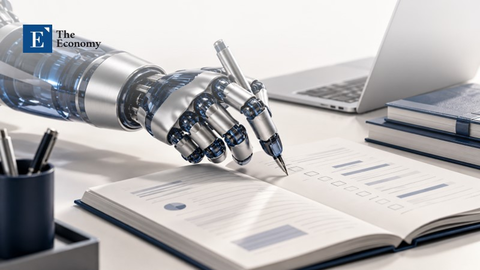
The argument in favor of AI as a solution is not unfounded. If technology does accelerate productivity, the benefits could be channeled into higher corporate profits and national income, broadening the tax base and generating enough additional revenue to reduce deficits and debt-to-GDP ratios. Investments in AI infrastructure, data centers, energy, and chips are already visible in every corner of the economy, and some industries are recording real productivity gains that cannot be attributed solely to statistical noise. In some occupations, especially repetitive office tasks, measurable improvements in speed and quality are real and documented. In some customer service cases, for example, the use of AI tools has been linked to a double-digit increase in cases resolved per hour, with the greatest benefit recorded in less experienced workers than in the most skilled ones.
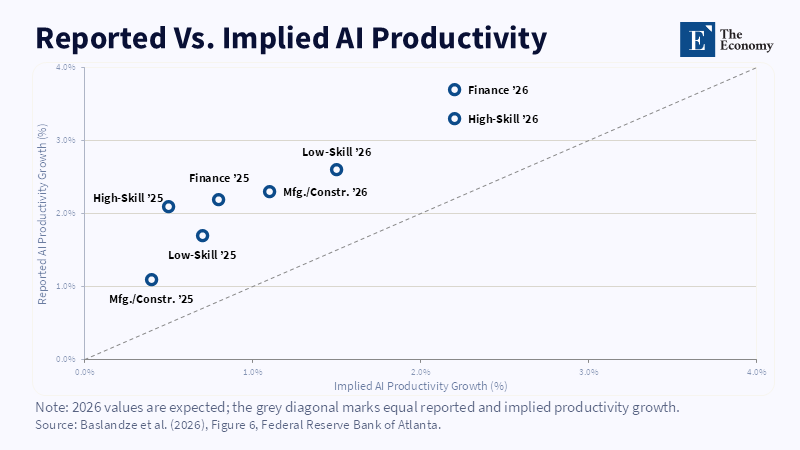
However, the very evidence fueling optimism also shows how difficult it is to separate the impact of AI from other causes. U.S. labor productivity has indeed accelerated in recent years compared to the previous decade but much of this acceleration appears to be linked to cost restructuring and correcting previous overcrowding of staff. Not only with new technology, as the analysis of U.S. productivity has shown. No single figure is yet sufficient to confidently attribute the share that AI deserves against a simple return to the office, an aging workforce or a cyclical recovery. Artificial intelligence remains part of the story, but less of a dominant part than some of the narratives around it suggest. and this distinction has direct consequences for any budgetary forecast based on it.
Why Growth Doesn't Automatically Turn into Tax Revenue
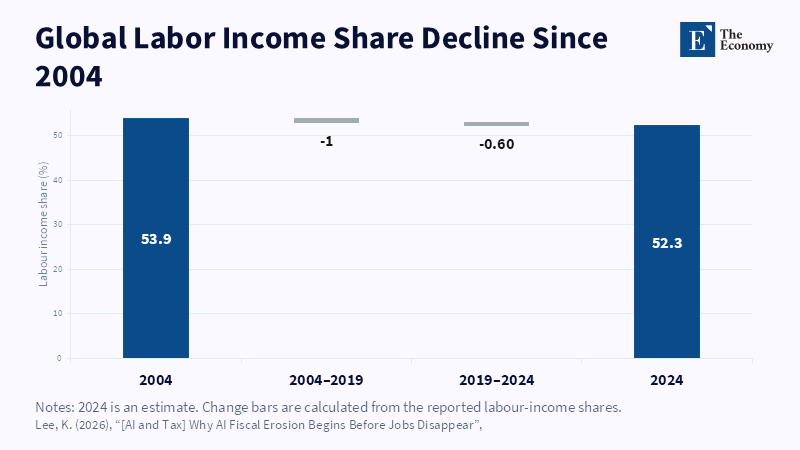
Even if AI offers real growth, that doesn't mean it will solve the debt problem. The income generated by AI tends to be disproportionately directed towards capital and corporate profits, not wages. Capital is generally more mobile and politically harder to tax than labor, as it can move between jurisdictions or postpone making profits in ways that simple payroll taxation does not allow. Similar issues are identified in a recent study on the fiscal erosion caused by artificial intelligence, where the shift of income from labor to capital appears as a central mechanism of revenue loss, even in cases where overall productivity is clearly improving.
Silicon Valley's projections of three to four percentage points of additional annual productivity may turn out to be overly optimistic. More conservative estimates by economists are closer to one to two percentage points, with even some of this benefit offset by an aging population, deglobalization, political populism, and the risks of applying technology to real business processes. Faster growth could itself raise interest rates. AI requires massive investments in data centers, energy, chips, and infrastructure, and the increased demand for capital, coupled with a potential decline in household savings, can push borrowing costs upward. The government's interest bill could thus rise in tandem with economic growth rather than shrink relative to it, a dynamic that has already begun to emerge in markets, where a sharp rise in long-term bond yields is squeezing AI-linked stocks.
A plausible counterargument is that previous technological revolutions, from electricity to the internet, eventually significantly broadened the tax base, so there's no reason for AI to be an exception. However, this objection overlooks two differences. First, previous technological transitions have taken decades to translate into broad employment and wage growth, while the United States' fiscal problem needs to be resolved much sooner. Second, the current tax system relies much more heavily on payroll taxes than in the past, which makes it particularly vulnerable to the very kind of income shift towards capital that AI seems to be accelerating. The comparison with electricity or the internet, no matter how instructive it may be historically, cannot by itself reassure those who currently prepare the state budget with a horizon of a decade and not a generation.
The Political Temptation to Spend a Future That Has Not Yet Come
There is a fourth risk, more political than economic. The anticipation of a future abundance thanks to AI may encourage tax breaks, expanded social benefits, increased defense spending, environmental investments, or even universal basic income programs, before these additional revenues are actually realized. New spending can easily absorb any additional revenue rather than reduce debt, especially in a political system where fiscal discipline is rarely rewarded electorally and where the promise of future prosperity is always more popular than immediate austerity.
The combination of high debt, elevated interest rates, political paralysis, and an external shock, such as a war, cyber conflict, or environmental disaster, could trigger a real debt crisis. It's one of the ironies of the moment: artificial intelligence can make the United States richer, but it can't correct the political trend of spending more than the state collects. For policymakers, the conclusion is concrete: any revenue forecast based on expected AI benefits must be accompanied by realistic margins of error, while any new spending commitment must be considered regardless of whether the technology delivers on its promises. Only a real crisis, not a technological promise, seems capable of creating the political pressure needed to reform taxes and spending, which in itself is an ominous finding for those hoping for preventive action.
The country should not treat the expected growth from artificial intelligence as a substitute for fiscal discipline. Forty trillion dollars of debt won't disappear because a language model wrote code faster or because a data center increased a chip company's profits. Artificial intelligence can widen the cake, but not force the political system to properly distribute the share that belongs to the public sector. The responsibility for debt stabilization remains, as always, political, and only the determination to rearrange taxes and spending now, before it is imposed by a crisis, can turn a real technological opportunity into a lasting fiscal benefit instead of another missed opportunity for reform.
This article reflects the analytical judgment of The Economy Editorial Board and does not constitute policy advice or the official position of any affiliated institution.
References
Lee, K. (2026) '[AI and Tax] Why AI Fiscal Erosion Begins Before Jobs Disappear', The Economy, 1 August.
Lichtenberg, N. (2026) 'A “Debt Spiral” Before a Fiscal Crisis: Interest on the National Debt Will Be Growing Faster than GDP in Just Five Years, Think Tank Warns', Fortune, 9 March.
Rogoff, K.S. (2026) 'The AI Growth Paradox', Foreign Affairs, August.
Steil, B. and Harding, E. (2023) 'For the First Time, the U.S. Is Spending More on Debt Interest than Defense', Council on Foreign Relations.
The Chosun Ilbo (2026) 'AI Boom Paradox: Rising Rates Pressure Tech Stocks', The Chosun Ilbo, 19 August.
Working across research, policy, and data-driven analysis, the Editorial Board ensures that published pieces reflect a consistent institutional perspective grounded in quantitative reasoning and long-term structural assessment.
Similar Post