Jevons Paradox and AI Adoption: Why Comparative Advantage Matters More Than Exposure

Working across research, policy, and data-driven analysis, the Editorial Board ensures that published pieces reflect a consistent institutional perspective grounded in quantitative reasoning and long-term structural assessment.
Authored On
Modified
AI adoption follows economics, not technical exposure alone
Lower costs can expand demand rather than eliminate jobs
Comparative advantage determines where automation becomes commercially rational

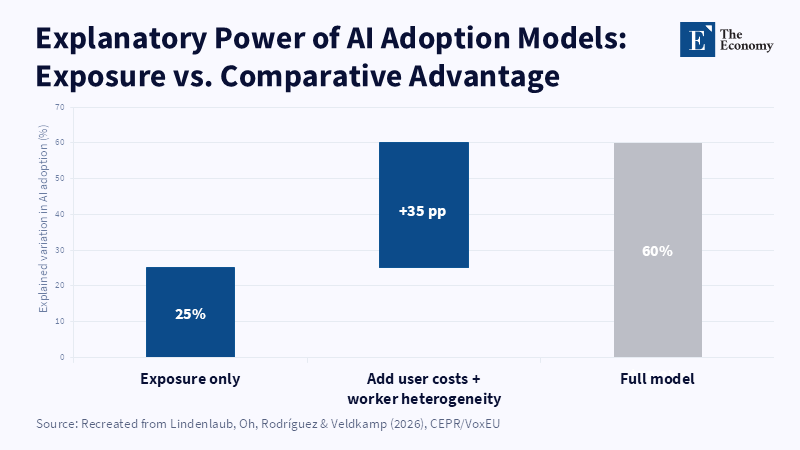
Technically exposed jobs tell only part of the story about AI at work but a more useful indicator is how many companies find an economic rationale for using it. In a representative sample of 9,835 employees in Germany, a model that only looks at the exposure of occupations to AI explains about 25 percent of the difference in actual adoption. When the employee's cost of use and productivity in relation to his salary are included in the model, the explanatory power rises to close to 60 percent. This changes the center of the discussion. Technical competence is not enough to lead to replacement. The company compares what it gets from a human, what it gets from a system and how much each one costs within the actual workflow. This is where comparative advantage and the Jevons paradox meet.
Comparative Advantage and AI Adoption
Two producers don't have to be completely different in every task for the division to make sense. As long as they have different relative opportunity costs. In the AI job market, the second producer is now an automation model or system. From a business perspective, the comparison is about the performance per unit of total cost, even when the system writes better, sees more data, or responds faster. This includes licenses, computing power, integration, control, security, privacy and human oversight time. In German research, Exposure and the comparative advantage measure give opposite signals for occupations that account for about 30 percent of employment. A profession may seem too exposed and yet remain financially resilient because people are cheap relative to the value they generate or because the cost of using AI is high.
This explains why predictions based solely on the capabilities of models often overestimate the speed of change. A technology may perform a task and not yet be worth using. The difference is clearly seen in computer vision research in the United States. The technical exposure is much greater than the part of the work that is actually advantageous to automate. The study estimates that only 23 percent of the pay associated with computer vision work that is technically exposed would be economically attractive to automate at today's costs. Across the U.S. economy as a whole, technically automatable computer vision jobs account for about 1.6 percent of nonfarm wages, while the economically attractive part falls to close to 0.4 percent. The gap between ‘can be done’ and ‘is worth doing’ is wide. The same distance will determine the pace at which AI will move from pilot projects to regular production.
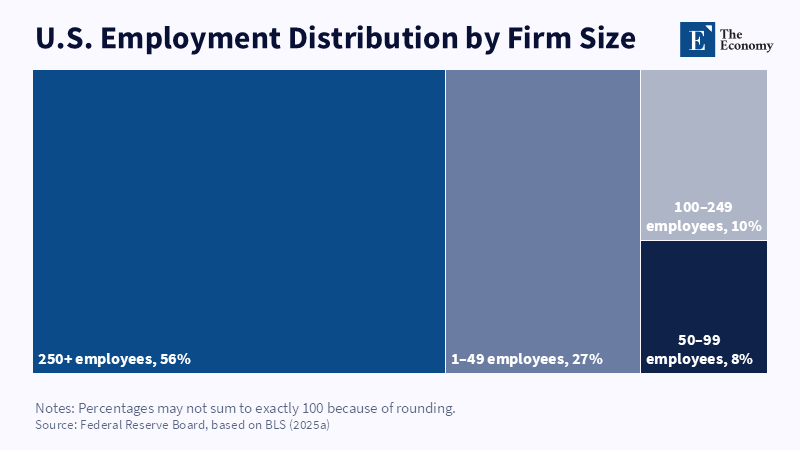
The scale of the business also changes the comparison. A large network can divide the fixed costs of development, security and integration across millions of transactions. A small company does not have the same capability. If a task takes up a few minutes of an employee's day, the purchase of a specialized system may never be amortized, even if the system performs the work flawlessly. This means that the same technology may have a comparative advantage in a multinational and a disadvantage in a small business. The market will therefore not be automated at a uniform pace. Adoption will be concentrated first where there is a large volume, a stable workflow and a low control cost. This detail is critical because it transforms the prediction for AI from a technical exercise to a problem of industrial organization and cost.
The Jevons Paradox in the Labor Market
The Jevons paradox adds a second layer. Improving the efficiency of a resource does not always lead to a lower overall use of it. If costs fall enough, demand can increase so much that total consumption increases. In the nineteenth century, the debate was about coal. Today the same idea is used for professional services and jobs that are made cheaper with AI. The analogy needs attention because labor is not a fuel and the demand for services is not unlimited. Nevertheless, the pattern is useful. If a call center reduces its cost per service, it may not just need fewer people. It can serve more customers, more markets and more channels. Productivity then affects both cost and market size.
The Philippines provides an interesting example, without proving a causal relationship on its own. Employment in call centers increased every year from 2016 to 2025 and approached two million workers, despite the rapid improvement of conversational AI systems. The data does not show that AI created these positions. But they do show that high technical exposure did not automatically translate into a contraction in employment. This is critical to applying the Jevons paradox at work. Technology can reduce the cost per unit of service and increase the amount of service requested. The effect on employment depends on which effect is stronger, the saving of man-hours or the expansion of demand.
The same logic also explains why cheap work abroad doesn't disappear once a better model emerges. AI can reduce the cost of an agent without zeroing out the value of the agent. It can write a first response, summarize the history and suggest solutions, while the human handles the exception, dissatisfaction, or the case that doesn't fit the standard. If the total cost of this combination falls, the company gains an incentive to sell more service. This is a more realistic version of the Jevons paradox for labor. In practice, what becomes cheaper may be the human judgment and computational assistance package. Employment then depends on how quickly the demand for the package grows relative to the hours of work it saves.
Labor Costs and Human Competitiveness
The comparative advantage becomes even clearer when AI is compared to workers in different markets. An American company may technically have the ability to automate some of its customer support and still continue to hire staff in countries with lower wages. This choice results from economic calculation and can be completely rational. If the overseas worker offers satisfactory quality, handles exceptions, understands the tone of the customer and costs less than the full AI solution, human labor retains a comparative advantage. Technology can be used in parallel, as a tool that increases the productivity of the same employee. In this case, the most profitable production unit may be a human with AI.
Data from customer service reinforces this version. In a study of 5,172 agents, a generative AI tool increased the number of issues resolved per hour by an average of 15 percent. The improvement was much greater for younger and less experienced workers and much smaller for more experienced ones. This is important for comparative advantage. AI does not necessarily replace the employee who has the lowest initial productivity. It can increase their productivity and change their relative position within the business. If a junior agent approaches the practices of an experienced agent faster, the cost per successful service drops without the human position disappearing. It may even make room for more customer contacts, longer opening hours, or services that were previously very expensive.
Productivity, Demand and Employment
This is where the most serious objection lies in the simple story of replacement. If AI abruptly reduces the cost of a service, businesses may buy much more from that service. A small law firm can take on more cases. A consulting firm can serve smaller clients. A support department can add languages and channels that previously did not justify the cost. The Jevons paradox does not guarantee an increase in positions. But it offers a mechanism that is missing from many forecasts. Demand does not stay stable when the price falls. This means that measuring "exposure" to AI is only the first step. To predict employment it is necessary to assess the elasticity of demand, the possibility of creating new services and how easily the technology reduces the overall cost of a real transaction.
Of course, there is also the opposite case. If demand is already saturated, or if AI can run almost the entire workflow at a low cost, substitution can be strong. Lower prices are not always enough to absorb labor savings. This is why the Jevons paradox should not be used as a general law that AI will create more jobs. It needs to be combined with advantage. The two together give a more useful set of questions. First it is examined whether AI is economically better than humans for the specific task. Then it is examined whether the fall in costs will increase demand enough to create new jobs around it. Only then is a more serious prediction made of the net effect on employment.
Macroeconomic data gives one more reason for caution. The Federal Reserve noted in 2026 that the real-world effects of AI remain concentrated in certain segments of the economy and have yet to emerge as a broad transformation of productivity and the labor market. Analysis of nearly 490,000 corporate earnings calls also found that approximately 95 percent of AI-related productivity sentences referred to future gains. This doesn't mean the benefits won't come. It shows that much of the business promise still remains an expectation. Comparative advantage requires realized costs and realized performance. The Jevons paradox requires a real price drop that creates additional demand. Without these two steps, the debate remains on technical capabilities and management expectations.
What Businesses Should Measure Before Automating
The current picture of adoption shows why this distinction has practical value. At the end of 2025, about 18 percent of U.S. businesses reported using AI in business operations, while about 41 percent of employees reported the use of generative AI for their work. Another executive survey estimated that 78 percent of the workforce worked in companies that had adopted some form of AI and 54 percent in companies that used large language models. The numbers differ because they measure different units, but they converge on one point: use spreads faster than complete job replacement. At the same time, the German model predicts that employee adoption could increase from 44 percent to about 81 percent within three years, mainly if the costs of use and integration fall. The speed at which AI enters production becomes as critical as refining the models themselves.
That's why businesses need more rigorous logic than "AI can do it." They need to measure the total cost per completed task, control time, failures, the need for human intervention, the cost of changing systems and the effect on final demand. The same logic is needed in the labor market. The position that seems more exposed may prove resilient, while a less impressive use of AI can spread quickly because it has low integration costs. The original finding thus returns with greater significance. The report explains only part of the adoption. Comparative advantage explains much more. The Jevons paradox adds the next step because cheaper production can enlarge the market produced. The prediction for labor should start from these two forces and not from a list of tasks that a model can already perform.
This article reflects the analytical judgment of The Economy Editorial Board and does not constitute policy advice or the official position of any affiliated institution.
References
Allen, Jeffrey S. (2026) ‘Monitoring AI Adoption in the US Economy’, FEDS Notes, Board of Governors of the Federal Reserve System, 3 April.
Brynjolfsson, Erik, Li, Danielle and Raymond, Lindsey (2025) ‘Generative AI at Work’, The Quarterly Journal of Economics, 140(2), pp. 889–942.
Green, Jemma (2026) ‘AI Costs More Than The People It Replaced’, Forbes, 2 July.
Jevons, William Stanley (1866) The Coal Question: An Inquiry Concerning the Progress of the Nation, and the Probable Exhaustion of Our Coal Mines. 2nd edn. London: Macmillan and Co.
Lab Report (2026) ‘Humans are still cheaper than AI for most work involving tasks that computer vision could technically automate’, edited by Mal James, ScienceBlog, 29 August.
Lindenlaub, Ilse, Oh, Ryungha, Rodríguez, María Alejandra and Veldkamp, Laura (2026) ‘Beyond exposure: Predicting AI adoption based on comparative advantage’, VoxEU, 30 August.
Ozkan, Serdar, Kalyani, Aakash and Sullivan, Nicholas (2026) ‘AI and Productivity: What Firms Are Saying on Earnings Calls’, Federal Reserve Bank of St. Louis, 31 July.
Rogelberg, Sasha (2026) ‘The AI boom hasn’t stopped U.S. companies from hiring cheap offshore labor, and overseas call center employment is still skyrocketing’, Fortune, 29 August.
Svanberg, Maja S., Li, Wensu, Fleming, Martin, Goehring, Brian C. and Thompson, Neil C. (2024) ‘Beyond AI Exposure: Which Tasks are Cost-Effective to Automate with Computer Vision?’, MIT FutureTech Working Paper.
Working across research, policy, and data-driven analysis, the Editorial Board ensures that published pieces reflect a consistent institutional perspective grounded in quantitative reasoning and long-term structural assessment.
Similar Post