[Howie Chang Series] Will Your Job be Replaced by AI & Automation?

Deeply committed to shaping sustainable talent pipelines, Howie has trained and mentored hundreds of professionals in AI, Product Management, UI/UX, and emerging technologies. As a certified HRD Corp trainer, he has delivered high-impact learning experiences for clients such as Dell, Clarivate, Micron, and Keysight. He has also lectured at Republic Polytechnic and Singapore Polytechnic, bringing practical relevance into the classroom.
Before returning to Penang to make a homegrown impact, Howie spent over a decade immersed in Southeast Asia’s startup and innovation ecosystems. His career reflects a rare blend of product thinking, user experience, and entrepreneurial grit, fuelling his drive to help others adapt, learn, and evolve.
In recognition of his contributions to the tech and innovation ecosystem, Howie was awarded the Pingat Jasa Kebaktian (PJK) by the Penang State Government.
Authored On
Modified
AI absorbs tasks first, shrinking entry-level hiring before layoffs
Coders, consultants and lawyers now sit inside automation’s reach
Judgment and continuous learning outlast any fixed job description

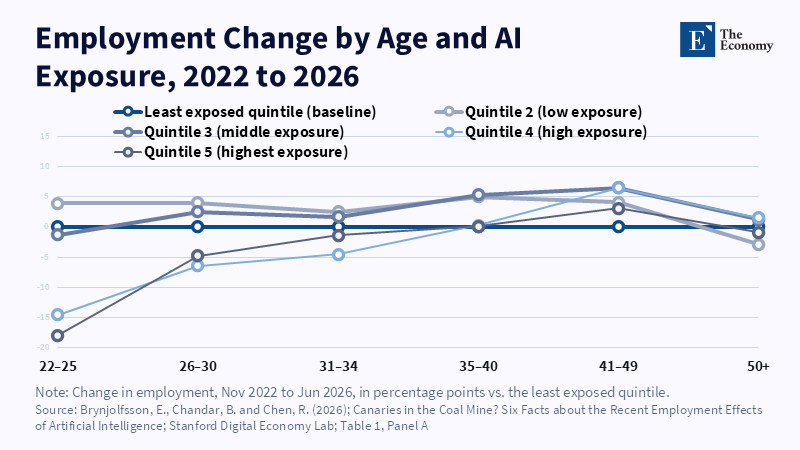
In June 2026, the employment of 22- to 25-year-olds in the occupations with the most exposure to AI was 19 percent lower than the level it would have reached if it had followed the pace of their peers in less exposed jobs. The finding comes from the Stanford Digital Economy Lab, which analyzes ADP payroll data for millions of American workers and comes with two details that change its reading. Experienced workers in the same occupations do not show a corresponding gap and the adjustment is mainly made through fewer young hires rather than waves of layoffs. The public debate about the AI job market has spent years divided into two camps, where one sees a job destroyer and the other a mechanism that will spawn more. Payroll data describes something narrower and harder to ignore, because AI first absorbs the pieces of work that once justified the first rung of a career.
The question that concerns millions of workers, namely whether automation will take their jobs, is not new and every major technological change since the Industrial Revolution has revived it. But Stanford’s data shifts the weight. It matters less which professions will survive and more which tasks and which employees gain more value when AI can perform an ever-increasing share of both routine and cognitive work. A few years ago, lists of “safe” directions were circulating, suggesting that industrial and office workers turn to software development, data analysis or machine learning. Several of these directions are among the most exposed today, which diverts attention from the title of a position to the relationship that everyone builds with technology. This relationship is gradually changing and its course explains why someone who may find himself outside a company tomorrow may, after systematic self-education, return to the market as a more reliable worker than he was before.
AI Replaces Tasks Before It Replaces Occupations
Every profession is a set of activities of unequal value and technology rarely takes the whole bundle together. The ATM is the best-known example of this logic. When machines spread in the United States, the number of cashiers per branch decreased, but banks opened more branches because their operating costs fell, so that cashiers’ employment did not collapse for decades, as a Boston University study has documented. Work changed content and turned to selling products and the relationship with the customer, while the title on the office door remained the same.
Industry was the first field where this logic became visible at scale. According to the International Federation of Robotics, in 2024, 542,000 industrial robots were installed worldwide, more than double the number ten years earlier, while the total number of robots in operation reached 4,664,000, up 9 percent in one year. China absorbed 54 percent of new installations. A study by MIT and Boston University in the Journal of Political Economy showed that, in American local labor markets, each additional robot per thousand workers reduced the employment-to-population ratio by about 0.2 percentage points and wages by 0.42 percent.
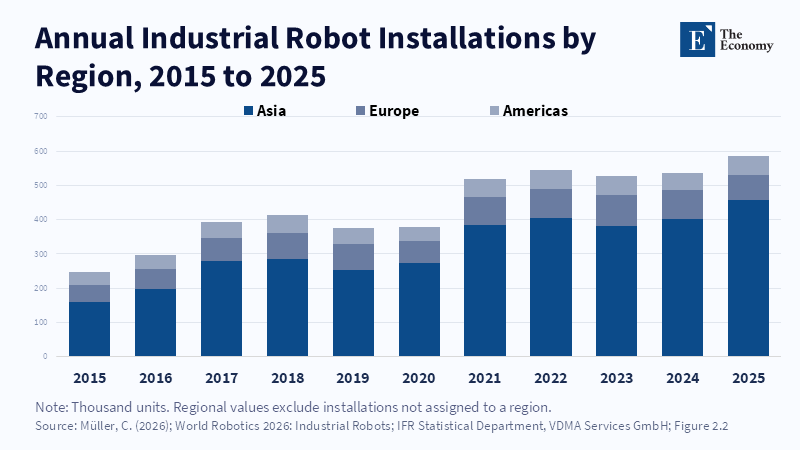
The robot on the production line, however, needed a structured environment, with predictable objects in predictable locations and that is why the limit of automation was identified for decades as physical routine. It was precisely this assumption that moved within three years and with it the map of exposure. The tools of this move were language models that read contracts, summarize meetings and respond to customers in dozens of languages, without the need for a specially designed space or guardrail around them.
Routine Office Work Is Now Exposed Too
The International Monetary Fund estimated in January 2024 that nearly 40 percent of global employment is exposed to AI, with the rate rising to about 60 percent in advanced economies, standing at 40 percent in emerging economies and falling to 26 percent in low-income countries. An analysis by researchers from OpenAI, OpenResearch and the University of Pennsylvania, published in Science in 2024, concluded that about 80 percent of the American workforce could see at least 10 percent of their tasks affected by large language models, while for about 19 percent that share reaches at least half.
Customer service set the most publicized example. In February 2024, Swedish fintech Klarna announced that its digital assistant handled 2.3 million conversations in its first month of operation, i.e. two-thirds of service conversations, doing work equivalent to that of 700 full-time employees. Fifteen months later, in May 2025, the company’s management told Bloomberg that the emphasis on costs had led to lower-quality service and that Klarna was restarting hiring human representatives. The assistant continued to answer the simple questions, while people returned to the cases where a customer needed someone to take responsibility for a decision.
The most careful measurement for the same industry comes from a study by Stanford and MIT researchers, published in the Quarterly Journal of Economics in 2025, which tracked 5,172 service reps at a major U.S. software company as they gradually gained access to a generative AI assistant. Productivity, measured in cases resolved per hour, increased by an average of 15 percent. The tool conveyed to newcomers the practices of their best colleagues and shortened a learning curve that once required much more time, which sounds like good news for new employees until the moment a company wonders how many of them it really needs to hire, when a new hire with AI is now performing almost as well as an older colleague working without it.
Professionals Are Now Inside the Automation Boundary
For years, doctors, lawyers, software engineers and consultants were considered protected by the very level of their education, an assumption that has ceased to be true. According to Stanford’s 2025 AI Index, the performance of AI systems on the SWE-bench, one of the key evaluation criteria for solving real-world software problems, rose from 4.4 percent in 2023 to 71.7 percent in 2024. The biggest drops for new employees are found in professions that rely on codified knowledge, i.e. knowledge taught in classrooms and recorded in textbooks, such as software development and customer service. In professions where tacit knowledge, which is acquired through practice and guidance, counts, experienced workers, on the contrary, record a faster increase in employment.
An experiment with 758 Boston Consulting Group consultants showed how irregular this line is. In tasks within the capabilities of GPT-4, consultants who used the tool completed an average of 12.2 percent more tasks, 25.1 percent faster and with quality rated over 40 percent higher. In a task designed to be outside of these capabilities, AI users were 19 percentage points less likely to give a correct answer than those who worked without it. The researchers described the phenomenon as a “jagged technological frontier,” where tasks of seemingly similar difficulty lie on opposite sides of it, within the same profession and often within the same workday.
The most serious objection to this reasoning is that the overall picture remains positive. The World Economic Forum, in its Future of Jobs 2025 report, predicts that by 2030 170 million jobs will be created and 92 million will be displaced, with a net gain of 78 million jobs, while the Stanford team itself finds no evidence of generalized displacement at the level of the economy. The divergence for young people, however, remains when technology companies and IT professions are removed, when each occupation’s exposure to interest rates and the possibility of teleworking is checked and has continued to widen for more than three years, long after interest rates peaked. A global net sum, however, does not answer whether the economics graduate who is looking for his first position as an analyst will find it, nor who will train the next experienced analyst if the first one is never hired.
What Counts in the AI Job Market When Code Isn’t Enough
The “learn to code” advice made sense as long as code was behind the boundary of automation. Today, software development is among the professions most exposed in ADP’s data, which moves where technical knowledge pays off without erasing its value. For each employee, therefore, what matters is which parts of their own bundle require judgment: defining a problem before solving it, coordinating people with conflicting interests, creativity and knowledge of a field deep enough to understand when an AI response is wrong while it sounds right.
The last point is directly linked to the Boston Consulting Group’s experiment, where the loss of 19 percentage points came from people who trusted the tool with a task it could not handle. The ability to use AI productively therefore includes the ability to question it. A company that cuts graduate hiring because a model writes the first versions of reports saves costs this year, but erodes the pool from which experienced workers will emerge that ADP’s own data show as the most resilient, since their tacit knowledge was acquired precisely through the routine tasks that are now assigned to machines and that no management seems to have planned how they will be replaced as a means of apprenticeship.
Retraining programs need a corresponding overhaul. A short programming course made sense when the obstacle was access to technical knowledge, whereas today the obstacle lies in experience in evaluating output, practice on real problems in an industry and the habit of checking an outcome before it reaches a client, patient, or court. Retraining, in this sense, is closer to apprenticeship than to certification and requires a change of mindset that no degree ensures on its own: the recognition that the skills that got someone this far are not necessarily the ones that will take them further. Inertia, in a market that is changing at this speed, has ceased to be a neutral option. The advantage seems to pass to those who started using the tools early, made mistakes with them and learned where their reliability stops, a path that has distinct stages.
From User to Creator in the Digital Age
The digital age is like an ocean with many depths and the worker’s relationship with it changes as he moves towards the open. In the first stage, he is a digital citizen, a consumer of technology who stands on the shore and watches the waters. He uses the applications as they are handed over to him, enjoys the comfort offered by familiar platforms and, like the first explorers of an unknown land, knows the landscape without changing it yet, although at some point he begins to wonder what is hidden beneath the surface. In the second stage, he becomes a collaborator. He works with other people through common platforms and now with AI itself and the digital world ceases to be a field of solitary exploration to become a space of shared work, where the value of tools is measured more by how much they uplift an entire team than by how much they facilitate a person.
Collaboration, however, is a first step towards something bigger. Over time, the worker sees the gaps and problems that require a solution and then the innovator wakes up, who stops using the technology as it is given and begins to adjust, combine and optimize it for specific problems, in order to direct it instead of being directed by it. The passenger of the digital road becomes someone who builds it. The fourth stage belongs to the creator, who sees where his field is moving, is not satisfied with the current situation and plans what the tools have to do before they exist. The digital traces in the sand, as the course continues, become maps for those who follow, since an explorer is ultimately also a cartographer and the route depends less on the starting point and more on the direction.
The findings of the past three years correspond to these stages with an accuracy that few would have predicted. The new service representatives of the Quarterly Journal of Economics study gained a lot as consumers of a tool and that’s precisely why their position became more easily replaceable. Boston Consulting Group consultants who knew when to ignore GPT-4 were already acting as collaborators. Klarna, when it needed to redesign its service around automatic replies and people on remote shifts, again looked for people for the conversations that the assistant couldn’t handle with the quality the company wanted and someone had to define which conversation goes where. The representative who loses his position because an assistant answers the simple questions is not doomed to stay in the first stage and the distance to the next is covered by continuous learning much more than by defending a fixed job description.
The 19 percent divergence with which this analysis began has a quality that is often lost in the public debate. It concerns hiring, not layoffs and concerns young rather than experienced workers in the exact same professions, meaning that the market continues to pay for the judgment that has been built over the years, while limiting the positions through which it was built. Whether employers will find ways to turn these young people into collaborators and innovators, the data has not yet shown.
The path of experienced workers in the same data, however, shows where the way out lies for those who cannot wait for the answer. Their value comes from tacit knowledge, from judgment gained through years of contact with real problems and this knowledge does not need the permission of any employer to start building. Automation will continue to move the limit and every job description written today will need to be rewritten within a few years. The most stable job in this market is the one that the worker himself builds through continuous learning and adaptability, moving from use to collaboration, from collaboration to innovation and, for those who get there, to creation.
The views expressed in this article are those of the author(s) and do not necessarily reflect the official position of The Economy or its affiliates.
References
Acemoglu, Daron and Restrepo, Pascual (2020) ‘Robots and jobs: evidence from US labor markets’, Journal of Political Economy, 128(6), pp. 2188-2244.
Autor, David and Thompson, Neil (2025) ‘Expertise’, Journal of the European Economic Association, 23, pp. 1203-1271.
Autor, David H., Levy, Frank and Murnane, Richard J. (2003) ‘The skill content of recent technological change: an empirical exploration’, Quarterly Journal of Economics, 118(4), pp. 1279-1333.
Bessen, James (2015) Learning by Doing: The Real Connection between Innovation, Wages, and Wealth. New Haven, CT: Yale University Press.
Brynjolfsson, Erik, Chandar, Bharat and Chen, Ruyu (2026) Canaries in the Coal Mine? Six Facts about the Recent Employment Effects of Artificial Intelligence. Working paper, August 2026. Stanford, CA: Stanford Digital Economy Lab.
Brynjolfsson, Erik, Li, Danielle and Raymond, Lindsey (2025) ‘Generative AI at work’, Quarterly Journal of Economics, 140(2), pp. 889-942.
Cazzaniga, Mauro, Jaumotte, Florence, Li, Longji, Melina, Giovanni, Panton, Augustus J., Pizzinelli, Carlo, Rockall, Emma J. and Tavares, Marina M. (2024) Gen-AI: Artificial Intelligence and the Future of Work. IMF Staff Discussion Note SDN/2024/001. Washington, DC: International Monetary Fund.
Dell’Acqua, Fabrizio, McFowland III, Edward, Mollick, Ethan R., Lifshitz-Assaf, Hila, Kellogg, Katherine C., Rajendran, Saran, Krayer, Lisa, Candelon, François and Lakhani, Karim R. (2026) ‘Navigating the jagged technological frontier’, Organization Science, 37(2), pp. 403-423.
Eloundou, Tyna, Manning, Sam, Mishkin, Pamela and Rock, Daniel (2024) ‘GPTs are GPTs: labor market impact potential of LLMs’, Science, 384(6702), pp. 1306-1308.
International Federation of Robotics (2025) World Robotics 2025: Industrial Robots. Frankfurt: International Federation of Robotics.
Klarna (2024) Klarna AI assistant handles two-thirds of customer service chats in its first month. Press release, 27 February. Stockholm: Klarna.
Maslej, Nestor, Fattorini, Loredana, Perrault, Raymond, Gil, Yolanda, Parli, Vanessa et al. (2025) Artificial Intelligence Index Report 2025. Stanford, CA: Stanford Institute for Human-Centered Artificial Intelligence.
Shibu, Sherin (2025) ‘Klarna is hiring customer service agents after AI couldn’t cut it on calls, according to the company’s CEO’, Entrepreneur, 9 May.
World Economic Forum (2025) The Future of Jobs Report 2025. Geneva: World Economic Forum.
Deeply committed to shaping sustainable talent pipelines, Howie has trained and mentored hundreds of professionals in AI, Product Management, UI/UX, and emerging technologies. As a certified HRD Corp trainer, he has delivered high-impact learning experiences for clients such as Dell, Clarivate, Micron, and Keysight. He has also lectured at Republic Polytechnic and Singapore Polytechnic, bringing practical relevance into the classroom.
Before returning to Penang to make a homegrown impact, Howie spent over a decade immersed in Southeast Asia’s startup and innovation ecosystems. His career reflects a rare blend of product thinking, user experience, and entrepreneurial grit, fuelling his drive to help others adapt, learn, and evolve.
In recognition of his contributions to the tech and innovation ecosystem, Howie was awarded the Pingat Jasa Kebaktian (PJK) by the Penang State Government.
Similar Post