AI Productivity Gains Will Thin Jobs Before They Erase Them

Working across research, policy, and data-driven analysis, the Editorial Board ensures that published pieces reflect a consistent institutional perspective grounded in quantitative reasoning and long-term structural assessment.
Authored On
Modified
AI productivity gains remain limited and uneven
Entry-level hiring may weaken before mass layoffs appear
Policy must protect workers as tasks are redistributed

The most informative figure in the AI employment debate is not 50% or 80% or any other prediction about what share of jobs will fall to automation. It is 0.6%. This was the estimated effect that AI would have on labor productivity growth in the surveyed U.S. companies in 2025. This is a positive number, but it is not an economic catastrophe. And it is equal to a predicted loss of less than 0.4% of jobs in 2026 from AI. Numbers like these do not imply that AI is without harm. They do imply that the first round of disruption will be minor, gradual and targeted relative to speculative headlines. AI gains in productivity are emerging as improvements within discrete tasks before they reach entire businesses. Employers may avoid announcing an AI layoff while they eliminate a reporting step, cut a support queue, or stop replacing a departing junior worker. In the short term, the danger is not mass unemployment. It is a continuous reduction in work, entry points and routine procedures that are used to help workers get started.
AI Productivity Gains Remain Narrow
America's economic data does not show obvious signs of an AI-driven productivity boom. In 2025, nonfarm business productivity increased by 2.1%. That was decent but not extraordinary. The growth then fell to an annualized rate of 0.3% in the first quarter of 2026 in spite of output per hour standing 2.8% higher than a year earlier. Such data is erratic and will be revised. Moreover, it captures every efficiency improvement, from the adoption of new technology to advances in logistics. No specific proportion of these increases can be attributed to generative AI. The main takeaway is more straightforward. Though investment in AI has become obvious, the all-in impact still looks like a typical productivity slowdown rather than an abnormal departure from the norm. The advantages might increase with time. But America's macro numbers thus far do not lend credence to the contention that firms can axe thousands of jobs yet maintain output and quality.
Census surveys account for some of the difference. Over half of the 2026 survey respondents said that their firms already made investments in AI, but in fact, the bulk of the expenditure was directed towards subscriptions, services and learning and development. Just 15% or so of the short-term boost in productivity was predicted to come from capital deepening. This is not the same as rebuilding a factory or getting a new operating system; it is usually renting a tool within an old process. A broader Census measure reported that between December 2025 and May 2026, between 17 and 20% of U.S. businesses had adopted AI, though the question spoke about its use for any work activity for tasks, such as drafting or analysis; adoption rates in information, publishing and finance were many times higher than in retail. This is an important difference: owning a tool together with a small number of other firms to perform a handful of specialized functions will just not produce the kind of economy-wide gains in AI productivity expected in the grandest predictions.
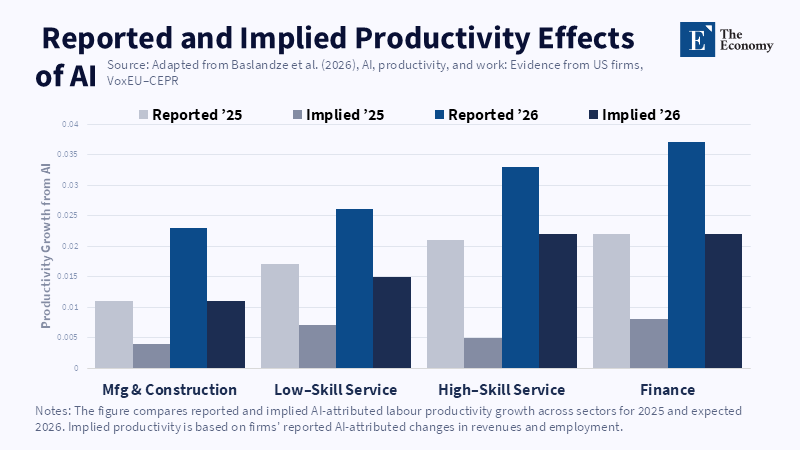
The best results occur in environments where the task, output and quality test are narrowly defined. A controlled experiment of professional writers found that ChatGPT reduced the time it took to complete the task by 40% and raised the evaluated quality of what was written (18%). An experiment with a large customer support business found that an AI assistant improved issues completed per hour by about 15% with the biggest improvements being observed among lower-skilled workers. Consultants using GPT-4 improved task completion (12.2%), worked 25.1% faster and improved their quality score for answers when the task was within the model's capabilities, on average, although these same persons were 19% less likely to produce the correct result on a task outside the model's capabilities AI productivity gains are therefore concrete but context-dependent. They're strongest when tasks are repeated, goals are constant and failures are easy to recognize. This is an idealized task profile, not a full picture of most tasks.
The First Labor Shock Is a Missing Hire
The absence of mass layoffs should not be mistaken for a lack of displacement. Employers can just drop a significant number of workers without it marking the end of a big chunk of jobs. They can leave vacancies unfilled, merge two entry-level roles, cancel one-off freelance jobs, or engineer a two-to-one increase in workload per employee. These measures are more discreet than shutting down the factory. They are more difficult to capture with monthly jobs data. CEO surveys already anticipate that by 2028, the portion of mundane clerical tasks will decline by over two percentage points, while that of sophisticated technical tasks will slightly grow. That is a form of reallocating jobs, but it does not occur without pain. A clerk cannot turn into a data specialist overnight merely because a line chart adds a technical term and erases three generic ones. The transition requires substantial investments of time, capital and trustworthy pathways into the new occupation. In their absence, smaller AI gains in productivity could impose substantial costs on a narrow group.
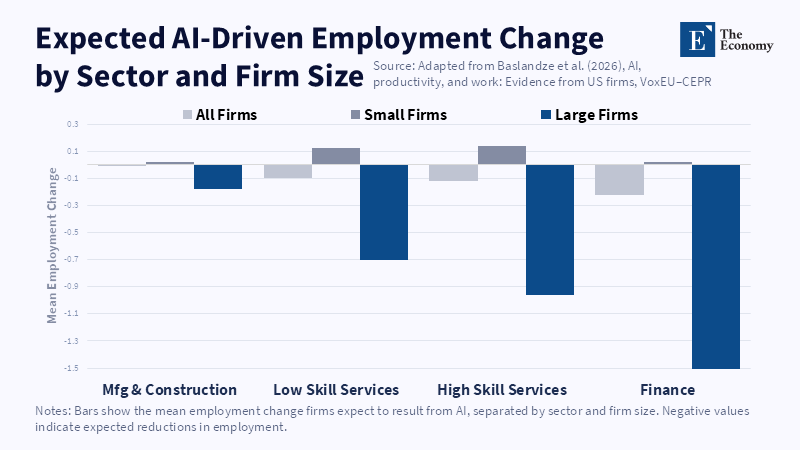
Early US payroll data hint at where that strain could first be felt. Relative employment in the age band 22-25 working in the most AI-saturated occupations fell 16% relative to the pre-generative-AI baseline following the advent of generative AI, even controlling for firm-level shocks. Older workers in those fields experienced no such loss. The effect was also magnified where AI use was more likely to automate jobs rather than augment them. While that does not exactly provide–or even suggest that–every job was lost, interest rates, the emptying out of new pandemic jobs and the virtually stagnant job market for technology-driven hiring are also relevant factors. Nonetheless, the age differentiation is hard to ignore. Those newly hired have a tendency toward a range of entry-level tasks–drafting and basic coding, reviewing documents, cleaning data sets, front-line support. These look like tasks that current models excel at performing. The job may still exist, but not the first step.
Freelance markets also have this pattern because, on average, prices and composition change faster than within large firms. A study of online labor markets revealed that there was less employment and earnings for jobs that are most prone to image and text generation. Demand is most obviously reduced by jobs that can be replaced with a low-cost first draft or a generated asset. More sophisticated requirements do remain, but the market is more competitive and what remains may involve further skill sets. This is an anticipation of job thinning. AI need not achieve an occupation at the level of an average worker, only remove enough billable portions to make the older role unprofitable. A translator who is losing simple product descriptions, or a designer who is losing a low-cost conceptual job, may still be operational at high-stakes work, but the job's income path may not be predictable or open to effective future entrants.
Human Judgment Still Limits AI Productivity Gains
Claims of fast automation often presume human checking as a transient flaw to be moved beyond with more advanced models. Checking is native to many workflows. A legal memo has to conform to given facts and jurisdiction. Code has to run within an existing and undocumented ecosystem. A financial report has to pass an audit. A customer response has to stop short of making any promise the company cannot honor. Knowledge is embedded in these tasks and must be converted into the result, both explicitly and unconsciously. They also have various consequences if the result is wrong. That is why even a benchmark can show strong performance while producing inefficiency in practice. In a study with random sampling of 16 experienced open-source coders in 2025, deploying these tools caused a 19% slowdown, rather than a speedup of over 20%. The result is only 246 tasks completed, so it shouldn't be interpreted as applying to all coding, but it illustrates how review, correction and implicit project knowledge can reverse the apparent trend.
Broader labor research corroborates this caveat. Another study assessing the effect on earnings and recorded working hours of inserting large surveys of workers into administrative records in Denmark found no effects two years after the introduction of chatbots and could exclude any effects larger than 2%. Workers changed tasks and in some cases, changed occupations, but the net labor effect was small. This does not imply AI has no utility. It implies that saved minutes do not automatically translate into increased output; time can show up in checking, in additional requests, in coordination, or in diminishing returns. Human productivity is finite; there is a lag for employees to adjust to using these tools, to determine when not to use them,and to recover from the mental load of constant supervision.
Policy Must Govern Reallocation Before Mass Unemployment
The first policy mistake would be to wait for a national unemployment spike. By then, the damaging shifts in specific career pathways may have long since occurred. Labor markets would do well to monitor vacancy trends, entry-level hiring, task content, contractor spending and hours worked by occupation. Aggregate headcount is too coarse. A firm with 1,000 workers could report no AI layoffs while reducing graduate recruitment, discontinuing 50 freelance workers and not replacing 30 exiting employees. Better metrics would also distinguish automation from augmentation. The very same new customer-service platform may eliminate routine customer inquiries without a worker, assist a new agent with difficult cases,and generate new demand in a cost-saving cycle by shortening wait times. Policy needs to account for all three impacts. Otherwise, group averages for productivity gains driven by AI may hide heavily concentrated workload losses and garner support created with the knowledge that workers have already exited the field.
The second mistake would be defending all the old tasks. Routine work is not valued just because someone does it. Instead, the focus should be on protecting earning power and pathways into better work, not the old steps. Firms benefiting from AI should publicly release impact assessments at the task level for make-or-break new deployments. These should detail what old jobs will be phased out, what new opportunities will be created, how quality will be measured and the fate of workers’ time that was previously spent on those now-eliminated tasks. Funding for retraining should be explicitly connected to incumbent openings and paid positions, not generic training courses. Wage insurance, portable benefits and stronger transition assistance could matter more than overarching commitments to resilience for everybody. Smaller companies will need support in the safe, creative implementation. They could benefit from AI, but might not have the managers, data infrastructure and legal expertise required to transform jobs safely.
The final one might be complacency. Short-term AI productivity improvements don’t cap the long term. Models are improving, prices are tumbling and companies are mastering the joining up of tools into longer workflows. The right response isn’t to write off automation but to guide its true course. And for the coming few years, labor markets are more likely to shed slivers of existing jobs than entire fields of work at once. That process might seem gentle when averaged out in the country, but it can be brutal to a new intern programmer, a freelance writer, or an admin worker who never sees the next gig. The initial figure of 0.6% should therefore be taken as a warning and not as an assurance. Small average gains can sustain huge local replacements. Public policy needs to catch those replacements early, safeguard access points and ensure firms pay their share for work that’s no longer necessary. The shape of work will begin to change long before the unemployment figures show it.
The views expressed in this article are those of the author(s) and do not necessarily reflect the official position of The Economy or its affiliates.
References
Baslandze, S., Edwards, Z., Graham, J., McClure, T., Sparks, M., Meyer, B., Ravindranath Waddell, S. and Weitz, D. (2026a) ‘AI, productivity, and work: Evidence from US firms’, VoxEU, 27 June.
Baslandze, S., Edwards, Z., Graham, J.R., McClure, T., Sparks, M., Meyer, B., Ravindranath Waddell, S. and Weitz, D. (2026b) ‘Artificial intelligence, productivity, and the workforce: Evidence from corporate executives’, Journal of Finance: Insights and Perspectives, forthcoming; CEPR Discussion Paper No. 21313.
Becker, J., Rush, N., Barnes, E. and Rein, D. (2025) Measuring the Impact of Early-2025 AI on Experienced Open-Source Developer Productivity. METR Research Paper.
Brynjolfsson, E., Chandar, B. and Chen, R. (2025) Canaries in the Coal Mine? Six Facts about the Recent Employment Effects of Artificial Intelligence. Stanford, CA: Stanford Digital Economy Lab.
Brynjolfsson, E., Li, D. and Raymond, L.R. (2025) ‘Generative AI at work’, The Quarterly Journal of Economics, 140(2), pp. 889–942.
Dell’Acqua, F., McFowland, E. III, Mollick, E.R., Lifshitz-Assaf, H., Kellogg, K.C., Rajendran, S., Krayer, L., Candelon, F. and Lakhani, K.R. (2023) Navigating the Jagged Technological Frontier: Field Experimental Evidence of the Effects of AI on Knowledge Worker Productivity and Quality. Harvard Business School Working Paper No. 24-013.
Hui, X., Reshef, O. and Zhou, L. (2024) ‘The short-term effects of generative artificial intelligence on employment: Evidence from an online labor market’, Organization Science, 35(6), pp. 1977–1989.
Humlum, A. and Vestergaard, E. (2025) Large Language Models, Small Labor Market Effects. NBER Working Paper No. 33777. Cambridge, MA: National Bureau of Economic Research.
Meninger, K. (2026) ‘We’re measuring AI productivity but missing the human capacity problem’, Forbes, 22 June.
Noy, S. and Zhang, W. (2023) ‘Experimental evidence on the productivity effects of generative artificial intelligence’, Science, 381(6654), pp. 187–192.
U.S. Bureau of Labor Statistics (2026) Productivity and Costs: First Quarter 2026, Revised. Washington, DC: U.S. Department of Labor.
U.S. Census Bureau (2026) Business Trends and Outlook Survey. Washington, DC: U.S. Department of Commerce.
Working across research, policy, and data-driven analysis, the Editorial Board ensures that published pieces reflect a consistent institutional perspective grounded in quantitative reasoning and long-term structural assessment.