The Training Gap Behind the Rise of SuperHuman Labor

Working across research, policy, and data-driven analysis, the Editorial Board ensures that published pieces reflect a consistent institutional perspective grounded in quantitative reasoning and long-term structural assessment.
Authored On
Modified
AI use is spreading faster than workplace training
Structured learning will determine who captures the productivity gains
Without coordination, AI may widen gaps between workers and firms

Just 15.9 percent of employed Americans, according to a survey by the New York Fed in November 2025, said their employer provided artificial intelligence training. However, 39 percent had used AI at work in the past year. That difference illustrates the emerging market in lifelong AI learning. New tools are diffusing around workplaces more quickly than companies, governments and educators are developing dependable ways to teach them. Workers who have expertise in their areas of work, confidence in their judgment and skills in AI will be able to do more tasks. Those studying alone will face greater risks of error, displacement and lower wages. Firms with suitable training systems will be able to do more with less. Others could buy the same software but not gain as much. Lifelong learning will clearly be necessary for all. The question in economics is who will pay, set up and validate it before the benefits accrue to a few.
AI Lifelong Learning Is Labor-Market Infrastructure
Lifelong learning is often understood as an education policy with labor-market benefits. In the AI economy, the relationship is reversing. It is becoming labor-market infrastructure delivered partly through education. Generative tools reduce the hours spent on drafting, searching, coding, analyzing and communicating. One still needs to frame a problem, judge an answer and understand how a decision will be used. These supporting skills determine whether AI saves time or produces confident mistakes. Employers increasingly favor workers whose digital skills are continuously updated. This changes the return on training. A single skill earned early on cannot sustain the years of discrete updates in software, workflow and task design. Companies need shorter learning cycles that follow changes in work. Workers need the skills that will transfer between employers. Governments need systems that will make such skills visible and credible. AI workplace learning is no longer an optional course offering. It is a shared capability, like transportation or digital connectivity, whose weakness can hold back national productivity.
The current supply system does not match that need. Universities have embedded AI into a range of degree programs and digital channels offer virtually unlimited self-directed content. Both serve useful purposes. Neither precisely serves an employee who needs to learn one tool, for one workflow, next month. Degree programs are long, expensive and founded on comprehensive bodies of knowledge. Open programs shift responsibility for choosing, sequencing and checking content to the learner. That design only suits those with plenty of existing literacy, confidence, time and insight into the needs of their workplace. A 2026 report on digital lifelong learning revealed that three-quarters of respondents said ease of use drove engagement. Older workers also showed a higher preference for structured courses. The sample was small, but the emerging market insight was clear. Easy access to content does not mean access to an effective learning pathway. The next skills divide will be defined less by age than by baseline expertise, ease of learning, job quality and workplace sponsorship. Without mentoring, allocated time and official certification, digital abundance risks reproducing the inequities it purports to resolve.
The Unequal Market for AI Lifelong Learning
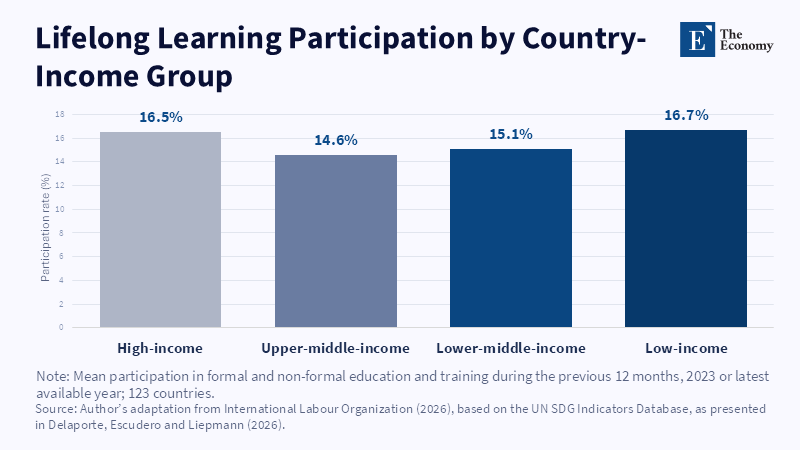
The strongest case seems to be for a double divide: one in access to AI and one in support to adapt to it. In the New York Fed survey, 58.7 percent of college graduates had used AI at work, compared with only 22.9 percent of those without a degree. Usage was 66.3 percent among workers making over $200,000 versus 15.9 percent for those on less than $50,000. Two-thirds of workplace users said AI increased their productivity, yet few had received training from their employer. The global lifelong-learning market might be even shallower. The International Labour Organization estimates that only about 16 percent of workers enrolled in organized learning during the previous year. Among formal manufacturing companies, 51 percent of permanent employees were given employer-sponsored training; informal workers were far more likely to learn by doing. These gaps matter because training is more than an entry point to technology. It is what determines who can reliably operate technology so as to be entrusted with higher-value tasks, more discretion and higher pay. The familiar gap between digitally confident younger and older workers could become a sharper divide within every generation.
Pre-existing skill inequalities continue to make that divide difficult to cross. According to an adult skills survey completed by the OECD in 2023, almost a fifth of adults tested were at low levels in literacy, numeracy and adaptive problem-solving; scores were most concentrated in the lowest end of the distribution. A one standard deviation increase in numeracy was associated with a roughly 9 percent increase in wages even accounting for formal education received. As is the case in many fields, AI is likely to exacerbate that premium because it rewards people who can frame questions, test outputs and link insights across disciplines. However, workplace experiments suggest AI can also narrow skill-based performance discrepancies when job design supports it. In one study of 5,172 customer service agents, a generative AI assistant increased productivity by 15 percent on average and the benefits disproportionately accrued to the least experienced, lowest-skilled personnel. The difference is institutional. A curated assistant trained on effective workplace practices can disseminate expertise. Giving a worker an unguided tool may instead simply reward the best-positioned to self-train. Unequal access to a chatbot does not mean equal access to its economic impact.
How the Training Gap Changes Business Decisions
Once AI skills become a complement to labor, weak training systems also begin to influence how firms hire, invest and organize. Firms need incentives to hire workers who can apply AI across multiple functions. An adaptable worker will be able to take on research, analysis, drafting and coordination work previously divided among different individuals. This emerging category can be described as SuperHuman Labor. It refers to people whose breadth of expertise and competency with AI allows them to produce outside their normal scope of one job. The term describes a true market response, but it also poses a risk to how the gains are distributed. Employers could bid up wages for a constrained pool of such talent while reducing entry-level hiring or compressing bottom-tier work. Leading firms could then spread fixed technology costs across greater output, facilitating higher returns and growth. Smaller companies, contractors and casual employers could find it harder to provide similar levels of training and absorb the risk of trained workers leaving. Shareholders will prefer firms that turn AI-enabled learning into repeatable processes to those that simply increase software spending. AI lifelong learning will thus influence competition between firms as much as mobility between workers. Organizational learning can become an asset that competitors cannot easily replicate.
The market will not self-correct the gap because each player has incentives to underinvest. Employers do not want to fund portable skills if trained workers can leave. Workers cannot reliably choose a course that will raise earnings. Low-paid workers suffer most from the financial setback of unpaid study time. Universities and commercial providers cater to paying demand. That supports broad programs and visible credentials rather than short courses aligned to shifting tasks. Governments still regard adult learning as a residual budget item; the ILO reports that 46 percent of countries spend less than 1 percent of education budgets on it. The result is a coordination failure. Firms wait for a sufficiently skilled applicant pool, workers wait for sufficiently credible signals of demand and providers sell what is easiest to put together. Meanwhile, organizations optimize around those who re-train fastest. The World Economic Forum forecasts that 59 out of 100 workers will require training by 2030, but 11 are unlikely to receive it. That missing group is the source of labor shortages, displacement costs and resistance to AI adoption. It is also where public co-investment and shared training in the sector can deliver benefits no individual business can maintain.
The Case for Training Before Displacement
The most serious challenge is that AI itself can serve as a tutor and make formal training less relevant. The evidence from the customer-service studies supports some of this. A good assistant can make sure that good ways of doing things are passed on immediately on the job. However, the reliability of AI varies by task. In a study of 758 consultants, AI users completed 12.2 percent more suitable tasks and worked 25.1 percent faster. On a task outside the AI's effective frontier, however, users were 19 percent less likely to produce the correct answer. Workers do not need more one-to-one teaching before they start using the system. They need to understand which tasks to use it for, how to audit its output and when to seek help. Policy should reinforce that with paid learning time, recognized short credentials and sector programs that small firms can share. Public funding should support training with certified workplace results. Training rights should extend not just to permanent employees but also to contractors, agency workers and people in transition. Managers need evidence showing which activities improve, where errors rise and who benefits from the changes. Training budgets should be driven by evidence, not assumptions.
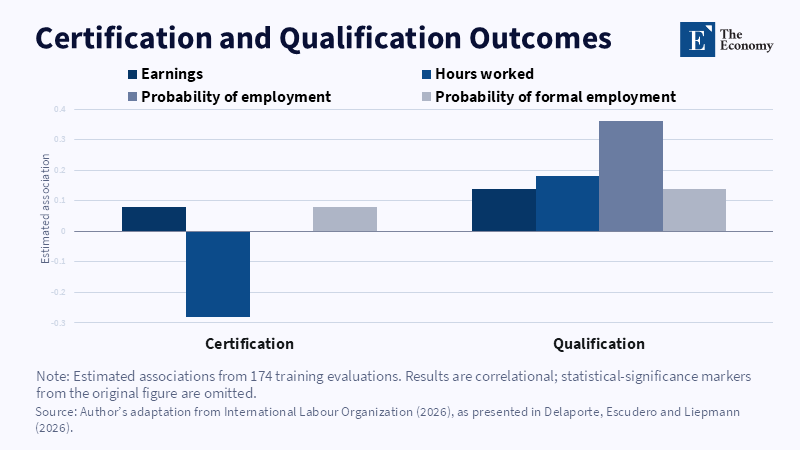
The urgent priority is to mainstream AI lifelong learning into the fabric of good work before benefits become concentrated on a narrow band of firms and workers. The focus must shift from course volumes to usable capacity. Training should be specified against concrete outputs, accompanied by guidance, tested against standards and made portable across jobs. Firms must regard learning time as productive investment, not a fringe benefit. Governments need to link co-investment to provision for lower-paid and atypical workers where private incentives are at their weakest. Education providers need to break skills into practical modules without reducing them to shallow tool demonstrations. The opening gap is the warning. AI is already used by 39 percent of employed respondents, but only 15.9 percent report employer training; diffusion is outrunning adaptation. Left unaddressed, the gap will favor the highly educated and self-directed. Closed through credible institutions, it can make AI a source of broader productivity rather than deeper inequality.
The views expressed in this article are those of the author(s) and do not necessarily reflect the official position of The Economy or its affiliates.
References
Brynjolfsson, E., Li, D. and Raymond, L. (2025) ‘Generative AI at work’, The Quarterly Journal of Economics, 140(2), pp. 889–942.
Delaporte, I., Escudero, V. and Liepmann, H. (2026) ‘Lifelong learning is becoming increasingly important in response to labour market transformations’, VoxEU, Centre for Economic Policy Research, 22 July.
Dell’Acqua, F., McFowland III, E., Mollick, E., Lifshitz, H., Kellogg, K.C., Rajendran, S., Krayer, L., Candelon, F. and Lakhani, K.R. (2026) ‘Navigating the jagged technological frontier: Field experimental evidence of the effects of artificial intelligence on knowledge worker productivity and quality’, Organization Science, 37(2), pp. 403–423.
Hashim, A., Kosar, G. and van der Klaauw, W. (2026) ‘Use of Gen AI in the workplace and the value of access to training’, Liberty Street Economics, Federal Reserve Bank of New York, 14 April.
International Labour Organization (2026) Lifelong Learning and Skills for the Future. World of Work Series. Geneva: International Labour Office.
OECD (2024) Do Adults Have the Skills They Need to Thrive in a Changing World? Survey of Adult Skills 2023. OECD Skills Studies. Paris: OECD Publishing.
Puri, G., Socklingam, N. and Herremans, D. (2026) ‘Digital lifelong learning in the age of AI: Trends and insights’, arXiv preprint, arXiv:2602.03114v1.
Ramana, K.V. (2026) ‘AI and lifelong learning: How adults are reskilling through intelligent education platforms’, AI Explore Tools, 26 January, updated 6 February.
The Economy Research Editorial (2026) ‘Beyond the prompt: Domain knowledge, AI competence, and the rise of Super-Human Labor’, The Economy Research, 7 April.
UNESCO (2025) AI and Education: Protecting the Rights of Learners. Paris: UNESCO.
World Economic Forum (2025) The Future of Jobs Report 2025. Geneva: World Economic Forum.
Working across research, policy, and data-driven analysis, the Editorial Board ensures that published pieces reflect a consistent institutional perspective grounded in quantitative reasoning and long-term structural assessment.