Why Fiscal Deficits, AI and Fed Policy Fail to Explain the Rise in the Natural Rate of Interest

Working across research, policy, and data-driven analysis, the Editorial Board ensures that published pieces reflect a consistent institutional perspective grounded in quantitative reasoning and long-term structural assessment.
Authored On
Modified
Study tests three explanations for r*'s post-2020 rise
Fiscal news, AI news, Fed meetings all fail to explain it
AI news lowers r*; the increase remains unexplained

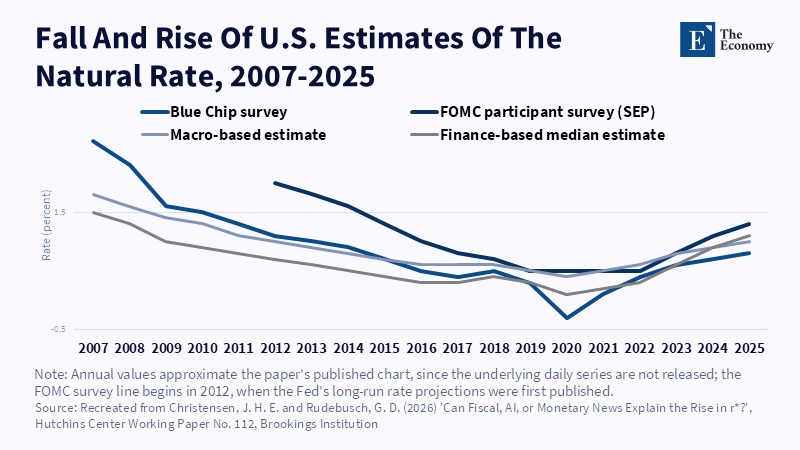
The United States' natural real interest rate, known in the literature as r, has been on a downward trend since the 1980s. In the 1980s and 1990s, this decline mainly reflected a decline in inflation expectations as the Federal Reserve's credibility gradually consolidated. In the 2000s and 2010s, however, the continuation of the decline was driven by deeper structural factors, such as lower productivity, an ageing population, cheaper capital goods and strong precautionary savings from emerging economies. Since 2020, however, this long trend seems to have reversed. Almost all available estimates of r record a rise of about one percentage point from the lows of 2020 to the end of 2025, a development that reignited a debate that had seemed closed for decades.
A Benchmark with Real Stakes for Debt and Policy
The issue is not just academic since r* is a critical indicator of debt sustainability for fiscal officials. For the central bank, it is the benchmark that separates an expansionary from a restrictive monetary policy. For investors, it acts as an anchor for the future discount rate. A permanent rise in r* by one percentage point means permanently higher costs of servicing public debt and a change in how markets price each future cash flow.
A recent study by Jens H. E. Christensen, of the Federal Reserve Bank of San Francisco and Glenn D. Rudebusch, of the Brookings Institution, does not propose a new explanation for this rise. Instead, it systematically tests the three explanations that have dominated the public debate: fiscal deterioration, artificial intelligence and monetary policy. Since the sample from 2020 to date is too small to confidently separate the trend from the cycle through conventional macroeconomic models, the authors opted for a high-frequency event analysis in four independent financial models of interest rate structure terms, which derive daily estimates of r* from inflation-hedged US Treasury bond prices.
Deficits Under the Microscope
The first and most widespread explanation links the rise of r* to expectations of a significant widening of fiscal deficits. A Federal Reserve official had warned in 2024 that the country was on an unsustainable fiscal path and that large deficits would exert upward pressure on the natural interest rate. An opposite view had been expressed, arguing that recent fiscal decisions, such as the imposition of tariffs, were actually putting downward pressure on the natural interest rate.
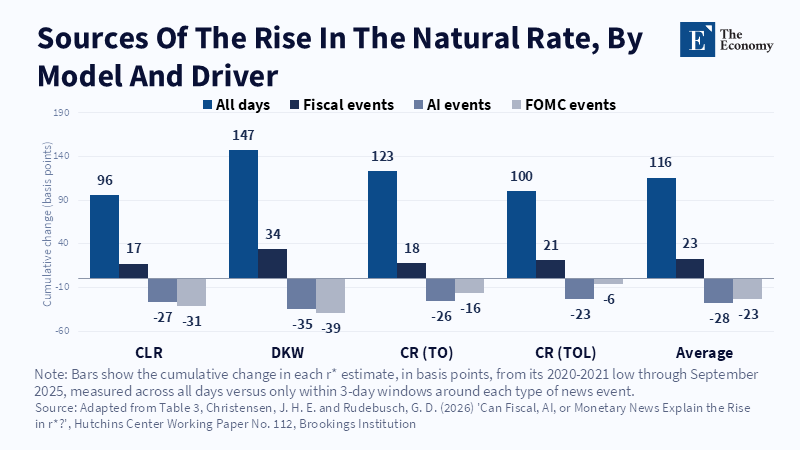
To examine the issue empirically, the authors recorded 52 fiscal events from January 2020 to September 2025. Included in the timeline are official cost estimates of the Congressional Budget Office, milestones of the parliamentary budget process and significant political events, such as the passage of the One Big Beautiful Bill Act in the summer of 2025. The choice of events was deliberately broad, so that the final estimate was likely at the upper, not conservative, end of the actual outcome. Nevertheless, fiscal events contributed an average of just 23 basis points to the total increase of 116 basis points recorded in the four estimates, or about one-fifth of the overall increase, without statistical significance in any of the four cases. Even projected debt as a percentage of GDP, which increased by about 20 percentage points over the same period, seems to have left a limited footprint on the natural interest rate, although it has more noticeably affected the nominal yields of ten-year bonds. This finding is in line with previous literature, which has calculated that a permanent increase in the deficit-to-GDP ratio by one percentage point raises long-term real yields by just one to six basis points.
What AI Model Releases Actually Moved
The second explanation links the rise to a sustainable increase in productivity due to AI, which would increase the demand for capital and reduce households' incentives to save. A contrasting view argues that AI acts as a strong disinflationary force and allows for looser monetary policy without the risk of overheating, which would mean a lower long-term benchmark rate. To empirically test these two conflicting positions, the authors recorded the release dates of 25 large AI models from four labs, starting with the launch of ChatGPT on November 30, 2022, at a time when the public and investors essentially began to assess the economic consequences of generative AI.
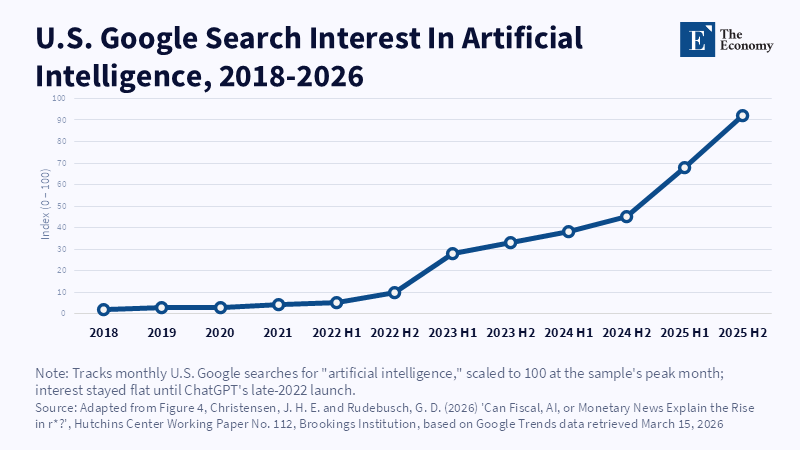
The result ran counter to the upward-pressure hypothesis. Around these events, the four estimates of r* recorded a cumulative decline of 23 to 35 basis points, with statistically significant negative signs in three of the four cases. The declines were relatively evenly distributed over time and did not cluster around one or two individual dates. The exact cause of the decline remains an open question for the authors, who cite both the deflationary mechanism and the hypothesis that uncertainty surrounding a technological change of such magnitude could increase precautionary savings, as well as a third possibility, that AI news may raise expectations of future tax revenues and thus reduce the credit risk premium of U.S. government debt. None of these assumptions are fully confirmed by the broader data available, such as savings rates or inflation expectations surveys.
When The Fed Stopped Setting The Pace
The third explanation concerns a more indirect mechanism: monetary policy's own influence on long-term rates. Earlier research had shown that almost the entire long-term decline in U.S. interest rates from 1989 to 2021 was concentrated in three-day windows around Federal Open Market Committee meetings, a finding interpreted as an indication that the Fed's announcements and forecasts around meetings provide investors with a form of long-term guidance. Following the same logic, the authors examined whether investors were incorporating fiscal and technology news primarily around these meetings. Extending the analysis to 2025 showed that this normality has collapsed in this decade. While before the pandemic changes around meetings explained most of the long-term decline in yields, from 2020 onwards the cumulative changes around Fed meetings explain nothing of the recent rise. In contrast, the windows around Fed meetings have trended mildly downward in r* this decade, with the four estimates falling 6 to 39 basis points from their lows in their respective windows, which deepens the mystery rather than resolving it.
A Rise Still Waiting For An Explanation
All three categories of events, fiscal, technological and monetary, fail to explain the rise of r* over this decade. Fiscal news exerts mild and statistically insignificant upward pressure. AI news is associated with a fall in the natural interest rate. Monetary policy, which has historically concentrated long-term investor readjustments, has ceased to play this role after 2020. The authors acknowledge that this result could partly reflect sample constraints or imperfections in the r* estimates themselves. But taken as it is, the finding suggests that the recent rise in real interest rates remains an enigma, especially given that some long-standing demographic and other structural forces continue to exert downward pressure on real interest rates.
The authors outline several directions for future research, without concluding the source of the rise. A first direction concerns how investors incorporate information into their expectations, given that official announcements may not be the most important stimuli they use, unlike discrete monetary policy announcements. A second direction concerns the shift in perspective towards global, not just domestic, forces, given that r* seems to have risen in this decade in other countries, not just the United States. The authors cite changes in global savings and investment, a possible trend towards de-globalization, the increase in the inflation risk premium following the unexpected wave of inflation that followed the pandemic and the increased investment needs for the transition to a low-carbon economy. None of these assumptions are empirically examined in this study; they are merely listed as directions that would be worth exploring further.
This article is based on an original research article published by The Economy Research. For the original version, please refer to Fiscal Policy, AI and Monetary News Fail to Explain the Rise in the Natural Rate of Interest.
The views expressed in this article are those of the author(s) and do not necessarily reflect the official position of The Economy or its affiliates.
References
Andrews, I. and Farboodi, M. (2026) 'Do Markets Believe in Transformative AI?', Working Paper, Massachusetts Institute of Technology.
Barr, M.S. (2026) 'What Will Artificial Intelligence Mean for the Labor Market and the Economy?', speech at the New York Association for Business Economics.
Christensen, J.H.E. and Rudebusch, G.D. (2026) 'Can Fiscal, AI, or Monetary News Explain the Rise in r*?', Hutchins Center Working Paper No. 112, Brookings Institution.
Gomez-Cram, R., Kung, H. and Lustig, H. (2025) 'Can U.S. Treasury Markets Add and Subtract?', NBER Working Paper No. 33604, National Bureau of Economic Research.
Gust, C. and Skaperdas, A. (2024) 'Government Debt, Limited Foresight, and Longer-Term Interest Rates', FEDS Working Paper No. 2024-27, Board of Governors of the Federal Reserve System.
Hillenbrand, S. (2025) 'The Fed and the Secular Decline in Interest Rates', Review of Financial Studies, 38, pp. 981-1013.
Waller, C.J. (2024) 'Some Thoughts on r*: Why Did It Fall and Will It Rise?', speech at the Reykjavik Economic Conference, Board of Governors of the Federal Reserve System.
Wiegand, C. (2025) 'The Effect of Fiscal Policy Shocks on Asset Prices', Working Paper, Social Science Research Network.
Working across research, policy, and data-driven analysis, the Editorial Board ensures that published pieces reflect a consistent institutional perspective grounded in quantitative reasoning and long-term structural assessment.
Similar Post