“Japan’s Fiscal Expansion Comes Back to Bite” Debt Service to Consume 30% of Budget, Tax-Cut Push Threatens Even Bigger Interest Bill

Anne-Marie Nicholson is a fearless reporter covering international markets and global economic shifts. With a background in international relations, she provides a nuanced perspective on trade policies, foreign investments, and macroeconomic developments. Quick-witted and always on the move, she delivers hard-hitting stories that connect the dots in an ever-changing global economy.
Authored On
Modified
Rising government borrowing costs as fiscal expansion persists and interest rates normalize
High-rate refinancing of debt issued during the low-rate era gathers pace, driving a 17% surge in debt-servicing costs next fiscal year
A self-reinforcing debt spiral takes hold as additional borrowing pushes interest rates even higher

Japan’s government debt-servicing costs, comprising principal repayments and interest expenses, are expected to swell to an all-time high next fiscal year as interest rates rise amid the government’s continued fiscal expansion. The country’s enormous debt stock, accumulated during the era of ultra-low interest rates, has begun to consume an increasingly large share of the government budget as monetary conditions normalize. With the administration of Prime Minister Sanae Takaichi pursuing tax cuts and higher spending, growing government bond supply and rising interest rates are eroding Japan’s fiscal capacity while adding to the Bank of Japan’s monetary-tightening burden. Delaying rate increases would exacerbate the depreciation of the Japanese currency, while selling US Treasuries to defend the exchange rate could push up long-term US interest rates. The United States’ decision to coordinate currency purchases with Japan for the first time in 28 years is widely seen as an effort to prevent such cascading shocks.
Debt-Servicing Costs Set to Consume Nearly 30% of Government Budget
According to the Nikkei on the 24th, Japan’s Ministry of Finance plans to include a record $230 billion in debt-servicing costs in its budget request for fiscal 2027, which runs from April 2027 through March 2028. That would be $33.3 billion more than the previous record set in the initial fiscal 2026 budget. The 17% increase would be the largest in 20 years. Total budget requests from government ministries are also expected to surpass $817 billion for the first time, meaning debt-servicing costs would consume roughly 30% of the total.
The primary reason for the sharp increase in debt-servicing costs is rising interest rates. The assumed interest rate used to calculate government bond interest payments has been raised from 3.0% in the fiscal 2026 budget to 3.8%. The higher assumed rate reflects the recent steep rise in long-term Japanese government bond yields amid concerns over fiscal sustainability stemming from the Takaichi administration’s expansionary fiscal stance, accelerating inflation and expectations of further rate increases by the Bank of Japan. On the 18th, the yield on 10-year Japanese government bonds, a benchmark for long-term interest rates, climbed to 2.945%, its highest level in about 30 years, bringing Japanese long-term rates to the threshold of 3%.
Concerns are mounting in particular over a vicious cycle in which fears of fiscal deterioration drive long-term rates higher, and those higher rates increase debt-servicing costs, further weakening the government’s fiscal position. With Japanese ministries’ fiscal 2027 budget requests expected to reach an all-time high, debt-servicing costs approaching 30% of the total would inevitably make it more difficult to allocate funds to other areas, including growth-oriented investment. Because the assumed interest rate will be finalized during the year-end budget formulation process, a further rise in rates before then could push debt-servicing costs even higher. Japan may have to secure more than $62.9 billion in additional funding for the next fiscal year to finance the Takaichi administration’s priority initiatives, including investment in growth sectors, higher defense spending and a temporary reduction in the consumption tax on food.
Table 1. Japan’s Fiscal 2027 Budget Requests and Debt-Servicing Cost Outlook
| Category | Fiscal 2026 | Fiscal 2027 Budget Request | Key Details |
|---|---|---|---|
| Debt-servicing costs | $197 billion | $230 billion | Increase of $33.3 billion Largest increase in 20 years at 17% |
| Assumed interest rate for debt-servicing costs | 3.0% | 3.8% | Reflects rising market rates and expectations of further rate increases |
| Total government budget requests | - | More than $817 billion | Record high Debt-servicing costs account for approximately 30% |
| 10-year government bond yield | 2.945% as of August 18 | Highest level in approximately 30 years Approaching 3% | |
| Additional funding requirements | - | Potentially more than $62.9 billion | To fund growth investment, higher defense spending and a temporary reduction in the consumption tax on food |
A Vicious Cycle of Debt, Interest Rates and Currency Depreciation
The Japanese government plans to secure funding through higher tax revenue, increased non-tax income and expenditure restructuring, but criticism is mounting that additional tax receipts alone will be insufficient to absorb the full fiscal burden. According to the Japanese Cabinet Office’s medium- to long-term projections, tax revenue is expected to reach $569 billion in fiscal 2027, up $42.8 billion from the fiscal 2026 forecast. This means that even with higher tax receipts, the government may still lack sufficient resources to cover both the increase in debt-servicing costs and the funding required for new policies. The interest burden could rise further as Japanese government bonds issued during the previous low-rate era mature and are refinanced at comparatively higher rates.
Japan’s enormous public debt is another source of pressure. The country’s public debt stood at 204.4% of gross domestic product last year, giving Japan the highest government debt-to-GDP ratio among major advanced economies. With the debt stock already exceeding twice the size of the economy, a prolonged period of elevated interest rates would inevitably cause the government’s interest burden to rise sharply. The more bonds Japan issues to finance public spending, the greater the supply pressure in the bond market and concerns over fiscal sustainability become, driving up long-term interest rates and refinancing costs. With population aging already producing a structural increase in social-security expenditures, expanding debt-servicing costs would rapidly diminish the fiscal capacity available for growth investment, defense spending and countercyclical economic measures.
If the Bank of Japan’s ability to tighten monetary policy is constrained by the government’s interest burden, continued currency depreciation and higher import prices may also be unavoidable. Further rate increases are needed to contain the import-price inflation generated by currency weakness, but raising the policy rate would simultaneously lift government bond refinancing rates and the government’s interest costs. Conversely, if policymakers delay tightening out of concern for the fiscal burden, persistent interest-rate differentials with the United States and other major economies are likely to revive selling pressure on the Japanese currency. A decline in its value raises the domestic-currency cost of crude oil and raw materials, while higher corporate production costs are passed on through product prices and household living expenses. If the government increases subsidies and fiscal spending to absorb the inflationary shock, it must issue additional bonds, creating a structure that once again pushes long-term interest rates higher.
Ishiba’s ‘Greece Warning’ Becomes Reality
These risks were already raised publicly in Japanese political circles last year. In May last year, then-Prime Minister Shigeru Ishiba opposed financing tax cuts through government bond issuance, warning in parliament that “Japan’s fiscal position is worse than Greece’s.” His assessment was that tax cuts funded by additional borrowing could undermine fiscal credibility at a time when interest rates had returned to positive territory and additional tax revenue was already being absorbed by social-security expenditures and interest costs. However, as demands for a consumption-tax reduction spread among voters exhausted by high inflation, the ruling coalition of the Liberal Democratic Party and Komeito failed to retain a majority in the House of Councillors election that July, and Ishiba stepped down as prime minister two months later.
Following the change in government, the tax cuts were adopted as policy, and the market-confidence problem Ishiba had warned about began to be reflected in government bond prices. The Takaichi administration has decided to lower the consumption tax rate on food and non-alcoholic beverages from the current 8% to 1% for two years beginning in April 2027, but it has yet to secure a stable funding source to offset the resulting annual revenue loss of approximately $31.4 billion. Financial markets inevitably focus first on how the government will fill the funding gap created by the tax cut, rather than on the policy objective of easing households’ cost-of-living burden. Unless a concrete funding plan is presented, the prospect of increased government bond issuance could be priced into the market in advance, raising the government’s borrowing costs even before the tax cut takes effect.
Japan is, of course, unlikely to face an imminent sovereign default comparable to Greece’s. Whereas Greece was unable to conduct an independent monetary policy under the common European currency regime and depended on external creditors, Japan controls the issuance of its own currency and has an extensive domestic investor base for government bonds centered on the Bank of Japan and domestic financial institutions. Yet even these safeguards cannot fully insulate the country from market discipline. If the government increases bond issuance without securing funding for its tax cuts, investors will demand higher yields, while efforts by the Bank of Japan to suppress government bond rates would exacerbate currency depreciation and import-price instability. The first shock to hit Japan is therefore likely to be “fiscal rigidity,” in which rising long-term interest rates, expanding debt-servicing costs and shrinking growth investment reinforce one another.
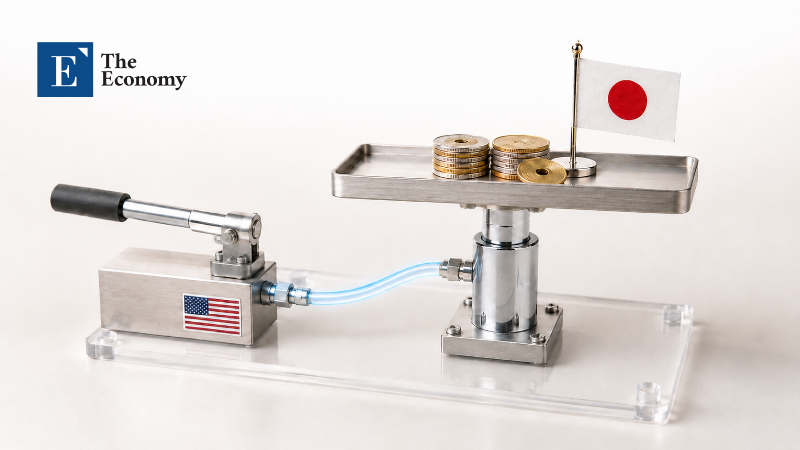
Dollar Nears 164 as US and Japan Coordinate for First Time in 28 Years
Japan’s fiscal instability, first exposed in the bond market, intensified selling pressure on the country’s currency in the foreign-exchange market. As the Takaichi administration pursued tax cuts and higher spending without presenting a stable source of funding, investors began pricing the prospect of additional government bond issuance and further fiscal deterioration into the exchange rate. Expectations that rising bond supply would lift both long-term rates and interest costs, reducing the Japanese government’s capacity to respond to economic weakness, also weighed on the currency. The dollar rose to nearly 164 against the Japanese currency last month, its highest level in about 40 years since 1986.
As currency weakness showed signs of triggering a broader decline across Asian currencies, the United States joined Japan’s intervention efforts. On the 31st of last month, the US Treasury purchased the Japanese currency alongside Japan. It was the first coordinated operation by the two countries to support its value since 1998, 28 years earlier. Acting on behalf of the US Treasury, the Federal Reserve Bank of New York sold European currency holdings and purchased the Japanese currency, while the Japanese government is estimated to have deployed between $69.1 billion and $75.4 billion over two days. US Treasury Secretary Scott Bessent warned that its abrupt depreciation could trigger competitive devaluations across Asia and directly cited excessive volatility in the South Korean currency.
Prolonged Currency Defense Could Also Pressure US Long-Term Rates
The US intervention is understood to have been motivated not only by the need to stabilize Asian exchange rates but also by a desire to protect its own government bond market. Japan was the largest foreign holder of US Treasuries as of the end of May, with holdings totaling $1.1431 trillion. If the Japanese government were to liquidate a large volume of its US Treasury holdings to secure the dollars needed for currency purchases, Treasury prices would fall and US long-term interest rates would inevitably rise. The increase in Japanese government bond yields, which has enhanced the relative investment appeal of domestic bonds, is another variable. If Japanese institutional investors, including insurers and pension funds, have less incentive to hold US Treasuries while bearing currency-hedging costs, the US bond market could face dual pressure from official-sector sales and the repatriation of private capital.
The effects of the joint intervention, however, did not last long. After approaching 164 immediately before the operation, the dollar fell into the 157 range on the 31st of last month and the 155 range on the 4th of this month. By the 11th, however, it had returned to the 159 range, reversing more than half of its initial decline. The intervention helped calm speculative positioning but failed to alter the underlying economic conditions responsible for the currency’s weakness.
FIMA May Avert Treasury Sales, but the Conditions Driving Currency Weakness Remain
The two countries therefore agreed to use the Federal Reserve’s Foreign and International Monetary Authorities Repo Facility, or FIMA Repo Facility, allowing Japan to secure intervention funds without selling US Treasuries in the open market. Under the arrangement, the Japanese government pledges US Treasuries held in its account at the New York Fed as collateral and borrows dollars, which it then sells in the foreign-exchange market to purchase its own currency. Under the current framework, each counterparty can obtain up to $60 billion per day, with maturities of either one or seven days. Bessent has also said the Federal Reserve should consider raising the limit in light of Japan’s potential demand and the size of the US Treasury market.
Dollar funding through FIMA, however, cannot eliminate the causes of the currency’s depreciation. Because the facility has short maturities, sustaining intervention funds over an extended period requires repeated borrowing, inevitably increasing the interest and refinancing costs borne by the Japanese government. Even if Japan avoids directly selling US Treasuries, higher Japanese long-term rates are likely to encourage more Japanese investors to shift funds into domestic bonds, weakening demand for US government debt. Economic research firm TD Economics estimated that declining demand from Japanese investors could raise the yield on 10-year US Treasuries by 0.20 to 0.50 percentage points over the medium term. Because higher US Treasury yields feed through to mortgage rates and corporate borrowing costs, a prolonged campaign to defend the Japanese currency could increasingly transmit the burden to the US real economy.
Anne-Marie Nicholson is a fearless reporter covering international markets and global economic shifts. With a background in international relations, she provides a nuanced perspective on trade policies, foreign investments, and macroeconomic developments. Quick-witted and always on the move, she delivers hard-hitting stories that connect the dots in an ever-changing global economy.
Similar Post