U.S. Warship Calls at Alaska’s Port of Whittier for First Time in 80 Years as Washington Bolsters Arctic Defenses Against Joint Chinese-Russian Patrols

Anne-Marie Nicholson is a fearless reporter covering international markets and global economic shifts. With a background in international relations, she provides a nuanced perspective on trade policies, foreign investments, and macroeconomic developments. Quick-witted and always on the move, she delivers hard-hitting stories that connect the dots in an ever-changing global economy.
Authored On
Modified
U.S. strengthens its operational infrastructure in Alaska through port expansion and aviation exercises
Growing Chinese-Russian military activity prompts closer surveillance of northern approaches
Control over logistics and resource transport routes emerges as another key factor in Arctic security
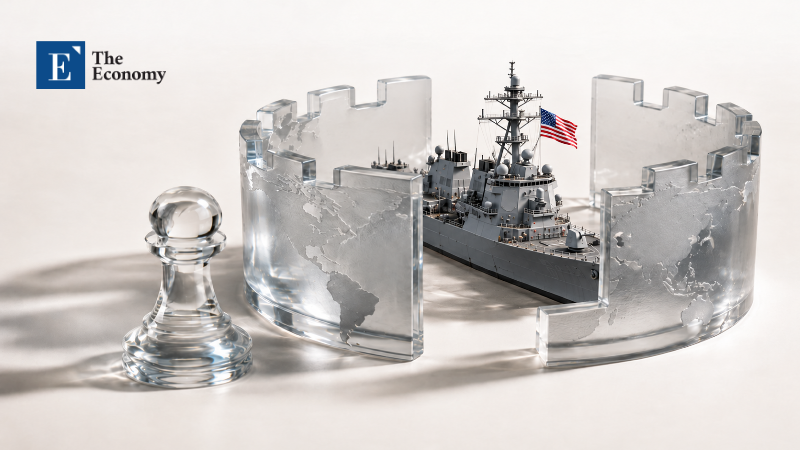
The United States is strengthening its Arctic defense posture, with Alaska serving as a central operational hub. Following the commissioning of its newest destroyer, USS Ted Stevens (DDG-128), in Alaska, Washington is also reinforcing its regional operational infrastructure through port expansion and exercises in airpower employment. The moves are seen as an effort to improve surveillance and response capabilities along the northern approaches as China and Russia increase their joint military activities near Alaska. With the two countries also expanding logistics and energy cooperation through Arctic shipping routes, their economic influence and control over those routes have emerged as key considerations in U.S. security planning.
USS Ted Stevens Joins the Missile Defense Force
According to naval affairs publication Naval News on October 7 (all dates local), USS Ted Stevens, the U.S. Navy’s newest Arleigh Burke-class Flight III guided-missile destroyer, was commissioned at the Port of Whittier, Alaska, on October 3. The second Flight III ship after USS Jack H. Lucas (DDG-125), Ted Stevens arrived at Whittier ahead of its commissioning ceremony. The visit marked the first port call by a U.S. Navy destroyer in approximately 80 years at Whittier, which was developed as a military installation during World War II.
The ship’s principal systems are the AN/SPY-6(V)1 air and missile defense radar and the Aegis Baseline 10 combat system, designed to counter aircraft and ballistic missile threats simultaneously. As the radar detects and tracks targets, the combat system processes large volumes of sensor data to support engagements. According to the U.S. Navy, the configuration enables concurrent air defense and ballistic missile defense even when multiple types of threats approach at once.
The ship’s electrical power and cooling infrastructure has also been reconfigured to support the high-performance radar and combat system. The Flight III design incorporated into Ted Stevens includes a 4,160-volt (V) electrical distribution system and gas turbine generators rated at 4 megawatts (MW) each. The power distribution system accommodates the demands of the high-powered radar, while expanded air-conditioning and cooling-water capacity dissipates heat generated by the electronic equipment. The hull structure was also modified to accommodate the weight of the new equipment and systems. Before commissioning, Ted Stevens completed ship shock trials using live explosives, validating its ability to withstand explosive shock and remain operational under combat conditions.
Port of Nome Expansion Strengthens Infrastructure for Arctic Maritime Operations
Alongside the introduction of its newest destroyer, the U.S. military is expanding port infrastructure. A prominent project involves converting the Port of Nome, on Alaska’s western coast, into a deepwater port capable of accommodating large vessels. The U.S. Army Corps of Engineers awarded Kiewit Infrastructure West a $399.4 million contract for Phase 1A construction in August last year, followed by a groundbreaking ceremony on September 2. Construction, scheduled to begin in earnest next spring, will extend the port’s causeway by approximately 366 meters and build a 183-meter dock. The work will create space for vessels to berth and load and unload cargo, with dredging to deepen the harbor proceeding as a separate subsequent phase.
The central objective of the expansion is to provide sufficient water depth for large vessels to berth directly. Nome’s outer harbor currently has a depth of approximately 6.7 meters, making safe access difficult for vessels with a draft—the depth of the portion submerged in water—exceeding 5.5 meters. Subsequent dredging to create a basin approximately 12.2 meters deep would allow the port to accommodate vessels such as Coast Guard icebreakers. By enabling large vessels to berth and handle cargo, the project would also expand the infrastructure available to supply fuel and provisions to naval vessels operating near the Arctic. The U.S. Army Corps of Engineers has likewise said the expanded Port of Nome will support research and public safety activities and serve as a hub for military operations in the Arctic.
Deployment of 54 F-35As Followed by Sortie Exercises From Dispersed Locations
While port expansion strengthens the foundation for maritime operations, the U.S. military is also reinforcing the airpower responsible for Alaska’s skies. In April 2022, the U.S. Air Force completed the deployment of 54 F-35As to Eielson Air Force Base, establishing two operational squadrons. The phased introduction of the fighters over approximately two years provided a permanently stationed stealth force capable of conducting operations from Alaska. Infrastructure upgrades needed to support the deployment proceeded in parallel. In May that year, the Air Force held an event marking the arrival of the final aircraft and formally recognized the completion of the F-35A deployment program.
Following the establishment of a permanent force, exercises have continued to develop the ability to operate fighters from multiple locations. During Tropic Tundra 26 in May this year, personnel from the 3rd Wing and the 673rd Air Base Wing deployed to the Coast Guard air station on Kodiak Island in southern Alaska, establishing the on-site support infrastructure needed for F-22 operations. With that support in place, F-22s launched on May 13 as part of a North American Aerospace Defense Command (NORAD) alert-response exercise, testing their ability to perform alert missions from an alternate operating location. During the same period, Joint Base Elmendorf-Richardson also conducted recovery training in preparation for damage to airfield facilities from an enemy attack. The exercise focused on procedures for rapidly repairing damaged facilities and resuming aircraft sorties.
Cooperation among the military services to supply fuel and materiel to deployed aircraft is also taking more concrete form. Exercise Kodiak Mace, conducted in Alaska in May this year, brought together Marine Corps aerial refueling and transport aircraft and Army helicopters. On May 14, a KC-130J assigned to Marine Aerial Refueler Transport Squadron 152 refueled a UH-60 Black Hawk from the Army’s 1st Battalion, 52nd Aviation Regiment, allowing the units to practice mutual support procedures. The following day, May 15, a KC-130J also conducted a cargo airdrop exercise in the Anchorage area, Alaska’s largest city and a critical logistics and military hub. According to the U.S. military, the training develops the ability of the Marine Corps and other services to coordinate across a range of operational environments and respond jointly.
Chinese-Russian Military Activity Near Alaska Heightens U.S. Vigilance
Experts see the reinforcement of U.S. forces in Alaska as an effort to counter Chinese and Russian military approaches. The two countries have previously extended their joint patrols into waters near Alaska, prompting U.S. responses. In August 2023, when 11 Chinese and Russian naval vessels approached Alaska’s Aleutian Islands, the U.S. Navy deployed four destroyers and P-8 maritime patrol aircraft to track their movements. The fleet’s approach to Alaska prompted calls within the United States to bolster defensive capabilities. Alaska Senators Lisa Murkowski and Dan Sullivan issued a joint statement at the time urging the allocation of funding and resources needed to expand regional military capabilities. The movement of a combined Chinese-Russian fleet in waters close to U.S. territory sharpened demands for stronger surveillance and response forces along the northern approaches.
Joint Chinese-Russian activity has repeatedly been observed at sea and in the air. In July 2024, two Russian Tu-95 bombers and two Chinese H-6 bombers entered the Alaska Air Defense Identification Zone, prompting U.S. and Canadian fighters to scramble in response. The bombers remained in international airspace and did not violate U.S. or Canadian sovereign airspace. In September that year, four Chinese and Russian coast guard vessels were also observed sailing in formation in the Bering Sea, between Alaska and Russia’s Far East. The U.S. Department of Defense’s identification of expanding Chinese-Russian cooperation as a key security consideration in its 2024 Arctic Strategy, alongside calls for stronger surveillance, communications capabilities and allied coordination, is likewise seen as a response to the changing situation along the northern approaches.
China and Russia Extend Cooperation From Military Coordination to Shipping-Route Operations
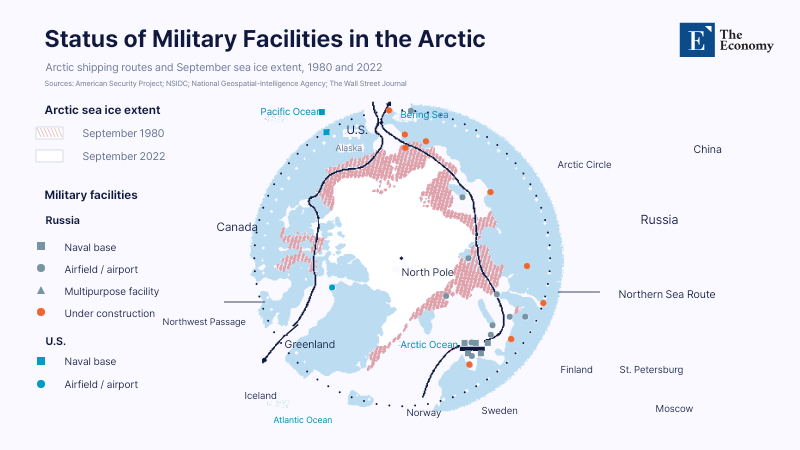
Washington’s concern is that Chinese-Russian military approaches are increasingly accompanied by cooperation over shipping-route operations. Russia currently manages transit authorization and icebreaker support for the Northern Sea Route (NSR), which runs along its northern coast. China is using this system to increase sailings by its vessels bound for Europe. In August this year, seven Chinese vessels received authorization to sail to Europe via the Northern Sea Route. The United States thus faces expanding Chinese-Russian cooperation along a route over whose operation it has little scope to exert influence.
Arctic shipping routes, where U.S. efforts to counter China and Russia intersect with the two countries’ cooperation, could also reshape logistics flows between Asia and Europe. In October last year, the container ship Istanbul Bridge carried electric vehicles, solar panels and other cargo from China through the Arctic, reaching the British port of Felixstowe in 20 days. Last month, Dubai Tower completed a voyage from Qingdao, China, to the same port in 24 days. As routes capable of shortening transit times enter commercial service, China is diversifying its export corridors to Europe, while Russia is gaining scope to expand its influence over international logistics through navigational support systems along its coast. U.S. Arctic planning must therefore also take account of the commercial infrastructure the two countries are building and the influence that accompanies it.
Chinese-Russian Cooperation on Arctic Resources Puts U.S. Access Under Pressure
The expansion of Chinese-Russian cooperation along Arctic shipping routes also reflects their shared interest in transporting energy resources produced in the Arctic to China. In a 2008 assessment, the U.S. Geological Survey (USGS) estimated that the Arctic could hold approximately 13% of the world’s undiscovered oil and 30% of its undiscovered natural gas. China has participated in Arctic resource development and transport through investment in Russia’s Yamal liquefied natural gas (LNG) project. The cooperation reflects the alignment of Russia’s desire to secure development financing and export markets with China’s aim to broaden its energy supply chains by participating from the production stage. When releasing its 2024 Arctic Strategy, the U.S. Department of Defense likewise highlighted Chinese financing for Russian Arctic energy projects alongside expanding military cooperation between the two countries. As investment in resource development, maritime transport of the resulting output and military activity in surrounding waters become increasingly intertwined, U.S. efforts to counter the two countries extend across the full range of their cooperation.
The United States is particularly wary that Russia could use the infrastructure it has established in the Arctic to restrict other countries’ access to shipping routes. In its 2024 Arctic Strategy, the U.S. Department of Defense said Russia imposes excessive requirements on foreign vessels transiting the Northern Sea Route and threatens the use of force against ships that fail to comply with its regulations. The strategy also explicitly raised concerns that Russia’s Arctic military capabilities could constrain U.S. force deployments to Europe and the Indo-Pacific, as well as crisis response. The assessment is that greater Russian control over the route could also narrow the military freedom of maneuver available to the United States and its allies.
Anne-Marie Nicholson is a fearless reporter covering international markets and global economic shifts. With a background in international relations, she provides a nuanced perspective on trade policies, foreign investments, and macroeconomic developments. Quick-witted and always on the move, she delivers hard-hitting stories that connect the dots in an ever-changing global economy.
Similar Post