“From a Launchpad for Chinese Companies’ Overseas Expansion to a U.S.-China Battleground”: AI Chip War Shakes Singapore, Testing Southeast Asia’s Diplomatic Balancing Strategy

Oliver Griffin is a policy and tech reporter at The Economy, focusing on the intersection of artificial intelligence, government regulation, and macroeconomic strategy. Based in Dublin, Oliver has reported extensively on European Union policy shifts and their ripple effects across global markets. Prior to joining The Economy, he covered technology policy for an international think tank, producing research cited by major institutions, including the OECD and IMF. Oliver studied political economy at Trinity College Dublin and later completed a master’s in data journalism at Columbia University. His reporting blends field interviews with rigorous statistical analysis, offering readers a nuanced understanding of how policy decisions shape industries and everyday lives. Beyond his newsroom work, Oliver contributes op-eds on ethics in AI and has been a guest commentator on BBC World and CNBC Europe.
Authored On
Modified
Singapore, a hub for Chinese companies’ overseas expansion, caught in U.S.-China rivalry for technological supremacy
AI computing resources and advanced chips reach China through Southeast Asia as U.S. expands export controls
Southeast Asia’s diplomatic balancing act under threat amid pressure to take sides, particularly in advanced industries
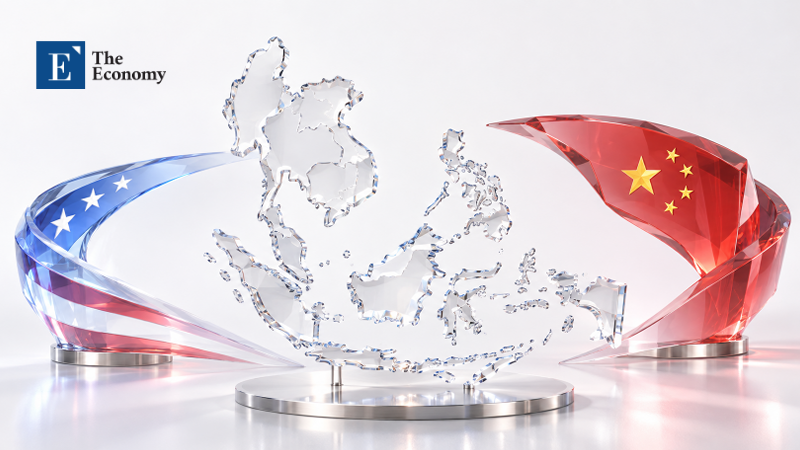
Singapore, long a launchpad for Chinese companies expanding overseas, is facing direct pressure from the U.S.-China rivalry for technological supremacy. Amid mounting allegations that Chinese companies have secured advanced semiconductors and artificial intelligence (AI) computing resources through Southeast Asia, the United States has tightened regulation and scrutiny of the region’s data centers and semiconductor supply chains. Market observers expect Singapore and other Southeast Asian countries to face demands for clearer strategic choices, particularly in advanced technology.
Chinese Companies Turn to Singapore
On the 12th (all dates hereafter local time), Hong Kong’s South China Morning Post (SCMP) reported that a rapidly growing number of Chinese companies are using Singapore as a base for overseas expansion. Chinese coffee chain Luckin Coffee launched its overseas business in Singapore in 2023 and opened its 100th local store this past September. Milk tea brand CHAGEE has also steadily expanded its business since opening its first overseas store in Singapore in 2019. Similar moves are taking place in the information technology (IT) industry. Chinese online fast-fashion company Shein and game developer HoYoverse have relocated their global headquarters to Singapore, while TikTok parent ByteDance and Chinese-linked data center operator DayOne have also expanded their local operations.
Statistics confirm this trend. According to the Chinese government, China’s direct investment in Singapore totaled USD 16.9 billion last year, exceeding its investment in all other Southeast Asian countries combined, as well as its investment in the United States and the European Union (EU). Singapore’s Economic Development Board (EDB) also reported that Chinese companies accounted for 20.6% of new fixed-asset investment commitments last year, surpassing the United States (17.3%) for the first time. Several factors explain why so many Chinese companies are focusing on Singapore. Its large ethnic Chinese population and use of English as an official language make it easy for them to adapt locally. Other strengths include its concentration of multinational companies, stable legal and regulatory framework, and abundant skilled professionals. These factors have fueled the spread in recent years of so-called “Singapore-washing,” in which Chinese companies establish headquarters or corporate entities in Singapore to dilute their perceived Chinese identity and reduce geopolitical risks.
U.S. Tightens Regulatory Scrutiny
The situation has changed, however, as the U.S.-China rivalry for technological supremacy has intensified. The United States has begun tightening regulation and scrutiny of Chinese-linked companies based in Singapore. A prominent example is TikTok, the video platform owned by China’s ByteDance. TikTok established a global management structure by placing key executives in Singapore and appointing Singaporean Shou Zi Chew as chief executive officer (CEO), but failed to dispel U.S. national security concerns over its ties to its Chinese parent. Ultimately, in January this year, it established a separate joint venture to operate its U.S. service and transferred an 80.1% stake to U.S. and global investors, including Oracle, Silver Lake and United Arab Emirates (UAE) investment firm MGX. ByteDance’s stake was reduced to 19.9%, while operational authority and control over U.S. user data, recommendation algorithms and content management were also transferred to the new entity.
More recently, controversy has erupted over allegations that Nvidia’s advanced AI chips reached China through Singapore. At the center of the controversy is Huang Le (Alice Huang), who has been identified as having had an extramarital relationship with former Nvidia CEO Jensen Huang and is suspected of ties to Chinese intelligence agencies. Huang Le has been accused of involvement in supplying China with at least USD 7.5 billion worth of Nvidia AI chips through a corporate network built by her family, including Singaporean cloud company Megaspeed and China’s Shanghai Century Litong. On the 12th, the Singapore government said that although there was insufficient evidence to substantiate criminal allegations against Huang Le relating to Megaspeed, she had provided inaccurate information during the investigation and was therefore issued a stern warning and barred from reentering the country.
Southeast Asia’s AI Infrastructure Market on Edge
Market observers say the episode could also constrain Chinese investment practices in Southeast Asian AI infrastructure. Until now, Chinese companies have built data centers in Southeast Asia or rented computing capacity from Nvidia chips through local cloud providers to circumvent U.S. export controls on advanced semiconductors. For example, in June last year, The Wall Street Journal (WSJ) reported that a Chinese AI developer had sent 4 engineers to Malaysia and rented about 300 servers equipped with Nvidia chips at a local data center to train an AI model. The engineers reportedly brought in approximately 80 terabytes (TB) of training data on hard drives and took the results, including model parameters, back to China after completing the training. In March this year, reports also emerged that ByteDance was working with Southeast Asian cloud provider Aolani Cloud on a project to deploy about 36,000 Nvidia Blackwell B200 chips in Malaysia.
Cases of illegal semiconductor shipments involving Southeast Asian countries have also continued to emerge. In February last year, Singaporean authorities charged 3 people, including Chinese nationals, with falsely declaring the end users of products purchased from U.S. server manufacturers Dell and Super Micro Computer. Authorities confirmed that the servers, which may have contained advanced Nvidia chips, had been shipped through Singapore to Malaysia, and also raised suspicions that they ultimately reached Chinese AI company DeepSeek. In August of the same year, the U.S. Department of Justice also arrested 2 Chinese nationals who had sent advanced graphics processing units (GPUs) through California-based ALX Solutions to logistics companies in Singapore and Malaysia before illegally exporting them to China. Investigators obtained records of at least 21 related shipments and also uncovered indications that Chinese and Hong Kong companies had paid the exporter.
Table 1. Cases of China’s Use of Southeast Asian AI Infrastructure and Semiconductor Shipments Through Indirect Routes
| Category | Date | Key Details |
|---|---|---|
| Use of AI infrastructure | June 2025 | Chinese AI company rents Nvidia servers at a Malaysian data center to train a model |
| March 2026 | ByteDance pursues construction of Blackwell B200-based infrastructure in Malaysia with a local cloud provider | |
| Illegal exports | February 2025 | Group charged in Singapore with falsely declaring servers’ end users and shipping them to Malaysia |
| August 2025 | 2 Chinese nationals arrested for smuggling advanced GPUs into China through logistics companies in Singapore and Malaysia | |
| March 2026 | Supermicro personnel charged with shipping USD 2.5 billion worth of AI servers to China through Southeast Asian companies and Taiwan | |
| June and October 2026 | Malaysian customs repeatedly intercepts servers equipped with advanced AI chips at an airport |
U.S. Policymakers Target Southeast Asia
The scale of smuggling cases has grown considerably this year. In March, U.S. prosecutors charged 3 people, including Super Micro Computer co-founder Wally Liaw, with illegally shipping USD 2.5 billion worth of advanced AI servers to China. They reportedly shipped U.S.-made servers to Taiwan and Southeast Asia, repackaged them and sent them to China, even placing fake servers in preparation for on-site inspections by the U.S. manufacturer. Malaysian customs also seized 72 servers equipped with advanced AI chips at Kuala Lumpur International Airport in June and intercepted another 30 last month. The servers seized in the two operations were valued at USD 12.93 million and USD 12.11 million, respectively. Customs authorities are expanding their investigation, believing the smuggling ring was involved in at least 5 attempts to illegally export semiconductors.
U.S. policymakers are also taking an active role in determining how American-made semiconductors are used. On the 4th, the Financial Times (FT) reported that Oracle had canceled a USD 7 billion AI chip rental contract with Tencent under pressure from the U.S. government. The contract would have allowed Tencent to use about 100,000 advanced AI chips at several data centers in Southeast Asia for 5 years. Separately, in May, the U.S. Commerce Department issued guidance aimed at restricting Chinese companies from obtaining advanced semiconductors through local subsidiaries in Southeast Asia. The U.S. Congress is also pursuing the Remote Access Security Act (RASA), which would expand the Commerce Department’s authority to regulate remote access to advanced semiconductors through overseas cloud services.
“The U.S. or China?” A Strategic Crossroads
This tightening of regulations is expected to place a considerable burden on the diplomatic balancing approach that Southeast Asian countries have long maintained. Countries in the region have sustained economic ties with both powers, expanding trade and production-network cooperation with China while drawing in U.S. investment and advanced technology. In particular, after the U.S.-China trade war began in 2018, companies with production bases in China relocated factories to Southeast Asia to avoid U.S. tariffs, turning the conflict between the two powers into an opportunity to attract new investment. Recently, however, cracks have begun to appear in this strategy as the United States extends its controls to Southeast Asia’s advanced technology and infrastructure sectors. For example, under U.S. pressure, Malaysia introduced a prior-approval requirement in July last year for the export, transshipment and transit of U.S.-made high-performance AI chips. On the 12th, it also said it was considering legislation to oversee data center operators, facility locations and the volume of GPUs brought into the country.
Pressure on Southeast Asian countries over their strategic choices is expected to intensify further, as the United States and China accelerate efforts to build separate technology cooperation frameworks. Through “Pax Silica,” launched in December last year, the United States is reorganizing supply chains around friendly countries, spanning critical mineral mining and refining, advanced semiconductor production, and data centers and AI infrastructure. South Korea, Japan, Singapore and the Philippines are among the current participants in Pax Silica. In response, China led the establishment in July of the World Artificial Intelligence Cooperation Organization, an intergovernmental international organization headquartered in Shanghai. The organization aims to jointly develop AI technology, strengthen developing countries’ technological capabilities and expand cooperation in shaping international AI rules and standards. A total of 29 countries, including Indonesia, Laos, Russia and Pakistan, signed its founding agreement.
Oliver Griffin is a policy and tech reporter at The Economy, focusing on the intersection of artificial intelligence, government regulation, and macroeconomic strategy. Based in Dublin, Oliver has reported extensively on European Union policy shifts and their ripple effects across global markets. Prior to joining The Economy, he covered technology policy for an international think tank, producing research cited by major institutions, including the OECD and IMF. Oliver studied political economy at Trinity College Dublin and later completed a master’s in data journalism at Columbia University. His reporting blends field interviews with rigorous statistical analysis, offering readers a nuanced understanding of how policy decisions shape industries and everyday lives. Beyond his newsroom work, Oliver contributes op-eds on ethics in AI and has been a guest commentator on BBC World and CNBC Europe.
- Previous “China’s Export Control Reprieve Buys Time,” but EU Supply Chain Independence Faces a Dilemma as Costs, Regulation and Pricing Hinder Efforts to Reduce Reliance on China
- Next Europe’s Push for an “EU Version of Section 301”: Darkening Prospects for Chinese Exports as Trade Restrictions Expand
Similar Post