“Space Becomes Another Battleground in the U.S.-China Rivalry for Supremacy”: China Accelerates Anti-Satellite Weapons Development as U.S. Counters With SpaceX

Aoife Brennan is a contributing writer for The Economy, with a focus on education, youth, and societal change. Based in Limerick, she holds a degree in political communication from Queen’s University Belfast. Aoife’s work draws connections between cultural narratives and public discourse in Europe and Asia.
Authored On
Modified
U.S. intelligence authorities flag surge in Chinese reconnaissance satellites and anti-satellite weapons development
China accelerates satellite network construction and orbital warfare technologies to expand its military capabilities in space
U.S. strengthens its position with private companies such as SpaceX as moves to reduce reliance on China accelerate
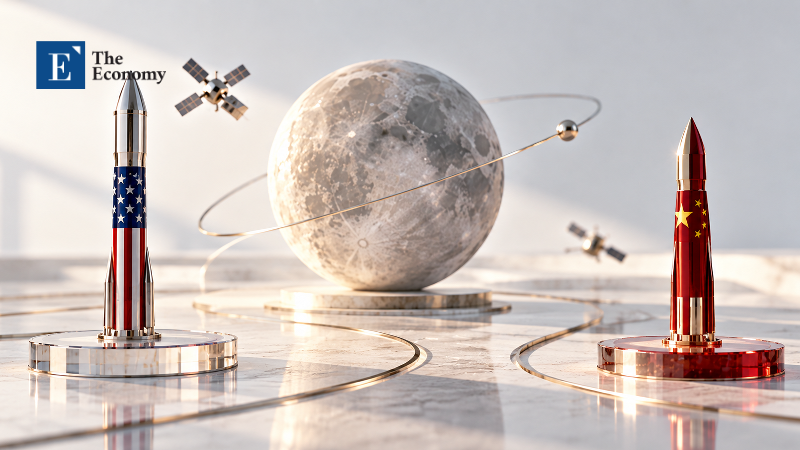
U.S. intelligence authorities have warned of China's expanding military capabilities in space. As China rapidly increases its intelligence, surveillance and reconnaissance (ISR) satellites and accelerates the development of ground- and space-based weapons systems, military competition between the United States and China in space is intensifying. Facing China's efforts to counter it, the United States is also turning to private space companies such as SpaceX to expand low-Earth-orbit reconnaissance satellite networks and missile detection networks, while increasing investment in lunar exploration and deep-space technologies.
U.S. Intelligence Authorities Warn of Space Security Threats
According to a report on the 28th by U.S. military news outlet The War Zone, the U.S. Defense Intelligence Agency (DIA) released a report titled “Challenges to Security in Space” on the 26th. All dates are local time. The report, the third edition following those published in 2019 and 2022, analyzes the space military strategies and weapons development of China, Russia, Iran and North Korea, based on information obtained through July this year. It assessed that China’s expansion beyond existing ground-based weapons into the development of space-based anti-satellite (ASAT) weapons poses a growing threat to U.S. and allied satellite operations.
Specifically, the DIA said China has already acquired multiple ground-based laser weapons with different power levels that can disrupt, degrade or physically damage satellites in low Earth orbit. It also projected that China could deploy additional space-based directed-energy weapons and high-powered ground-based weapons systems by the end of the 2020s, extending its attack range to higher orbits. Directed-energy weapons deliver concentrated energy, such as lasers or high-powered microwaves, to targets to disable sensors and electronic equipment.
Civilian Satellites Also Used for Reconnaissance
China’s existing space-based reconnaissance capabilities were also identified as a major U.S. concern. According to the DIA, China had more than 510 intelligence, surveillance and reconnaissance (ISR) satellites as of July this year, more than three times the number in 2018. These include not only electro-optical satellites that collect conventional optical imagery, but also synthetic aperture radar (SAR) satellites, which are relatively less affected by clouds or darkness, and electronic and signals intelligence satellites that collect communications and radar signals. Information gathered through this reconnaissance network can be used to identify and track targets for long-range precision strikes. The DIA assessed that China is strengthening its ability to monitor U.S. and allied military forces, particularly in key Indo-Pacific areas including the Korean Peninsula, Taiwan, the Philippines, the South China Sea and the Indian Ocean.
The potential use of civilian satellites for military purposes was also cited as a risk. The roughly 510 Chinese reconnaissance satellites counted by the DIA included commercial and civilian satellites as well as those directly operated by the Chinese government. Under China’s military-civil fusion policy, satellite imagery and reconnaissance information collected by private companies can be provided to the People’s Liberation Army. Some Chinese commercial satellite companies were found to be supplying satellite imagery even to state actors excluded from services by Western companies over their support for weapons proliferation. This means the Chinese military can expand its intelligence-gathering reach and target detection capabilities through the civilian space industry without increasing the number of satellites it launches and operates itself.
Table 1. Trends in China’s Expanding Military Capabilities in Space
| Area | Key Developments |
|---|---|
| Anti-satellite weapons | Acquisition of ground-based lasers capable of disrupting and damaging low-Earth-orbit satellites; development of space-based directed-energy weapons |
| Reconnaissance satellites | Operation of more than 510 intelligence, surveillance and reconnaissance satellites, more than three times the number in 2018 |
| Use of civilian satellites | Use of commercial satellite imagery and information for military purposes through the military-civil fusion system |
| Orbital warfare technologies | Development of an Earth-Moon satellite network, satellite tracking and capture technologies, and in-orbit refueling |
Intensifying Efforts to Counter the United States
China is also continuing its efforts to counter U.S. military capabilities in space. For example, at a symposium in Beijing in April last year, the Chinese Academy of Sciences (CAS) announced that it had established the world’s first three-satellite network between Earth and the Moon by linking the DRO-A and DRO-B satellites in distant retrograde orbit (DRO) with the DRO-L satellite in low Earth orbit. A DRO uses the gravitational interaction between Earth and the Moon to allow spacecraft to operate for extended periods with relatively little fuel. The United States also regards this orbital region as strategically important for lunar exploration and deep-space missions. Through the project, China verified inter-satellite communications and measurement technologies over distances of up to 1.17 million km, while also acquiring technologies that reduce reliance on ground-based observation facilities and enable satellites to determine one another’s positions and orbits.
This competition is also expanding into orbital warfare, in which satellites directly track or approach another country’s satellites to interfere with their functions. According to a Reuters report last month based on an analysis of military documents, space-tracking data, patents and procurement records, China is developing so-called “hunter satellites” that track and capture other spacecraft, as well as in-orbit refueling technologies. In June, China’s uncrewed spacecraft Shenlong, or “Divine Dragon,” released a small object of unknown purpose and conducted proximity maneuvers in low Earth orbit, where commercial and military satellites are concentrated.
U.S. Counters With SpaceX
The United States is also strengthening its military capabilities in space in response to China’s push. It is using the launch and satellite operation technologies of private space companies such as SpaceX to expand military reconnaissance networks and missile defense systems. According to Reuters, SpaceX is working with the U.S. National Reconnaissance Office (NRO) to build a network of hundreds of reconnaissance satellites in low Earth orbit, steadily expanding deployments since launching the first group in May 2024. The network is designed to rapidly identify ground targets around the world and relay the information gathered to military and intelligence agencies. In July, SpaceX also secured an additional launch contract worth USD 1.6 billion (approximately USD 1.65 billion) from the U.S. Space Force, agreeing to conduct 18 Falcon 9 launches by 2027 to place Defense Department satellites used for purposes including detecting and tracking airborne targets into orbit.
SpaceX also has a prominent role in the race to explore the Moon. It is participating in NASA’s crewed lunar exploration program, Artemis, by developing a lunar lander based on its next-generation Starship spacecraft. On the 23rd, NASA announced that it was revising the lander development plans of SpaceX and another U.S. private space company, Blue Origin, and pursuing a crewed lunar landing in 2028. To that end, SpaceX is studying an approach involving multiple Starships supplying cryogenic propellant in low Earth orbit and docking the lunar lander with the crewed Orion spacecraft for the journey to the Moon.
Blocking Access to Chinese Capital, Personnel and Components
SpaceX is also stepping up its strategy to reduce its ties to China. A prominent example is its restriction on investors from mainland China and Hong Kong subscribing for shares in its initial public offering (IPO). The measure reflects export controls on advanced defense technologies under the U.S. International Traffic in Arms Regulations (ITAR) and regulatory compliance risks. In July, Nikkei Asia also reported that SpaceX had sent audit teams to overseas suppliers, including those in Taiwan, and demanded that Chinese-national executives, engineers and employees at their production facilities be removed from relevant work, and that the use of components and equipment made by Chinese companies cease. Some suppliers were reportedly instructed to replace even Chinese-made surveillance cameras and networking equipment. SpaceX is also pursuing a “non-China, non-Taiwan” (NCNT) supply chain that sources components from locations outside both China and Taiwan.
The possibility that this shift away from China could spread beyond SpaceX to other companies led by CEO Elon Musk cannot be ruled out. In July, The Wall Street Journal (WSJ) reported that Tesla was considering separating its China operations in preparation for a possible merger with SpaceX. According to the report, some Tesla executives had been instructed to prepare for the separation, while the company’s advisers discussed options ranging from spinning off or selling its local subsidiary to withdrawing from the market. However, Musk categorically denied the report on his social media platform X, saying the matter had never even been discussed, while Tesla’s China unit also said the report was unfounded.
Aoife Brennan is a contributing writer for The Economy, with a focus on education, youth, and societal change. Based in Limerick, she holds a degree in political communication from Queen’s University Belfast. Aoife’s work draws connections between cultural narratives and public discourse in Europe and Asia.
- Previous “Strengthening Deterrence Against China Through Joint Weapons Production”: U.S.-Japan Defense Industry Cooperation Accelerates, Heightening Military Tensions in Northeast Asia
- Next Europe’s Push for an “EU Version of Section 301”: Darkening Prospects for Chinese Exports as Trade Restrictions Expand
Similar Post