“U.S. and Japan Seek to Contain China’s Expansion, While China Warns Against Rearmament”: Rising Military Tensions in East Asia Accelerate Reshaping of Security Order

Oliver Griffin is a policy and tech reporter at The Economy, focusing on the intersection of artificial intelligence, government regulation, and macroeconomic strategy. Based in Dublin, Oliver has reported extensively on European Union policy shifts and their ripple effects across global markets. Prior to joining The Economy, he covered technology policy for an international think tank, producing research cited by major institutions, including the OECD and IMF. Oliver studied political economy at Trinity College Dublin and later completed a master’s in data journalism at Columbia University. His reporting blends field interviews with rigorous statistical analysis, offering readers a nuanced understanding of how policy decisions shape industries and everyday lives. Beyond his newsroom work, Oliver contributes op-eds on ethics in AI and has been a guest commentator on BBC World and CNBC Europe.
Authored On
Modified
Japan urges defense of first island chain and preservation of U.S. security commitments amid China’s military expansion
China-Japan tensions intensify after remarks on a Taiwan contingency, expanding from diplomatic and trade disputes to military confrontations
Japan strengthens long-range strike capabilities with U.S. support; China criticizes “neo-militarism”
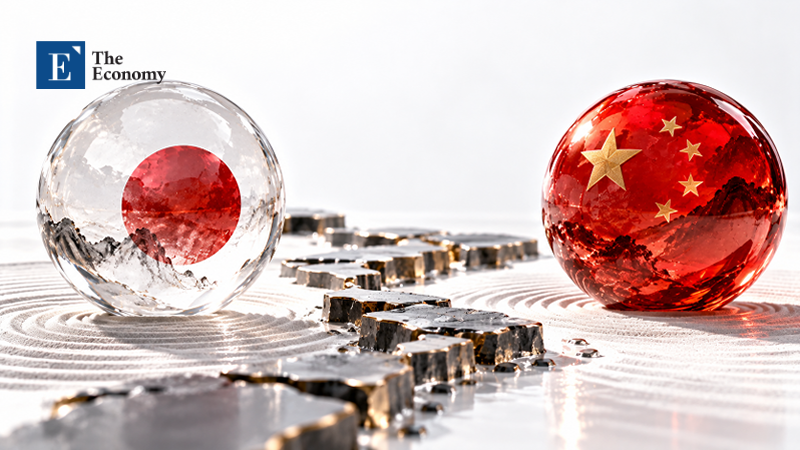
Security tensions between Japan and China are escalating. Since Japan’s remarks about the Taiwan Strait last year triggered a diplomatic dispute between the two countries, clashes have spread to maritime affairs and trade, while military confrontations have also intensified. China has strongly objected, characterizing Japan’s defense buildup as a move toward “neo-militarism.” Japan, meanwhile, is further strengthening security cooperation with the United States, wary of China’s military expansion and its potential advance into the first island chain.
Japan Highlights Wariness of China
According to a Nikkei Asia report on the 25th (all dates hereafter are local time), Yoshihide Yoshida, former chief of staff of Japan’s Self-Defense Forces Joint Staff, presented “three red lines” that the United States and its allies should uphold to contain China’s military expansion at the 13th Mount Fuji Dialogue, a U.S.-Japan policy forum held in Tokyo on the 24th. Specifically, these were defending the first island chain connecting Okinawa, Taiwan and the Philippines; maintaining U.S. nuclear deterrence; and securing Western superiority in advanced technologies such as artificial intelligence (AI) and quantum technology. He noted that China is rapidly catching up with the United States in military power and advanced technology, and has already pulled ahead in some areas. He also stressed the importance of defending the first island chain through sustained U.S. military involvement. Referring to the so-called “Acheson Line,” under which U.S. Secretary of State Dean Acheson excluded the Korean Peninsula and Taiwan from the Far Eastern defense perimeter in 1950, he emphasized that Washington must clearly maintain its regional defense commitments.
Japanese participants also focused on how changes in U.S.-China relations could affect East Asia’s security order. As U.S. President Donald Trump and Chinese President Xi Jinping have sought to improve relations through three meetings over the past year, concerns have spread that Japan could be sidelined. Masataka Okano, former secretary general of Japan’s National Security Secretariat, said, “The status quo in East Asia is changing gradually and quietly, out of public view,” adding, “We must pay attention to China’s incremental expansion of influence.” Regarding the U.S.-Japan alliance, he said, “It is time to consider not simply the alliance’s strength, but how to enhance its sustainability,” arguing that “a security vacuum must not emerge in Asia.”
China-Japan Rift Deepens
Japanese figures’ efforts to keep China in check are seen as stemming from the diplomatic and security disputes between the two countries that intensified last November. The immediate trigger was a statement by Japanese Prime Minister Sanae Takaichi at a House of Representatives Budget Committee meeting on November 7 last year. Takaichi said that if China used warships to exercise force against Taiwan, it could constitute a “survival-threatening situation” under Japan’s security legislation, allowing the country to exercise its right to collective self-defense. China strongly objected, accusing Japan of seeking to intervene militarily in the Taiwan issue. That same month, Xue Jian, China’s consul general in Osaka, posted threatening remarks directed at Takaichi on social media. China’s Foreign Ministry subsequently formally demanded that Takaichi retract her remarks and warned that Japan would have to bear responsibility for all consequences. The Japanese government, however, refused to retract them, saying they did not go beyond the scope of its existing security policy. Both countries summoned the other’s ambassador to lodge protests.
The dispute soon spread to economic and people-to-people exchanges, as well as maritime security. On November 14 last year, the Chinese government advised its citizens to refrain from visiting Japan, and a trilateral meeting of South Korean, Chinese and Japanese culture ministers scheduled for the 24th of the same month was postponed at China’s request. Around the same time, four China Coast Guard vessels entered territorial waters around the Japanese-administered Senkaku Islands, known in China as the Diaoyu Islands. On December 6 last year, a J-15 fighter jet from the Chinese aircraft carrier Liaoning also illuminated a Japan Air Self-Defense Force F-15 fighter jet with radar over international waters near Okinawa. Japan’s Defense Ministry protested to China, describing the incident as a dangerous act threatening aircraft safety. China countered that the Japanese fighter had interfered with its navy’s normal training.
Military Tensions Between the Two Countries Intensify
This year, the confrontation has extended to trade restrictions and maritime enforcement. In January, China’s Ministry of Commerce announced a ban on exports to Japan of dual-use items that could contribute to strengthening Japan’s military capabilities. The restrictions included certain rare-earth-related items used in semiconductors, electric vehicles and defense industries. In February, Japan’s Fisheries Agency seized a Chinese fishing vessel and arrested its captain after the vessel failed to obey an order to stop in Japan’s exclusive economic zone (EEZ) near Nagasaki Prefecture. It was Japan’s first seizure of a Chinese fishing vessel since 2022. At the time, China’s Foreign Ministry urged Japan to ensure the safety and lawful rights and interests of the Chinese crew.
Japan is also stepping up efforts to strengthen its long-range strike capabilities in response to China’s growing military influence. According to Kyodo News, Japan’s Defense Ministry operationally deployed domestically produced long-range missiles for the first time in March at Camp Kengun in Kumamoto Prefecture, Kyushu, and Camp Fuji in Shizuoka Prefecture. This marked the first time Japan had translated the “counterstrike capabilities” specified in its revised 2022 National Security Strategy into operational military assets. Specifically, Camp Kengun received Type 25 surface-to-ship guided missiles, an upgraded version of the existing Type 12 surface-to-ship guided missile with a range of approximately 1,000 km. Launched from Kyushu, the weapon can strike China’s coastal areas and waters around Taiwan. Camp Fuji reportedly received Type 25 high-speed gliding projectiles, which follow irregular trajectories that make them difficult to intercept.
Table 1. Key Developments in the China-Japan Dispute
| Period | Area | Key Events |
|---|---|---|
| November 2025 | Travel and trade | China advises its citizens to refrain from visiting Japan, suspends imports of Japanese seafood and puts talks on resuming Japanese beef imports on hold |
| Diplomacy and culture | Trilateral meeting of South Korean, Chinese and Japanese culture ministers and bilateral cultural and academic events postponed or canceled | |
| Maritime affairs | China Coast Guard vessels enter Japanese territorial waters around the Senkaku Islands | |
| December 2025 | Military | J-15 fighter jet from Chinese aircraft carrier Liaoning illuminates Japanese F-15 fighter jet with radar over international waters near Okinawa |
| January–February 2026 | Trade | China bans exports of dual-use items to Japan and adds 20 Japanese companies and institutions to its export control list |
| Maritime affairs | Japan seizes Chinese fishing vessel in its exclusive economic zone and arrests its captain | |
| March 2026 | Military | Japan operationally deploys domestically produced long-range missiles in Kyushu and Shizuoka for the first time |
China Strongly Objects to “Revival of Neo-Militarism”
The Chinese government strongly objected to these moves by Japan, warning against a revival of “neo-militarism.” At a regular briefing in April, Chinese Foreign Ministry spokesperson Mao Ning said, “Japan’s deployment of offensive weapons under the pretext of defense and counterstrikes goes far beyond the principles of self-defense and an exclusively defense-oriented policy.” She criticized the move, saying, “It violates documents with international legal force, including the Cairo Declaration, the Potsdam Declaration and Japan’s Instrument of Surrender, and also contravenes Japan’s constitution and established norms.” She added, “This reflects efforts by Japan’s right-wing forces to shift security policy in an offensive and expansionist direction,” arguing that “Japan’s neo-militarism threatens regional peace and stability, and the international community must remain highly vigilant.”
At the same briefing, she also cited an incident in which an active-duty Japanese Self-Defense Forces officer broke into the Chinese Embassy in Japan. In that incident in March, Second Lieutenant Kodai Murata of the Japan Ground Self-Defense Force climbed over the wall of the Chinese Embassy in Tokyo while carrying a bladed weapon, entered without authorization and was arrested by police. Mao said, “Rather than reflecting on its failure to properly manage the Self-Defense Forces, Japan is stoking external threats and accelerating its military buildup,” calling it “a very dangerous trend.” She urged Japan to “reflect deeply on its history of militarist aggression, honor its commitments in the military and security spheres, and act prudently.”
Structural Changes in U.S.-Japan Military Cooperation
Active U.S. support is one reason China is closely watching Japan’s efforts to strengthen its military capabilities. Under Article 9 of its pacifist constitution, which took effect in 1947 following its defeat in World War II, Japan renounced war and the use of force to resolve international disputes and has faced constitutional constraints on maintaining military forces. Although it established the Self-Defense Forces in 1954 with U.S. support, its use of military power centered on the principle of an exclusively defense-oriented policy aimed at defending against armed attacks on Japan itself. In recent years, however, China’s military buildup and intensifying tensions in the Taiwan Strait have prompted Japan to strengthen its defense capabilities, a direction the United States has also supported. At the U.S.-Japan summit in April 2024, then-U.S. President Joe Biden endorsed Japan’s plans to acquire counterstrike capabilities and increase defense spending. At the U.S.-Japan foreign and defense ministers’ meeting in July that year, the two sides also discussed ways to expand cooperation on the operation of Japan’s counterstrike capabilities. At the summit between President Trump and then-Japanese Prime Minister Shigeru Ishiba in February last year, the United States reaffirmed that it “welcomes Japan’s policy of strengthening its defense capabilities.”
More recently, the two countries have also strengthened their combined operational capabilities as the United States actively uses military sites on Japan’s southwestern islands to curb China’s advance into the western Pacific. During the large-scale joint exercise “Keen Sword 27,” held from the 19th to the 29th of this month, the United States and Japan plan to deploy mobile missile systems on Japan’s Yonaguni Island, near Taiwan. The U.S. Marine Corps will deploy the Navy/Marine Expeditionary Ship Interdiction System (NMESIS) and the Marine Air Defense Integrated System (MADIS) in the area. Japan’s Self-Defense Forces will also commit long-range missile assets to participate in island defense and maritime access-denial exercises. The concept is to counter the Chinese military’s seaward advance by dispersing small units equipped with anti-ship and air-defense missiles across key positions along the first island chain, rather than concentrating large numbers of troops at specific bases.
Oliver Griffin is a policy and tech reporter at The Economy, focusing on the intersection of artificial intelligence, government regulation, and macroeconomic strategy. Based in Dublin, Oliver has reported extensively on European Union policy shifts and their ripple effects across global markets. Prior to joining The Economy, he covered technology policy for an international think tank, producing research cited by major institutions, including the OECD and IMF. Oliver studied political economy at Trinity College Dublin and later completed a master’s in data journalism at Columbia University. His reporting blends field interviews with rigorous statistical analysis, offering readers a nuanced understanding of how policy decisions shape industries and everyday lives. Beyond his newsroom work, Oliver contributes op-eds on ethics in AI and has been a guest commentator on BBC World and CNBC Europe.
Similar Post