“From a Joint Defense Agreement to Security Talks with Iran”: Saudi Arabia, Türkiye and Pakistan Strengthen Regional Security Cooperation Amid Iran War and Houthi Offensive

Oliver Griffin is a policy and tech reporter at The Economy, focusing on the intersection of artificial intelligence, government regulation, and macroeconomic strategy. Based in Dublin, Oliver has reported extensively on European Union policy shifts and their ripple effects across global markets. Prior to joining The Economy, he covered technology policy for an international think tank, producing research cited by major institutions, including the OECD and IMF. Oliver studied political economy at Trinity College Dublin and later completed a master’s in data journalism at Columbia University. His reporting blends field interviews with rigorous statistical analysis, offering readers a nuanced understanding of how policy decisions shape industries and everyday lives. Beyond his newsroom work, Oliver contributes op-eds on ethics in AI and has been a guest commentator on BBC World and CNBC Europe.
Authored On
Modified
Saudi, Turkish and Pakistani delegations visit Iran for security talks
Houthi-Saudi fighting compounds Iran war, deepening Middle East security instability
“We must reduce dependence on the U.S.”: Three countries sign joint defense agreement, but practical military cooperation remains a challenge
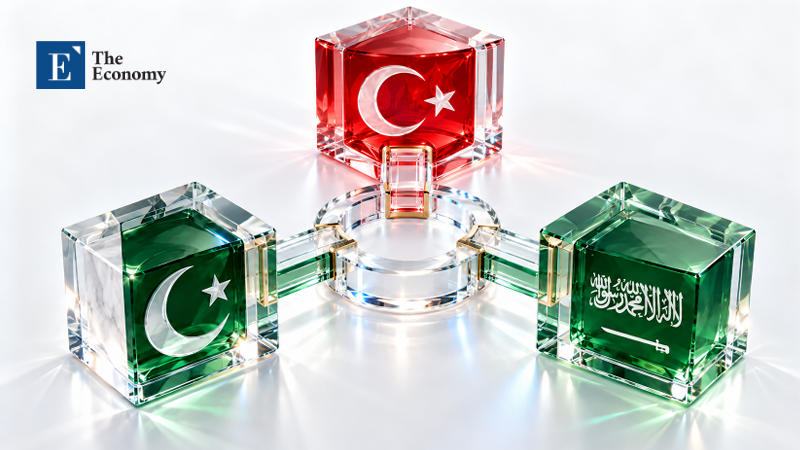
High-level delegations from Saudi Arabia, Pakistan and Türkiye visited Iran for talks aimed at easing regional military tensions. The move reflects a growing need for mediation by regional countries as fears mount over renewed armed conflict between the United States and Israel on one side and Iran on the other, compounded by attacks on Saudi Arabia by Yemen’s Iran-backed Houthi armed group. Saudi Arabia, Türkiye and Pakistan, now at the negotiating table, recently signed a trilateral joint defense agreement and have begun strengthening an independent security cooperation network.
Efforts to Ease Regional Tensions in the Middle East
According to Reuters and AFP on the 26th (all dates hereafter are local time), senior military and security officials from Saudi Arabia, Türkiye and Pakistan met with Iran’s leadership in Tehran that day to discuss regional security and ways to ease military tensions. Pakistan proposed the talks, and Pakistani army chief Asim Munir reportedly visited Tehran the previous week to present the idea of multilateral consultations to Iran’s leadership.
The meeting’s main agenda items included preventing renewed military conflict between the United States and Iran, Houthi attacks on Saudi Arabia, and restoring normal maritime shipping through the Strait of Hormuz. In a joint statement issued after the meeting, the four countries said they would expand regional cooperation and continue follow-up consultations to stabilize security. However, they did not disclose a schedule for further talks or specific military de-escalation measures.
Risks of Armed Conflict Abound
The meeting took place amid discussion of possible renewed U.S. and Israeli attacks on Iran. The two sides have been engaged in prolonged armed conflict since the United States and Israel launched military operations against Iran in February. In June, mediation by Pakistan and Qatar produced a provisional agreement that included reopening the Strait of Hormuz and lifting the U.S. blockade of Iranian ports, but fighting subsequently resumed and negotiations were suspended. U.S. President Donald Trump has recently continued to signal the possibility of additional military strikes against Iran, while hard-line statements about military action against Iran have also persisted in Israel. In particular, growing concerns that military conflict could resume around the U.S. midterm elections on November 3 have accelerated mediation efforts by regional countries.
Armed conflict between Saudi Arabia and the Houthis is also cited as a key factor behind the talks. Fighting between them resumed in earnest in July, when Saudi-backed Yemeni government forces carried out an airstrike on the international airport in the Houthi-controlled capital, Sanaa. At the time, Yemeni government forces said they had struck the airport’s runway to prevent an Iranian aircraft from landing. In retaliation, the Houthis launched ballistic missiles and drones targeting Abha International Airport in southern Saudi Arabia. This was the first Houthi attack on Saudi Arabia since the two sides entered an informal ceasefire in 2022. The Houthis subsequently expanded their attacks to maritime targets, striking Saudi vessels passing through the Red Sea, while Saudi Arabia launched additional airstrikes on Houthi strongholds in Yemen.
Saudi Arabia Suffers Heavy Damage from Houthi Offensive
In August, fighting between the two sides spread to energy facilities and other targets. The Houthis launched missile and drone attacks on oil facilities in Yanbu in western Saudi Arabia and Jizan in the south, and on August 9 targeted Saudi state oil company Aramco’s Jizan refinery. On the same day, Houthi attacks also killed 7 people and injured up to 30 at the western port of Mocha and nearby areas controlled by Saudi-backed Yemeni government forces. In response, Saudi Arabia stepped up its military response, continuing airstrikes on Houthi strongholds in Yemen. On September 13, it struck key Houthi strongholds including the northern province of Saada and Taiz province, and reportedly carried out large-scale airstrikes in the Hodeidah, Marib and Taiz areas on the 16th.
This month, Houthi attacks on civilian facilities on Saudi soil have become particularly prominent. An attack on King Khalid International Airport in Riyadh on the 10th killed 13 people and injured 309. On the 11th, another projectile struck Terminal 4, killing 1 person and injuring 11. On the 15th, the Houthis attacked the presidential palace compound in Aden in southern Yemen, killing 5 people. The Saudi-led coalition retaliated, declaring that it had destroyed 127 sites in Yemen, including weapons storage facilities and missile launch facilities. Fighting between the two sides continued right up to the Tehran meeting. On the 24th, the Houthis announced that they had attacked Saudi airports, refineries and oil pipelines, and on the 26th they also claimed attacks on Saudi crude oil pumping facilities and King Khalid International Airport. The Saudi-led coalition, in turn, said it had intercepted 2 Houthi ballistic missiles and destroyed 2 Houthi ballistic missile launchers in Sanaa.
Table 1. Impact of the Iran War on Saudi Arabia and Türkiye
| Country | Sector | Key Details |
|---|---|---|
| Saudi Arabia | Military and Security | Houthi offensive expands to energy and civilian facilities, increasing casualties and threats to infrastructure |
| Türkiye | Military and Security | Ballistic missiles from Iran repeatedly threaten and violate its airspace |
| Economy | Rising energy import costs and growing uncertainty surrounding natural gas and trade networks linked to Iran |
Türkiye Also Faces Threats from Iran
Türkiye, which joined Saudi Arabia at the meeting, is also among the countries that have suffered considerable damage from the Iran war. It has faced continuing direct military repercussions, including ballistic missiles launched from Iran threatening its airspace. On March 4, a ballistic missile launched from Iran traveled over Iraq and Syria toward Turkish airspace before being shot down by North Atlantic Treaty Organization (NATO) air defenses. On the 9th of the same month, a ballistic missile from Iran actually entered Turkish airspace before being intercepted by NATO air defenses. Similar incidents followed on March 13 and 30.
The economic burden is also growing. Given Türkiye’s heavy dependence on energy imports, the sustained rise in international oil prices since the Iran war has dealt a severe blow. Turkish Energy and Natural Resources Minister Alparslan Bayraktar said in March that every USD 1 (approximately USD 1.02) increase in international oil prices per barrel raises the country’s annual energy import costs by USD 400 million (approximately USD 408 million). In addition, because Türkiye shares a border with Iran and maintains natural gas supply and trade ties with it, the country is directly exposed to supply chain and logistics instability.
How Effective Is the Makkah Joint Defence Agreement?
Facing security shocks originating from Iran, Saudi Arabia and Türkiye have joined forces to strengthen military and defense cooperation with Pakistan, a nuclear-armed military power that has maintained close cooperative ties with both countries. A prominent example was the signing of the Makkah Joint Defence Agreement at a trilateral summit in Mecca, Saudi Arabia, in August. At the heart of the agreement is a collective defense clause stipulating that an armed attack on any one of the three countries will be regarded as an attack on all three. The agreement also includes measures to expand defense cooperation, such as joint military exercises, joint weapons production, military technology transfers and intelligence sharing.
As the three countries move beyond the U.S.-centered security order to establish an independent defense cooperation framework, some experts say significant constraints remain before the agreement can develop into a functioning military alliance. Each country faces different security challenges—conflicts with Iran and Yemen for Saudi Arabia, military confrontation with India for Pakistan, and obligations as a NATO member for Türkiye—leaving uncertainty over whether the others would actually intervene if one were attacked. One foreign affairs expert said, “I believe the likelihood of the collective defense framework becoming operational in the near term is low,” adding, “Implementation of the agreement will gradually expand, primarily through military intelligence sharing, joint exercises and defense industry cooperation.”
Oliver Griffin is a policy and tech reporter at The Economy, focusing on the intersection of artificial intelligence, government regulation, and macroeconomic strategy. Based in Dublin, Oliver has reported extensively on European Union policy shifts and their ripple effects across global markets. Prior to joining The Economy, he covered technology policy for an international think tank, producing research cited by major institutions, including the OECD and IMF. Oliver studied political economy at Trinity College Dublin and later completed a master’s in data journalism at Columbia University. His reporting blends field interviews with rigorous statistical analysis, offering readers a nuanced understanding of how policy decisions shape industries and everyday lives. Beyond his newsroom work, Oliver contributes op-eds on ethics in AI and has been a guest commentator on BBC World and CNBC Europe.
Similar Post