Russian Naval Buildup Heightens North Atlantic Tensions, Spurring Measures From Uncrewed Surveillance Networks to Joint Fleets

Matthew Reuter is a senior economic correspondent at The Economy, where he covers global financial markets, emerging technologies, and cross-border trade dynamics. With over a decade of experience reporting from major financial hubs—including London, New York, and Hong Kong—Matthew has developed a reputation for breaking complex economic stories into sharp, accessible narratives. Before joining The Economy, he worked at a leading European financial daily, where his investigative reporting on post-crisis banking reforms earned him recognition from the European Press Association. A graduate of the London School of Economics, Matthew holds dual degrees in economics and international relations. He is particularly interested in how data science and AI are reshaping market analysis and policymaking, often blending quantitative insights into his articles. Outside journalism, Matthew frequently moderates panels at global finance summits and guest lectures on financial journalism at top universities.
Authored On
Modified
NATO Steps Up Vigilance Against Russian Submarines, Begins Expanding Surveillance Networks
Britain Pursues Joint Warship Operations With Allies as Canada Joins Arctic Surveillance Efforts
Securing Maintenance and Logistics Capacity to Support Expanded Operations Remains a Challenge

Britain and other members of the North Atlantic Treaty Organization (NATO) are rushing to expand undersea surveillance networks and joint operations in response to Russia’s growing submarine capabilities. Britain plans to build a North Atlantic surveillance network combining uncrewed equipment, sensors and artificial intelligence (AI), while sharing ship operations and logistics systems with allies including Norway. Canada, which faces Russia across the Arctic Ocean, has also moved to acquire underwater detection equipment and establish northern operational support hubs. However, available ships and maintenance capacity remain insufficient for expanding surveillance and patrol missions, while constraints on securing vessels and personnel to repair damaged undersea infrastructure are adding to the burden.
Royal Navy Strengthens Undersea Surveillance With Uncrewed Systems
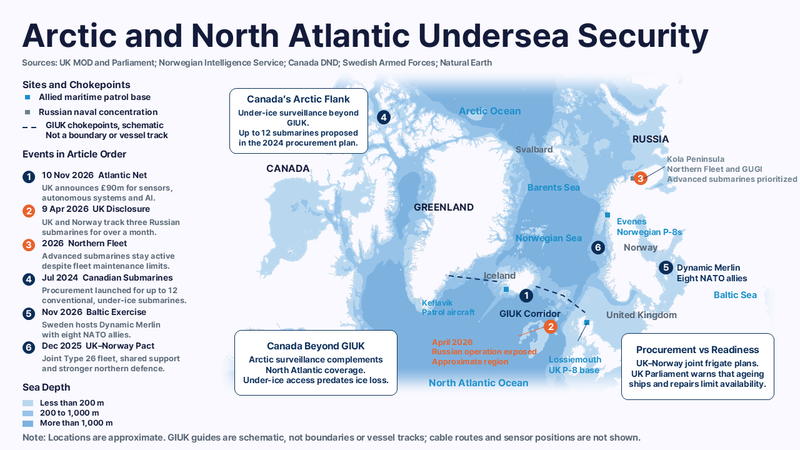
According to Reuters and Britain’s Ministry of Defence on the 11th (all dates hereafter are local time), the British government has decided to invest GBP 90 million in uncrewed systems, sensors and AI to monitor the North Atlantic and protect critical undersea infrastructure. The investment will fund Atlantic Net, the first phase of the Atlantic Bastion initiative, which combines crewed ships with uncrewed assets. Specifically, advanced sensors, sonar and autonomous equipment will be deployed in the waters linking Greenland, Iceland and Britain and connected through AI. The AI will integrate and analyze underwater information collected by the equipment and provide the results to anti-submarine warfare vessels and Astute-class submarines to support detection and tracking. The navy plans to use the system to identify underwater movements early and monitor undersea communications cables and energy networks.
The Royal Navy and marine technology company Ocean Infinity Solutions will jointly build the surveillance network. They plan to combine underwater detection equipment with communications, remote operation and data services under naval command, sourcing key equipment and systems primarily from British small and medium-sized businesses. Commercial X, a newly established organization tasked with improving defense procurement procedures, will also participate to accelerate deployment. Speaking the previous day at the International Seapower Conference in Oslo, Norway, British defense minister Luke Pollard said the time from concept to operation would be cut to two years, half the usual period, allowing Atlantic Net to enter service next year. Underwater information obtained through the network will also support maritime surveillance by NATO and countries participating in the Joint Expeditionary Force (JEF).
Additional Patrol Aircraft Investment Follows Undersea Protection Operations
Alongside expanding its uncrewed surveillance network, Britain is focusing on operations using ships and aircraft to protect undersea infrastructure. In North Atlantic operations disclosed on April 9, Britain worked with allies including Norway for more than a month, monitoring underwater activity with surface ships and aircraft. The Royal Navy deployed frigates and a logistics support ship, while the Royal Air Force contributed P-8 maritime patrol aircraft. Norway also provided a frigate and P-8 patrol aircraft. The two countries’ forces were tasked with monitoring the tracked targets’ movements around the clock. About 500 British military personnel participated, with aircraft logging more than 450 flight hours and frigates sailing thousands of nautical miles.
Additional funding has also been allocated to the air assets supporting prolonged tracking missions. In April, Britain’s Ministry of Defence announced plans to invest an additional GBP 100 million in the P-8 maritime patrol aircraft program, which is responsible for locating submarines. It subsequently told Parliament that the funding would be used for maintenance and necessary operational enhancements. The P-8 is a key asset that shares detection and tracking duties with surface ships and submarines across the sea surface, air and underwater domains. Separately planned upgrades include equipping the aircraft with British-made Sting Ray torpedoes.
Joint Operations Expand to Allied Warships
The Royal Navy is coordinating missions between ships and continuing follow-on deployments to maintain uninterrupted maritime surveillance. One example was the deployment of the Type 23 frigate HMS St Albans to take over tracking duties from another ship of the same class, HMS Somerset. After completing the handover, Somerset was assigned a four-month mission in the North Atlantic to monitor submarine movements and protect critical undersea infrastructure. Britain is also working to align equipment and operating procedures with allied warships so they can smoothly hand over missions to one another.
Norway is the partner with which Britain has formalized cooperation on joint ship operations. Under the Lunna House Agreement signed last December, the two countries agreed to form a combined fleet of at least 13 Type 26 frigates: eight British ships and at least five Norwegian vessels. In particular, they plan to share maintenance facilities, technology and equipment and align operating standards so that their ships can take over one another’s missions. Joint patrols will cover the waters between Greenland, Iceland and Britain, with protecting undersea communications cables and electricity and gas supply infrastructure among the main tasks. Britain also agreed to participate in a Norwegian project to develop motherships that carry and operate uncrewed mine-detection equipment and undersea warfare systems.
While pursuing bilateral joint operations, Britain has also begun cooperation to connect the operational and logistics systems of northern European navies. On the 10th, representatives of the 10 Joint Expeditionary Force (JEF) participating countries signed the Northern Navies Initiative agreement aboard the British aircraft carrier HMS Prince of Wales, docked in Oslo. The participating countries agreed to standardize training requirements, prepare joint operational plans before crises arise and incorporate interoperability from the equipment development stage. Specifically, the plan would allow one country’s task force to command allied sensors and uncrewed vessels, while deployed ships could receive repairs, fuel and supplies at allied ports. Autonomous equipment introduced in the future will also be connected to participating countries’ command-and-control systems for joint operation.
Russian Ships Threatening British Waters Increase 30% in Two Years
Britain’s efforts to strengthen naval cooperation are driven by Russia’s modernization of its submarine force and increased activity in surrounding waters. When signing a defense agreement with Norway last December, the British government said the number of Russian ships threatening British waters had risen 30% over the preceding two years. Russia has also drawn up a long-term investment plan to support its naval buildup. Russian President Vladimir Putin approved the Naval Development Strategy until 2050 last May, after announcing in April of the same year plans to allocate USD 100 billion to building new naval vessels over the following 10 years. His instructions at the time also included mass-producing shipborne drones, uncrewed surface vessels and underwater vehicles, and integrating them into satellite-linked reconnaissance and strike systems.
In the submarine sector, the central effort is replacing multipurpose nuclear-powered submarines designed during the Soviet era with fourth-generation Yasen- and Yasen-M-class boats. On March 19, Russian Navy Commander-in-Chief Alexander Moiseyev announced plans to replace existing third-generation submarines with Yasen-family vessels within the next 10 years. The replacement program covers Akula-, Sierra- and Oscar-II-class submarines, with the new boats intended to handle anti-submarine warfare, attacks on ships and land strikes. Moiseyev particularly emphasized long-range strike capabilities, identifying Kalibr cruise missiles, P-800 Oniks anti-ship missiles and 3M22 Zircon hypersonic missiles as weapons carried by the Yasen family. Russia reportedly plans to continue building these submarines in series while progressively upgrading them with advanced weapons and equipment.
Table 1. Russian Naval Modernization and Expanding Underwater Activity
| Category | Key Item | Details |
|---|---|---|
| Naval buildup | Activity around Britain | British government announced last December that Russian ships threatening British waters had increased 30% over the preceding two years |
| Long-term strategy and investment | Naval Development Strategy until 2050 approved last May Plans announced in April of the same year to allocate USD 100 billion to building new naval vessels over the following 10 years | |
| Expansion of uncrewed forces | Pursuit of mass production of shipborne drones, uncrewed surface vessels and underwater vehicles Instructions to integrate them into satellite-linked reconnaissance and strike systems | |
| Submarine modernization | Generation replacement plan | Plans announced on March 19 to replace third-generation submarines within the following 10 years Replacement of Akula-, Sierra- and Oscar-II-class submarines with fourth-generation Yasen- and Yasen-M-class boats |
| Missions and weapons | Plans for anti-submarine warfare, attacks on ships and land strikes Kalibr cruise missiles, Oniks anti-ship missiles and Zircon hypersonic missiles identified as armaments Plans to pursue serial construction and the introduction of advanced weapons and equipment | |
| Northern Fleet deployment | Arkhangelsk deployment | Delivered in December 2024; moved to the Zapadnaya Litsa base early last year Third Yasen-family submarine at the base approximately 60 km from the Norwegian border |
| Underwater strike training | Kalibr launched while submerged in the Barents Sea on May 22 last year Yasen-M class designed to carry Kalibr and Oniks missiles in eight vertical launch tubes | |
| Undersea infrastructure Activity nearby | Targets tracked by Britain | Targets of the prolonged tracking operation disclosed in April One Akula-class attack submarine and two special-purpose submarines belonging to the Main Directorate of Deep-Sea Research (GUGI) |
| British Ministry of Defence assessment | Special-purpose submarines operated near undersea infrastructure while the attack submarine diverted attention Included British and allied EEZs Special-purpose submarines’ missions described as surveying underwater infrastructure in peacetime and damaging it during conflict |
Russia Deploys Third Yasen-Class Submarine to Northern Fleet
New submarines are being deployed to Russia’s Northern Fleet base near Norway. The Yasen-M-class K-564 Arkhangelsk, delivered to the Russian Navy in December 2024, moved early last year to the Zapadnaya Litsa base on the Kola Peninsula. It is the third Yasen-family submarine deployed to the base, approximately 60 km from the Norwegian border. On May 22 last year, it subsequently conducted an underwater strike exercise, firing a Kalibr cruise missile while submerged in the Barents Sea. The Yasen-M class is designed to carry Kalibr and Oniks missiles in eight vertical launch tubes, enabling attacks on both land targets and surface ships.
Russia’s underwater activity also includes covert surveys around undersea infrastructure. The targets of the prolonged tracking operation Britain disclosed in April were one Russian Akula-class attack submarine and two special-purpose submarines belonging to the Main Directorate of Deep-Sea Research (GUGI). Britain’s Ministry of Defence assessed that the special-purpose submarines operated around undersea infrastructure in other waters while the attack submarine drew the attention of surveillance forces. According to Britain, GUGI’s special-purpose submarines are designed to survey underwater infrastructure in peacetime and damage it during conflict. Their activities at the time also extended into the exclusive economic zones (EEZs) of Britain and its allies.
Heightened Vigilance in the Baltic Sea and Arctic Ocean
Russian submarine activity identified in British and allied waters has also become a challenge requiring a collective response from European countries that share undersea infrastructure. Protecting cables and pipelines connecting multiple countries requires their ships and aircraft first to align procedures for sharing underwater detection data and jointly tracking submarines. NATO members are therefore conducting joint exercises in the Baltic Sea to test procedures for operating these assets together. Dynamic Merlin 26, a five-day anti-submarine exercise that began on the 9th with Sweden as its base, involved eight countries in total, including Britain, Germany, France, the Netherlands, Denmark, Finland and Canada. Surface ships and maritime patrol aircraft from the participating countries practiced locating and tracking German and Swedish submarines while sharing detection data. The Baltic Sea is considered particularly challenging for distinguishing submarine signals from background noise because of its shallow waters and heavy merchant shipping traffic.
Canada, which joined the anti-submarine exercises in Europe, is also watching for approaches to its own shores through the Arctic Ocean. Canada’s Department of National Defence has identified the Atlantic, Arctic and Pacific oceans as areas of Russian submarine activity and made strengthening underwater surveillance along all three coasts a defense priority. Facing Russia across the Arctic Ocean, Canada must also monitor underwater routes crossing the Arctic. As declining sea ice makes access easier for foreign ships, nuclear-powered submarines can remain submerged and move beneath the ice for extended periods. The Canadian navy’s Arctic strategy document also identifies submarines operating beneath sea ice and the ability to damage undersea infrastructure as threats.
Canada’s response combines acquiring underwater detection equipment with expanding military activity in northern waters. Its Department of National Defence plans to introduce submarine-detection sensors, acquire seabed survey capabilities and establish northern operational support hubs for deployed personnel and equipment. The aim appears to be to secure both equipment for understanding underwater conditions and the logistical infrastructure needed for an on-site response. In July, Canada conducted Operation Latitude jointly with the United States in northern waters, including the Bering Sea. Canadian naval vessels and coast guard icebreakers participated in maritime activities, while Royal Canadian Air Force CP-140 Aurora patrol aircraft provided long-range surveillance and reconnaissance to monitor the northern approaches to North America.
Table 2. Royal Navy Force Shortfalls and Constraints on Undersea Cable Repairs
| Category | Key Item | Current Status and Constraints |
|---|---|---|
| Naval force shortfalls | Frigates and destroyers | Five frigates and six destroyers, totaling 11 ships 58% of the requirement of 19 ships |
| Anti-submarine detection assets | Five frigates equipped with Sonar 2087 towed-array sonar Three ships short of the requirement of eight | |
| Aging and maintenance burdens | Deteriorating operational availability of anti-submarine frigates and nuclear-powered submarines House of Commons Defence Committee questioned the ability to sustain maritime missions in the Arctic and North Atlantic in 2030 | |
| Capability gaps during ship replacement | Delayed commissioning of new ships | Commissioning of new frigates, originally scheduled for the mid-2020s, delayed Limits to extending the service lives of aging Type 23 frigates |
| Retirement of existing ships | Richmond and Iron Duke retired in the middle of this year, reducing Type 23 frigates from seven to five Iron Duke listed for retirement less than three years after completing a five-year major refit Anti-submarine patrols, carrier escorts and protection of strategic submarines entering and leaving port concentrated on remaining ships | |
| Undersea cables Repair constraints | Securing repair vessels | Aging vessels for communications cable maintenance and repair Deployment of power cable repair vessels to new cable-laying projects limits emergency mobilization |
| Personnel and permits | Shortage of skilled personnel and differing national permitting procedures Repairs may be delayed even after damage locations are identified | |
| Risk of supply disruptions | Delays in securing ships, personnel and work permits could prolong communications and electricity supply disruptions |
Shortages of Ships and Repair Capacity Hinder Expansion of Undersea Defenses
However, the expansion of surveillance areas and operations is also exposing shortages of the ships, maintenance capacity and logistics assets needed to sustain them. Britain, for example, which leads Europe’s maritime response, is struggling to secure deployable forces as declining frigate numbers coincide with maintenance delays. According to a report released on the 22nd of last month by the House of Commons Defence Committee, the Royal Navy had five frigates and six destroyers, just 58% of its requirement of 19 ships. In particular, only five of the required eight frigates equipped with Sonar 2087 towed-array sonar for detecting submarines remained. Citing the aging of anti-submarine frigates and nuclear-powered submarines and their maintenance burden, the committee questioned whether current operational availability would allow the navy to sustain the maritime missions required in the Arctic and North Atlantic in 2030.
The ship replacement process has also created capability gaps. The committee assessed that commissioning schedules for new frigates, originally set for the mid-2020s, had slipped, while extending the service lives of aging Type 23 frigates until their replacements arrived had become difficult. In July this year, HMS Richmond and HMS Iron Duke retired, reducing the Type 23 frigate fleet from seven ships to five. Iron Duke was placed on the retirement list less than three years after completing a major five-year refit. With delays in new ship deliveries coinciding with the retirement of existing vessels, the remaining frigates are bearing the combined burden of anti-submarine patrols, carrier escorts and protection of strategic submarines entering and leaving port.
Alongside the navy’s surveillance missions, gaps remain in securing the civilian ships and personnel needed to repair damaged undersea infrastructure. In a joint statement last year, the European Subsea Cables Association (ESCA) and the International Marine Contractors Association (IMCA) said shortages of skilled personnel and differing national permitting procedures were delaying cable repairs. Vessels used to maintain and repair communications cables are aging, while power cable repair ships are sometimes deployed to new cable-laying projects, making them unavailable for immediate emergency repairs. When repair vessels are occupied with other projects or work permits are delayed, repairs cannot begin even after the damaged location has been identified. Thus, even after surveillance networks detect signs of trouble, delays in securing vessels and personnel and completing administrative procedures could prolong disruptions to communications and electricity supplies.
Matthew Reuter is a senior economic correspondent at The Economy, where he covers global financial markets, emerging technologies, and cross-border trade dynamics. With over a decade of experience reporting from major financial hubs—including London, New York, and Hong Kong—Matthew has developed a reputation for breaking complex economic stories into sharp, accessible narratives. Before joining The Economy, he worked at a leading European financial daily, where his investigative reporting on post-crisis banking reforms earned him recognition from the European Press Association. A graduate of the London School of Economics, Matthew holds dual degrees in economics and international relations. He is particularly interested in how data science and AI are reshaping market analysis and policymaking, often blending quantitative insights into his articles. Outside journalism, Matthew frequently moderates panels at global finance summits and guest lectures on financial journalism at top universities.
- Previous Flying 4,800 km, parachuting in and heading straight into battle: Alaska-based U.S. airborne troops confront the ‘tyranny of distance’
- Next “China’s Export Control Reprieve Buys Time,” but EU Supply Chain Independence Faces a Dilemma as Costs, Regulation and Pricing Hinder Efforts to Reduce Reliance on China
Similar Post