“Where Will the Iran War Head After the Midterms?” Trump Moves to Secure Defense Funding and Weapons, With Policy Clashes Expected if Democrats Retake Congress

Oliver Griffin is a policy and tech reporter at The Economy, focusing on the intersection of artificial intelligence, government regulation, and macroeconomic strategy. Based in Dublin, Oliver has reported extensively on European Union policy shifts and their ripple effects across global markets. Prior to joining The Economy, he covered technology policy for an international think tank, producing research cited by major institutions, including the OECD and IMF. Oliver studied political economy at Trinity College Dublin and later completed a master’s in data journalism at Columbia University. His reporting blends field interviews with rigorous statistical analysis, offering readers a nuanced understanding of how policy decisions shape industries and everyday lives. Beyond his newsroom work, Oliver contributes op-eds on ethics in AI and has been a guest commentator on BBC World and CNBC Europe.
Authored On
Modified
U.S.-Iran peace talks remain deadlocked, with further military clashes possible after U.S. midterms
As Democrats’ chances of retaking Congress rise, Trump moves to secure defense funding in advance
U.S. expands joint weapons production with allies including Japan, bolstering its ability to sustain military operations
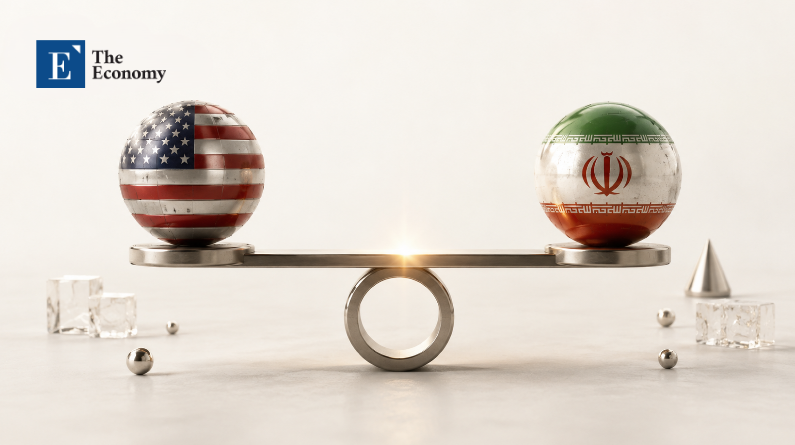
Military uncertainty surrounding the United States and Iran is growing. As the prospect of Democrats regaining a congressional majority gains attention ahead of the U.S. midterm elections, observers have begun suggesting that political checks on future military operations against Iran could intensify. Others, however, argue that a shift in control of Congress would not sharply reduce Washington’s capacity to conduct military operations in the short term. That is because the Donald Trump administration has already pushed to secure separate defense funding and additional appropriations while accelerating efforts to expand weapons production capacity with allies such as Japan.
Iran-Qatar Talks Hit Snags
According to Reuters on the 31st of last month (all dates hereafter are local time), Iranian negotiators held more than 12 hours of discussions with a delegation of Qatari envoys in Tehran the previous day before moving to Doha on the 31st to continue talks. Qatar proposed that the United States and Iran implement incremental confidence-building measures each day for seven days before beginning comprehensive peace negotiations. Iran, however, expressed reservations, saying its core demands had not been adequately reflected. The biggest sticking point was the sequence of discussions on sanctions relief and the nuclear issue. Washington maintains that Iran’s nuclear program must be on the agenda from the outset, while Tehran insists that the United States must first lift its blockade of Iranian ports and ease sanctions on oil exports.
Iran reportedly proposed reopening the Strait of Hormuz to shipping within two days if the United States accepted its demands. Those conditions included the withdrawal of new U.S. sanctions; restoration of waivers for existing oil export sanctions; a reduction in the U.S. military presence in the Middle East; recognition of shipping routes designated by Iran and Oman; and an end to hostilities on regional fronts, including Lebanon. Despite the sharp differences between the two sides, the negotiations themselves have reportedly continued. Iranian Foreign Minister Abbas Araghchi told state media on the 1st, “Talks are continuing, but we have not reached a final conclusion,” adding, “We hope the other side will exercise sound judgment and prioritize diplomacy over other options.”
Trump Keeps Up Military Threats
The United States is also leaving room for a diplomatic solution. U.S. Secretary of State Marco Rubio said on the 31st of last month that President Trump had not decided whether to launch additional attacks on Iran and preferred a diplomatic resolution. However, international observers are not ruling out the possibility of renewed military clashes after the U.S. midterm elections on the 3rd. Trump has repeatedly increased pressure on Iran by signaling his willingness to use further military force. At a rally in Fort Myers, Florida, on the 23rd of last month, for example, he said, “We may carry out another little ‘Epic Fury’ operation.” Epic Fury is the name of the military operation that began with U.S. and Israeli attacks on Iran on February 28.
At Joint Base Andrews in Maryland on the 28th of last month, Trump also responded to reporters’ questions about the possibility of additional airstrikes after the midterms by saying, “I can’t say for sure, but anything is possible.” He asserted, “We are in a very strong position on Iran,” adding, “The only question is when I want to end the war.” He went on to say, “Iran wants a deal but is delaying the negotiations,” stressing, “They may be waiting for the election, but the election will not help them.” The U.S. government has also shown signs of preparing for a resumption of armed conflict. According to the Associated Press, U.S. diplomatic and defense officials recently notified Middle Eastern countries and allies that attacks on Iran could resume after the midterms and advised them to prepare for Iranian retaliation. They warned that a new military operation could last several days and that Iran could strike energy facilities and critical infrastructure in the Gulf region.
Republicans’ Hold on Congress Under Threat
As tensions between the two countries rise again, forecasts differ on the Trump administration’s course of action after the midterms. One view is that the election results could put constraints on the administration’s military and diplomatic moves. A joint Reuters/Ipsos poll released on the 26th of last month put Trump’s job approval rating at 32%. That was a rebound of 1 percentage point from the record low of 31% recorded a week earlier, but still 15 percentage points below the 47% recorded when he took office in January. Erosion of support among Republicans is also pronounced. In a Reuters/Ipsos poll conducted on September 17–20, Trump’s job approval rating among Republican supporters stood at 73%, down 13 percentage points from 86% in January this year. Over the same period, Republican approval of his economic policies fell from 80% to 56%, while approval of his handling of the cost of living declined from 70% to 44%.
Under these circumstances, if Democrats regain a majority in either the Senate or the House in the midterms, they will be able to strengthen checks on the Trump administration through their budget review and congressional investigative powers. In particular, the still-unfinalized budget for fiscal year 2027 (October 2026–September 2027) is likely to emerge as a major issue after the elections. Defense spending is one of the key potential flashpoints. In its fiscal 2027 budget proposal released in April, the Trump administration asked Congress to allocate a total of USD 1.5 trillion to defense, an increase of about 66% from the previous year. Democrats, however, oppose the request, citing the administration’s insufficient consultation with Congress over the Iran war and its plans to cut nondefense spending.
Table. Outlook for the Trump Administration’s Approach to Iran After the Midterms
| Outlook | Key Rationale | Expected Impact |
|---|---|---|
| Constraints on military and diplomatic moves | If Democrats regain a majority, they could exercise oversight of the fiscal 2027 defense budget and procedures for conducting the war | Obstacles to securing additional defense funding and pursuing military operations against Iran |
| Limited immediate impact | President retains military operational authority and veto power; additional funding could be pursued before the new Congress takes office | Existing course of military operations against Iran maintained |
Trump and Republicans Prepare in Advance
Others, however, argue that even if Democrats regain a majority in the midterms, the Trump administration’s military operations against Iran will not change immediately. The administration continues to maintain its legal interpretation that it can conduct military operations without separate congressional authorization, and overriding a presidential veto would require support from at least two-thirds of both the House and the Senate. Late last month, the Brookings Institution, a U.S. think tank, assessed that even if Democrats gained a congressional majority, they would struggle to secure enough seats to override a presidential veto. It also noted that completely cutting off funding for the war would be a politically costly option, as it could affect U.S. military operations and readiness.
The Trump administration is also pursuing a strategy of securing separate defense funding in anticipation of congressional budget constraints. A sweeping tax-cut and spending law passed under Republican leadership in July last year included USD 156 billion in funding for the Department of Defense. The funds were made available for obligation through September 2029, and, unlike the defense budget, their designated uses are relatively broad, giving the department greater discretion over their management. Republicans could also move after the midterms to minimize Democratic influence over the budget. The Center for Strategic and International Studies (CSIS), a U.S. think tank, said that if Republicans lose their congressional majority in the elections, they could use the budget reconciliation process to pursue additional defense funding before the new Congress takes office in January next year. While ending debate on ordinary legislation in the U.S. Senate generally requires 60 votes, bills considered through budget reconciliation can pass with a simple majority.
Moves to Secure More Weapons
Meanwhile, the United States is accelerating efforts to secure weapons by drawing on its allies’ production capacity. In April, Kyodo News reported that the U.S. and Japanese governments were pursuing plans to establish a new public-private partnership framework before the end of the year to jointly develop and produce advanced defense equipment using dual-use technologies. A plan to manufacture drones developed by a U.S. startup in Japan was reportedly being considered as the first project. In May, Japanese Defense Minister Shinjiro Koizumi and U.S. Ambassador to Japan George Glass jointly visited a production facility operated by local drone manufacturer Prodrone, signaling their interest in related industrial cooperation. Discussions on expanding missile production capacity have become more concrete. At the Defense Industrial Cooperation, Acquisition and Sustainment (DICAS 2.0) talks in April, the United States and Japan reaffirmed plans to roughly quadruple production of the jointly developed SM-3 Block IIA sea-based ballistic missile interceptor. In August, the U.S. Department of Defense signed framework agreements with Boeing and RTX to expand supplies of key components for the SM-3 missile family. The United States and Japan are also discussing ways to strengthen joint production capacity for PAC-3 MSE interceptor missiles used in the Patriot air defense system.
On the 29th of last month, the two countries agreed to establish a final assembly and inspection facility in Japan for the Advanced Medium-Range Air-to-Air Missile (AMRAAM). The decision was finalized during talks between Defense Minister Koizumi and U.S. Secretary of Defense Pete Hegseth on the sidelines of the ASEAN Defence Ministers’ Meeting-Plus (ADMM-Plus) in Cebu, the Philippines, on the 28th. AMRAAM is an advanced medium-range air-to-air missile manufactured by Raytheon, a subsidiary of U.S. defense company RTX, and is used by fighter aircraft to strike enemy aircraft beyond visual range. During the initial phase of flight, it uses targeting information supplied by fighter aircraft and other sources, then tracks its target with its own active radar seeker in the terminal phase.
Oliver Griffin is a policy and tech reporter at The Economy, focusing on the intersection of artificial intelligence, government regulation, and macroeconomic strategy. Based in Dublin, Oliver has reported extensively on European Union policy shifts and their ripple effects across global markets. Prior to joining The Economy, he covered technology policy for an international think tank, producing research cited by major institutions, including the OECD and IMF. Oliver studied political economy at Trinity College Dublin and later completed a master’s in data journalism at Columbia University. His reporting blends field interviews with rigorous statistical analysis, offering readers a nuanced understanding of how policy decisions shape industries and everyday lives. Beyond his newsroom work, Oliver contributes op-eds on ethics in AI and has been a guest commentator on BBC World and CNBC Europe.
Similar Post