Flying 4,800 km, parachuting in and heading straight into battle: Alaska-based U.S. airborne troops confront the ‘tyranny of distance’

Anne-Marie Nicholson is a fearless reporter covering international markets and global economic shifts. With a background in international relations, she provides a nuanced perspective on trade policies, foreign investments, and macroeconomic developments. Quick-witted and always on the move, she delivers hard-hitting stories that connect the dots in an ever-changing global economy.
Authored On
Modified
Nonstop flight and parachute drop into Hawaii test the link between long-distance movement and combat
Exercises in Asia draw on local aviation and armored forces
Alaska’s role as a hub strengthened, from troop deployment to combat support

The U.S. Army is continuing exercises that deploy troops from Alaska across the Pacific and send them into combat alongside local forces. The 11th Airborne Division’s recent nonstop flight of approximately 4,800 km, followed by a parachute drop into Hawaii to secure key positions, was part of training linking long-distance movement with ground combat. In South Korea, Japan, India and Indonesia, troops coordinated with local aviation and armored forces to review operational procedures across terrain ranging from mountains to jungles. As Chinese and Russian joint military activities continue in the waters and airspace around Alaska, the U.S. military is reorganizing its forces stationed there and strengthening command and supply systems to support Arctic defense and long-range deployments to the Indo-Pacific.
Testing the feasibility of direct long-range deployment
According to U.S. defense news outlet Defence Blog and publicly released U.S. Army materials on the 11th (all dates local), troops from the Alaska-based 11th Airborne Division recently flew approximately 4,800 km nonstop before securing key positions in a simulated assault operation in Hawaii. The operation, called Arctic Aloha, was part of the Joint Pacific Multinational Readiness Center (JPMRC) exercise 27-01 and focused on testing procedures for sending troops directly into ground combat after a long-distance journey. Col. Matthew Adamczyk, the division’s deputy commanding officer for operations, said the exercise would validate the division’s ability to “strategically deploy and project power across a large distance,” according to a November 6 U.S. Army account.
The troops boarded C-17 Globemaster III transport aircraft at Joint Base Elmendorf-Richardson and spent approximately eight hours in transit, donning parachutes and combat equipment aboard the aircraft to prepare for the jump. During the flight, they joined an infantry company that had completed the U.S.-Japan exercise Keen Sword in Japan and deployed to the target area as a battalion-sized task force. The exercise linked long-distance flight, the joining of units and the seizure of objectives into a single operation to counter the so-called ‘tyranny of distance,’ in which the vast distances between bases and troops constrain movement and coordination. During a November 9 interview with The Economy, Brigadier General Matthew S. Komatsu, deputy commander of Alaskan Command (ALCOM), used the same expression, “tyranny of distance,” when discussing the difficulty of coordinating activities across Alaska’s widely separated locations. His remarks concerned the wider Alaska theater, not the Arctic Aloha exercise specifically.
As the troops crossed the Pacific, they also practiced command-and-control procedures during airborne transit. Command personnel aboard the transport aircraft connected through digital communications networks with I Corps, U.S. Army Pacific and the joint force headquarters at Joint Base Pearl Harbor-Hickam in Hawaii to share battlefield information. Particular emphasis was placed on maintaining communications while headquarters neutralized simulated enemy air defenses and verifying that conditions were suitable for the parachute drop. Under this procedure, I Corps coordinates the use of space, cyber and electronic warfare assets, while participating forces, including the 25th Infantry Division, strike air defenses before airborne troops are inserted. Following the preparatory strikes, approximately 300 troops parachuted into the Pohakuloa Training Area on the island of Hawaii, tasked with securing key facilities and terrain.
After the airborne troops secured their positions, the 25th Infantry Division conducted a long-range air assault over water. Helicopters from the 25th Combat Aviation Brigade carried troops from the division’s 2nd Mobile Brigade across the sea and dropped them at their objectives, where the infantry entered ground combat. Immediately after landing, the troops moved to covered and concealed positions in the volcanic terrain, engaged opposing forces and practiced securing and defending the target area. The exercise also included supply procedures linking long-distance flight with ground combat. Aviation and logistics support units operated refueling sites established in advance on individual islands to support aircraft movements, and the 8th Theater Sustainment Command reportedly airdropped heavy cargo immediately after the troops’ insertion.
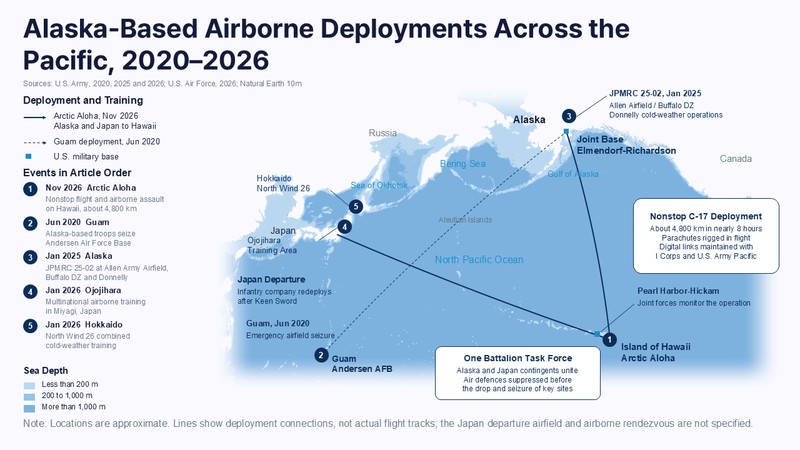
Repeated drills to secure key positions after parachute drops in Guam and Alaska
Exercises deploying troops from Alaska to Pacific islands to secure key positions have been underway for several years. On June 30, 2020, approximately 350 soldiers from what was then the 25th Infantry Division’s 4th Airborne Brigade deployed to Andersen Air Force Base in Guam. They received deployment orders a few days before the operation, boarded C-17 transport aircraft at Joint Base Elmendorf-Richardson, donned parachutes during the flight and jumped into Guam to secure the airfield. The exercise was part of an emergency deployment readiness assessment, intended to combine deployment preparations, long-distance air movement and the seizure of objectives into a single operation.
Exercises that continue into ground combat after securing key positions are also being repeated in Alaska. During JPMRC’s cold-weather combat exercise 25-02, held in Alaska in January last year, troops from the 11th Airborne Division’s 2nd Brigade flew aboard C-130 and C-17 transport aircraft to Allen Army Airfield and Buffalo Drop Zone. Their mission was to seize the airfield and establish an operational foothold, with the division’s 1st Brigade serving as the opposing force. After parachuting in, the troops established defensive positions, patrolled snow-covered fields and forests and engaged in combat, while support units delivered ammunition and supplies. The U.S. Army said the exercise also included follow-on resupply needed for combat after the drop, including transporting vehicles and heavy equipment by CH-47 Chinook helicopter.
Organizing transport and supply units to support combined exercises overseas
Training linking parachute drops with cold-weather ground operations continued in a combined exercise with Japan’s Self-Defense Forces in January this year. Troops from the 11th Airborne Division attended joint briefings and rehearsals at the Narashino Training Area before participating in multinational airborne training at Ojojihara in Miyagi Prefecture. The airborne insertion for North Wind 26, held in Hokkaido on the 22nd of the same month, involved four C-130J transport aircraft and 106 paratroopers from the 2nd Brigade, with jumpmasters from the Japan Ground Self-Defense Force’s 1st Airborne Brigade also taking part. The schedule called for personnel and equipment checks immediately after the drop, followed by five days of cold-weather training. The troops practiced winter operational procedures with the Self-Defense Forces and concluded with a field training exercise simulating combat.
Transport, maintenance and supply organizations are also being established to support recurring field exercises. Last month, the 11th Airborne Division activated an Arctic sustainment brigade at Joint Base Elmendorf-Richardson to coordinate logistics support for units dispersed throughout Alaska. The road distance between the division’s two principal garrisons, Joint Base Elmendorf-Richardson and Fort Wainwright, is approximately 560 km, with another 160 km to travel from Fort Wainwright to the Donnelly Training Area. Key responsibilities include moving equipment and managing supply schedules using Polar Express, the ground transportation network linking the two garrisons. The division’s Arctic Aviation Command supplements ground transportation by carrying troops, equipment and supplies to training sites by helicopter.
Table 1. Major 11th Airborne Division exercises in Asia
| Training location | Exercise and timing | Participating forces and key activities |
|---|---|---|
| India | Yudh Abhyas This year | Combined exercise with Indian forces Adapting to local climate and terrain; mastering operational procedures |
| Indonesia South Sumatra | Super Garuda Shield September 4 | Participation by the 1st Battalion, 501st Parachute Infantry Regiment Coordinating jump timing and communications procedures among participating countries’ troops Organizing multinational platoons into a single battalion after the drop, moving to objectives and conducting jungle training |
| South Korea Yeongpyeong Training Area, Pocheon, Gyeonggi Province | Linked to Freedom Shield South Korea-U.S. combined-arms live-fire training March 23–24 | Participation by the 1st Squadron, 40th Cavalry Regiment A total of 900 South Korean and U.S. Army and Marine Corps personnel participated Drone reconnaissance → mortar and Apache strikes → ground maneuver supported by K2 tanks and K21 infantry fighting vehicles Engineer support for breaching obstacles; coordinating the timing of firepower and maneuver between units |
900 South Korean and U.S. troops conduct combined-arms training in Pocheon
The 11th Airborne Division’s training locations span Northeast, Southeast and South Asia. This year, it conducted the combined exercise Yudh Abhyas with Indian forces in India and sent troops to Super Garuda Shield in Indonesia. On September 4 in South Sumatra, Indonesia, soldiers from the 1st Battalion, 501st Parachute Infantry Regiment coordinated jump timing and communications procedures with troops from participating countries before deploying together into the tropical region. After the drop, platoons from several countries were assigned to a single battalion formation, moved toward their objectives and continued with jungle training. Practicing operational procedures with local forces in different climates and terrain is a common element of these overseas exercises. As Maj. Gen. John P. Cogbill, commanding general of the 11th Airborne Division, put it in a September U.S. Army report, “The Arctic is our expertise, but it is not our limitation.”
South Korea is also a major training location. On March 23–24 this year, the 1st Squadron, 40th Cavalry Regiment, under the 11th Airborne Division, participated in South Korea-U.S. combined-arms live-fire training at the Rodriguez Live Fire Complex, also known as the Yeongpyeong Training Area, in Pocheon, Gyeonggi Province. Linked to the South Korea-U.S. combined exercise Freedom Shield, the training involved a total of 900 personnel from the South Korean Army and Marine Corps and the U.S. Army and Marine Corps. The formation combined troops arriving from Alaska with U.S. Forces Korea attack helicopters, U.S. Marine Corps engineers and firepower liaison personnel, and South Korean mechanized units. The U.S. 2nd Infantry Division explained that the training in South Korea was intended to help a unit specializing in Arctic warfare improve its adaptability in a different environment and practice long-range deployment procedures.
The training in Pocheon can be seen as a process of familiarizing troops with South Korean terrain while coordinating with forces stationed locally. The exercise began with reconnaissance drones identifying enemy positions, followed by successive strikes from South Korean 81 mm mortars, U.S. 60 mm mortars and Apache attack helicopters. In coordination with this fire support, ground troops advanced toward enemy positions with support from K2 tanks and K21 infantry fighting vehicles and secured key objectives. During the advance, they also practiced breaching obstacles such as minefields with support from engineer units. The exercise linked the missions of multiple units to strike enemy positions identified through reconnaissance and coordinate ground troop movements accordingly.
Table 2. Key developments in the drawdown and reorganization of U.S. forces in Alaska
| Category | Timing | Key details |
|---|---|---|
| Post-Cold War force reductions | July 1994 | Inactivation of the 6th Infantry Division, responsible for Arctic combat |
| March 1997 | Naval Air Facility Adak’s military mission ended A base for monitoring Soviet submarines during the Cold War | |
| Reorganization of Arctic forces | 2021 | U.S. Army announced its Regaining Arctic Dominance strategy Efforts to establish combat brigades for cold-weather operations and an operational headquarters led by a major general |
| By April 2022 | 54 F-35As deployed to Eielson Air Force Base Two operational flying squadrons established | |
| June 2022 | 11th Airborne Division reactivated Approximately 12,000 troops stationed in Alaska and two existing brigades of the 25th Infantry Division integrated | |
| Chinese-Russian joint military activities | August 2023 | 11 Chinese and Russian vessels operated near the Aleutian Islands Tracked by four U.S. Navy destroyers and maritime patrol aircraft |
| July 2024 | Two Russian Tu-95s and two Chinese H-6s entered the Alaska Air Defense Identification Zone U.S. and Canadian fighter jets scrambled in response Flew in international airspace without violating either country’s territorial airspace | |
| Strengthening Arctic strategy | 2024 | U.S. Department of Defense’s Arctic Strategy reflected expanding Chinese-Russian military cooperation Specified stronger Arctic surveillance and communications systems and expanded operations and exercises |
| Deployment to outlying islands | September 2024 | Approximately 130 personnel, including troops from the 11th Airborne Division and a Multi-Domain Task Force, temporarily deployed to Shemya Island Training to deploy ground forces to outlying islands in the Aleutian chain |
Reorganizing Alaska forces reduced after the Cold War
The 11th Airborne Division’s repeated overseas deployments are tied to the U.S. military’s force reorganization, which uses Alaska as a hub for Arctic defense and troop deployments to the Indo-Pacific. After the Cold War ended in the early 1990s, Alaska saw a succession of major unit inactivations and base closures. The 6th Infantry Division, responsible for Arctic combat, was inactivated in July 1994, and the naval air facility on Adak Island in the Aleutians ended its military mission in March 1997. During the Cold War, Adak Island had served as a base for monitoring Soviet submarine movements in the North Pacific. Following the Soviet Union’s collapse, however, the U.S. military reorganized its overseas and forward basing structure, and Alaska’s division-level combat units and maritime surveillance facilities were included in the reductions.
The factor that has recently gained the greatest weight in U.S. Arctic defense planning is continued Chinese-Russian joint military activity around Alaska. In August 2023, when 11 vessels from the two countries operated near the Aleutian Islands, the U.S. Navy deployed four destroyers and maritime patrol aircraft to track them. In July the following year, two Russian Tu-95 bombers and two Chinese H-6 bombers entered the Alaska Air Defense Identification Zone, prompting U.S. and Canadian fighter jets to scramble. Although the Chinese and Russian bombers flew in international airspace without violating territorial airspace, the United States is focusing on the two countries’ accumulation of joint operational experience near its territory. The U.S. Department of Defense’s 2024 Arctic Strategy also expressed concern about Chinese-Russian military cooperation. It cited joint exercises off Alaska’s coast as evidence of a changing security environment and identified stronger Arctic surveillance and communications systems and expanded operations and exercises as priorities. A separate The Economy analysis based on its interview with ALCOM cautioned, however, that joint patrols and exercises should not be treated as proof that Russian and Chinese forces can fight as a single integrated force.
The U.S. Army’s reorganization to prepare for Arctic competition with China and Russia took concrete shape with the Regaining Arctic Dominance strategy announced in 2021. Its central objective was to establish combat brigades trained and equipped for extreme cold-weather operations and an operational headquarters led by a major general to command them. Accordingly, the 11th Airborne Division was reactivated in June 2022, bringing approximately 12,000 troops in Alaska and two existing brigades of the 25th Infantry Division under the new division’s command structure. Airpower was strengthened during the same period, with 54 F-35As deployed to Eielson Air Force Base and two operational flying squadrons established by April 2022. In September 2024, approximately 130 personnel, including troops from the 11th Airborne Division and a Multi-Domain Task Force, temporarily deployed to Shemya Island in the Aleutians as part of training to send ground forces to outlying islands.
U.S. and India also conduct air assault training in mountains near the Chinese border
The air-mobile forces organized in Alaska are also continuing training in the mountains of northern India near China. On September 25, the 11th Airborne Division’s 1st Mobile Brigade Combat Team conducted an air assault with Indian forces near Auli in Uttarakhand to secure two objectives. Part of Yudh Abhyas 2026, the exercise involved forming companies from a mix of U.S. and Indian platoons and inserting troops aboard Indian military helicopters. After a battalion reconnaissance team surveyed the target area, the lead company secured the first objective. Follow-on troops landed near the second objective aboard Dhruv Mk III helicopters and formed up for an assault. Indian troops then rappelled from helicopters to join them, and the combined force shifted to a defensive posture after securing both objectives.
The helicopter air assaults used in this exercise and parachute drops from transport aircraft are both methods of airborne insertion maintained by the U.S. Army. The 101st Airborne Division specializes in helicopter-based air assaults, while the 82nd Airborne Division is tasked with securing key positions through parachute drops to support follow-on operations. The 11th Airborne Division likewise practices mission-appropriate insertion methods based on its 1st Brigade’s air assault capability and its 2nd Brigade’s parachute capability. In the exercise in India, aligning U.S. ground troops’ operational plans with local aviation forces was particularly important.
The combined training by Indian aviation forces and U.S. ground troops near the Chinese border is seen as reflecting an intention to counterbalance China. Auli, where the exercise took place, is approximately 100 km from the Line of Actual Control (LAC) between China and India. A U.S.-India combined exercise held there in 2022 triggered a diplomatic dispute between the two countries and China. In this location, which had previously experienced such tensions, the two countries this year tested procedures for forming mixed units and commanding them together. Indian platoons were assigned to a U.S.-led company, while U.S. platoons were integrated into an Indian company tasked with deception operations, with each company carrying out its assigned mission. By practicing readiness and interoperability—the U.S. military’s stated official training objectives—in the mountains near the Chinese border, the exercise can also be seen as building experience needed for a joint response in a contingency.
Anne-Marie Nicholson is a fearless reporter covering international markets and global economic shifts. With a background in international relations, she provides a nuanced perspective on trade policies, foreign investments, and macroeconomic developments. Quick-witted and always on the move, she delivers hard-hitting stories that connect the dots in an ever-changing global economy.
- Previous “Destabilizing the Regime Without Military Operations”: U.S. Maritime and Economic Pressure Paralyzes Iran’s Oil Exports, Raising Fears of Internal Power Struggles Under Prolonged Pressure
- Next Russian Naval Buildup Heightens North Atlantic Tensions, Spurring Measures From Uncrewed Surveillance Networks to Joint Fleets
Similar Post