[Arctic Maritime Strategy] Russia–China Military Cooperation: How Alaskan Command Plans for Deterrence

Working across research, policy, and data-driven analysis, the Editorial Board ensures that published pieces reflect a consistent institutional perspective grounded in quantitative reasoning and long-term structural assessment.
Authored On
Modified
Russia-China activity creates planning challenges without demonstrated unified command
Komatsu sees potential dual-use value in China's Arctic research data
ALCOM says TUNDRA MERLIN is intended to deter conflict, not provoke it
This article is based on an interview conducted by The Economy with Brigadier General Matthew S. Komatsu, Deputy Commander of Alaskan Command (ALCOM), on November 9, 2026, supplemented by publicly available military, government and research sources.
Alaskan Command's Public Affairs office reviewed this article before publication for factual accuracy and attribution, provided factual clarifications, and confirmed that BG Komatsu's comments were quoted accurately and in context. This review does not imply endorsement of the article or its editorial conclusions.
The analysis and editorial judgments in this article are independently developed by The Economy and do not necessarily represent the views of any interview participant or government organization.
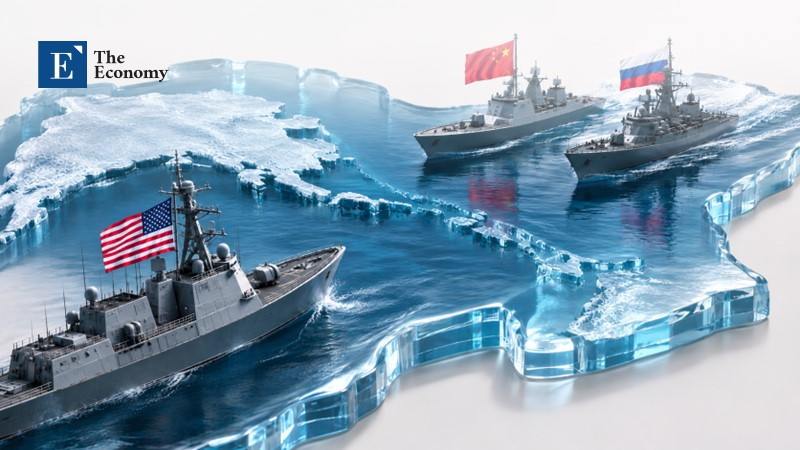
On July 24, 2024, NORAD intercepted two Russian Tu-95 and two Chinese H-6 bombers in the Alaskan Air Defense Identification Zone. The aircraft remained in international airspace, and NORAD did not assess the flight as a threat. The patrol nevertheless demonstrated that Russian-Chinese military cooperation can bring Chinese aircraft into an area near North America where they had not previously appeared. The two militaries have not demonstrated that they can fight as a single integrated force. For Alaskan Command, the more immediate question is how to monitor, understand and deter activity by both countries within a theater that crosses multiple military and civilian jurisdictions.
Russia and China's Military Cooperation is Increasing
Russia has a different starting point in the North Pacific. They have been operating out of Vladivostok for decades and their aircraft and submarines are routinely a part of their nuclear deterrence. China does not have these assets operating around Alaska. However, they are becoming able to take advantage of Russia's access and knowledge of the area. Congressional Research Service Analyst Andrew S. Bowen has stated that Russia and China performed seven joint military exercises or patrols in 2023 and eleven in 2024. The two nations began operating their strategic bombers together in 2019. Naval exercises have taken place to practice anti-submarine warfare and air defense. In August of 2025, the two nations operated submarines together for the first time in the Sea of Japan and the East China Sea. These events do not mean that China will be permanently operating assets in the North Pacific, but their operational coordination is increasing.
The bomber patrol in July of 2024 is also noteworthy for what occurred before the bombers reached Alaskan waters. General Christopher Cavoli informed Congress that the Chinese bombers took off from the same base as the Russian bombers. General Gregory Guillot, who was commander of U.S. Northern Command at the time, stated that transferring access to China allows them to expand their reach against North America. If Russia allows China to use its bases to launch its bombers, it allows China to reach the United States without having to create a base in the Arctic. Having access to Russian bases to operate out of does not mean they can operate as a single force.
Maritime cooperation provides another dimension. In September 2024, U.S. Coast Guard personnel observed Russian Border Guard and Chinese Coast Guard vessels on a joint patrol in Russia's exclusive economic zone southwest of St. Lawrence Island. In July 2026, the Coast Guard monitored the Chinese research vessels Xue Long and Xue Long 2 transiting through the U.S. exclusive economic zone and over its extended continental shelf. Operating in an EEZ is not the same as entering U.S. territorial waters: foreign vessels retain navigation rights, while marine scientific research in the relevant maritime zones may require U.S. consent. Rear Admiral Bob Little told Reuters that four Chinese research ships had operated offshore in the U.S. Arctic during 2026 as of September, compared with five in 2025. None of those figures independently establishes a military purpose for any particular voyage.
How Coordinated Can These Nations Become?
After determining that an activity is occurring, it is necessary to evaluate what is happening. Showing a force is capable of arriving somewhere can look the same as conducting a military exercise. However, each of these situations presents a different problem to the defender. Showing that forces are capable of arriving in an area can be done with little effort and could be there just to send a political message. Conducting an exercise requires the two forces to work together and complete certain tasks. Operating on a patrol requires them to work together over a longer period of time. Actually being able to fight together would require many more things to be in place.
The Congressional Research Service did an analysis on this in June of 2026. Andrew S. Bowen determined that the two nations have no formal defense pact and that their forces are not interoperable. Many of their exercises are conducted with the two nations next to each other, but they are not operating as one unit. This does not mean that these exercises are pointless. They allow both nations to become more comfortable with each other's command structure. It should not be assumed that they can operate together as one force because of these exercises.
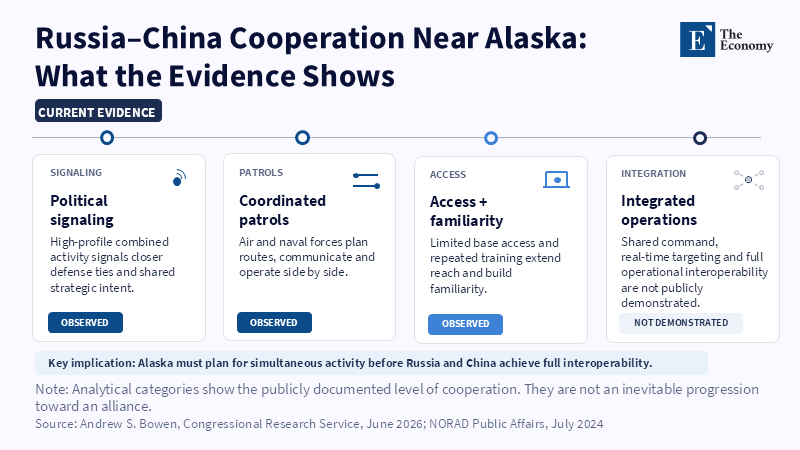
This distinction matters when assessing the demands placed on American forces. Separate Russian and Chinese activities could occur in the same period without being directed as a single military operation. Defense personnel would still need to identify each activity, evaluate its significance and determine whether any relationship between them was supported by evidence. More simultaneous activity may increase analytical and coordination demands; it should not be treated as proof of a unified Russia-China command.
Brigadier General Matthew S. Komatsu, Deputy Commander of Alaskan Command, spoke with The Economy about the two countries without claiming they formed one operational military force. He described Russia and China as countries considered in U.S. defense planning but made a narrower, personal observation about his own attention: he said he had thought more about China in his first six months at ALCOM, but during 2026 had found himself thinking more about Russia than he expected. He also acknowledged that competitor activities involve strategic signaling. On Chinese research voyages, Komatsu said scientific information can have both civilian and military applications, and offered his personal assessment that China seeks to understand the changing Arctic operational environment in a way consistent with its stated ambition to become a global military power. He did not identify any specific research voyage as a proven intelligence operation, and the interview did not determine whether Russia and China are progressing toward integrated military command.
Russia and China at the Same Time
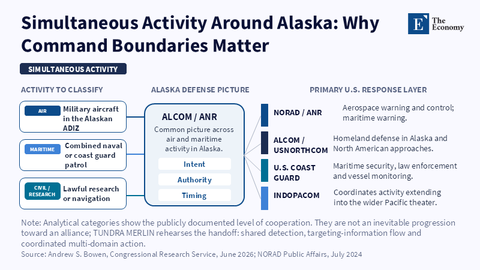
Simultaneous activity could place additional demands on North American monitoring systems even without a combined Russian-Chinese command. For example, Russian aircraft operating near the Alaskan ADIZ and Chinese vessels transiting the Bering Sea would require different surveillance, legal and command responses. This is an illustrative scenario, not a forecast or an ALCOM contingency plan. The main analytical question is how separate organizations maintain an accurate common picture when different types of activity occur at once.
Responsibility is divided across several organizations: NORAD provides binational aerospace warning and control and maritime warning; Alaskan Command synchronizes homeland defense under NORTHCOM; U.S. Pacific Command (USPACOM) has separate Pacific responsibilities; and the Coast Guard exercises maritime missions under its own authorities. Activities by foreign aircraft and vessels may therefore generate information relevant to more than one institution. Komatsu described how ALCOM brings those interests together, but his interview did not disclose a specific Russia-China intelligence-assessment process or suggest that ALCOM alone decides whether two countries' actions are linked.
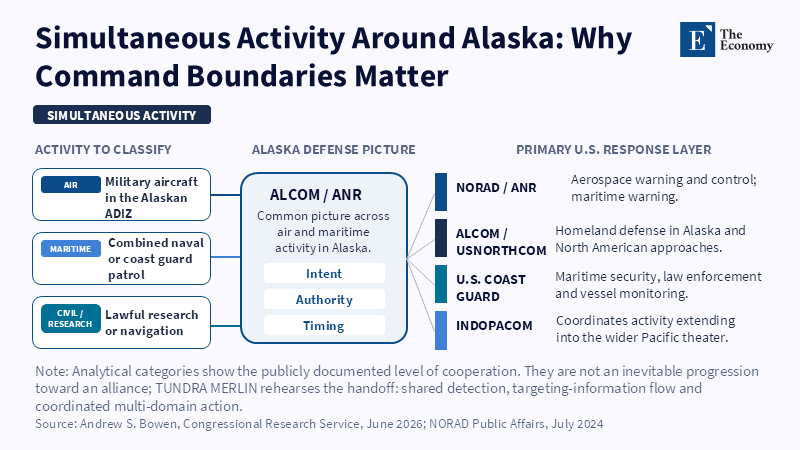
A risk of treating all Russian and Chinese movements as one operation is that analysts may overstate what the two militaries can currently accomplish together. NORAD explicitly said the July 2024 bomber patrol was not assessed as a threat, and lawful transit by research vessels cannot be equated with an attack or established intelligence mission. Deterrence planning can consider overlapping activity while retaining these distinctions about legal status, capability and intent.
Deterrence Without Escalation: What ALCOM Says It Is Doing
ALCOM has conducted Operation TUNDRA MERLIN to strengthen the integration of forces involved in Alaska's defense. Public accounts of the 2026 campaign describe combined air, ground and maritime activities, including U.S.-Canadian exercises involving surveillance and simulated engagements. These demonstrate the ability to coordinate forces under existing arrangements, rather than evidence that ALCOM is responding to a confirmed unified Russian-Chinese plan. Komatsu stressed that Russia and China's activities inform the exercise's operational design, while the command remains focused on deterrence.
Komatsu said competitor activity does not necessarily change each individual ALCOM action, but it "informs the operational design" of TUNDRA MERLIN. He emphasized that the command does not seek to provoke or escalate tensions and wants its preparation to be visible. "We 100% want our adversaries to see us doing these things," he explained. In his account, the principal purpose of the campaign is deterrence; training and readiness also prepare forces if deterrence fails. The claim was about ALCOM's intended signal, not evidence that Moscow or Beijing has interpreted the message in any particular way.
Much of the coordination occurs at a combined headquarters (CHQ) whose total staffing, ALCOM Public Affairs subsequently confirmed, is 466 personnel across the Alaskan NORAD Region (ANR), ALCOM, Eleventh Air Force, PRSC and the 611th Air Operations Center (611th AOC). Komatsu described an effort over the past two years to reduce barriers among the ANR, ALCOM and Eleventh Air Force missions, summarizing the collaborative attitude as "kind of everybody does everything." Nevertheless, commanders continue to determine which of the three distinct legal authorities permits each action. ALCOM does not thereby command every force in the theater; its synchronization mission depends on relationships with the units that actually carry out maritime and air operations.
ALCOM has no assigned or allocated forces of its own, Komatsu explained, so the command works with units and partners already deployed in the theater. The Coast Guard and Royal Canadian Navy provide especially persistent maritime awareness. The Coast Guard Arctic District has committed to maintaining a permanent liaison officer at ALCOM headquarters, and Canada assigned a senior O-6 coordinator in 2026. In August, Canadian C-17 transport aircraft also supported an American deployment to Nome. These examples show how existing cooperation supports readiness; they are not evidence of a new Russian-Chinese combined military operation.
The evidence therefore sits at three different levels. Russian regional military activity is longstanding. Chinese military and research activity near northern approaches has become more visible, and cooperation with Russia can extend the places where Chinese assets appear. Yet public evidence of an integrated Russia-China military force remains limited, and Komatsu offered no claim that one is already present. He ended the interview with a different measure of success: a peaceful Arctic in which U.S. and allied preparations deter aggression so effectively that conflict never reaches the region. ALCOM must nevertheless train for the possibility that deterrence fails. That tension between visible preparedness and avoiding confrontation, rather than an assumption of inevitable conflict, is the central point of his remarks.
This article was independently prepared by The Economy Review following an interview with Brigadier General Matthew S. Komatsu of Alaskan Command.
Statements attributed to Brigadier General Komatsu reflect his interview remarks, reviewed by Alaskan Command's Public Affairs office for accuracy and context. Other analysis, interpretations and conclusions are The Economy's own and should not be construed as official positions of ALCOM, U.S. Northern Command, the Department of Defense, the Canadian Armed Forces or any other institution.
Alaskan Command's Public Affairs office completed a pre-publication review for factual accuracy and attribution. Such review does not constitute institutional endorsement of the article, its conclusions or any subsequent use by third parties.
Identification of military organizations, individuals and institutions does not imply sponsorship, partnership or endorsement.
References
Alaskan Command Public Affairs (2026) ‘U.S., Canadian Forces to Rehearse Joint Maritime Strikes in the Bering Sea’, 18 September. DVIDS
Bowen, Andrew S. (2026) Russian Military Activities in Asia: Combined Military Exercises and Patrols. Washington, DC: Congressional Research Service. everycrsreport.com
Fouche, Gwladys (2026) ‘US watching Chinese marine presence off Alaska, Arctic Coast Guard chief says’, Reuters, 21 September. Reuters
North American Aerospace Defense Command Public Affairs (2024) ‘NORAD detects, tracks and intercepts Russian and PRC aircraft operating in the Alaskan ADIZ’, 24 July. norad.mil
The Economy Editorial Board (2026a) ‘[Arctic Maritime Strategy] Bering Strait Military Competition: The U.S. Answers China and Russia on a 2033 Timeline’, The Economy Strategy Review, 22 October. economy.ac
The Economy Editorial Board (2026b) ‘[Arctic Maritime Strategy] Sovereignty, Navigation Rights and Great-Power Rivalry in the Bering Strait’, The Economy Strategy Review, 23 October. economy.ac
United States Coast Guard (2024) ‘U.S. Coast Guard encounters joint Chinese Coast Guard, Russian Border Guard patrol in Bering Sea’, 1 October. news.uscg.mil
United States Coast Guard (2025) ‘U.S. Coast Guard Responds to Increased Chinese Research Vessel Activity in U.S. Arctic’, 8 August. news.uscg.mil
United States Coast Guard (2026) ‘Coast Guard Secures the U.S. Arctic as Chinese Research Vessels Arrive in the Bering Sea’, 17 July. news.uscg.mil
United States Northern Command Public Affairs (2026) ‘Joint Force Demonstrates Integrated Air, Land Capabilities for Arctic Homeland Defense’, 6 August.
Working across research, policy, and data-driven analysis, the Editorial Board ensures that published pieces reflect a consistent institutional perspective grounded in quantitative reasoning and long-term structural assessment.