[Howie Chang Series] Shaping the Future of Learning with Technology

Deeply committed to shaping sustainable talent pipelines, Howie has trained and mentored hundreds of professionals in AI, Product Management, UI/UX, and emerging technologies. As a certified HRD Corp trainer, he has delivered high-impact learning experiences for clients such as Dell, Clarivate, Micron, and Keysight. He has also lectured at Republic Polytechnic and Singapore Polytechnic, bringing practical relevance into the classroom.
Before returning to Penang to make a homegrown impact, Howie spent over a decade immersed in Southeast Asia’s startup and innovation ecosystems. His career reflects a rare blend of product thinking, user experience, and entrepreneurial grit, fuelling his drive to help others adapt, learn, and evolve.
In recognition of his contributions to the tech and innovation ecosystem, Howie was awarded the Pingat Jasa Kebaktian (PJK) by the Penang State Government.
Authored On
Modified
AI tutors make explanation cheap; education must build capability
Teachers become mentors, assessors and guides of learning
Access is widening, but gains still favor connected students

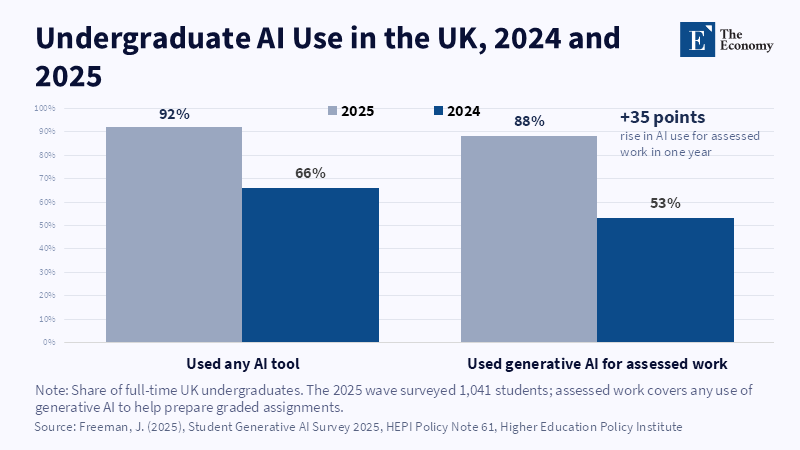
In February 2025, the UK’s Higher Education Policy Institute published a survey of 1,041 full-time undergraduate students, according to which 92 percent were already using an AI tool and 88 percent had turned to generative AI tools for graded assignments, when a year earlier the figure was 53 percent. Such a jump in twelve months leaves little room for the comfortable admission that it is enough to upload lecture notes to a platform for a curriculum to be considered contemporary. Artificial intelligence in education explains, gives examples, corrects and recapitulates almost instantaneously and so a question that for years has remained theoretical becomes practical for every dean and every teacher, i.e. what is the use of education when explanation is no longer scarce. The answer is more encouraging than it sounds, because technology is changing learning much more profoundly than simply digitizing the material: it is shifting it towards personalization, participation and continuous access and transforming the teacher from a transmitter of information to a guide.
From Content Transmission to Skill Development
For almost two decades, digital transformation in universities and schools mainly meant learning management systems, the well-known LMS, where slides, video lectures and submission deadlines were uploaded. These systems solved an administrative problem, organized the material and recorded who delivered what and when, but left untouched the basic logic of the classroom, a flow of information from the teacher to the student that was simply transferred to the screen. The learning experience platforms, LXPs, went a step further, with paths designed by the student himself, discussions between fellow students and tools like Slack next to the formal material, so that solitary study becomes something closer to a community. The transition from LMS to LXP mattered because it treated the student as an active participant in their own learning, yet language models entered everyday study so quickly that comparing the two platforms is now reminiscent of a discussion about the shelf at a time when the book itself has changed.
Content ceased to be a scarce commodity. A freshman who gets stuck in a fluid mechanics exercise at two in the morning gets an explanation, an alternative example and a comment on his solution without waiting for the next week’s office hours, which means that a course whose value is measured by the amount of information it transmits already has a competitor who does not get tired and costs little. Knowledge of information is no longer enough as a goal. What is left in the institution is to cultivate skills that no model can acquire on behalf of the student: to correctly formulate a problem, to judge whether an answer stands, to combine knowledge from different fields, to defend a decision in front of people who disagree. Wharton and University of Pennsylvania researchers who studied GPT-4 in high school math classes put it in practical terms, noting that generative AI makes mistakes and that anyone who uses it should be able to verify what it produces.
For those who design curricula the consequence is specific and quite uncomfortable. A course outline written as a list of topics that are “covered” describes content that the student can now find anywhere, while an outline written as a list of what the student will be able to do at the end of the semester forces the lecturer to think about how to prove it. This shift requires administrations to admit that converting old notes into PDFs and videos does not constitute a reform, however satisfactorily it appears in the annual digital maturity reports and that the real work, adapting teaching to each student, was until recently financially unfeasible for any department with hundreds of enrollees and today, for the first time, it is becoming possible.
Personalization at Scale with AI in Education
The most rigorous test to date on whether a digital teacher can take on this job was published in June 2025 in Scientific Reports. A Harvard team led by Gregory Kestin organized a randomized trial in an introductory physics course, in which each student was taught one topic in an active learning classroom with experienced teachers and another at home, on their own, through a digital teacher based on GPT-4 and designed with the same pedagogical principles. The median learning improvements of students who worked with the digital teacher were more than double those in the classroom, the study time was shorter and the students also reported greater engagement. The comparison has weight, because active learning belongs to the best-documented teaching methods that exist, so the algorithm was confronted with a really good classroom.
The most common objection is that such tools make students dependent and that the safest policy is to ban them, although some governments, Malaysia among them, have chosen to allow ChatGPT in universities under specific guidelines. The study by Hamsa Bastani, Osbert Bastani and their colleagues, published in 2025 in the Proceedings of the National Academy of Sciences, gives this concern a measurable form. Nearly a thousand high school students were divided into groups with access to a simple ChatGPT-style interface, with access to a digital teacher who had pedagogical safeguards, or without any help at all. In the practice exercises, the simple interface team did 48 percent better than the control group, but when access was removed and the exam came, it scored 17 percent lower. The digital teacher team improved by 127 percent in practice and in the exam achieved about the same score as the students who never had access, i.e. without the loss suffered by their classmates.
Read together, the two studies lead to the design. A chatbot without limits, which delivers the answer ready-made, acts as a crutch, as described by the authors themselves, while a digital teacher who holds back the solution and asks for the next step avoids the damage and, in Harvard’s version, doubles the benefit. The ban eliminates both together, while almost nine out of ten students already use such tools on their own initiative, so the real dilemma of an institution is about which digital teacher to offer and how to regulate it. Educational technology startups and platforms such as Khan Academy’s Khanmigo, along with adaptive practice apps aligned with national curricula and language platforms that change the difficulty according to the user’s mistakes, are already doing something that used to be the prerogative of those who paid for private lessons, that is, they are carving a separate path for each student through the same abilities.
The Teacher as a Mentor, Evaluator and Guide of Learning
Transferring the first explanation to a machine pushes the teacher toward jobs that machines do poorly and their role expands beyond teaching to that of facilitator and digital mentor. The Harvard team did not present its findings as a reason to replace professors and the article itself notes that chatbots are made to serve the user, which is something other than helping them learn, a gap that was filled because a teacher designed the questions, stages and feedback. The researchers suggested that basic knowledge be passed on to the digital teacher outside of the classroom, so that time in the classroom goes to complex problem-solving, project-based tasks and teamwork. The teacher becomes the one who sets up the environment, chooses the limits of the tool and intervenes when the machine leads the student to a dead end.
The second role is about assessment and human judgment. In the Higher Education Policy Institute’s survey, 40 percent of students felt that a text written by artificial intelligence would get a good grade in their subject, compared to 34 percent who disagreed, meaning that students themselves question how much a grade says when it is based only on the final product. The prestige of the score passes to anyone who can see the reasoning behind the work, ask why one solution was chosen and not the other, understand when a student is stuck out of ignorance and when out of anxiety. In the World Bank project in Nigeria, discussed below, AI has always worked with teachers in the classroom to guide the sessions and this pattern was not accidental.
For deans and school principals, change has a cost and a date. The same report by the Higher Education Policy Institute called for bold staff retraining programs and documented a widening gap between students who want the institution to provide them with tools and those who say they actually receive them, so a portion of the budget that currently goes to the production of videotaped lectures should be shifted to teacher hours for feedback, oral exams and mentoring, as well as to the continuous professional development of the teachers themselves, so that they learn to write instructions for digital teachers and read their students’ interaction logs, something that few training programs cover today.
Learning Becomes Active and Assessment Is Rewritten
Students are no longer tied to a room at certain times and this changes both the way of teaching and the assessment. In the Harvard trial, the lesson with the digital teacher was completed at home, individually and took more time than in the classroom. The explanation can be done asynchronously, whenever everyone needs it, while the time everyone spends together in the room, the most expensive and the rarest, must go to what requires the presence of people in the same space: projects, collaboration, solving problems without a ready answer and creation. The idea of the flipped classroom has existed for years, but it stumbled upon the fact that many students arrived unprepared because the video at home did not answer their questions, a problem that a digital teacher available around the clock solves to a large extent.
Assessment is where most institutions lag. When 88 percent of students have used generative AI in assignments, the three-thousand-word homework primarily measures the ability to write a good instruction to the model, which is why the Higher Education Policy Institute recommended that institutions check whether their assessments can be easily completed with AI. Redesign means scoring the process along with the outcome, with interim drafts, decision logs, oral defense of the project and creation in the classroom. A paper that asks students to openly use a model and then document where it went wrong and how they found it tests exactly the verification ability that Wharton researchers consider essential.
Collaboration with fellow students also takes on another place and this is where the logic of LXPs proves to be more resilient than their comparison to LMSs suggested. A technology college that combined its learning platform with Slack so that students could share ideas and work together on projects beyond working hours has turned solitary study into collaborative work and the same community infrastructure can now become a field of critique, where a team of three students takes three different solution plans from three different tools and must agree on which one stands and why, identify the contradictions and present the final choice to a lecturer who will question it, an exercise that teaches judgment in a way that no one-on-one chatbot conversation can replicate, no matter how well-designed. The difficulty lies in the fact that such assignments require more teacher time per student, time that is only freed up if the first explanation has actually been passed on to the machine.
Access Is Expanding, but Inequality Is Not Disappearing on Its Own
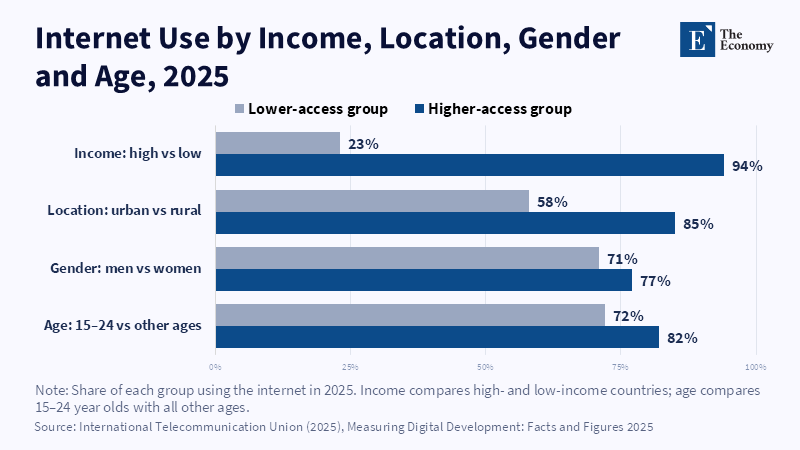
Continuous access has a condition that is often forgotten. According to the International Telecommunication Union, about 6 billion people, three-quarters of the world’s population, were using the internet in 2025, while 2.2 billion were staying offline, 96 percent of whom live in low- and middle-income countries. In cities 85 percent of residents are connected, in the countryside the percentage drops to 58 percent. A digital teacher doubling learning in Cambridge, Massachusetts is teaching nothing to a child who doesn’t have a connection or device and the digital divide, which until recently education ministries treated as an infrastructure issue, is now becoming a matter of learning outcomes.
The World Bank’s study in Edo State, Nigeria, shows what technology can achieve even in difficult conditions, but also where it stumbles. In a randomized trial, first-year senior secondary students participated for six weeks in an after-school program with Microsoft Copilot, based on GPT-4 and achieved an improvement of 0.31 standard deviations, which the researchers calculated corresponds to one and a half to two years of regular schooling. The same group recorded that participation in the sessions was made difficult by rainy season floods, teacher strikes and afternoon work by students and that the benefits were greater for students with better initial performance and from more affluent households. The tool worked and the next step is to extend the same benefit to those starting from a more difficult position, which depends on the design of the program as much as on the technology itself.
A similar pattern occurs in richer systems. In the British survey, students from more affluent backgrounds reported greater enthusiasm for AI throughout the questionnaire and when the institution does not provide tools, the best version of them ends up with whoever pays a subscription. The national digital platforms already used by millions of students and educators in several countries are the obvious point where a digital teacher with pedagogical safeguards could reach everyone on the same terms, provided that the connection, devices and teacher training are funded as part of the same plan, rather than added after the fact. Where governments, educators and educational technology startups are moving in the same direction, technology can become a driver of quality and inclusion in education.
The 88 percent figure in the British survey describes a world where explanation, example and feedback cost almost zero and post-AI education only makes sense if it produces people who create and judge, rather than effective consumers of information. The tools to do this are there and the Harvard and Nigerian trials show that they can speed up learning significantly when designed by teachers and accompanied by humans. The speed with which students have adopted the tools, with use in assignments rising from 53 percent to 88 percent within a year, shows that the demand for a different way of learning already exists and institutions that will redesign teaching and assessment around it have before them the opportunity to shape a generation of creators and critical thinkers. The measure of their success will be the one used by the Wharton researchers, what the student can do when the tool is removed and in their study the students who worked with the properly designed digital teacher passed this test without loss.
The views expressed in this article are those of the author(s) and do not necessarily reflect the official position of The Economy or its affiliates.
References
Bastani, Hamsa, Bastani, Osbert, Sungu, Alp, Ge, Haosen, Kabakcı, Özge and Mariman, Rei (2025) 'Generative AI without guardrails can harm learning: Evidence from high school mathematics', Proceedings of the National Academy of Sciences, 122, e2422633122.
De Simone, Martín, Tiberti, Federico, Barron Rodriguez, Maria, Manolio, Federico, Mosuro, Wuraola and Dikoru, Eliot Jolomi (2025) From Chalkboards to Chatbots: Evaluating the Impact of Generative AI on Learning Outcomes in Nigeria. Policy Research Working Paper 11125. Washington, DC: World Bank.
Freeman, Josh (2025) Student Generative AI Survey 2025. HEPI Policy Note 61. Oxford: Higher Education Policy Institute.
International Telecommunication Union (2025) Measuring Digital Development: Facts and Figures 2025. Geneva: International Telecommunication Union.
Kestin, Gregory, Miller, Kelly, Klales, Anna, Milbourne, Timothy and Ponti, Gregorio (2025) 'AI tutoring outperforms in-class active learning: an RCT introducing a novel research-based design in an authentic educational setting', Scientific Reports, 15, 17458.
Deeply committed to shaping sustainable talent pipelines, Howie has trained and mentored hundreds of professionals in AI, Product Management, UI/UX, and emerging technologies. As a certified HRD Corp trainer, he has delivered high-impact learning experiences for clients such as Dell, Clarivate, Micron, and Keysight. He has also lectured at Republic Polytechnic and Singapore Polytechnic, bringing practical relevance into the classroom.
Before returning to Penang to make a homegrown impact, Howie spent over a decade immersed in Southeast Asia’s startup and innovation ecosystems. His career reflects a rare blend of product thinking, user experience, and entrepreneurial grit, fuelling his drive to help others adapt, learn, and evolve.
In recognition of his contributions to the tech and innovation ecosystem, Howie was awarded the Pingat Jasa Kebaktian (PJK) by the Penang State Government.
Similar Post