Redesigning a Flipped Classroom Beyond Completion Rates

With a strong focus on blended learning methodologies and flipped classroom strategies, Ms. Lai empowers both educators and students to embrace modern teaching practices. She is deeply passionate about people development and lifelong learning and believes in equipping educators with the skills needed to navigate the evolving educational landscape, ensuring they remain agile in the era of Generative AI and digital transformation.
Authored On
Modified
High completion rates hid shallow learning in a flipped course
Short videos and Jigsaw teaching gave preparation a purpose
The redesign is promising, but outcome evidence is still pending

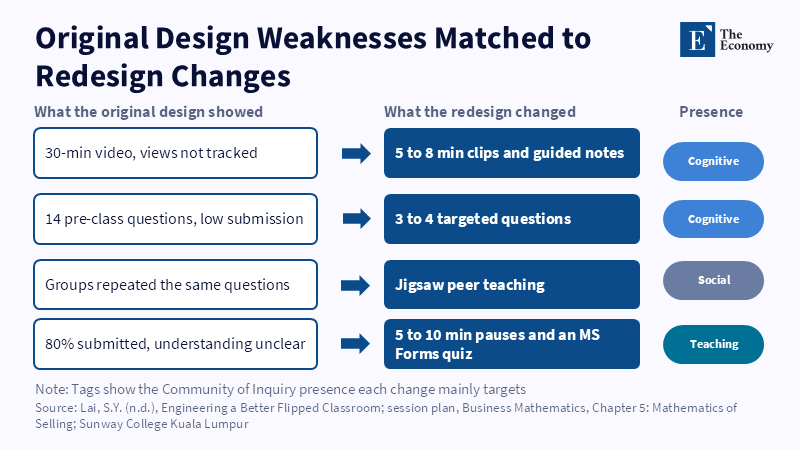
A thirty-minute recorded lesson, a sheet of fourteen exercises and a mind map that had to be uploaded to Microsoft OneNote before the tutorial: this was the preparation Lai Sok Yee asked of her first-year Diploma students in Business Mathematics at Sunway College Kuala Lumpur. In class, there was a recap of the lecture, a group discussion on the same material and a few more exercises. On paper, the design looked like a reasonable flipped classroom and the numbers did not immediately contradict that impression, since about 80 percent of the students submitted the mind map on time. Lai had to look beyond the numbers to see that a well-organized program could still keep learning on the surface, and that the solution was about designing the entire learning path, not just adding a new tool.
When Completing a Task Passes for Learning
The 80 percent had an explanation that was not necessarily related to learning. Submitting the mind map counted towards attendance, so students had every reason to hand in something regardless of whether they had engaged closely with the video. Lai also had no reliable way to know how attentively they had watched it. Some students reported that the thirty-minute recording was too long and that they sometimes relied on the presentation slides instead when preparing their mind maps. The maps themselves were often superficial, and technical problems with downloading work from MindMeister sometimes resulted in unclear screenshots being submitted instead.
The fourteen exercises had the opposite effect to what she wanted. Students said that there were too many questions and the submission rate was low, meaning that a workload designed to prepare them had itself become an obstacle to preparation. In the tutorial, the problem took a different form: students revisited material they had already encountered before class, followed by a recap from the lecturer. Those who had completed the preparatory work could therefore find parts of the face-to-face session repetitive, while how much each student had actually understood remained unclear.
From all of this she drew a conclusion that applies far beyond mathematics. A completed task proves that something has been submitted and nothing more. Blended learning easily produces digital records, video viewing logs, quizzes, mind maps, forum posts and a teacher can compile an entire dossier of them without knowing which student can calculate a markup on the selling price. “Technology makes some aspects of participation more visible. It does not automatically make learning more meaningful,” Lai writes. In her course, it did not show where understanding was stumbling and that was the gap that the redesign had to fill.
The Community of Inquiry Framework Changed the Question
To revisit the course as a whole, Lai turned to the Community of Inquiry framework, as articulated by Garrison, Anderson and Archer. The framework describes three interrelated elements of a learning experience. Cognitive presence is about how the student builds meaning and connects ideas, social presence is about interacting with others and teaching presence covers the design, facilitation and guidance that make the first two possible. When she put her old program through this filter, the picture was clear and not particularly flattering. Cognitive presence was in her intentions, but the length of the video and the volume of the exercises undermined it. Social presence existed in the tutorial groups, but there was no clear reason for anyone to collaborate, since they were all working on the same material over and over again.
The biggest gap was on her side. She needed better ways to know whether students were engaging with the material, where they were struggling and when direct clarification would be most useful. The study by Law, Geng and Li in a blended learning environment, published in Computers & Education in 2019, reinforces the importance of cognitive, social and teaching presence working together. So the question changed. Instead of asking how to improve her video, she started asking how the pieces of the experience should fit together. That is where the priorities of the redesign came from: independent study that is manageable and visible to the lecturer, collaboration with a real intellectual purpose and specific moments for checking and clarification.
Shorter Videos and Fewer Exercises Made Preparation Visible
The chapter on the Mathematics of Selling is divided into four sections: markup on cost, markup on selling price, markdown and turnover and inventory valuation. In the new version, each student is assigned one of them a week in advance and watches a five- to eight-minute video, with subtitles, dedicated to that section alone. The videos are uploaded to Edpuzzle, so Lai can see each student’s progress as they study. Markup on the selling price shows why the split makes sense. If a product sells for RM100 and the markup is 20 percent of the selling price, the markup is RM20 and the cost is RM80. The unit is small, but it hides a relationship between price, markup and cost that the student must understand before solving an unfamiliar problem and the principle of segmentation in Richard Mayer’s work on multimedia learning supports precisely this choice.
A short video, however, can also be playing in the background. That’s why she added guided notes with blanks, which students fill in sequentially as the explanation progresses, a technique that Elizabeth Barkley and Claire Howell Major suggest to keep the focus on the essentials. The fourteen exercises became three or four, all on the student’s assigned section, in line with the guidance of Cynthia Brame of Vanderbilt University that pre-class preparation should connect with the work done in class. The second online hour is collaborative. Students assigned the same section work together, make a mind map in Canva, compare their solutions and post the final version to the OneNote Collaboration Space.
A reasonable objection is that this lowers the bar, since each student initially focuses on only one part of the chapter. Her answer comes from the evidence of the old design. The heavier load existed only on paper: the low submission rate for the exercises and the superficial mind maps showed that a larger nominal workload did not necessarily produce deeper preparation. In the new version, the student who takes on a section knows that in the tutorial they will have to teach it to classmates who have not studied it in the same depth and that, at the end, they will be expected to demonstrate individual understanding as well.
The Flipped Classroom Works When Every Student Has Something to Teach
The first ninety minutes of the tutorial are now a Jigsaw activity. The four expert groups are disbanded and the class is recomposed into new groups, each with one representative from each section. Students then take turns teaching their part to the others before the session closes with a discussion of the key points. The difference from a regular group exercise is that every participant has a distinct contribution to make because each member brings knowledge that the others need. For a mathematical subject, this means that the student has to explain why an operation is correct, not just how it is done. When a classmate asks why the markup is subtracted, the student is forced to put into words the relationship behind the calculation instead of simply repeating a procedure.
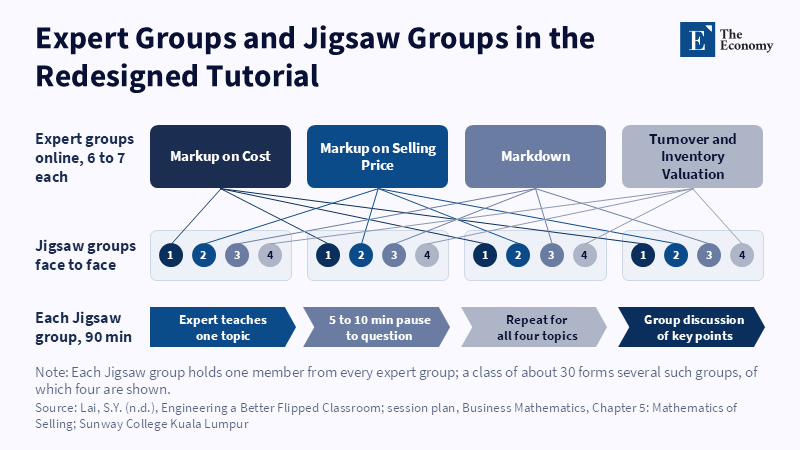
In an active learning classroom it is easy to assume that movement equals progress when students discuss, draw maps and teach each other, but this does not indicate whether the learning sought has been achieved. After each round of peer teaching, there is a five- to ten-minute pause, during which students organize what they have heard, identify what is not clear to them and ask questions, while Lai goes through the groups and intervenes where a misunderstanding is in danger of going unnoticed. The idea draws on Mary Budd Rowe’s research on pauses in science teaching and the work of Ruhl, Hughes and Schloss on the pause procedure in lectures, as well as Bonwell and Eison’s definition of active learning as an activity where students do things and think about what they do.
The last thirty minutes are for confirmation. The class goes over the answers to the guided notes, students check their own work and at the end they individually answer an automatically graded Microsoft Forms quiz. Lai no longer relies on a single piece of evidence. The mind map shows how students organize concepts, the solved exercise shows whether they can apply a calculation, peer explanation can reveal gaps in reasoning and the individual quiz shows what each student can do without help. No single measure is enough on its own to decide what needs further attention.
Tools Serve the Design, but the Proof Is Still Pending
All of these changes tie in with John Biggs’ constructive alignment principle, according to which activities and assessment should serve the learning outcome. Her learning outcome was simple to state: students should use simple calculations to solve business problems involving markups, markdowns, turnover and inventory valuation, not produce attractive maps or complete digital assignments. Edpuzzle helps monitor video engagement, guided notes structure independent study, Canva supports shared summaries, OneNote facilitates the exchange of solutions and Microsoft Forms provides the individual check. The choice of tool mattered, but its relationship to the activity and the outcome mattered more. For an institution investing in digital learning, this means that another platform will not correct low engagement or repetitive class time unless educators first define which learning problem it is meant to solve and what evidence would show that it is helping.
The limits of the case must be clearly stated. “These are design improvements, not proof that every student will learn more effectively,” Lai writes. Her material documents the redesign and its rationale, but it does not contain comparative data after implementation on performance, knowledge retention or student satisfaction. To answer this, it is necessary to compare assessment results across successive cohorts, examine the quality of the explanations students give each other and systematically collect their views on the new experience, work that has not yet been done.
The 80 percent Lai started with counted submissions, not understanding. The flipped classroom is usually described as a simple rearrangement, with the lecture outside the room and activities inside it, but if students watch a lecture at home and then listen to essentially the same material again in class, the only thing that has changed is the location of content delivery. The lecturer stays central to the process while talking less: the role shifts towards setting expectations, structuring interaction, monitoring progress and clarifying misconceptions. The more meaningful question is no longer how many students submit a task, but how many can explain the reasoning behind what they have learned. The redesign is intended to make that understanding more visible, but the outcome evidence is still to come.
The views expressed in this article are those of the author(s) and do not necessarily reflect the official position of The Economy or its affiliates.
References
Barkley, E.F. and Major, C.H. (n.d.a) 4 ways to improve your online teaching. CrossCurrents, K. Patricia Cross Academy.
Barkley, E.F. and Major, C.H. (n.d.b) 5 tips for engaging online course design. CrossCurrents, K. Patricia Cross Academy.
Barkley, E.F. and Major, C.H. (n.d.c) Creating engaging asynchronous lectures with your phone or laptop. CrossCurrents, K. Patricia Cross Academy.
Biggs, J. (2003) Teaching for Quality Learning at University. 2nd edn. Buckingham: Society for Research into Higher Education and Open University Press.
Bonwell, C.C. and Eison, J.A. (1991) Active Learning: Creating Excitement in the Classroom. ASHE-ERIC Higher Education Report No. 1. Washington, DC: The George Washington University, School of Education and Human Development.
Brame, C.J. (2013) Flipping the Classroom. Nashville, TN: Vanderbilt University Center for Teaching.
Garrison, D.R., Anderson, T. and Archer, W. (2000) ‘Critical inquiry in a text-based environment: Computer conferencing in higher education’, The Internet and Higher Education, 2(2-3), pp. 87-105.
Law, K.M.Y., Geng, S. and Li, T. (2019) ‘Student enrollment, motivation and learning performance in a blended learning environment: The mediating effects of social, teaching, and cognitive presence’, Computers & Education, 136, pp. 1-12.
Mayer, R.E. (2009) Multimedia Learning. 2nd edn. New York: Cambridge University Press.
Rowe, M.B. (1980) ‘Pausing principles and their effects on reasoning in science’, in Brawer, F.B. (ed.) Teaching the Sciences. New Directions for Community Colleges, No. 31. San Francisco: Jossey-Bass.
Ruhl, K.L., Hughes, C.A. and Schloss, P.J. (1987) ‘Using the pause procedure to enhance lecture recall’, Teacher Education and Special Education, 10(1), pp. 14-18.
With a strong focus on blended learning methodologies and flipped classroom strategies, Ms. Lai empowers both educators and students to embrace modern teaching practices. She is deeply passionate about people development and lifelong learning and believes in equipping educators with the skills needed to navigate the evolving educational landscape, ensuring they remain agile in the era of Generative AI and digital transformation.
Similar Post