Middle Powers and Artificial Intelligence: Why the Collective Coalition Remains Unlikely

Working across research, policy, and data-driven analysis, the Editorial Board ensures that published pieces reflect a consistent institutional perspective grounded in quantitative reasoning and long-term structural assessment.
Authored On
Modified
Middle powers lack AI investment scale to rival US-China
ASEAN's tariff failure shows coalition governance is hard
Narrow bilateral deals work better than grand AI coalitions
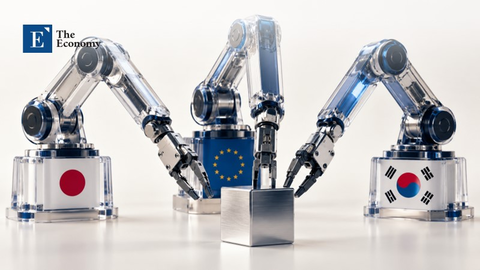
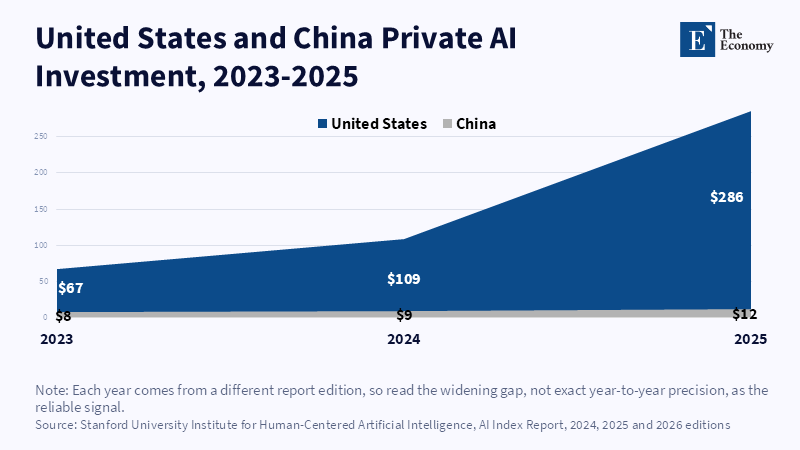
In 2025, the United States' private investment in AI reached nearly $286 billion, more than twenty-three times the more than $12.4 billion reported by China in the same year, according to an analysis by David Rediker for the Brookings Institution. No middle-power group can come close to this scale by pooling budgets measured in the tens of billions. This is the accounting problem behind an idea that is gaining traction in discussions around AI geopolitics: that Europe, Japan and South Korea could pursue what Rediker calls modular sovereignty, building collective capacity at select levels of the AI stack rather than accepting complete dependence on Washington or Beijing. The proposal is attractive. The question that often remains unanswered is whether such an alliance can actually be built and governed, rather than whether it can simply be financed.
What the Middle Powers Have to Gain
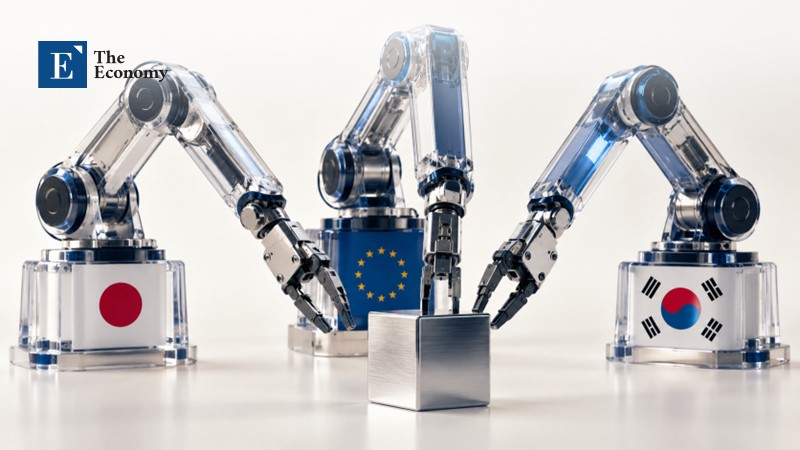
Individually, no middle power has enough computing power or capital to influence the trajectory of cutting-edge AI. Collectively, the picture is changing. Japan has advanced robotics and decades of experience in industrial automation, all of which are reflected in the Noetra initiative, a forty-four-stakeholder program that targets multimodal models for manufacturing and energy. South Korea has a leading position in high-bandwidth memory and a rapidly growing base of domestic models, while the European Union has public procurement of as much as two trillion euros per year, according to Brookings' calculation. None of these advantages rival the American or Chinese scale alone, but taken together, they are something worth organizing.
Physical and industrial AI is where Rediker identifies the clearest window of opportunity for middle powers, precisely because U.S. dominance there is less entrenched than in the cloud or general-purpose models. China already dominates at the absolute scale, with 54 percent of new industrial robot installations worldwide in 2024, but that doesn't rule out competition in regulated sectors like hospitals, energy grids and defense infrastructure, where jurisdiction counts more than price. The European initiative InvestAI set itself the goal of mobilizing two hundred billion euros, but funding for the projected AI giant factories shrank rather than widened along the way, a divergence between rhetoric and practice that Rediker himself points out.
South Korea has also shown something rarer among the middle powers: mediation ability. At the Asia-Pacific Economic Cooperation (APEC) summit in Gyeongju in November 2025, Seoul helped reconcile conflicting blocs by recasting controversial terms into language acceptable to all sides. The same analysis identifies another strength point that does not require shared ownership of infrastructure: the so-called adaptation layer, i.e. a country's ability to shape how foreign models adapt to local languages and institutions. New America's Shangri-La series of dialogues came to a similar conclusion. When representatives of middle powers sat down at the same table, their most concrete proposals were about evaluation standards and open tools, not shared ownership of models or infrastructure.
ASEAN as a Cautionary Example
The most direct evidence of what happens when middle powers attempt to act collectively comes from Southeast Asia, not artificial intelligence. The Association of Southeast Asian Nations has six decades of institutional experience and a culture of consensus known as the ASEAN Way. But when Washington announced reciprocal tariffs in April 2025, Malaysian Prime Minister Anwar Ibrahim's attempt to establish a unified regional position quickly hit its limits. Bilahari Kausikan, Singapore's former ambassador to the United Nations, called the proposal impossible given the differences between the coalition's economies, according to a report by MalaysiaNow. The Trump administration ultimately refused to negotiate with ASEAN as a whole, preferring bilateral talks with each state, the very dynamics that a united front intended to prevent.
Even ASEAN's most tangible recent success shows how slowly consensus is moving. The Digital Economy Framework Agreement, which also touches on artificial intelligence, took more than three years of negotiations before being concluded in 2026, with a further ratification period of one hundred and eighty days for each member, as recorded by the Rajah and Tann Asia legal brief. If a coalition with such a deep institutional tradition takes so long for a simple rules-based agreement, the expectation that Europe, Japan and South Korea could quickly set up a joint industrial consortium with shared ownership of models seems optimistic. Even the European Union, the most comprehensive example of regional integration, has been slow to join the American Pax Silica initiative, a development that Rediker himself attributes to European fragmentation.
The same pattern was repeated on more urgent security issues. The border dispute between Cambodia and Thailand in 2025 was finally resolved thanks to the individual mediation of Malaysia as the presiding country rather than through a permanent ASEAN mechanism, while the civil conflict in Myanmar remains unresolved over a number of presidencies, as recorded by the Real Instituto Elcano. The accession of Timor-Leste as an eleventh member in the same year was a milestone of institutional continuity, but not a demonstration of renewed collective capacity.
The Problem of Governance
The standard proposed by Brookings, a qualified majority approval process combined with a contribution-versus-access principle, solves the theoretical question of benefit-sharing. But it does not solve the practical question of what happens when governments disagree on whose data they used to train which model, or which country the regulator has jurisdiction over for critical infrastructure. Brookings itself recognizes the Gaia-X initiative as an example of institutional failure, precisely because neither side had the ultimate responsibility for implementation.
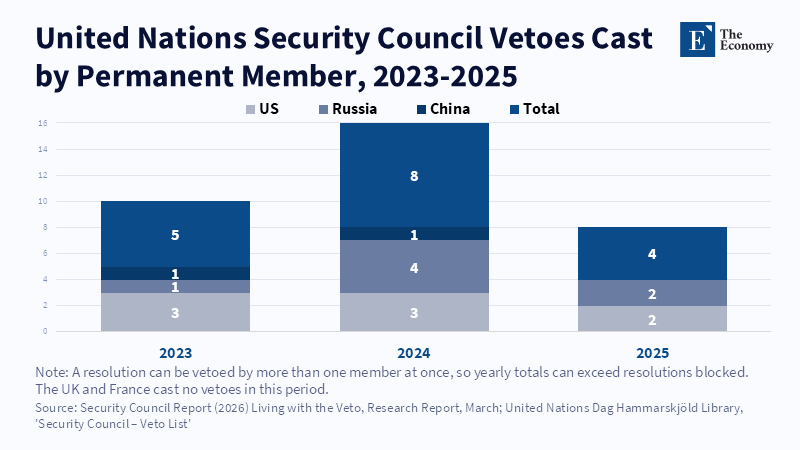
A more extreme but enlightening parallel is offered by the UN Security Council. The Lowy Institute, argues that the right of veto is not a design flaw but the cornerstone of the institution itself, a concession that kept the great powers within the organization rather than abandoning it as they did with the League of Nations. The price is that the Council is paralyzed at a time when the interests of its members actually clash. In 2024, eight vetoes were recorded on seven draft resolutions, the highest number since 1986, according to a report by the Security Council Report, with four more vetoes to follow in 2025. A governance structure with analogous logic to an AI coalition, where any major decision would require broad consensus among governments with divergent interests, would risk reproducing similar paralysis, even without the stakes of life and death of the Security Council.
The argument in favor of moving forward despite the obstacles certainly has some basis, since Brookings itself warns that the window of opportunity for physical and industrial artificial intelligence is narrowing as foreign platforms take root deeper. But this argument is weakened by the fact that Airbus, the model often referred to in the proposal, solved the issue of ownership early on through a single corporate entity with its own balance sheet, something that none of the three countries has yet agreed to reproduce.
That's not to say that every form of resource pooling is doomed. A separate analysis by Brookings, led by Benjamin Tanner and colleagues, describes AI dominance as a spectrum of strategies rather than a binary option, calling instead for managed interdependence through alliances that distribute risk by stack level. The distinction matters: cooperation in specific, narrow areas seems feasible, while a single, fully governed coalition with shared computing power and common models has not proven feasible in the timeline that urgency itself imposes.
Narrow Agreements Instead of a Grand Coalition
The alternative to collective governance is not necessarily full alignment with a superpower, although this option retains appeal. Japan and South Korea had already joined the US Pax Silica initiative long before the State Department sent, in August 2026, a letter warning signatories of incompatibility with overlapping initiatives. At the same time, China's World Artificial Intelligence Cooperation Organization acts as a similar attraction, with Kazakhstan having already joined both organizations, a sign that some governments prefer to hedge the risk rather than wait for a medium-sized alternative.
The arrangements that the middle powers have indeed managed to maintain tend to be narrower and less ambitious than a full consortium. South Korea's bilateral diplomacy with individual ASEAN members through the New South Policy has yielded deeper agreements than collective bargaining has ever achieved. The informal MIKTA group, which has linked Mexico, Indonesia, South Korea, Turkey and Australia since 2013 without binding commitments, has survived precisely because it requires few of its members. The compromise is real. Such cooperation would lose the economies of scale promised by modular sovereignty, but it would be feasible in a way that history itself shows: a full-fledged industrial consortium is not, at least for the time being.
The question is not whether reliance on American or Chinese artificial intelligence has a real cost. It does. The question is whether the middle powers can turn their existing assets into a common, managed infrastructure at the scale and timeline demanded by competing with the $286 billion of U.S. investment. The experience of ASEAN, the history of the Security Council and the very slowness of European integration show that the answer, for now, is no. The most realistic path for Europe, Japan and South Korea is through narrow, bilateral arrangements tailored to the specific merits of each, not through a coalition waiting for the right governance formula to get started.
This article is based on an original research article published by The Economy Research. For the original version, please refer to Middle Powers and the Limits of Collective Agency in Artificial Intelligence.
The views expressed in this article are those of the author(s) and do not necessarily reflect the official position of The Economy or its affiliates.
References
Elizabeth, R. (2025) 'Southeast Asian diplomacy in the era of great power rivalry: the ASEAN way', Asia Scotland Institute, 1 July.
Kumar, A. (2026) 'The UN is not broken - it was built this way', Lowy Institute, The Interpreter, 5 May.
Lee, S. and Lee, H. (2026) 'Asia-Pacific AI governance: a call for middle-power partnerships', CETaS Commentary, The Alan Turing Institute, 7 May.
Lee, S.Z. (2023) 'Middle power and power asymmetry: how South Korea's free trade agreement strategy with ASEAN changed under the New Southern Policy', Contemporary Politics, 29(3), pp. 318-338.
MalaysiaNow (2025) 'Prominent Singapore diplomat rubbishes Anwar's proposal for ASEAN to collectively discuss tariff with US', MalaysiaNow, 10 May.
Rajah & Tann Asia (2026) 'ASEAN Digital Economy Framework Agreement: negotiations concluded, targeted for signing in November 2026', Rajah & Tann Asia, Legal Update.
Real Instituto Elcano (2026) 'La ASEAN en 2025: entre el avance y el estancamiento', Real Instituto Elcano, Comentario.
Rediker, D.A. (2026) 'Middle power AI agency: preserving choice between the United States and China', Brookings, 8 September.
Security Council Report (2026) Living with the Veto, Research Report, March.
Tanner, B., Kerry, C.F., Wyckoff, A.W., Kyosovska, N., Renda, A. and Tabassi, E. (2026) Is AI Sovereignty Possible? Balancing Autonomy and Interdependence. Washington, DC: Brookings Institution.
Working across research, policy, and data-driven analysis, the Editorial Board ensures that published pieces reflect a consistent institutional perspective grounded in quantitative reasoning and long-term structural assessment.