Nobody Was Made Redundant: AI’s Hidden Labour-Market Divide

Authored On
Modified
AI can remove work without formal redundancies
Timing and positioning may matter as much as skill
Reduced hiring is weakening the first career rung

In January, one of the digital services companies I advise planned to hire developers. Three or four, with real intent and an available budget. The positions were never published. No one officially canceled them. They just stopped being a plan sometime around March. By June, the founders could explain to me why, without me having to ask. AI had changed their calculations before even one ad appeared.
In the last year, I've seen similar changes within three companies. Some people came out stronger, doing a better job and offering more value. Others were quietly replaced, without anyone using that word. I kept waiting for skill to determine which group people landed in, because that is the story we usually tell. In the cases I saw, however, what mattered substantially was when they repositioned: before the tools arrived or after they had already changed jobs. After the tools arrived, there was far less room to move.
When AI Changes the Price of Work
The reason I'm not convinced by an explanation based solely on skills lies in the mechanism. My observations are about digital service companies because these are my clients. The arithmetic, however, applies to any business that buys hours of skilled labor and resells them. None of these founders cut back on spending because they disliked people. They tried to maintain viable businesses and when costs changed, so did the decisions they considered economically reasonable. A professional's excellent performance doesn't automatically protect them when the client decides they need to buy less of their work.
At the web and design company, the whole journey unfolded in about seven months. In June, I was told that expensive websites had become harder to sell, since the customer could now build a rough AI-powered version, paying a fraction of the price. At the time, I had said that the price floor had not just been moved. The floor had not moved. It had dropped out. They were no longer competing with a freelancer asking for two thousand pounds, but a subscription of a few hundred a month.
In July, we put the numbers down. About thirty thousand pounds of freelance work over the year, versus an estimated cost of using AI for the same job the following year at about a third. No one was fired. There was no restructuring or announcement. Assignments just stopped. This should be of interest to an economist: a freelancer who stops receiving briefs does not appear anywhere as a job lost. At the same time, the largest client of a second company reduced its retainer by about 40%, saying it could now produce the content in-house. The cut came a month after the company had changed direction. It was thus absorbed by the costs of external partners instead of the owner's profit margin. Timing again and only just.
A larger study of 1,388,711 job postings on an international freelance job platform captured a similar picture. Özge Demirci, Jonas Hannane, and Xinrong Zhu found that, within the eight months following the launch of ChatGPT, ads for writing and programming jobs that were more susceptible to automation fell by 21% compared to categories that relied more on manual labor. Following the introduction of image-generation tools, postings for image-creation work recorded a 17% relative decline. The jobs that remained were more complex and better paid. This doesn't prove that every missed assignment was replaced by AI, but it does capture the mechanism I've observed: fewer assignments appear, competition increases and the remaining work shifts towards more complex tasks before any formal redundancy is recorded.
The Hiring That Never Happens
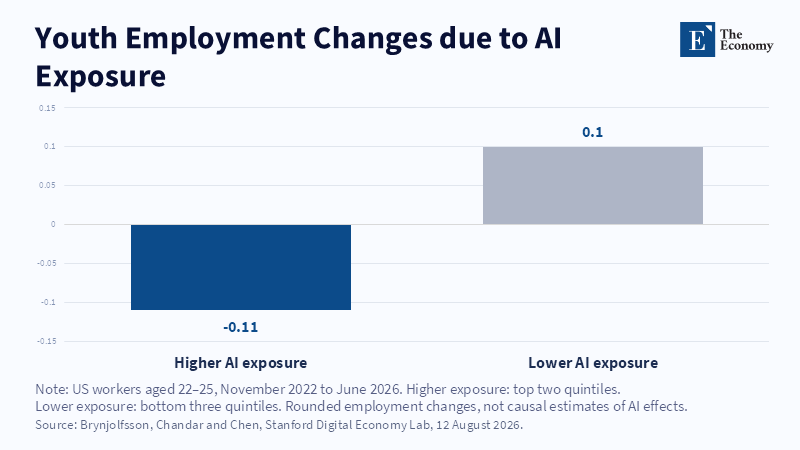
The broader data lends weight to the observation that adjustment may precede layoffs. Erik Brynjolfsson, Bharat Chandar and Ruyu Chen, at Stanford's Digital Economy Lab, examine payroll data of millions of U.S. workers. In the revision published on 12 August 2026, the employment of 22 to 25-year-olds in highly AI-exposed occupations is about 19% lower than the level it would have been if it followed the path of their peers in less exposed occupations. With the same indicator, the discrepancy was 15% in July 2025. This is not a layoff rate.
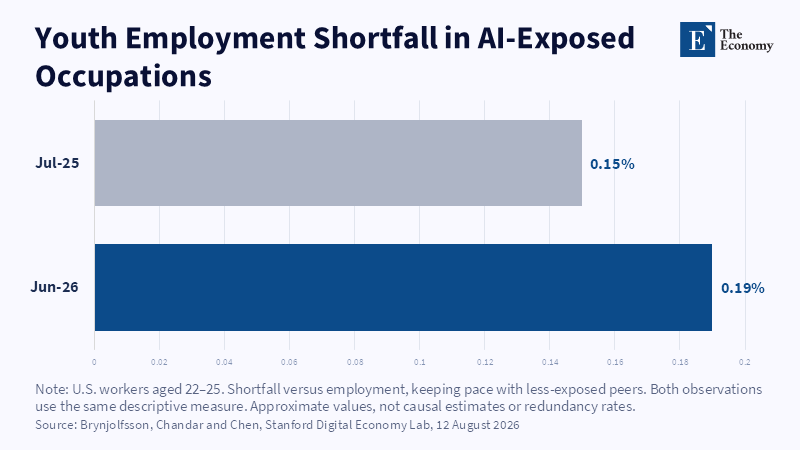
What I would put in front of a policymaker is the way the gap is formed: mainly through reduced hiring of young people, rather than increased departures. The authors do not find a generalized displacement of workers across the economy and characterize the findings as descriptive, not causal. The evidence does not prove that AI caused all the divergence, nor that adaptation time takes precedence over skill. But they fit into a mechanism I see within businesses: summaries, formatting and standardized texts are passed into a model, while the stepping stone that would train a new employee ceases to be available.
Measurement in retrospect can easily present this process as a difference in skills. Within a team, one person absorbs everything related to the new tools like a sponge. Two seats away, someone with the same title, the same access and the same experience treats them as something optional and continues as before. Six months later, the first seems strengthened and the second replaceable. Same industry, same tools, same building. A survey can record the result as a skills gap, without distinguishing between what pre-existed and what was created along the way. Three companies are not enough to solve this issue. They are enough to make me doubt that the final picture alone explains how we got there.
The Vacancy Was Rewritten in Private
Time is also closing in ways that are hard to see outside the business. Roles are redefined before they are published. One founder described the next hire as someone who would not write, but edit and review. He would not be hired just for what he can produce, but for his own judgment. Reasonable description of a future job. But none of those who would apply for the previous version received a rejection letter. The position was rewritten behind closed doors. When the ad appears, the substantive decision will already be made and the candidate will only see the result.
The flip side is that the first move costs money. Those who switch early can finance the transition while they still have the room to do so. The first customer with a new model can cost even three times as much as it should, because everything takes longer to find a way. He, however, builds the process by which the business will work later. With revenue still flowing in, the effort is treated as an investment. When revenue is lost, the same effort becomes a rescue operation, with less money and much less room for error.
The third company moved late. It had received the same advice, but went ahead when the market forced it. Within a few weeks, three clients requested a service that it had not yet organized as a specific offer. A competitor who had already done so took the job. Remodeling her proposal took four months without a new client. I don't infer from this that her people were any less capable. I notice that the same change now had to be made while the company had already lost work. The delay had changed the conditions in which their abilities were to be used.
Not Everyone Can Move Early
Here, the issue goes beyond business and becomes an issue of inequality. This is the part that interests me the most. A timely change of direction requires things that are not equally available to everyone. First, information. The two companies that moved early paid someone to explain to them what was coming. That was me. The third received the same advice, but let the market teach her the lesson months later, paying the full price. Information is not enough, as this case shows. Without it, however, the ability to move in time becomes even more limited.
It also needs financial leeway, because change requires time and income that must already be there. It also needs decision-making power. The owner of a company can redefine her entire business model in a fortnight, because it is hers. The employee within the same company has no corresponding ability. I watched a man go from a monthly salary to an hourly external collaboration that brought in a few hundred pounds a month. Same person, same skills, different position and no say over that position. The urge to adapt sounds different when one has no control over the subject or the terms of one's work.
I have to be clear about my own position. I build artificial intelligence tools, which help avoid the need for the next hire. I employ people. I also advise the companies that decide on the cuts. I am on three sides of the same process at the same time, so the information reaches me early and clearly. I don't present it as a credential. It's exactly the advantage I describe. The ability to see change over time is something that almost no one who suffers its consequences gets in the same way.
| Mechanism | Evidence from the three companies | What conventional statistics may miss |
|---|---|---|
| Planned vacancies disappear | Three or four developer roles were never advertised | No recorded redundancy or rejected applicant |
| Freelance commissions stop | Around £30,000 in annual freelance work was compared with AI usage costing roughly one-third as much | Lost income without a recorded job loss |
| Retainers shrink | One major client reduced its retainer by approximately 40% | Work shifts away before employment formally changes |
| Roles are redefined | A planned writing role became an editing and review role before advertisement | The original entry-level vacancy disappears invisibly |
| Late repositioning costs more | The third company spent four months rebuilding its offer without gaining a new client | Timing affects the resources available for adaptation |
Judgement Still Matters, but the First Rung Is Disappearing
The serious objection is that in the end, skills are crucial and retraining is the answer. There is truth to this. When a client of one of these companies tried to do the work with AI on their own, the result was visibly worse. This difference was paid for beforehand. The professional judgement held the line. The skill is not negligible. The promise of retraining, however, often presupposes a rung that is removed at the same time. If the starting position is converted to curation instead of production, I don't know where the curator's judgment will come from when no one has first spent three years doing the work.
Employers' plans also show that investment in AI skills and workforce reduction can occur at the same time. The World Economic Forum's 2025 survey covered more than 1,000 employers, representing over 14 million workers in 55 economies. Two-thirds planned to hire people with specific AI skills, while 40% anticipated reducing their workforce where AI could automate tasks, and 85% planned to prioritize upskilling. These are employer expectations, not recorded employment outcomes, so the survey does not validate the three cases I describe. It shows, however, that hiring, retraining, and staff reduction are being considered simultaneously rather than as sequential stages.
The Luddites are the usual analogy in such discussions. My point is that superior quality alone does not guarantee the survival of a job. A worse but much cheaper result can win over the customer. Even if new work is created elsewhere, this does not ensure that it will be available to the people who lost the previous one. Our version of this problem appears when we tell workers to retrain without answering what specific job this effort will lead them to and who will give them the first chance.
If time and place in the process explain a significant part of the difference, consequences arise that don't fit comfortably into ordinary conversation. Where the advantage comes from timely information, information needs to be disseminated, along with access to training. Advice to retrain isn't enough when some people learn what's coming much earlier and have the money and power to react, while the rest are informed through a missed assignment. There's also a measurement problem: the thirty thousand pounds of outside work replaced by about ten thousand pounds of AI use don't show up as a layoff. The loss can be reflected elsewhere, in income or hours worked, but a redundancy rate doesn't describe this change.
One founder called this way of thinking ruthless. He was not wrong, even though no single decision was presented as a plan to displace people. The changes I describe don't even require the technology to become better than it is today. If model development were to stop this afternoon, these pressures would remain, because prices and the options available have already changed. Those who realized this in time had time to move while there was still the next step. Those with the least leeway are now being asked to predict which jobs will survive. In the first company, however, the three or four January positions never reached the market. There was no candidate or rejection . There was only one job opportunity that stopped being offered.
The views expressed in this article are those of the author and do not necessarily reflect the views of The Economy, its Editorial Board, or any affiliated institution.
References
Brynjolfsson, Erik, Chandar, Bharat and Chen, Ruyu (2026a) ‘Canaries in the Coal Mine? Six Facts about the Recent Employment Effects of Artificial Intelligence’, Stanford Digital Economy Lab, revised 12 August 2026.
Brynjolfsson, Erik, Chandar, Bharat and Chen, Ruyu (2026b) ‘No Widespread Displacement, but the AI
Employment Gap for Young Workers Has Widened to 19%’, Stanford Digital Economy Lab, 12 August.
Demirci, Özge, Hannane, Jonas and Zhu, Xinrong (2025) ‘Who Is AI Replacing? The Impact of Generative AI on Online Freelancing Platforms’, Management Science, 71(10), pp. 8097–8108.
Merchant, Brian (2023) Blood in the Machine: The Origins of the Rebellion Against Big Tech. New York: Little, Brown and Company.
World Economic Forum (2025) The Future of Jobs Report 2025. Geneva: World Economic Forum.