The Discount Nobody Books: Why Digital Reputation Is Priced Into a Business Before It Goes to Market

Authored On
Modified
Digital reputation can shape a buyer’s assessment before formal due diligence begins
Evidence links online reviews to revenue, but not to a measured transaction valuation discount
Sellers must distinguish removable or correctable content from material that can only be contextualised or repositioned

A seller finds out late. The buyer has already done the searches, read the reviews and looked at the record of publications. By the time anyone says the word ‘reputation’ out loud, the buyer’s assessment of the business may already have changed. In May, The Economy described a version of this problem, looking at franchise food and beverage assets that had been put up for sale without attracting buyers. It concluded that the industry is being re-evaluated as an area where the capabilities to manage regulatory and reputational risk determine corporate value. The article was about restaurants in Korea. The mechanism is not limited to restaurants.
Many sellers treat digital reputation as a marketing problem, address it late and reach for the wrong tools. It is a matter of due diligence and both processes follow different timelines. Some content can be removed for legal reasons or because it violates a platform's rules. Others cannot. When there is no such basis, the response must focus on correcting the record where warranted and changing what ranks around the material in search results, a slower process with a less predictable outcome. The first step is to determine which category each case belongs to. ow effectively the remaining time before the sale can be used depends on that answer.
Reputation Is an Asset the Accounts Are Not Built to Hold
A potential discount is not recorded separately because there is no dedicated accounting line for it. Goodwill is a residual amount that arises at the time of acquisition, after considering the fair value of identifiable net assets. It is recognized only in a business combination and is not a separate valuation of reputation. A company's public image affects its revenue daily, but internally generated reputation is not typically recognized as a separate asset on the balance sheet. Its financial consequences can be reflected in the results long before any sale is made.
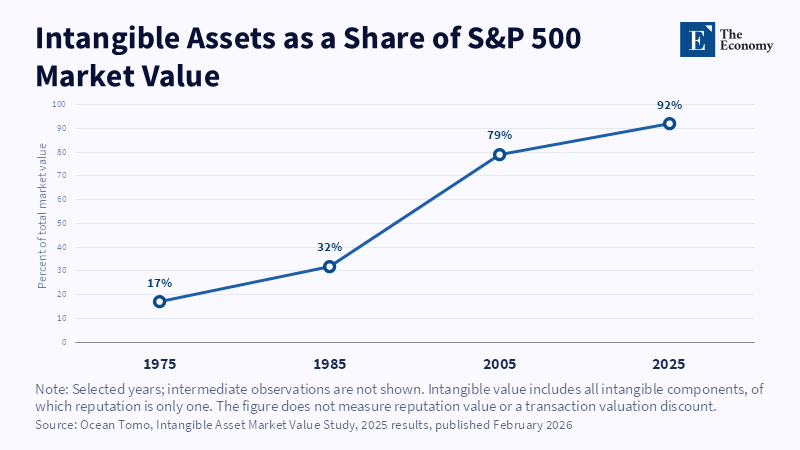
The editorial board of The Economy developed a related argument in July, in "The Hidden Balance Sheet: Measuring Firm-Specific Intangible Assets Before They Break," pointing out that much intangible investment remains uncounted until it begins to degrade. The scale of what is not fully reflected in the accounts is not negligible. The fifty-year study by Ocean Tomo estimates the share of intangible value in the S&P 500's market value at 17% in 1975 and about 92% in 2025. The percentage refers to the total intangible value, of which reputation is only one component. It does not measure reputation or any discount in valuation due to reputation. The two measurement problems are related, but they are not identical. "The Hidden Balance Sheet" examines internal signals, using employee reviews to identify changes in organizational capital. Here, the signals are external and public, therefore easier to observe and much harder to control. Anyone can look for them without permission and without informing the company.
Direct documentation of the effect on revenue is offered by Michael Luca's research at Harvard Business School. Luca matched the ratings on Yelp with restaurant revenue data from the Washington state tax authority. A one-star increase in the score led to a 5% to 9% increase in revenue. The result was for independent restaurants and did not appear in those owned by chains. It is a much narrower finding than the headlines often imply. With this limitation intact, it remains essential: when a business does not have a strong enough brand to absorb the impact of the rating, the rating takes on some of its role. The study documents an effect on demand, not a measured percentage discount on the sale price of the business.
The First Diligence Step Is a Search That Nobody Records
In practice, a buyer's first move is often a search. It precedes access to the electronic file of the transaction and can precede any signature. Someone from the team types the name of the company into Google and reads the results. It is the cheapest step in the process. It is also one of the earliest, so it sets the framework for what follows. This search is often not recorded. It does not have a separate fee, does not appear in the letter describing the process and leaves no trace of the timeline. By the time a formal question is asked of the seller, the person asking it may have already formed an opinion and checked whether it is confirmed.
The first page of results is not neutral territory. In BrightLocal's 2025 consumer survey, just 4% of respondents said they never read online business reviews, while 27% consult only a single website when reading them. A business buyer looks at how its consumers behave. If they see an unfavorable source dominating the front page, they need to factor in the likelihood that customers will see the same picture.
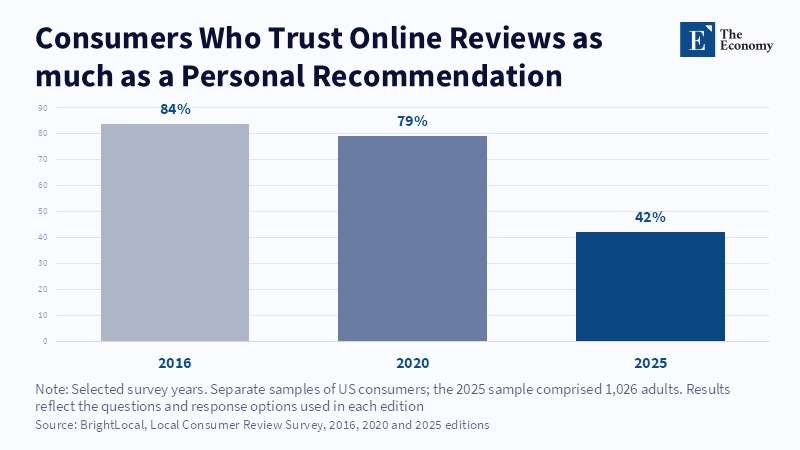
The same research highlights something else that is less often mentioned. Trust in reviews had declined noticeably by 2025. This does not mean that reputation ceases to matter in the evaluation of a business. In the suggested reading here, it increases the importance of the content of the first page in relation to the average of the stars, because a skeptical reader looks for the substance behind the rating, rather than accepting it without consideration.
That is why an old publication can create more uncertainty than a profile with low ratings. A two-star average points to a business problem that the buyer can investigate and incorporate into their forecasts. A supervisory action, a lawsuit, or a case involving the founder, in third place in the results and dated eighteen months earlier, leaves open questions. The seller can rarely close them with only their own version. Unanswered questions can lead to more conservative assumptions, as the buyer also evaluates the possibility that there is a part of the story that he has not yet heard.
Digital Footprint Analysis Is Becoming a Formal Part of Due Diligence
This job now also has an organized professional form. Deloitte in the UK offers the Digital Footprint Analysis service, which examines a company's public digital footprint as part of pre-acquisition due diligence. The service is primarily about cyber risk and is linked to the broader integrity check. Its scope also includes public information on critical executives, especially information that can be used for targeted attacks. Terminology has practical value: a salesperson who does not know what is being considered has difficulty preparing.
Digital footprint analysis covers domain names, subdomains, infrastructure, exposed credentials and public information related to employees. It also includes forgotten digital assets, such as old subdomains and systems without security updates that remain accessible from the internet. Alongside it sits integrity due diligence, covering background research, beneficial ownership analysis, sanctions screening and adverse-media review. The last term is of particular importance. The Economy’s profile of Vcheck Global describes this field: adverse-media and public-record research that can concern specific individuals as well as the legal entity.
Risks associated with people include a history of litigation, undisclosed conflicts of interest, exposure to reputational risks, regulatory issues and indications of problematic behavior. Many of these can leave public traces years before a transaction's disclosure list is compiled. An initial finding can then lead to more extensive investigation when the buyer deems it worthy of further investigation.
The sequence is the reverse of what many founders expect. The researcher identifies a trace, the trace generates a question; the question reaches the disclosures; and the founder is asked to respond under pressure for a five-year-old publication that he had forgotten. Deloitte's analysis of corporate due diligence and corporate governance explains the institutional dimension: material risks must reach the board of directors to be assessed in the context of transaction oversight.
What Can a Seller Remove, Correct or Only Reposition?
An honest answer to what can be corrected within the time before a sale is more limited than many reputation restoration service providers admit. The critical distinction concerns whether there is a legal basis or rule violation that allows for tampering with the content. How detrimental it is to the business is not enough in itself to justify its removal.
Table 1: Routes for Removing, Correcting or Repositioning Digital Reputation Content Before a Sale
| Content | Basis for action | Mechanism | Indicative timeline |
|---|---|---|---|
| Fake or incentivised reviews | Applicable platform policy violations | Submit a documented report identifying policy breaches and supporting evidence | Weeks to months |
| Defamatory statements | Applicable defamation law | Formal notice or legal claim, depending on the jurisdiction and facts | Months |
| Factually inaccurate reporting | Editorial correction | Request a correction from the original publisher | Weeks to months |
| Resolved legal matters | Privacy-law delisting, where the individual and content are eligible | Request removal from relevant name-based search results; the source page remains online | Months |
| Accurate, lawfully published negative coverage | No removal entitlement solely because coverage is negative | Publish substantive, accurate current information; changes in search visibility are not guaranteed | Three to six months or longer |
Note: Timelines are indicative; remedies depend on jurisdiction and applicable rules.
Accurate and legally published negative coverage is not removed simply because it makes a sale difficult. Supervisory action that happened remains a fact. What can change is the context around it, with documented corrections where needed, information on the progress of a case and essential information about how the business is currently operating. The position of a result in the search can also be changed, without this being guaranteed. It is one thing to come across an old publication as first information and another after having read reliable material about the current situation. The less obvious position does not mean absence. The seller must know the difference before signing anything.
In the author's practical estimation, the time sequence is more important here than the intensity of the effort. Work that begins twelve months before the process leaves more time for the new material to be indexed and historicized. Work that begins six weeks before the electronic transaction file is opened can make its expediency apparent. A sharp accumulation of favorable content just before the sale can prompt additional questions during the audit. These intervals are indicative, not guaranteed result times. The review of rating platforms is worth starting early, as the review of reports and the application of their rules are outside the direct control of the business.
Reputation Enters Due Diligence as a Risk Exposure
The discount described here is a potential consequence of this exposure, not an empirically measured percentage applied to each transaction. The risk may affect valuation assumptions or translate into a lower multiple, a larger escrow or holdback, a longer earn-out, or additional indemnities. The sources examined the impact on revenue and the importance of risk to the valuation of a business. They do not isolate the amount of discount that is specifically due to digital reputation. In Deloitte's global survey of reputational risk, 87% of more than 300 executives rated it as more important than other strategic risks. This was already the case in 2014. Reputation, therefore, is also about checking the business before a sale, with possible consequences for its terms. The seller's practical margin is to know what the buyer will find and to have documented answers before the negotiation begins.
Disclosure: The author is affiliated with FameNinja, an online reputation management firm. This article contains no client case studies, service promotion or comparative claims about providers. Statements based on the author’s professional experience rather than published sources are identified as practitioner assessments.
The views expressed in this article are those of the author and do not necessarily reflect the views of The Economy, its Editorial Board, or any affiliated institution.
References
Delaney, Siobhán (2026) ‘F&B Assets Pile Up, but Buyers Are Nowhere to Be Found: Triple Pressure from Profitability Erosion, Franchise Disputes and Reputational Risk’, The Economy, 15 May.
Deloitte Center for Board Effectiveness (2016) ‘M&A: The Intersection of Due Diligence and Governance’, On the Board’s Agenda, 2 May.
Deloitte Touche Tohmatsu Limited (2014) Reputation@Risk: 2014 Global Survey on Reputation Risk. Survey conducted by Forbes Insights.
Deloitte UK (2026) ‘Digital Footprint Analysis: Due Diligence for M&A Cyber Risks’, Deloitte, 9 March.
Google (n.d.a) ‘Prohibited & Restricted Content’, Maps User Generated Content Policy Help.
Google (n.d.b) ‘Right to Be Forgotten Overview’, Google Legal Help.
International Accounting Standards Board (n.d.) IAS 38 Intangible Assets. London: IFRS Foundation.
Johnson, Matthew (2026) ‘Ocean Tomo Releases 2025 Intangible Asset Market Value Study Results’, Ocean Tomo Insights, 12 February.
Luca, Michael (2016) Reviews, Reputation, and Revenue: The Case of Yelp.com. Harvard Business School Working Paper No. 12-016, revised March. Boston, MA: Harvard Business School.
Murphy, Rosie (2016) ‘Local Consumer Review Survey 2016’, BrightLocal, 7 November.
Murphy, Rosie (2020) ‘Local Consumer Review Survey 2020’, BrightLocal, 9 December.
Paget, Sammy (2025) ‘Local Consumer Review Survey 2025’, BrightLocal, 29 January.
The Economy (2026) ‘Vcheck Global’, The Economy Wiki, 20 August.
The Economy Editorial Board (2026) ‘The Hidden Balance Sheet: Measuring Firm-Specific Intangible Assets Before They Break’, The Economy Strategy Review, 6 July.