The Heatwave, the Harvest and Inflation: The Problem of Climateflation for Central Banks

Working across research, policy, and data-driven analysis, the Editorial Board ensures that published pieces reflect a consistent institutional perspective grounded in quantitative reasoning and long-term structural assessment.
Authored On
Modified
Heatwaves are becoming a recurring driver of inflation
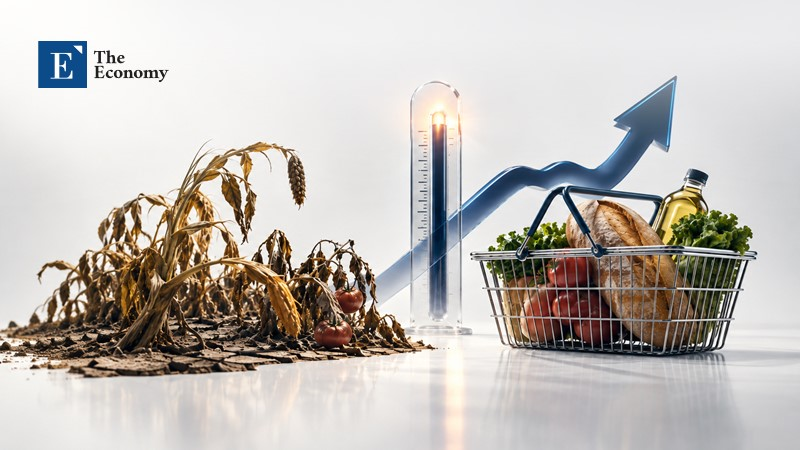
Harvest damage transmits heat into measurable food-price shocks
Central banks are building tools to track this pattern
On June 21, France issued the highest level of heat alert in 35 of its 96 administrative regions, with temperatures around Paris reaching 41 degrees Celsius. Prime Minister Sebastien Lecornu called an emergency meeting and banned alcohol consumption at music festivals, while the SNCF canceled 71 intercity train services due to the risk of damage to the trains' air conditioning. A month later, the fires in Gironde and Landes forced more than 220,000 people to flee their homes, while around Madrid evacuations exceeded 70,000. Such images look like isolated incidents, something that happens, causes damage and passes. But the European Central Bank has already measured what such a heatwave leaves behind: that of the summer of 2025 added between 0.4 and 0.7 percentage points to the inflation of unprocessed food in the eurozone within twelve months.
A Heatwave, Not a Model
The most common reaction to a heatwave is not based on a model. It is based on what one sees at the time: schools closing early, a festival being canceled, a report of hotels in Rome where tourists took refuge in the underground archaeological parts of the Colosseum to escape the heat. This perception is not wrong, it is simply incomplete. It treats each heatwave as an isolated event that will pass as soon as the temperature drops, without any mechanism linking one episode to the next or to macroeconomics in general.
The problem is that the same pattern is repeated and with increasing frequency. Western Europe recorded the hottest June in the history of measurements this year, a high barometric system remained for weeks over the continent and constantly supplied warm air from the Sahara to the Mediterranean. Some countries even recorded pyrocumulonimbus clouds, i.e. storms created by the fires themselves and can trigger new outbreaks. When the phenomenon repeats itself at this rate, the logic of the "isolated incident" begins to seem inadequate, even for those who are not professionally involved in monetary policy.
From Heat to Plate
The channel through which a heatwave turns into an inflation problem is no mystery. It's the harvest. In the summer of 2022, the heatwave destroyed olive groves in Spain, poultry production in the UK fell by 9 percent year-on-year because the birds could not withstand the heat and Northern Italy experienced its worst drought in seventy years, with a direct impact on rice production for risotto. None of these losses were left in the fields. It went to food prices and from there to the consumer price index.
Philip Lane, a member of the ECB's Executive Board, presented data in May that put a number on this relationship. The 2025 heatwave added 0.4 to 0.7 percentage points to eurozone unprocessed food inflation over twelve months, an effect that does not disappear once the temperature drops but lasts for an entire year. In the longer term, Maximilian Kotz and colleagues at the Barcelona Supercomputing Center, in collaboration with researchers from the ECB and the Potsdam Institute, estimated that higher temperatures could add up to 3.2 percentage points per year to global food inflation as we approach 2035. In an even warmer climate of the 2060s, the same research team calculated that an extreme summer could add up to 1.8 percentage points to food prices in Europe, compared to a hypothetical scenario without any climate change.
The chain does not stop at the harvest. Railways in Germany struggled to operate normally last month as steel lines expanded and bent in extreme heat, while electrical signaling equipment is at risk of failure above a temperature limit. France's EDF was forced to adjust production at the Blayais nuclear power plant as the temperature of the Gironde River rose, while three more units were temporarily shut down. Each such disruption adds friction to an economy already struggling with the harvest and where the impact on food prices ends and where the wider supply disruption begins.
Modeling the Shock, Not Guessing It
The answer to this uncertainty is not to wait for the next heatwave and react then. ECB researchers, including Kuik, Osbat and Vidal-Quadras Costa, incorporated weather variables into a Random Forest model that predicts unprocessed food inflation six months ahead. The finding is that this model improves forecasting even when prices of basic commodities related to agriculture are already taken into account. In other words, temperature is not just another variable among many. It carries information that is not already found in commodity prices.
At the same time, Erlandsen, Ho, Kyriakopoulou, Talbot and Millar, in a recent column for CEPR, presented the framework of the Network for Greening the Financial System, known as NGFS. This framework proposes a five-step process for each climate shock: identifying the shock, assessing its spillover to the rest of the economy, assessing whether a real monetary policy dilemma arises, defining and communicating the decision and finally continuous monitoring. This is not a formula that gives an automatic answer. It is rather a structure that forces the policymaker to ask the same question every time, rather than relying on the intuition of the moment.
Why Central Banks Can't Ignore Climateflation
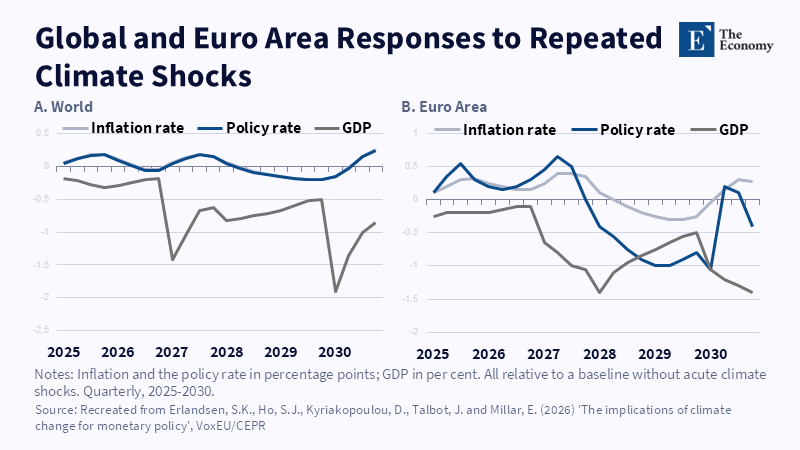
The traditional recipe for a temporary supply shock is simple: ignore it, don't react with tighter monetary policy to a price increase that will subside on its own. The problem is that climate change makes this logic harder to implement, precisely because shocks no longer come in isolation. The NGFS scenario considered by the CEPR authors combines repeated heatwaves, droughts, floods and cyclones in different regions of the world and shows that the result is a fall in GDP alongside increased volatility in inflation, which creates exactly the dilemma that central banks are trying to avoid. The same scenario appears in the chart "Global and Euro Area Responses to Repeated Climate Shocks." Euro area GDP falls sharply in exactly the years the scenario treats as El Niño years, 2027 and 2030, while inflation and the policy rate move the other way. The world as a whole follows the same pattern, only with a smaller amplitude.
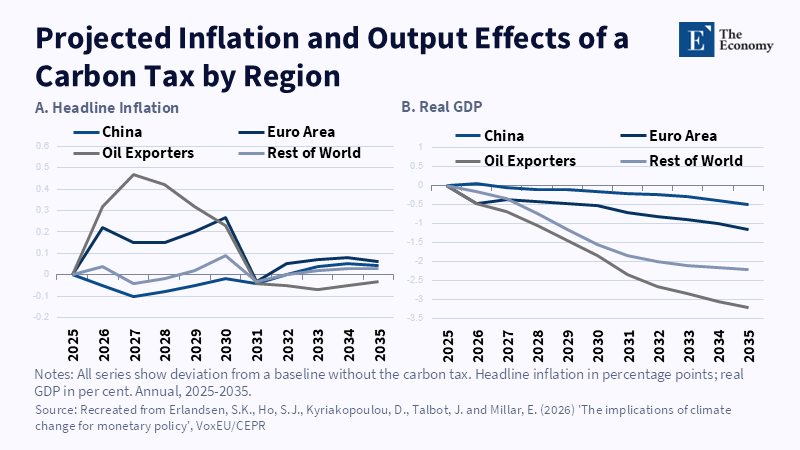
One could argue that a single heatwave remains, statistically, a relative price shock and not something that threatens medium-term price stability. This is true for a single episode. But it is not true when the episodes follow one another, as each new shock finds the economy less resilient than the previous time. Germany's road and rail infrastructure, designed for a milder climate, has not adapted to the pace of temperature rise, which has averaged 0.56 degrees Celsius per decade over the past thirty years, almost twice the global average. Meanwhile, the political controversy surrounding the proliferation of air conditioners in France and Germany is delaying precisely the adaptation measures that would reduce the severity of the next episode. Each repeated shock, in other words, leaves less room for resilience for the next and it is this accumulation that turns a series of temporary disruptions into something more permanent. The same logic extends to the shift away from fossil fuels. In the chart "Projected Inflation and Output Effects of a Carbon Tax by Region," a carbon tax aligned with national emissions targets adds as much as 0.47 percentage points to inflation in oil-exporting economies around 2027, while their real GDP falls progressively by more than 3 percent by 2035. The same dilemma a heatwave creates, a transition policy creates as well, only the cause is regulatory rather than natural.
This phenomenon, which some call climateflation, is no longer unique to Europe. Researchers who analyzed monthly consumer price index data from 121 countries found that the effect of high temperatures on food inflation lasts for at least twelve months, with the gap between countries already warming and countries with mild climates widening. Central banks can suppress demand, but they cannot repair a damaged crop. Tightening on a supply problem simply shifts costs from food to investment and consumption, without solving the original problem.
The question for agriculturally exposed businesses and policymakers is no longer whether a heatwave will occur again, but how often and how much the delay in adaptation will cost. Energy markets are already showing what these costs look like: in the summer, when solar production is at its peak, wholesale electricity prices fall to zero or turn negative, while in the evening, when demand for air conditioning remains high but the sun has set, the grid is squeezed again. The same asymmetry, between a momentary comfort and a deeper fragility, characterizes the effect of heat on food.
The June heatwave in Paris has passed. Schools have reopened, trains have run normally and attention has shifted to the next issue. What has not passed is the effect on the price of bread and olive oil, which will appear in inflation indicators months later, without always being linked in the consumer's mind to the heatwave that caused it. If the same sequence is repeated next summer and again the year after, the question will no longer be whether it is an isolated shock. It will be whether the institutions have had time to build the tools they need to recognize it in time.
This article reflects the analytical judgment of The Economy Editorial Board and does not constitute policy advice or the official position of any affiliated institution.
References
Erlandsen, S.K., Ho, S.J., Kyriakopoulou, D., Talbot, J. and Millar, E. (2026) 'The implications of climate change for monetary policy', VoxEU, CEPR, 3 September.
Kotz, M., Kuik, F., Lis, E. and Nickel, C. (2024) 'Global warming and heat extremes to enhance inflationary pressures', Communications Earth & Environment, 5, 116.
Kuik, F., Osbat, C. and Vidal-Quadras Costa, I. (forthcoming) 'Earth, wind, fire and grocery bills: exploring the forecasting power of weather variables for euro area food inflation'.
Lane, P.R. (2026) 'Climate change and monetary policy', keynote speech at the Climate, Nature and Monetary Policy Conference, European Central Bank, Frankfurt am Main, 5 May.
Working across research, policy, and data-driven analysis, the Editorial Board ensures that published pieces reflect a consistent institutional perspective grounded in quantitative reasoning and long-term structural assessment.