Borrowing Costs in Emerging Markets: The Country Premium

Working across research, policy, and data-driven analysis, the Editorial Board ensures that published pieces reflect a consistent institutional perspective grounded in quantitative reasoning and long-term structural assessment.
Authored On
Modified
Emerging-market firms pay a persistent country-level borrowing premium
Deeper local savings can widen access and lower yields
Financial liberalisation expands access but adds global-rate exposure

A company can have good sales and low debt but it can also have sound management and steady profits. Nevertheless, it may borrow more expensively just because it is in the wrong country. In over 330,000 bond issuances from 50,000 companies in 138 countries, the real borrowing costs for companies from low- or middle-income countries were about 2 percentage points higher than the cost for companies in rich countries, based on 2015 to 2024 data. So the cost of borrowing in emerging markets also carries a country premium. The quality of the company counts a lot as does the country. The state, the local market, the amount of available capital and tmarket liquidity and the quality of available information also enter the price. For many companies, the country where they are headquartered acts like a permanent premium.
Borrowing Costs Start with the Sovereign
The cost of capital must be treated as a basic national infrastructure. Roads and electricity change the cost of production. The government bond market shapes the cost of money. In low- or middle-income countries, a rise of one percentage point in the yield of the government bond is associated with an increase of about 76 basis points in the yields of domestic corporate bonds. In international issues, the rise is about 46 basis points. The state gives the market the first benchmark. On top of this comes the price of corporate risk. An unstable or shallow government market raises the bar from the beginning. The company can be consistent. But the investor also sees inflation. Investors price the currency, the course of the state and the possibility of a sudden change in policy. He also examines whether he will be able to sell the bond easily.
The 2024 data shows how heavy this base is. In emerging countries, except China, real yields on new government bonds in local currency approached 4 percent. In low-income countries they exceeded 7 percent. In OECD countries, it was around 2 percent. The same problem can be seen in dollar debt. The cost of new dollar-denominated government debt in emerging countries rose from about 4 percent in 2020 to over 6 percent in 2024. For several low-scoring issuers, it exceeded 8%. The difference does not stay in the state budget. It passes to banks and corporate bond prices. It also passes to plans for new units, equipment and jobs. At the same time, the IMF recorded an increase in the share of companies under economic pressure, with the problem being more acute in emerging markets. Higher rates are already exposing weaker balance sheets.
At the end of 2024, almost 4.5 trillion dollars of government bonds in emerging countries had to mature by 2027. The amount was close to 40 percent of the relevant debt stock. In low-income countries and high-risk issuers, more than half of the debt was in this maturity zone. New borrowing is now done on more expensive terms. This increases the interest paid by the state. It also reduces the space for other spending. Then comes the private market. The state pulls in a large part of the available capital. It offers a high return without the same corporate risk. A private company then has to give even more. So the cost of borrowing can become a cycle. Higher sovereign borrowing costs raise corporate financing costs. More expensive credit cuts investment while weaker growth makes it difficult for the state again.
Why Local Bond Markets Still Matter
A seemingly easy solution is to go abroad but the data shows why this is not enough. In the 1990s, less than 30 percent of corporate bonds in low- or middle-income countries were in local currency. In 2024, the rate had reached almost 90 percent. The change reduces a key risk. A company's income and debt are most often in the same currency. A fall in the local currency does not automatically inflate the weight of dollar debt. But borrowing costs remain high. From 2015 to 2024, the gap in real yields was about 2.5 percentage points on local currency bonds. In dollar issuances it was about 1.5 points. Local credit solves some of the risk. But it keeps the issuer in a market that often has less money, fewer large investors and sparser transactions.
This helps explain the strong preference in the local market. The choice has a practical basis. Small and new companies often have no other market. The same is true for those issuing bonds for the first time. Local banks and funds know the name, customers and assets better. They also have a better insight into how the industry works within the country. This knowledge reduces some of the control costs. Relationships fill gaps that a foreign investor would ask to fill with many official documents. There is also the issue of currency. Research by the Bank for International Settlements shows that credit in local currency can act as a reserve when a strong dollar cuts dollar credit. For a medium-sized company, then, more expensive local money can be safer than a cheaper foreign loan.
The Cost of Accessing Global Markets
Borrowing costs can fall when a company gains access to London, New York, or another major market. But the transition comes at a cost. Foreign investors usually know less than local creditors. They require clear financial statements, a solid track record, sound corporate governance, adequate issue size and reliable legal documentation. A recognised credit rating may also be required. Interest rates show how much this process counts. Unlisted companies from low- or middle-income countries pay about 84 basis points more than publicly traded ones when they borrow internationally. The difference is linked to the information gap. That information gap raises due diligence costs and leads investors to demand a higher return. Private placements show the same pattern. They can be cheaper at home, where the buyer knows the issuer. Abroad they often cost more due to low liquidity and heavier controls.
There is a second price as the international market offers much more capital. But it transfers the US central bank's moves to the company more directly. A rise of one percentage point in the key interest rate of the United States is associated with a rise of about 47 basis points in the international corporate yields of low- or middle-income countries. In the domestic market, the ratio is about 10 basis points. The foreign market is deeper. It is also more tied to the global cycle. The currency adds another risk. In 2024, smaller emerging countries had about 40 percent of their sovereign debt in foreign currency. For emerging countries as a whole, excluding China and India, the share was about 20 percent. In the OECD, it was close to 6 percent. A large devaluation can thus turn a low nominal interest rate into a very expensive final liability.
Local Savings Can Lower Borrowing Costs
The most useful policy field is on the local capital side. A country with little money for long-term investment has to pay more for each new loan. Pension funds, insurance companies and investment funds can change this relationship. Research in 30 low- or middle-income countries looked at changes that created privately managed pension accounts. After the changes, the local investor base increased. For companies that issued bonds at home both before and after, real yields fell by about 150 basis points. The result was about 60 basis points stronger where funds had more freedom to buy securities beyond government bonds. The existence of savings alone is not enough, the money must also be able to reach the private economy.
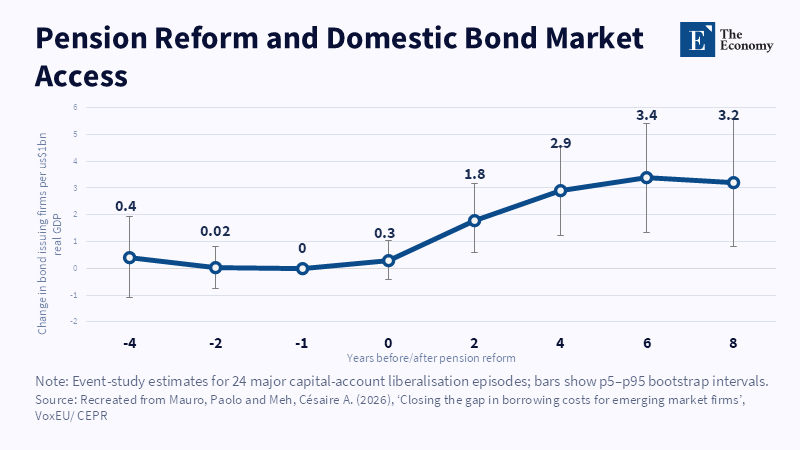
This also changes the way progress should be measured. Success is not only seen in the average interest rate. After a change, new companies with higher risk may enter the market. The average can then stay almost the same. The benefit remains real. More companies find money. Older and more stable issuers can pay less. The importance for the economy is great. A 2025 study of nearly 80,000 companies found that raising capital from stocks and bonds in low- or middle-income countries doubled as a percentage of GDP from 2000 to 2022. Net capital issuance reached $4 trillion between 1990 and 2022. In the first year after raising, investment in fixed assets increased by 16 percent in low-income countries. In middle-income countries, it increased by 8 percent. Cheaper money is directly related to productive capacity.
Building this foundation needs caution as a large pension system doesn't help enough if the rules send almost all the money to the state. A large banking market is also not enough. Companies need securities that can be bought and sold easily. They need a clear price and stable rules. Authorities can open up space for insurance and pension funds without loosening control. Public debt managers also have a role. Regular issuances on key maturities give benchmarks. An active market for old securities helps pricing. Investors can then compare risk better. They can go in and out at less cost. Market depth is not created by a large bill. It is built with many simple rules that remain stable for years.
Making the Country Cheaper for Capital
Opening up to foreign flows can provide quicker relief but it needs the right order. In 24 major episodes of market opening from 2000 to 2021, companies that issued internationally before and after the change saw their real yields fall by about 120 basis points. The result has large economic significance. For the 47 less open developing countries, applying the same effect to international issuances of the previous decade gives estimated interest savings of about roughly $78 billion over the past decade. The estimate does not mean that every country will earn the same amount. It shows the costs that a closed market can have. Opening up needs a stable economic policy. It needs clear rules and reliable data. It also needs local buyers who do not leave with foreign money when fear grows in international markets.
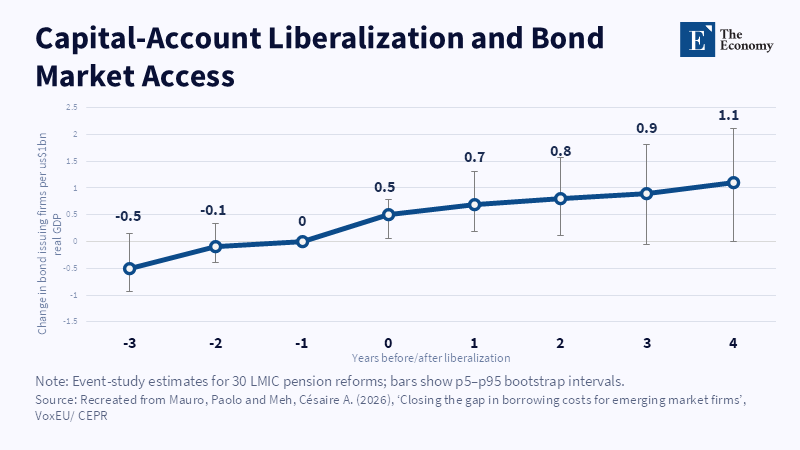
A developing country cannot quickly acquire the depth and history of the United States or northern Europe. But that does not make the headquarters premium permanent. The inclusion of government bonds in a large international index has been linked to a drop of about 64 basis points in the real returns of established international corporate issuers. Earlier IMF research also showed that better standards for publishing government data were associated with lower government borrowing costs. Small institutional steps can therefore change the price. Stable issuances, clean data and a good market for government securities help. So do clear rules for large funds and better corporate information. None of these changes require a country to become rich first. It is part of the path to cheaper capital.
Borrowing costs in emerging markets will not go down just because companies will look for money abroad. Many do not have the size or track record that the international market demands. Others can borrow abroad but they take on greater exposure to the dollar and global interest rates. The most stable solution is to bring down the price of the headquarters itself. A better government benchmark curve is needed. More local capital with a long horizon is needed. It needs access to foreign money with proper control. It also needs cleaner data from the state and corporations. The initial difference of 2 percentage points shows how high the price is. Politics does not need to promise to zero it. It needs to reduce it steadily so that the country of the headquarters will cease to function as a permanent charge on growth.
This article reflects the analytical judgment of The Economy Editorial Board and does not constitute policy advice or the official position of any affiliated institution.
References
Albuquerque, B. et al. (2025) Corporate Sector Vulnerabilities and High Levels of Interest Rates. Washington, DC: International Monetary Fund.
Avdjiev, S., Burger, J. and Hardy, B. (2024) ‘New spare tires: local currency credit as a global shock absorber’, BIS Working Papers, No. 1199.
Cady, J. and Pellechio, A.J. (2008) ‘Sovereign Borrowing Cost and the Data Dissemination Initiative’, in Alexander, W.E., Cady, J. and Gonzalez-Garcia, J.R. (eds.) The IMF’s Data Dissemination Initiative After Ten Years. Washington, DC: IMF.
De Biase, P. et al. (2025) ‘Sovereign debt markets in emerging market and developing economies’, in Global Debt Report 2025. Paris: OECD Publishing.
Mauro, P. and Meh, C.A. (2026) ‘Closing the gap in borrowing costs for emerging market firms’, VoxEU, Centre for Economic Policy Research.
Mauro, P. and Meh, C.A. (eds.) (2026) Curbing the Cost of Borrowing for Businesses: The Role of Bond Markets in Low and Middle Income Countries. Washington, DC: International Finance Corporation, World Bank Group.
Meh, C.A. and Schmukler, S.L. (eds.) (2025) Financing Firm Growth: The Role of Capital Markets in Low and Middle Income Countries. Washington, DC: World Bank.
Working across research, policy, and data-driven analysis, the Editorial Board ensures that published pieces reflect a consistent institutional perspective grounded in quantitative reasoning and long-term structural assessment.