Beijing’s Dilemma Over Hong Kong’s Wealth Hub

Working across research, policy, and data-driven analysis, the Editorial Board ensures that published pieces reflect a consistent institutional perspective grounded in quantitative reasoning and long-term structural assessment.
Authored On
Modified
Hong Kong overtook Switzerland as the largest cross-border wealth hub
Beijing’s anti-graft drive limits how far capital can open
Clear rules could keep wealth from drifting to Singapore

At the end of 2025, assets held in Hong Kong on behalf of non-residents reached about $2.95 trillion, an amount that marginally exceeded Switzerland’s $2.94 trillion and made Hong Kong’s wealth hub the world’s largest cross-border hub, according to the Boston Consulting Group. Around the same time the ranking was published, Beijing turned against brokers serving mainland investors without a license and a few weeks later imposed a 20 percent income tax on offshore trusts. The timing says a lot about how the Chinese leadership views the city’s success. Much of the wealth that makes Hong Kong’s wealth hub grow comes from money leaving mainland China and a piece of that money has origins that the leadership sees as a threat to its own power, which brings China to a choice that no major trading power has forever avoided: between opening up its financial market and controlling the corruption that that opening would facilitate.
China Opened Trade Payments but Kept Capital Locked
Economies that grew through exports almost always end up opening their capital accounts, sometimes by their own choice and sometimes under pressure from trading partners. Japan followed this route in the early 1980s and South Korea after the 1997 crisis. The logic is understandable to anyone who has ever sent goods abroad. An exporter from Rotterdam or Chicago who sells to a Chinese buyer wants the certainty that payment will arrive and an importer wants to know that he can pay his supplier without the remittance being frozen at a foreign exchange control office. When a government restricts foreign trade so severely that payment is not certain, this regulatory risk becomes a cost that no international partner wants to bear and the pressure to open up grows with each new trade record.
China found an intermediate path early on. In December 1996, it accepted the obligations of Article VIII of the International Monetary Fund, making the yuan convertible for trade payments, while keeping the capital account closed. The exporter is paid and the importer pays his supplier, but the individual who wants to transfer his savings into U.S. government bonds or to a flat in London stumbles upon an annual foreign exchange purchase limit of $50,000 per person. The system endured nearly three decades because it satisfied trading partners without having to satisfy investors, who, as the economy grew at double-digit rates, had several reasons to keep their money in the country.
These reasons have weakened significantly. The Institute of International Finance estimated that Chinese households, businesses and financial institutions transferred about $807 billion abroad in 2025, the highest amount on record, with outflows to foreign equities up 67 percent to $208 billion and to foreign bonds up 75 percent to $153 billion. Some moved through legal channels, while another part went through insurance companies, trusts and unlicensed brokers that had been operating for years in a grey zone. A full liberalization of the capital account today would put pressure on the yuan and reserves long before any benefit to foreign investors was seen, as happened between mid-2014 and early 2017, when the country’s foreign exchange reserves fell by nearly a trillion dollars.
Dirty Money Is Xi Jinping’s Political Problem
The Chinese leadership has a second reason to keep the doors half-closed, which rarely comes up in monetary policy discussions. Wealthy businessmen, as well as officials who have become rich from bribes, have been looking for years for a second home for their money, an account abroad that will provide them with a way out if an investigation approaches or if a political change turns the state against them. For this category of people, the freedom of movement of capital works like an insurance policy and any new legal channel abroad can, with the appropriate legal structure and a willing intermediary, be turned into a concealment channel, which the Chinese authorities know from their own investigations better than any foreign regulator, since many of the major cases of the last decade have ended up in accounts, real estate and companies outside the borders.
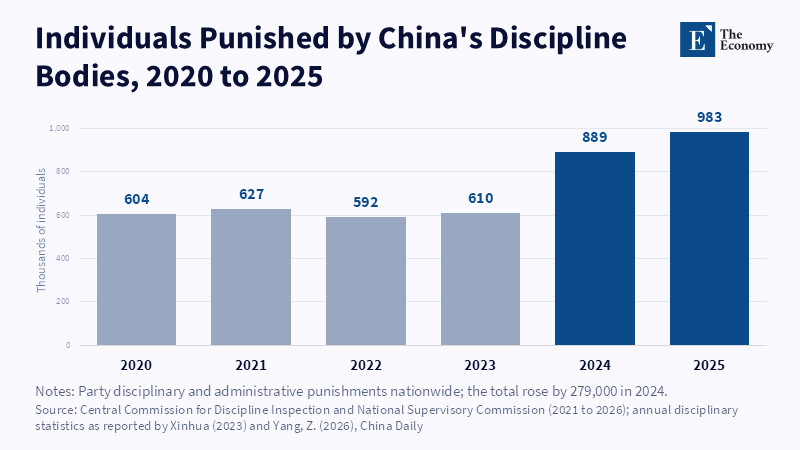
Combating this wealth has been a central goal of Xi Jinping’s rule since 2012 and has not relaxed. The Central Commission for Discipline Inspection announced that 983,000 people were sanctioned in 2025, compared to 889,000 in 2024, while 115 provincial or ministry-level officials were investigated, 42 more than the previous year. In the same year, 505 cases of cross-border corruption were opened and 963 fugitives were returned through the Sky Net 2025 campaign and a parallel asset-recovery operation. A campaign of this magnitude has become a permanent mechanism of the state and in order to work, it needs the ability to follow money across borders. A fully free system of capital would take away this possibility, which is why Xi cannot promise foreign investors a free market without undermining his first political goal.
Hong Kong’s Wealth Hub and the Return of Grey Money
Hong Kong has been at the center of this story since July 1997, when Britain withdrew and the city returned to Chinese rule. It has kept common law, a freely convertible currency and a deep banking market, characteristics that made it ideal for legitimate investors and for exactly the same reason attractive to those who wanted to hide illicit profits. The case of Xiao Jianhua encapsulates this dual use. The billionaire was driven from the city’s Four Seasons hotel to mainland China in January 2017 and in August 2022 was sentenced by a Shanghai court to 13 years in prison, while his group, Tomorrow Holdings, was fined 55.03 billion yuan, about $8.1 billion, the largest in the country’s history. The court ruled that from 2001 to 2021 the group gave state officials shares, real estate and cash worth more than 680 million yuan to avoid oversight, a story that showed how narrow the city’s autonomy is when Beijing judges that the money passing through it threatens its financial security.
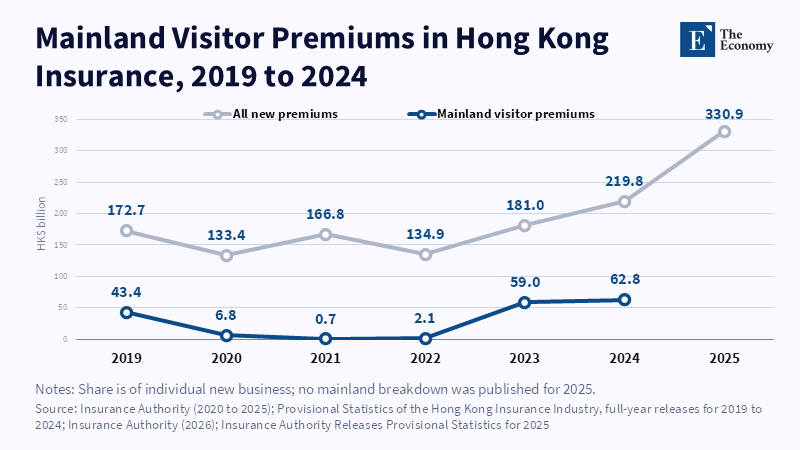
As of 2024, the climate has changed. After years of pandemic restrictions, authorities in Beijing and Hong Kong eased barriers to bring investors back to the city. On February 26, 2024, the revised version of the cross-border Wealth Management Connect program came into force, tripling the individual investment limit from 1 to 3 million yuan and opening participation to brokerage firms. Hong Kong stock purchases by mainland investors pushed net outflows to buy securities to $58.3 billion in July 2025, the highest monthly level since 2010, according to the State Administration of Foreign Exchange. Life insurance sales in the city rose by 50 percent in the same year, to a record $42 billion and Reuters Breakingviews described the $50,000 annual limit as one of the building materials with which family wealth moves from the mainland to the city.
Along with the legal channels, the others were inflated. In December 2025, the Hong Kong Customs and Excise Department dismantled, in the operation codenamed Mirage, a five-person ring that allegedly laundered about 8.9 billion Hong Kong dollars through fictitious commercial transactions, i.e. the technique that allows a fake export invoice to transfer funds that no bank would approve as a simple remittance. At the same time, brokers such as Futu, Tiger Brokers and Longbridge had for years opened accounts to residents of mainland China, an activity that the China Securities Regulatory Commission described as providing services without the required licenses. The distance between an investor diversifying his portfolio and an official hiding the proceeds of bribery is not always visible on the account opening form and this ambiguity was enough to mobilize Beijing.
The 2026 Crackdown Has Not Yet Favoured Singapore
The answer came in two waves. In May 2026, Chinese regulators announced sanctions for foreign entities that offered unlicensed services to mainland investors, as well as domestic banks that served them, with a provision to confiscate illicit profits. At the end of July, the Ministry of Finance imposed a 20 percent income tax on offshore trusts, with an obligation to declare within 90 days for unpaid taxes on assets transferred to trusts since January 2023. The city’s banks quickly got the message. Some wealth managers have restricted executive travel to mainland China and suspended events for clients there, while a major Chinese wealth manager has stopped paying referral fees to employees who sent clients to its Hong Kong subsidiary, Reuters reported. Reuters Breakingviews estimated that about $2.6 billion of profits are at risk for the banks it examined, an amount equal to 10% to 20% of what they earned in 2025 from Hong Kong and mainland China.
The most common objection to this policy is that the crackdown will simply send the funds to Singapore, that Beijing will lose the control it seeks and that Hong Kong will pay the cost without anything in return. The evidence does not support this reading, at least not yet. The new rules on trusts are about the income of Chinese residents regardless of where the structure is set up, so a trust in Singapore does not offer a tax advantage over one in Hong Kong. Singapore also has its own reasons for caution, since after the August 2023 raids, when authorities revealed that ten foreigners of Chinese origin linked to illegal gambling had laundered about S$3 billion, the country tightened fund provenance controls and the approval of a family office began to take over a year. Deloitte counted 3,384 single-family offices in Hong Kong at the end of 2025, while the Singapore government reported more than 2,000, with both sides using different definitions.
Singapore remains a viable option, however and that’s where the risk for Hong Kong lies. Its authorities have pledged to reduce account opening time from more than six weeks to less than a month, while advisers who spoke to Nikkei Asia describe joint ventures with local partners to keep transactions outside the reach of Chinese authorities. If investors conclude that Hong Kong is both the prime money channel and the first target of any Chinese control campaign, proximity to China, which is currently sold as an asset, will start to be priced in as a risk. Hong Kong’s Financial Secretary said in June that Beijing wants the city to succeed as an international financial center, an assurance that will be tested in how the autumn rules will be implemented.
A Constructive Fix Needs Clear Rules on Both Sides
For city regulators, a constructive solution starts with the ability to distinguish one type of mainland money from another. This means wealth provenance checks that don’t stop at paper, meaningful cross-checking of commercial invoices with actual shipments and a willingness to share information with mainland tax authorities through existing automatic exchange mechanisms. The Hong Kong Monetary Authority has already announced a third version of Wealth Management Connect with higher limits, a wider range of products and potential expansion beyond the Pearl River Delta region, while the city’s government has set a goal to attract or expand at least 220 family offices by 2028. Every new approved channel that replaces a gray one reduces the space for those who live off the ambiguity and the banks that notice it first will keep customers counting in the long run.
For Beijing, the difficulty lies elsewhere. Economists at Natixis pointed out in June that the biggest problem for Hong Kong businesses is the uncertainty of how far the crackdown on cross-border flows will go and that uncertainty costs more than any specific tax, because an international asset manager can price a 20 percent rate but not a rule that can be changed without notice within a quarter. A published, stable framework that distinguishes legal diversification from the transfer of the proceeds of corruption would allow Xi to continue his campaign without scaring off the investors the city needs. The tools already exist, since Stock Connect and Wealth Management Connect have been operating for years as closed circuits with known boundaries and extending Wealth Management Connect beyond the Greater Bay Area to Shanghai and Beijing would give wealthy mainland residents a legal route abroad that the state can monitor.
The difference between Hong Kong and Switzerland in Boston Consulting Group’s ranking was about $10 billion, an amount just a little larger than the $8.1 billion fine imposed on Tomorrow Holdings in 2022. That gives an idea of how fragile first place is. If the city proves that it can host mainland wealth without becoming a haven for dirty money, Hong Kong’s wealth hub has everything it needs to remain the center of Asia. If laundering and Beijing’s successive campaigns become the norm, trust will wear off and capital will return to Singapore. The 90-day deadline for declaring unpaid taxes on trusts expires in the fall and the first data on how many families declared, how many liquidated and how many moved their structures elsewhere will show in which direction the scales are tilting.
The views expressed in this article are those of the author(s) and do not necessarily reflect the official position of The Economy or its affiliates.
References
Al Jazeera (2022) ‘Chinese-Canadian billionaire Xiao sentenced to 13 years in prison’, Al Jazeera, 19 August.
Bloomberg (2025) ‘China’s capital outflows hit record amid liberalization push’, Bloomberg News, 18 August.
Boston Consulting Group (2026) ‘Hong Kong surpasses Switzerland as largest cross-border wealth hub’, press release, 27 May.
Burroughes, Tom (2026) ‘China’s offshore financial clampdown makes a mark’, WealthBriefing, 11 August.
China Daily (2026) ‘China’s anti-graft efforts deepen in 2025, with 115 senior officials probed’, China Daily, 19 January.
Chuang, Aileen (2025) ‘Wealth Connect 3.0: HKMA chief promises upgrades to boost appeal’, South China Morning Post, 26 March.
Customs and Excise Department (2025) ‘Hong Kong Customs detects money laundering case involving $8.9 billion via fictitious trading activities’, press release, Hong Kong SAR Government, 23 December.
Insurance Authority (2026) ‘Insurance Authority releases provisional statistics for 2025’, press release, 24 April.
International Monetary Fund (1996) ‘People’s Republic of China accepts Article VIII obligations’, Press Release No. 96/58, 4 December.
Nguyen, Khac Phu (2026) ‘China expands outbound investment rules after $807 billion left the country’, Yahoo Finance, 3 June.
Nikkei Asia (2026) ‘China crackdown rattles Hong Kong wealth hub status’, Nikkei Asia, October.
Park, Min-ju (2026) ‘Chinese wealth shifts from Singapore back to Hong Kong’, Seoul Economic Daily, 8 October.
Reuters (2026a) ‘Beijing’s investment clampdown clouds outlook for Hong Kong banks, insurers’, Reuters, 11 June.
Reuters (2026b) ‘China tax crackdown forces wealthy investors to assess their offshore trusts’, Reuters, 21 August.
Reuters Breakingviews (2026) ‘Hong Kong’s wealth hub faces a leaner future’, Reuters, 18 June.
The Asset (2024) ‘Enhanced Wealth Management Connect scheme raises investment limit, expands range of products’, The Asset, 26 February.
Yang, Zekun (2026) ‘China’s anti-graft authorities reveal extent of year’s work’, China Daily, 28 February.
Yuen, Vera (2026) ‘Beijing cracks down on Hong Kong’s hub of wealth’, East Asia Forum, 8 October.
Working across research, policy, and data-driven analysis, the Editorial Board ensures that published pieces reflect a consistent institutional perspective grounded in quantitative reasoning and long-term structural assessment.