Fiscal Populism and the Long Bill for U.S. Treasuries

Working across research, policy, and data-driven analysis, the Editorial Board ensures that published pieces reflect a consistent institutional perspective grounded in quantitative reasoning and long-term structural assessment.
Authored On
Modified
Left-wing fiscal populism leaves central banks paying for decades
Trump’s push for cheap money cost Treasury markets’ trust
Thirty-year Treasury yields hit 5.70%, highest since 2002

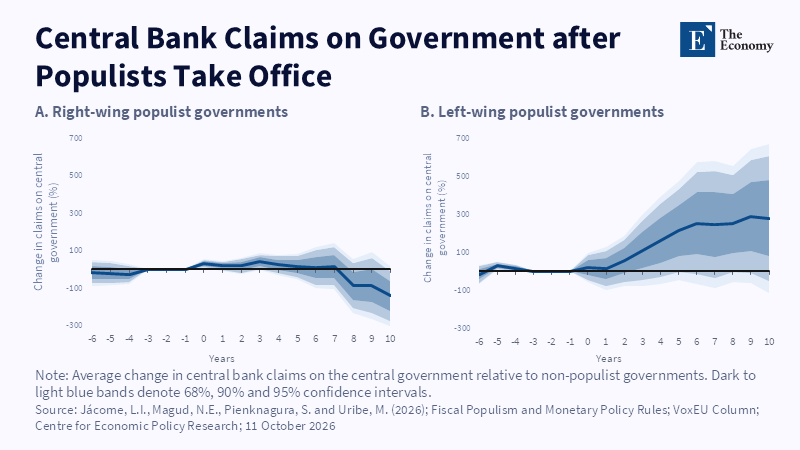
Ten years after a left-wing populist government took power, the central bank’s credit to the state has cumulatively increased by about 300 percent compared to countries governed by non-populists. The finding comes from a study released in September 2026 as a National Bureau of Economic Research working paper, authored by economists from the International Monetary Fund, Georgetown University and Columbia University and covering advanced and emerging economies from 1960 to 2008. Fiscal populism is not a new idea for anyone who has worked in a central bank, and the conclusion that monetary deficit financing brings inflation will not surprise any economist, but documenting it with hard data has value, especially for a second finding that concerns the present and not the past. The central banks of countries that have gone through such governments are still paying the price, decades later, because the markets do not forget. The same logic explains why, since the spring of 2025, investors have been pricing the dollar and US Treasury bonds in a way that no longer resembles a haven.
Fiscal Populism Leaves Central Banks Paying for Decades
The team of Luis Jácome, Nicolas Magud, Samuel Pienknagura and Martín Uribe combined the populist government database compiled by Manuel Funke, Moritz Schularick and Christoph Trebesch with the IMF’s data on central bank lending to the central government. Populism is defined here by the leaders’ speech, not by the results of their policies, which makes the test tougher, since rhetoric does not always translate into action. If populist governments are all looked at together, the central bank’s credit to the government increases by 150 percent over a decade, but without statistical significance. The picture changes when governments are ideologically divided. Right-wing populists are associated with a modest and statistically insignificant increase, while leftists are associated with a cumulative increase of 300 percent, a finding that matches their preference for expansionary policies aimed at domestic demand and redistribution.
The second step of the analysis links this credit to prices. An increase by one standard deviation in the central bank’s lending to the state raises inflation by about one percentage point at its peak, within two years, and leaves the price level 4 percent higher after ten years compared to a country that has not gone through such an episode. This is essentially the empirical confirmation of the “unpleasant monetarist arithmetic” described by Thomas Sargent and Neil Wallace in a 1981 paper for the Federal Reserve Bank of Minneapolis, where a state that does not stop spending will eventually force its central bank to print money, whatever the intention of its governor.
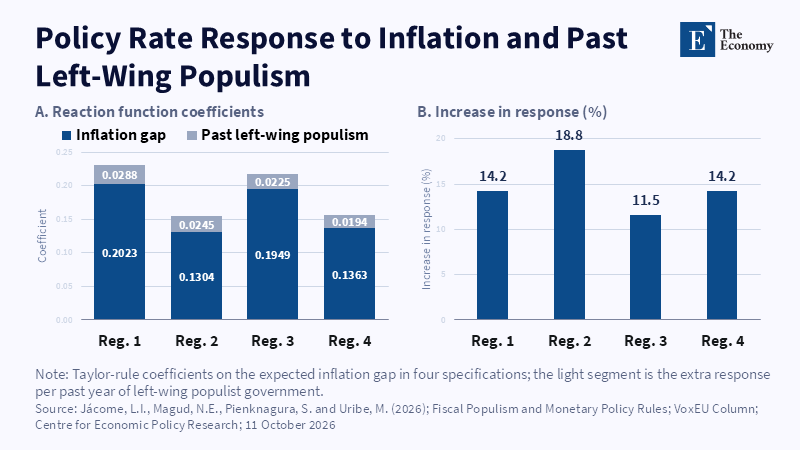
The finding that matters most to the present concerns 32 countries with an inflation-targeting regime, examined with quarterly data until 2023. The central banks of countries with a history of left-wing populism and deficit monetization are now raising interest rates more aggressively when inflation expectations move away from the target, and the gap widens when inflation forecasts diverge more from each other. One would expect that years of inflation-targeted operation would gradually erase this need, but the data shows that the extra toughness persists regardless of time, which the researchers attribute to a latent possibility of a return of fiscal dominance, which markets continue to price long after responsible politicians have left the scene and citizens have begun to forget their names. The cost is paid by households and businesses that borrow more expensively, for decisions made before many of them were born.
The Promise of Austerity and the Shift to Cheap Money
At the beginning of 2025, markets had reason to give the new Trump administration the benefit of the doubt. Elon Musk’s Department of Government Efficiency promised $2 trillion in spending cuts, a goal that soon dropped to $1 trillion, and the rhetoric of shrinking the federal government looked, for bond managers, like a commitment to fiscal discipline. This image did not last long. The “Liberation Day” tariffs in early April caused a simultaneous sell-off of stocks, US bonds and the dollar, a combination unusual for a country that is supposed to issue the planet’s safe haven, and at the same time the president began publicly attacking Jerome Powell for not cutting interest rates. On May 28, 2025, Musk walked away, telling CBS that the One Big Beautiful Bill Act increases the deficit and undermines DOGE’s work, while the Congressional Budget Office estimated in a preliminary estimate that the bill’s tax provisions alone would add $3.8 trillion to the decade’s deficits.
The foreign exchange market read the message faster than any other. The DXY dollar index ended the first half of 2025 down 10.8 percent, the worst first-half performance since 1973, when the Bretton Woods system collapsed, having fallen from about 110 points at the end of 2024 to below 97. The president himself made no secret of his preference, publicly saying that a weaker dollar makes “a hell of a lot more money”, while the then Chair of the Council of Economic Advisers, Stephen Miran, had already outlined the so-called Mar-a-Lago Accord with the aim of deliberately devaluing the currency. Harvard’s Kenneth Rogoff called the plan fundamentally flawed because it links US deindustrialization to the international role of the dollar without this relationship being valid. In September 2025, Miran was appointed to the Fed’s Board of Governors, where he voted to cut interest rates at every meeting, and shortly before that the White House had attempted to remove Governor Lisa Cook.
For the investor who holds US bonds, this sequence has a very specific reading. A government with a deficit close to $2 trillion has two ways to alleviate the cost of servicing its debt. The first goes through less spending and higher revenues; it is politically painful and convinces the markets precisely because it costs. The second goes through the central bank, with interest rates lower than inflation justifies, so that the government pays less interest and the lender is compensated with currency that loses value. The president openly asked the Fed to reduce the key interest rate from about 3.6 percent to 1 percent, a level that almost no economist considered compatible with the inflation of the time, and the market received this as the second option, something like a breach of the tacit agreement between the borrower and the lender, without even having to be announced. In May 2026, the dollar remained about 10 percent lower than on the day of the inauguration, according to the Associated Press, and the American Institute for Economic Research economist who spoke to the agency described it as a hidden tax on household purchasing power.
A $2 Trillion Deficit, the Iran War and Yields at a 24-Year High
A year and a half later, the fiscal part of the story has gotten worse than even pessimists predicted. The war with Iran, which began on February 28, 2026 without congressional authorization, had cost the Pentagon more than $38 billion by August according to the CBO, the White House requested in June additional funding of $87.6 billion, and the defense budget submitted for 2027 reaches $1.5 trillion, almost 50 percent above current levels. The 2026 fiscal year ended on September 30 with a deficit of $1.993 trillion, $218 billion more than in 2025, because spending increased by $386 billion while revenues rose by just $169 billion. The fastest-growing spending class was net interest on debt, with an increase of $115 billion, or 11%, and the Committee for a Responsible Federal Budget points out that gross debt has exceeded $40 trillion and that Washington is now paying more in interest than it does on defense, even in the midst of war.
The bond market reacted in a way that leaves no room for misinterpretation. In the auction of August 13, the Treasury Department sold $25 billion of thirty-year bonds with a yield of 5.216 percent, the highest for this duration since 2001. On September 29, the thirty-year yield reached 5.62 percent, a level the market had not seen since June 2002, and on October 7 it rose intraday to 5.70 percent, with the ten-year moving above 5.3 percent. The impressive thing about this move is that it happened while the Fed was raising interest rates. Kevin Warsh, whom Trump himself chose and the Senate confirmed on May 13, 2026, led on September 16 the first hike since 2023, by 25 basis points to a 3.75% to 4.00% range, in a unanimous decision and with the Fed predicting PCE inflation of 3.7% at the end of the year, and the president responded on Truth Social by calling for interest rates at 1 percent and “fast”.
In a market that trusts the central bank, a rate hike should hold long-term yields back because it convinces people that inflation will return to target. Here the opposite is happening. At the end of September, the two-year was hovering around 4.92 percent and the thirty-year almost 70 basis points higher, which means that investors are asking for an ever-higher premium to commit money to distant horizons, where Warsh’s current tightness guarantees nothing for the Fed’s stance in 2030 or 2040. Inflation has been above the 2 percent target for more than five years, something that Warsh himself acknowledged at the press conference on September 16. The message the holder of a bond maturing in 2056 receives is that the Fed’s independence depends on individuals, not institutions, and that a president who doesn’t want to cut spending will continue to push for cheap money, no matter how much borrowing costs go up.
Why the Damage Outlasts a Four-Year Term
The most plausible objection to this scenario is that institutions held out. Warsh raised interest rates despite public pressure, the Fed voted unanimously, and Trump’s term ends in January 2029, so the risk premium would have to be withdrawn with him. The data of recent weeks does not support this optimism. The September 16 hike did not hold back the long end of the curve, as the thirty-year rose from 5.29 percent on September 22 to 5.70 percent two weeks later, meaning the market is not questioning the intent of the current Fed chair but the institution’s ability to withstand a president who wants the opposite. The research by Jácome, Magud, Pienknagura and Uribe describes exactly this mechanism, since central banks with a populist past need to react harder no matter how many years go by under inflation targeting, because markets continue to price in a positive possibility of a return of fiscal dominance.
A second objection concerns ideology. The study identifies the phenomenon in left-wing populists rather than right-wingers, and Trump is rarely described as a leftist. But the classification concerns rhetoric, while the mechanism described by the data concerns behavior, i.e. expansionary fiscal policy with corresponding pressure on the central bank to keep the cost of financing the state cheap. With a $2 trillion deficit at full employment, tax cuts that the CBO estimates at trillions, war without funding and an open demand for an interest rate of 1 percent with inflation close to 3.7 percent, the U.S. monetary policy requested by the White House has all the characteristics of the profile that the research associates with long-term damage, whatever label it carries. There is also the thesis that the dollar’s weakness is simply a correction of an overvaluation that lasted 15 years, and Kenneth Rogoff partially supports it, but a cyclical correction of the currency does not explain why a falling currency is accompanied by bonds that are also falling.
For portfolio managers, the implication is that the term premium on U.S. Treasuries should be treated as a structural feature rather than as a temporary anomaly that will disappear in the 2028 election, and that hedging foreign exchange risk in dollar holdings has become an entry price. For the Fed, the price is more insidious. Like the central banks in the sample that carry a past of deficit monetization, it will need to react more aggressively to any deviation in expectations, at the cost of mortgages, business investment, and employment, and this cost will also be paid by governments that had nothing to do with the loss. The Treasury, for its part, has already started buying back bonds with a maturity of 20 to 30 years, such as the one scheduled for October 8, but the buybacks push the problem into the future and do not touch its cause, which is a budget that does not balance even in good years.
A Bill That Comes Due in 2056
The 300 percent increase in central bank credit to the state, recorded by researchers on left-wing populist governments, is the study’s striking figure, but the most enduring finding is the least spectacular, namely that these countries’ central banks continue to pay for lost trust long after the politicians who spent it have left. The U.S. hasn’t gotten to the monetization of the deficit, and Warsh’s Fed showed in September that it can still say no. But the market prices something other than a person’s intentions. The $25 billion of thirty-year bonds sold on August 13 at a yield of 5.216 percent will cost the Treasury, approximately, $1.3 billion a year in interest until 2056, a total of about $39 billion, an amount almost equal to what the war in Iran cost until August according to the CBO, and this is just one auction out of dozens that will take place until January 2029.
The views expressed in this article are those of the author(s) and do not necessarily reflect the official position of The Economy or its affiliates.
References
Associated Press (2026) ‘Iran war has cost the US more than $38 billion, budget office says’, Associated Press, 15 September.
Board of Governors of the Federal Reserve System (2026) Federal Reserve issues FOMC statement and Summary of Economic Projections. Press release, 16 September. Washington, DC: Board of Governors of the Federal Reserve System.
Business Insider (2025) ‘The dollar posted its worst first-half performance since Nixon was president’, Business Insider, 1 July.
Committee for a Responsible Federal Budget (2026) CBO Estimates $2.0 Trillion Deficit for First 11 Months of FY 2026. Press release, September. Washington, DC: Committee for a Responsible Federal Budget.
Congressional Budget Office (2026) Monthly Budget Review: September 2026. Washington, DC: Congressional Budget Office.
Funke, Manuel, Schularick, Moritz and Trebesch, Christoph (2023) ‘Populist leaders and the economy’, American Economic Review, 113(12), pp. 3249-3288.
Global News (2025) ‘Musk says Trump’s “big, beautiful” tax bill undermines his DOGE cuts’, Global News, 28 May.
Jácome, Luis I., Magud, Nicolas E., Pienknagura, Samuel and Uribe, Martín (2026a) Fiscal Populism and Monetary Policy Rules. NBER Working Paper No. 35758. Cambridge, MA: National Bureau of Economic Research.
Jácome, Luis I., Magud, Nicolas E., Pienknagura, Samuel and Uribe, Martín (2026b) ‘Fiscal populism and monetary policy rules’, VoxEU Column, Centre for Economic Policy Research, 11 October.
Rogoff, Kenneth (2025) ‘Trump’s misguided plan to weaken the dollar’, Project Syndicate, 6 May.
Sargent, Thomas J. and Wallace, Neil (1981) ‘Some unpleasant monetarist arithmetic’, Federal Reserve Bank of Minneapolis Quarterly Review, 5(3), pp. 1-17.
Sedensky, Matt (2026) ‘The value of the U.S. dollar has weakened since Trump took office. Experts say that can be a “hidden tax”’, PBS News, 4 May.
U.S. Department of the Treasury (2026a) Treasury Auction Results: 30-Year Bond, 13 August. Washington, DC: U.S. Department of the Treasury.
U.S. Department of the Treasury (2026b) Daily Treasury Par Yield Curve Rates. Washington, DC: U.S. Department of the Treasury.
Working across research, policy, and data-driven analysis, the Editorial Board ensures that published pieces reflect a consistent institutional perspective grounded in quantitative reasoning and long-term structural assessment.