AI in Education Fails When Institutions Start With the Tool

Prior to Team4Tech, Goutham has worked in the education landscape in India in various roles at Teach For India and Learning Links Foundation. Goutham is an alumnus of the Teach For India Fellowship Program where he worked as a teacher in an under-resourced community school. Goutham has worked as an Alumni Impact Manager for the South Indian state of Tamil Nadu and has worked in setting up Communities of Practice for the alumni community of 400+. He has also been instrumental in setting up the recruitment strategy for the Teach For India Fellowship Program for the state. He is passionate about education and strongly believes that technology is a powerful tool towards educational equity.
Beyond work, Goutham is a cat parent. He plays tennis at the club level and is a part of a two-piece music band called The Coconut Milk Project.
Authored On
Modified
AI adoption stalls on institutional capacity, not tool access
Connectivity, language and curriculum fit decide whether tools work
Coaching, evidence and government buyers turn pilots into customers

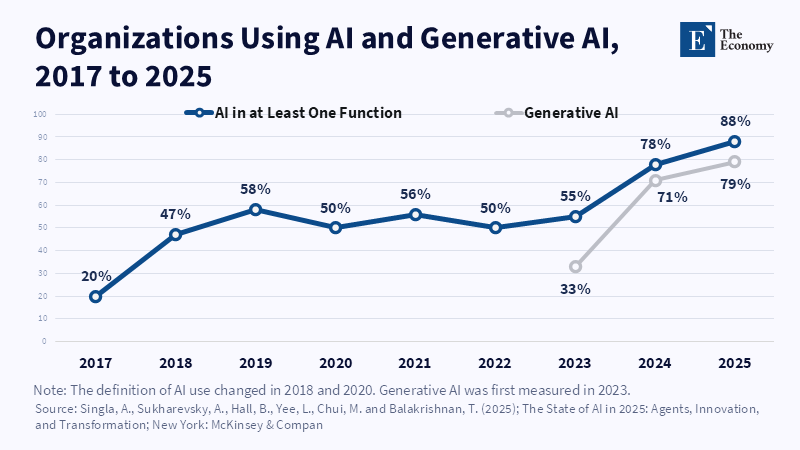
In the summer of 2025, McKinsey surveyed 1,993 respondents in 105 countries on how their organizations are using AI. 88% said they regularly use it in at least one function, compared to 78% a year earlier. Only 39% could attribute any effect to it on operating profits and most of them placed it below 5%. About one in three had begun to extend it to the entire organization. Access explains little of this gap, at a time when a subscription to a language model costs about twenty dollars a month. Most of it is explained by the ability of organizations to select, customize, evaluate and integrate the tools into the work they already do. That's where AI adoption stumbles, long before model quality comes into play.
In education, the same pattern appears in a different uniform. Team4Tech, a Menlo Park, California-based organization that supports non-governmental education organizations, has taken more than 80 organizations through its AI capacity-building programs in the past two years. The total reach of these organizations exceeds one million students. In the initial evaluations, many participants left the question of how their organization would use generative AI blank. Others simply wrote the name of a tool, with no application next to it. The percentage of those who could describe three specific uses rose from 34% to 78% after the program. This detail says more than any satisfaction indicator. It describes organizations that already had the tools in their hands and had not yet decided what problem they would solve with them.
Anyone who has worked in a medium-sized company that has decided to "switch to artificial intelligence" recognizes the scene. The company buys licenses and sometimes builds its own internal tools. Then it discovers that the sales department wants something completely different from the accounting department. Two teams with the same responsibility work at such a different pace and style that the same tool suits one and annoys the other. Someone, usually a person who ends up being a teacher although it appears nowhere in a job description, explains over and over again how the system works to colleagues who had learned about it the previous month and forgot about it. Then comes the question of results. One has to judge whether a mistake can be corrected with a better tool or with more human control. The educational challenge described by organizations in Africa is the same business problem wearing a different mask. In both cases, confidence in the tool comes slowly, after a lot of accumulated experience.
Local Constraints Decide Whether an AI Tool Works
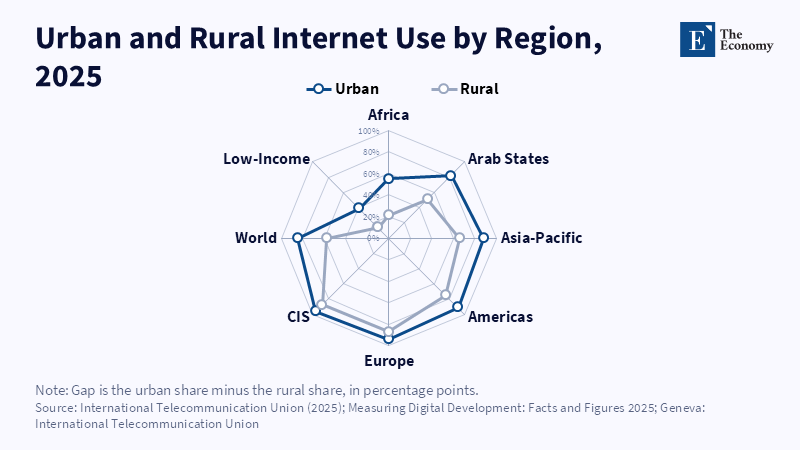
The International Telecommunication Union estimated that in 2025 only 36% of Africa's population was using the internet. In cities the figure was 55%, while in rural areas it dropped to 21%. A tool that requires a stable connection and a computer per student thus blocks most of its users before the pilot even starts. The Rising Hope Girls Educational Foundation in Nigeria started from this reality. According to the organization's data, more than 70% of the country's students attend rural schools with overcrowded classes and few books. ReadBuddy, the tool designed by the organization, is a voice reading assistant built on top of GPT-3.5, a model that no one would call groundbreaking in 2025. Children read aloud stories with local cultural content. The system detects pronunciation errors and difficult words and prepares simple reports for the teacher. It works with low bandwidth and within the existing timetable, without asking the school to reorganize itself around technology.
The pilot data reported by the organization show a 25% improvement in reading accuracy in 1,200 students within six weeks. About 200 teachers who used its tools spent roughly half as much time on administrative tasks such as lesson planning. The results are self-reported, without a control group and so they should be read with caution. The order of decisions matters more than the percentages: first the connection, the language and the class size, then the model. Kenya Connect took the same route on the curriculum side. It entered the Team4Tech cohort with the general idea that AI can help teachers plan lessons. It quickly found that the generic results of the chatbots did not fit the Kenyan Competency-Based Curriculum. The answer was a prompt framework tied to specific learning outcomes of the curriculum. The tool choices were adapted to the technical comfort of the teachers themselves, which in many schools is limited.
Language is the limitation that technical specifications usually omit. Dignitas works with more than 2,500 schools in 17 counties in Kenya. It found that the tools performed better in English, which made it difficult for facilitators working in Swahili. In addition, much of the content produced was not related to the lives of students in informal settlements. The organization's coaches ended up checking every comment in the system before it reached the teacher and aligning it with the national curriculum. This control does not appear in any product presentation. Without it, the tool would be another English-language chatbot in schools that needed it in another form, with other examples and for other students.
Table 1. Constraints and Adaptations in Five AI Deployments in Africa
| Organization | Country | Main constraint | Adaptation | Reported result |
|---|---|---|---|---|
| Rising Hope Girls Educational Foundation | Nigeria | Rural schools with low connectivity and overcrowded classes | Low-bandwidth, voice-based ReadBuddy with local stories | 25% gain in reading accuracy among 1,200 students in six weeks, self-reported |
| Kenya Connect | Kenya | Generic outputs outside the national curriculum | Prompt framework tied to curriculum learning outcomes | Evidence-collection framework for classroom practice |
| Dignitas | Kenya | Tools that perform in English, not Swahili | Coaches review every AI comment before it reaches teachers | Feedback up to three times faster |
| Educate! | Rwanda | Data ownership and privacy in a national system | CAMIS analytics moved to an open-source platform | Low-cost state-owned system covering over four million students |
| World Bank, Edo pilot | Nigeria | Floods, teacher strikes and after-school student work | Sessions in school computer labs coordinated by teachers | Learning gains of about 0.3 standard deviations in six weeks |
Training Sells the Tool, After-Sales Support Keeps It Running
No one buys a washing machine because they were shown once in the store which button to press. They buy it because they know a technician will come when the machine starts banging during the spin cycle. Artificial intelligence presents itself as an interlocutor, but it remains a program, with settings, versions and failures that no tutorial predicts. The psychology of memory explains why a two-day workshop is not enough. Hermann Ebbinghaus measured in 1885 that, one day after learning, the time savings during relearning had dropped to about a third. The reproduction of the experiment by Jaap Murre and Joeri Dros at the University of Amsterdam in 2015 gave results very close to the originals. A software's processes have menus that change every few months and commands that need to be formulated precisely. There's no reason for them to be forgotten any slower than Ebbinghaus's nonsense syllables, especially when no one uses them the next week.
Data from workplaces points in the same direction. Boston Consulting Group surveyed more than 10,600 workers in 11 countries for the AI at Work 2025 survey. Only one in three thought they had been properly trained. Regular use was significantly higher among those who had received at least five hours of training, with access to face-to-face classes and coaching. Among frontline workers, the adoption of artificial intelligence was stuck at 51%. In Team4Tech organizations, after the end of the courses, the request that came up most often was about continuing coaching and technical assistance. This was followed by funding, product development, government partnership support and evidence generation. Organizations that had just finished a program with measurable knowledge improvement were looking for, in practice, the washing-machine technician.
The most serious objection is that the tools are becoming so easy that support will soon be unnecessary and that a good model in the hands of students is enough. The strongest evidence in favor of this view comes from Nigeria. There, a randomized evaluation by the World Bank in the state of Edo in 2024 recorded learning gains of about 0.3 standard deviations, after six weeks of afternoon classes with Microsoft Copilot. But the same result undermines the objection. The program ran in school computer labs, with teachers coordinating the sessions and content tied to the English curriculum. Turnout was hit by the floods of the rainy season, teacher strikes and the afternoon work of many students. In business, McKinsey found something similar. Companies that extract significant value, about 6% of the sample, are almost three times more likely to have redesigned their workflows from scratch. More often than not, they have also defined when a model result needs human verification, a job that no improvement in the interface has made redundant.
Evidence and Government Turn AI Pilots Into Recurring Customers
The phrase "recurring customer" sounds commercial for a school system, but it accurately describes the next stage. A tool tested in ten schools does not yet have a buyer who will pay for it every year. In most countries in sub-Saharan Africa, this buyer is the ministry of education. Dignitas went through two cohorts of Team4Tech's program to develop the coaching assistant of the LeadNow platform. According to its coaches, the assistant made the feedback process up to three times faster. The team's question gradually shifted from how the AI function is improved to what kind of coaching system the Kenyan public school can absorb and maintain. The organization completed the cycle with a cost-effectiveness investment case and an outcome evidence framework, designed for the Kenyan Ministry of Education.
In Rwanda, Educate! is one step ahead. It helped develop CAMIS, the national assessment system that collects continuous data from more than four million students. When it wanted to add an analytical layer of artificial intelligence, the first issue it needed to solve was data ownership. The answer was to move to an open-source platform that protects privacy and leaves the state with a system that it can maintain at a low cost. At this point, the government has a role that no organization can take on alone. It can set proof and quality criteria before a tool enters the classroom and pay for the support along with the software. The gap is big. UNESCO recorded in 2023, in a survey of more than 450 schools and universities, that less than 10% had institutional policy or official guidance on generative AI.
The distance between the 88% of businesses that use AI and the 39% that see some economic outcome is the distance between an organization that knows the name of a tool and one that knows what to do with it. AI adoption closes that distance the way any durable product closes it. It needs repairs and updates, someone picking up the phone and, at some point, a buyer renewing the contract because the evidence is on their desk. It remains open who will pay for this support when the grants run out. The funding described by the organizations themselves is small and fragmented. For Rising Hope it was five million naira through the Ford Foundation and $10,000 worth of AWS credits. These amounts cover two digital labs and a limited expansion and are far from a national support system.
This article was developed for The Economy Strategy Review based on Team4Tech’s AI capacity-building work and prior published materials, prepared for the author’s review and approval.
References
Beauchene, Vinciane, Duranton, Sylvain, Kalra, Nipun and Martin, David (2025) AI at Work: Momentum Builds, but Gaps Remain. Boston: Boston Consulting Group.
De Simone, Martín, Tiberti, Federico, Barron Rodriguez, Maria, Manolio, Federico, Mosuro, Wuraola and Dikoru, Eliot Jolomi (2025) From Chalkboards to Chatbots: Evaluating the Impact of Generative AI on Learning Outcomes in Nigeria. Policy Research Working Paper 11125. Washington, DC: World Bank.
Dougherty, Rachel (2026) '5 Key Takeaways from Team4Tech's AI Capacity-Building Cohorts', Team4Tech, 27 August.
Ebbinghaus, Hermann (1885) Über das Gedächtnis: Untersuchungen zur experimentellen Psychologie. Leipzig: Duncker & Humblot.
International Telecommunication Union (2025) Measuring Digital Development: Facts and Figures 2025. Geneva: International Telecommunication Union.
Miao, Fengchun and Holmes, Wayne (2023) Guidance for Generative AI in Education and Research. Paris: UNESCO.
Murre, Jaap M. J. and Dros, Joeri (2015) 'Replication and analysis of Ebbinghaus' forgetting curve', PLOS ONE, 10(7), e0120644.
Singla, Alex, Sukharevsky, Alexander, Hall, Bryce, Yee, Lareina, Chui, Michael and Balakrishnan, Tara (2025) The State of AI in 2025: Agents, Innovation, and Transformation. New York: McKinsey & Company.
Team4Tech (2025) Dignitas, Kenya: Strengthening Teacher Practices Through AI-Powered Teacher Coaching. Generative AI Cohort Case Study. Menlo Park, CA: Team4Tech.
Team4Tech (2026) Rising Hope Girls Educational Foundation, Nigeria: Cohort-Based Learning Supports RHGE in AI Implementation. Generative AI Cohort Case Study. Menlo Park, CA: Team4Tech.
Prior to Team4Tech, Goutham has worked in the education landscape in India in various roles at Teach For India and Learning Links Foundation. Goutham is an alumnus of the Teach For India Fellowship Program where he worked as a teacher in an under-resourced community school. Goutham has worked as an Alumni Impact Manager for the South Indian state of Tamil Nadu and has worked in setting up Communities of Practice for the alumni community of 400+. He has also been instrumental in setting up the recruitment strategy for the Teach For India Fellowship Program for the state. He is passionate about education and strongly believes that technology is a powerful tool towards educational equity.
Beyond work, Goutham is a cat parent. He plays tennis at the club level and is a part of a two-piece music band called The Coconut Milk Project.