The AI Spending Race: Could Corporate Investment Become a Game of Survival?

Working across research, policy, and data-driven analysis, the Editorial Board ensures that published pieces reflect a consistent institutional perspective grounded in quantitative reasoning and long-term structural assessment.
Authored On
Modified
Fewer than 2 percent of firms drive half of AI spending
DRAM history shows how investment can become compulsory
Adopters may face a race, but evidence is pending

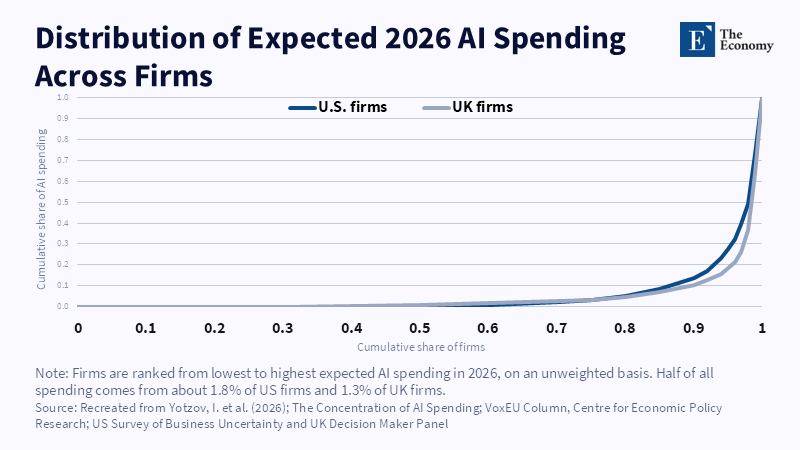
A tiny minority of firms is paying most of the AI bill: 1.8 percent of U.S. companies are expected to account for half of all corporate AI spending in 2026, compared with 1.3 percent in the UK. A recent CEPR survey of senior managers in the U.S. and UK estimates 2026 AI spending in these two economies at $280bn and $25bn, respectively and implies that these few leading firms will drive half of that spend. On its own, it is hardly surprising that a relatively small group of firms accounts for such a disproportionate share of AI expenditure, but this raises the question of whether the apparent 'race to the frontier' among AI model developers may extend to firms that adopt their products and whether that race may eventually become necessary to maintain business viability.
Large Firms Spend More Because They Employ More
The survey reports average annual spending on AI per employee of $1,363 in 2025 by U.S. firms (expected to rise to $2,043 in 2026) and of $422 (expected to rise to $725) in the UK. These are averages weighted by employee headcount and are substantially above the median U.S. firm (which expects to spend $294 per employee in 2026). The survey received 845 U.S. and 1,273 UK responses and captures only reported and planned spending on AI, with no information on subsequent productivity or other benefits of that investment.
Given the manner in which enterprise AI products are typically priced (per employee, per token, etc.), it should be expected that aggregate spending on AI will scale with the number of employees, such that firms with many employees (e.g., 100k) using Microsoft Copilot or ChatGPT Enterprise will see spend orders of magnitude greater than firms with fewer employees (e.g., 100) using the same product. There are further reasons why large firms may spend more: they will have more functions (customer service, back-office/finance, HR, legal/compliance, engineering, etc.) and employees to which they can deploy AI, increasing returns to integrating AI across those functions. Large firms can also more readily absorb failed experimentation into novel uses of AI and may choose to reduce recruitment or lay off existing staff in response to increased productivity from AI (alternatively, they may expand production or introduce new products). AI-related layoffs have featured in recent headlines, although this alone cannot indicate whether firms are reducing staff in favour of AI, as there are multiple reasons for firms to do so.
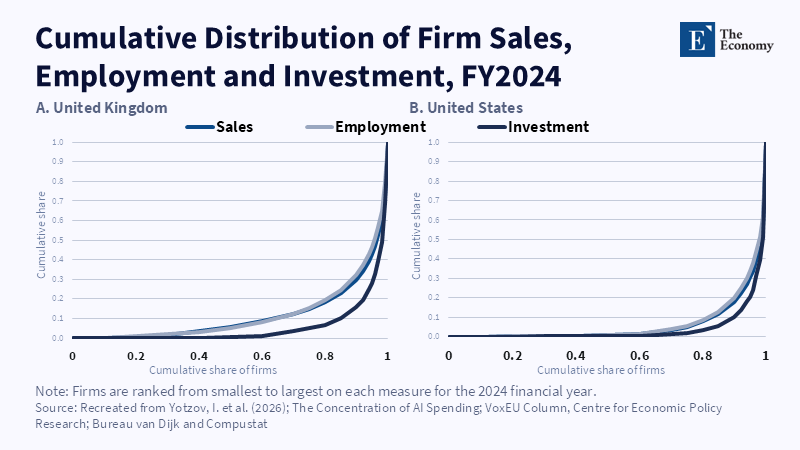
The CEPR study notes that while spending on AI is more concentrated than revenues and employment, it is broadly similar to that of total investment by firms (measured against data for US/UK firms from Compustat/company accounts for 2024). The fact that large firms spend more on AI is therefore not particularly remarkable and mirrors patterns seen with total investment by firms in other periods and contexts.
DRAM Shows How Investment Becomes Compulsory
In the case of dynamic random access memory (DRAM), firms found themselves compelled to invest heavily in successive technology upgrades. Japanese producers were dominant in DRAM through the 1980s, but subsequent technology transitions required firms to commit to larger plants/investments and exposed them to pronounced cyclical swings in prices. South Korea's Samsung and SK Hynix continued investing in successive upgrades to remain competitive with one another and others, contributing to the collapse of German (Qimonda, 2009) and Japanese (Elpida, 2012) firms as market leaders. There were multiple factors that led to the demise of these firms (including the 2008 Global Financial Crisis and associated reduction in lending, strong Japanese currency, etc.) and both countries continued to produce some semiconductors. Nonetheless, it illustrates how firms can be 'forced' to invest to remain competitive, such that if a firm falls behind on an upgrade cycle, it will see costs rise relative to its competitors, who can in turn undercut its prices and grow, thereby causing it to fall behind further and ultimately foreclosing its ability to invest to close the gap. Each firm would be better off if the others did not invest as much, but no single firm can 'stop' investing without losing market share; hence it can be described as an 'arms race' / investment prisoner's dilemma (or possibly a game of chicken if firms attempt to outlast each other's willingness to continue investing).
AI developers are currently in this situation, where continued spending on R&D to improve and scale models and build out infrastructure and talent is essential to remaining competitive. While it is uncertain what the near-term payoff will be for any one firm, they continue to invest to avoid falling behind. Of course, there are differences from the DRAM analogy (e.g., competition on factors other than cost, lower barriers to customers switching model providers, etc.), but the dynamics are similar in important respects.
Could the AI Spending Race Spread to AI Adopters?
It remains to be seen whether firms that adopt AI will experience similar dynamics and find themselves compelled to increase their adoption of AI to remain competitive. To illustrate, there are two insurance companies that use AI to varying degrees to process claims, underwrite risks, respond to customer enquiries, etc., with the first investing more comprehensively in AI than the second. If the former is able to reduce its costs of serving each customer and/or increase speed of service, it may be able to gain customers from the latter, grow its profits and reinvest further in AI, thereby expanding the gap and further reducing its costs relative to the latter. The latter is then left with declining market share/profits and correspondingly reduced ability to invest in AI to close the gap.
If firms can leverage AI to improve their productivity and grow revenues relative to employees, this is likely to increase concentration in industries. It may be even more pronounced in the case of AI, to the extent that firms can leverage the same systems/data to deploy AI more widely across their operations and build tacit knowledge on how best to harness AI. As firms find they can reduce costs and expand, they will find it increasingly rational to invest further in AI to maintain/expand their competitive edge, irrespective of the standalone returns to any further investment.
It is worth noting that while this may lead to increased industry concentration, it is not likely to lead to a duopoly/monopoly outcome given the (relatively) low cost to each firm of using frontier AI tools (a few $ per month/user vs. billions per frontier fab) and the rapidly declining price of state-of-the-art models since 2023. If using frontier AI becomes easier/cheaper, then there is a reasonable prospect of firms converging on similar levels of adoption and competitive advantage dissipating over time (although this will depend on whether the gains from AI create moats for early adopters, e.g., data, processes, scale, customer lock-in etc.). At present, it is not yet possible to distinguish between a world in which firms converge on AI usage and one in which increasing adoption leads to divergence in performance and increasing concentration in industries. Future analysis will require identifying whether firms with high spending on AI subsequently experience reduced costs, increased revenues and market share vs. peers, controlling for firm size and pre-existing performance, etc.
Separately from spending by AI model developers, spending on AI by firms adopting its outputs will, for the time being, largely track other forms of firm investment (higher at larger firms, growing rapidly). This may not remain the case if firms can successfully use AI to reduce costs and increase their scale, at which point investment in AI will become quasi-compulsory to compete effectively and the current cohort of large spenders, roughly 2 percent of U.S. firms, will be the firms that have survived to date and continued investing. It took DRAM roughly 20 years to converge to three dominant producers; time will tell whether/how rapidly the market for AI adoption will consolidate.
The views expressed in this article are those of the author and do not necessarily reflect the views of The Economy, its Editorial Board, or any affiliated institution.
References
Brynjolfsson, E., Jin, W., Petropoulos, G. and Wang, X. (2023) Information Technology, Firm Size, and Industrial Concentration. NBER Working Paper No. 31065. Cambridge, MA: National Bureau of Economic Research.
Yotzov, I. et al. (2026) ‘The concentration of AI spending’, VoxEU. Centre for Economic Policy Research, 7 November.
Working across research, policy, and data-driven analysis, the Editorial Board ensures that published pieces reflect a consistent institutional perspective grounded in quantitative reasoning and long-term structural assessment.
Similar Post