Populism's Zero-Sum Legacy: Political Rhetoric or the Disappearance of Economic Opportunity?

Working across research, policy, and data-driven analysis, the Editorial Board ensures that published pieces reflect a consistent institutional perspective grounded in quantitative reasoning and long-term structural assessment.
Authored On
Modified
Populist rhetoric teaches zero-sum beliefs during early adulthood
Shrinking entry-level opportunity may teach the same lesson
Korea’s young men show both mechanisms at work

In Feb 2025 Statistics Korea announced that there were 504,000 individuals from the age of 15 to 29 who were not working nor looking for a job and their current situation is resting. This is the first time this number has gone above half a million since 2003, when the data started. Then, in June during the presidential election, the combined exit poll from KBS, MBC, and SBS revealed that males in their 20s voted 37.2% for Lee Jun-seok and 36.9% for Kim Moon-soo. Lee Jae-myung won 24.0% of that demographic while winning 58.1% of women in their 20s. Could these young men who feel less opportunity and young men who act as if everything in politics is a zero-sum game be the same demographic? If so, which came first? Recent research provides evidence on how populists teach zero-sum beliefs to their citizens. Using data on populist heads of state and over 260,000 respondents in 53 countries, they find that individuals who have lived through a longer period of their early adulthood under a populist leader exhibit higher levels of zero-sum beliefs for about 20 years. They attribute this to rhetoric and a lack of trust in experts, with little evidence that economic difficulties caused these beliefs. While the results are sound, they fail to analyze how the economy may be affected by the actions of populist leaders, by reducing investments in certain sectors and protecting certain groups from taking losses.
How Populists Teach Zero-Sum Beliefs
The method is fairly innovative; they use individuals who have been surveyed in a similar time frame and in the same country but have lived through different numbers of years with a populist leader from age 18 to 25. They use the list of populist presidents and prime ministers by Manuel Funke, Moritz Schularick, and Christoph Trebesch to calculate this. For example, a person born in America in 1993 and surveyed in 2019 would have lived through 2 out of 8 years under Trump as president, whereas someone born in 1985 would have lived through 0 of those years. With many observations of people being exposed to different numbers of years under a populist, they find that the more years someone lived through under a populist leader, the more likely they are to believe in zero-sum beliefs later in life. If people were exposed to a populist leader before birth, during childhood, during adolescence, or after they turn 25, they do not show any significant differences in believing in zero-sum beliefs.
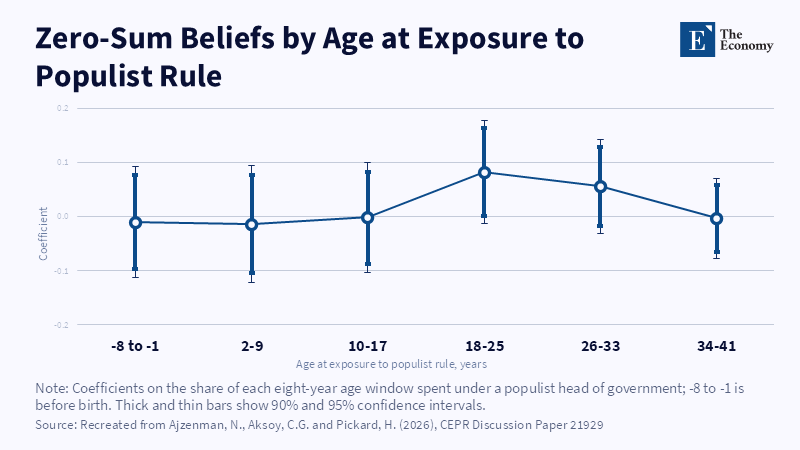
There is some evidence that populists use rhetoric that leads to zero-sum beliefs. They find that populist leaders use more rhetoric against the elite on two measures. When they speak at the United Nations, they display 0.67 standard deviations more zero-sum beliefs than other governments. Those who were exposed to populists in their formative years also believe less in scientists, and when the media was freer before a populist leader took office and radio and TV had higher penetration rates, there was a higher impact of zero-sum beliefs, which suggests that the rhetoric used by populist leaders taught these beliefs to the citizens who were exposed to them in their formative years. A notable result is that individuals who were exposed to populists in their formative years do not have a higher chance of voting for populist parties, but do have a higher chance of voting for extreme parties that have the same ideology as the populist leader they were exposed to.
They try to rule out scarcity as an explanation. According to Funke, Schularick, and Trebesch, GDP per capita is roughly 10% lower after 15 years under populist rule. So it's a reasonable belief that scarcity played a role in individuals believing in zero-sum games. They test this by seeing if downturns during non-populist leaders cause individuals to believe in zero-sum beliefs. They find that downturns do not cause individuals to believe in zero-sum beliefs, so they conclude that scarcity is not the answer. However, there is a difference between a downturn and not hiring individuals. A downturn can happen to all age cohorts at once and will not last forever. But if a company stops hiring new individuals, they could go through recessions and not have that effect.
How Redistribution and Less Investment Shape Job Availability
All governments have a budget constraint when it comes to the money they can give out and regulate. This means that when they give out money to certain groups and protect them from job loss, they are not investing in other groups who may need it more. Or they may not allow companies to expand. Redistribution is commonly thought to take away from growth, but there is no evidence to support that claim. Ostry, Berg, and Tsangarides from the IMF in 2014 showed that there is little evidence of redistribution taking away from growth, except in some extreme cases. So it is necessary to look at the incidence of who takes the losses and how that affects job availability.
When laws are made that make it costly to fire workers, companies will hire fewer new workers to minimize that cost. They will protect those they already have and will not create as many jobs. If a worker is retired and has a fixed amount of income coming in each month, they will not be affected by a change in laws. But someone who just graduated will have fewer job opportunities. As shown by Funke, Schularick, and Trebesch, when countries go through populist rule, there is usually economic disintegration and less stability, which leads to companies not expanding in that country and hiring fewer workers. Finance ministries and labor regulations should understand that when they create these laws, there is an opportunity cost that is going to be paid by individuals who are entering the workforce.
Why Korea Invested More in China Than at Home
According to a 2007 IMF paper, China had been South Korea’s top investment destination since 2002, taking about 45% of Korean investment on average, more than double its share in the 90s. Korea has invested around 10 billion dollars in China since 2002, while investing little in its domestic manufacturing and seeing its manufacturing employment drop. Some companies closed down and others started producing in China. Companies that have invested in China have seen their local sourcing increase from 27% in 1996 to 46% in 2003 and decreased imports from Korea from 65% to 37%.
There are many reasons why Korea started to invest more in China. One study from the Korea Institute for International Economic Policy by Deok Ryong Yoon argues that Korean wages were high, there were labor issues and the appreciation of the Korean won led to the spike in investment. This means 2 out of 3 reasons were related to labor. The IMF paper stated that Korea had high employment protection and severance costs. And when the Korean government decided to convert non-regular workers to regular workers after 2 years, it believed this would lead to higher employment costs and higher turnover. Of course, China joining the WTO and having cheap labor played a role as well. It cannot be said that Korean labor laws led to Korea investing more in China, but it can be shown that they played a role.
Blaming this on the governments from 1998-2007 is difficult as well. According to the IMF paper, China was already taking close to half of its later share of Korean investment during the 90s.. So it was happening before the governments that implemented these labor laws. When South Korea went through a financial crisis in 1997, it decided to open up the labor market to allow companies to fire workers. But that could also have been a result of companies borrowing too much from overseas and not repaying it. So it can be said that Korea's dualized labor market may have caused fewer opportunities for young workers.
How the Labor Market Shapes Zero-Sum Beliefs in Young Koreans
There has been a recent study by Soohyun Lee, who states that young men were the deciding factor in why Yoon Suk-yeol became president. She goes on to say that these young men became sexist due to their dualized labor market and felt as if they had to compete with women for jobs. This shows that when there are fewer job opportunities for young workers, they may start to believe in zero-sum beliefs because there is a limited number of jobs they can get; they may feel as if everyone else is taking from them.
A Carnegie Endowment study from April 2025 showed that the difference in support for Yoon Suk-yeol in the 2022 election was 41 points between men and women aged 18- 29. They also found that the higher the status aspiration gap a male had, the more they believed in hostile sexism and modern sexism. There is a 14-point difference between those who have no status aspiration gap and those who have a large one. When asked if marriage was extremely important or very important, 26% of men in their 20s and 30s who were not married said yes. Only 8% of women said yes to that question, which suggests that they are trying to get a good job to marry someone. And because there are fewer jobs available for them, they start to believe in zero-sum beliefs.
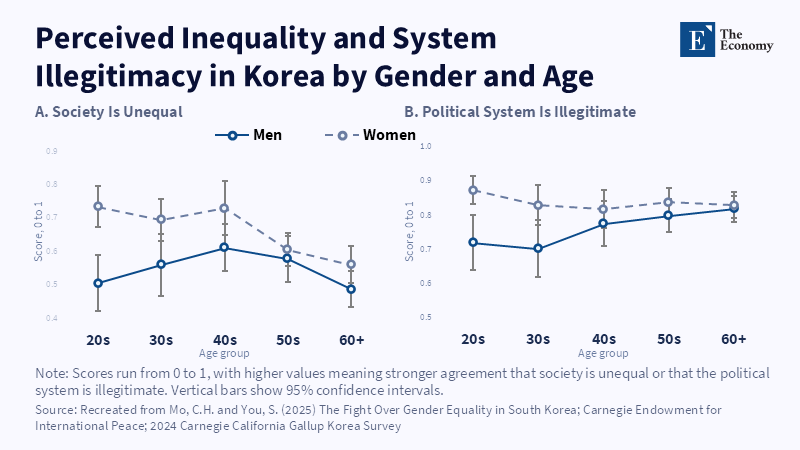
The only problem with this argument is that someone who is in their 20s in 2025 would have been born in 1996-2006. So they would have become adults during the time of Park Geun-hye, Moon Jae-in, and Yoon Suk-yeol. If the theory that people are taught zero-sum beliefs from their formative years under populist leaders is true. Then why would South Koreans believe that they should vote for conservative parties after having a progressive leader? This shows that scarcity and populist talking may both play a role in zero-sum beliefs. But it is unclear which one is bigger.
Populist Rhetoric or Scarcity
The downturn test looks for scarcity only in downturns, when overall employment falls. In August of 2025, Statistics Korea showed that employment rose by 166,000 year over year, while it fell by 219,000 among those aged 15-29 and rose by 401,000 among those aged 60 and above. So, during that month, the labor force was increasing and not in a downturn. This shows that individuals may believe in zero-sum beliefs when they are losing employment to those who are older than them, which could be due to companies not investing as much in their domestic labor force.
It can be tested whether scarcity and populist talking both play a role in individuals believing in zero-sum beliefs by finding cohorts that were exposed to the same amount of populist talking but had less opportunity when they entered the workforce. Useful data include what percentage of new hires are young workers. Another option is the wage gap between new workers who become regular employees and those who are non-regular. Statistics offices can help with this by allowing researchers to see who was hired at what age and if they are still working at that age. Governments can also require that when finance ministries create new labor laws or pensions, they know how many people will be affected by those laws.
In February 2025, there were 504,000 individuals in Korea who were not working and are resting. This could be due to a lack of opportunity when they entered the workforce. There may have been less job availability for them when they were hired, and they may have been taught that they live in a zero-sum world. This is visible in exit polls and other studies that have shown that young Koreans believe in zero-sum beliefs. The answer to this question lies with the individuals who are becoming adults this decade.
The views expressed in this article are those of the author and do not necessarily reflect the views of The Economy, its Editorial Board, or any affiliated institution.
References
Ajzenman, N., Aksoy, C.G. and Pickard, H. (2026) Populist Rule and the Formation of Zero-Sum Beliefs. CEPR Discussion Paper No. 21929. London: Centre for Economic Policy Research.
Asia Business Daily (2025) ‘Lee receives overwhelming support from voters in their 40s and 50s’, The Asia Business Daily, 4 June.
Chensavasdijai, V. (2007) ‘Korea’s competitiveness in the global marketplace’, in International Monetary Fund, Republic of Korea: Selected Issues. IMF Country Report No. 07/345. Washington, DC: International Monetary Fund.
Funke, M., Schularick, M. and Trebesch, C. (2023) ‘Populist leaders and the economy’, American Economic Review, 113(12), pp. 3249-3288.
Lee, S. (2025) ‘Anti-gender politics, economic insecurity, and right-wing populism: the rise of modern sexism among young men in South Korea’, Social Politics, 32(3).
Mo, C.H. and You, S. (2025) The Fight Over Gender Equality in South Korea. Washington, DC: Carnegie Endowment for International Peace.
Ostry, J.D., Berg, A. and Tsangarides, C.G. (2014) Redistribution, Inequality, and Growth. IMF Staff Discussion Note SDN/14/02. Washington, DC: International Monetary Fund.
Statistics Korea (2025a) Economically Active Population Survey, February 2025. Daejeon: Statistics Korea.
Statistics Korea (2025b) Economically Active Population Survey, August 2025. Daejeon: Statistics Korea.
Yoon, D.R. (2007) Korea’s Outward FDI in Asia: Characteristics and Prospects. Seoul: Korea Institute for International Economic Policy.
Working across research, policy, and data-driven analysis, the Editorial Board ensures that published pieces reflect a consistent institutional perspective grounded in quantitative reasoning and long-term structural assessment.