Easy Money May Not Win Elections, but Its Economic Consequences Can Outlast Them

Working across research, policy, and data-driven analysis, the Editorial Board ensures that published pieces reflect a consistent institutional perspective grounded in quantitative reasoning and long-term structural assessment.
Authored On
Modified
Easy money does not measurably lift incumbents’ vote shares
Political pressure leaves higher prices and inflation expectations behind
Election-year deficits persist, burdening the governments that follow
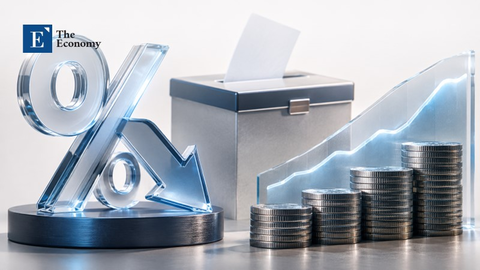
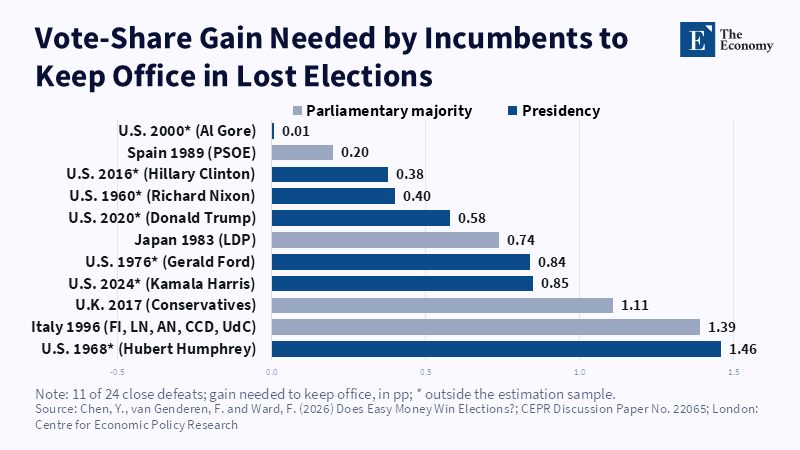
In 385 parliamentary and presidential elections between 1900 and 2020 from 18 countries, the central estimate is that easy money in the form of 0.91 percentage points of interest rates over a term of office has no significant impact on the vote share of the incumbent. That's according to a paper by economists at the Erasmus School of Economics. Even taking the upper bound of their confidence interval only allows for a 0.9-point increase in the incumbent's vote share. Governments lost 104 of those elections, either a parliamentary majority or the presidency. Easy money would have saved none of those governments at the central estimate and at most 15 at the outer bound, all of which would have been close races. Not encouraging news for a finance minister looking to the Central Bank to help win the next election. However, to know how much it costs, there is a second question to ask. Since easy money does not win an election, how much is it costing for the next few elections?
How Easy Money Fails to Win Elections
When considering the time lags involved, it shouldn't come as much of a surprise. Easy money takes some time to make its way to consumers' budgets and often the decision that caused the Central Bank to ease is not top of mind when the public evaluates how well their government has done. The Erasmus economists try many different permutations of their analysis to see if easy money can win an election. They find that easing only in the year before an election, easing when the economy is in a slump or when inflation is high, or even allowing rate rises to have a different effect than rates falling, all have no significant effect on the incumbent's chances of winning. Previous research often had the problem that central banks tend to ease when the economy slows down. So when low interest rates correlate with governments losing elections, it could just be that the Central Bank was easing because the economy was in a slump.
Of course, this doesn't mean that central banks can't be used to influence politics. The study only looks at one variable here: can a government win its next election if its Central Bank eases. There may be other effects that come from pressuring a Central Bank that this research can't pick up on. It is possible to have a medicine that doesn't cure an illness but still has side effects. Those side effects just don't show up in an election study. So a central banker receiving phone calls from the finance minister, or a member of parliament writing laws that control how those phone calls occur, should think about those side effects.
How Political Pressure Lifts the Price Level
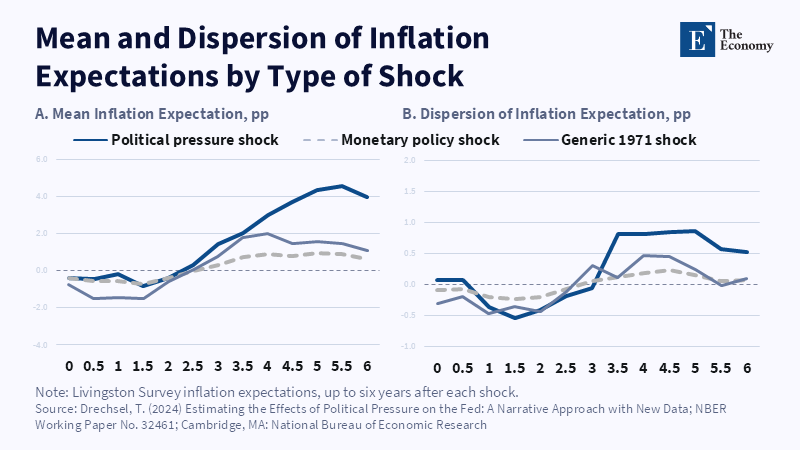
A paper from the University of Maryland collected over 800 interactions between U.S. presidents and the Federal Reserve from 1933 to 2016. These were taken from presidential daily diaries located at presidential libraries. One president who stands out is Richard Nixon, who had 160 interactions with the Federal Reserve. Using Nixon's pressure on the Federal Reserve to lower interest rates before the 1972 election, the paper can isolate a shock to political pressure. They find that interest rates fall about 100 basis points over the next couple of quarters. The response in output is insignificant. What the paper can show is that the price level increases and remains about 5% higher four years later. Applying half as much pressure as Nixon and leaving it on for six months would raise the U.S. price level by over 8%.
Nixon won 49 states in the 1972 election. Inflation rose during his presidency and after he left office. President Ford took over and lost in 1976. President Carter took over and lost in 1980 with inflation in the double digits. It wasn't until the Fed, under Paul Volcker, raised interest rates high enough to cause a recession that inflation came down. Obviously, there were other factors at play during this time. The 1973 and 1979 oil shocks were huge contributors to inflation. But the paper can show that political pressure will raise inflation expectations both on average and cause them to be more dispersed than what is seen from just an easing of monetary policy.
One example of this playing out is in Turkey. President Erdogan pressured his Central Bank to lower interest rates throughout 2021 and 2022. Inflation reached 85.5% in October 2022, according to the Turkish Statistical Institute. Erdogan won the presidential election runoff in May 2023, which again shows that easy money doesn't decide an election. After he won, the Central Bank raised rates from 8.5% to 50%. Ten days after raising rates to 50%, the opposition party won the nationwide vote in local elections. Taking 37.8% of the vote to Erdogan's Justice and Development Party's 35.5%. This is the first national defeat for Erdogan's party since coming to power in 2002.
How Election-Year Deficits Rise and Stay Up
Looking at fiscal policy, a similar story plays out. Researchers from the University of Groningen and the World Bank found that countries run a primary deficit about .6% of GDP higher during election years. They spend about .5% of GDP more and increase wages by about .1% of GDP. This holds true for both democracies and non-democracies. What happens the year after the election is where things get interesting. Some of that spending is clawed back, mainly by lowering capital expenditures, which is not something a government should want to do. But the primary deficit does not come back down and wages are never reduced.
Taking the averages from this paper allows a quick calculation. If a country has elections every 5 years and increases its primary deficit by .6% of GDP each time and never takes that money back, it will have increased its primary deficit by 2.4% of GDP after 20 years. Researchers from Groningen and the World Bank find that when countries have fiscal rules or are under an IMF program, or if the electorate is more informed, these effects are not as prevalent, which is why those institutions should be in place. The world is already running a combined public debt of 93.9% of GDP as of 2025, according to the IMF. And they expect it to reach 100% by 2029, which has only been seen after WWII.
There are, of course, many examples of developed countries running high deficits. In the United States, interest payments on the public debt passed 1 trillion dollars for the first time in fiscal year 2025. Up about 80 billion dollars or 8%, from the previous year, while the total deficit remained around 1.8 trillion dollars. The U.S. is paying for many years of government debt that has been accumulated under different administrations. Both Republicans and Democrats have contributed to this number. And no matter who is in office, they will have to pay for it. Similar to what the University of Maryland paper showed with the price level.
The Cost of Countercyclical Policy
One argument against these claims is that governments and central banks need to step in when the economy slows. Not lowering interest rates or sending money to consumers when they lose jobs can have long-lasting effects on the economy. High unemployment, failed businesses and lost investment can be costly. When the pandemic hit in 2020, unemployment reached 14.7% in the US. It came down to 3.8% by February of 2022. That is why the CARES Act in March of 2020 and the stimulus that followed in 2021 were necessary. The U.S. elections in 2020 can't show that less should have been done, nor can 2024 show that too much was done.
A paper from the Federal Reserve Bank of San Francisco found that US stimulus checks may have increased inflation by 3% by the end of 2021. By comparing the U.S. to other OECD countries that helped their citizens less. Even when acting to be countercyclical and not to win elections, there are still costs that will have to be paid. Raising interest rates to bring inflation down causes some type of recession. So governments need to be careful when using fiscal and monetary policy to help the economy, especially if those actions are being taken to win an election.
What Easy Money Leaves the Next Government
Most countries have elections every 4 or 5 years. When a government pressures its Central Bank, the price level is still rising after 4 years. And when it spends more money in an election year, that deficit never comes back. So it is safe to assume that if easy money is used to win an election, it will have an impact on the next government. The question was whether easy money can win an election and it can't. But what about the effects that come after winning or losing that election? As with Nixon, his inflation stayed around for the next 2 presidents. In Turkey's case, Erdogan will have to deal with the effects of his interest rates after winning his election. Sometimes the next government is the same.
This means central banks need to be independent from governments. It has been argued in the past that politicians would pressure their central banks to lower interest rates to win elections. It is now clear that this doesn't work. But it will cause higher inflation expectations that will need to be corrected by the next government. So central banks need to be able to raise interest rates when needed to prevent that from happening, which is why there should be fiscal rules and IMF programs to help keep deficits in check. And why the U.S. should worry about its debt and how it will pay it off.
There are 385 elections in this dataset that show that easy money will not win an election. So it can be assumed that most governments that have pressured their central banks have done so for nothing. But that doesn't mean there is no harm. If the Erasmus estimates hold for the 1972 election, Nixon's pressure on the Federal Reserve did little to help him win 49 states. But the University of Maryland's estimates show that it did raise the price level and that price level was still rising 4 years later. Also, after Erdogan raised interest rates to combat inflation, his party lost the nationwide vote in local elections. Were voters punishing him for high inflation or for raising interest rates to lower inflation? That is unknown. But it happened 10 months after he won an election.
The views expressed in this article are those of the author and do not necessarily reflect the views of The Economy, its Editorial Board, or any affiliated institution.
References
Central Bank of the Republic of Türkiye (2024) Press release on interest rates, 21 March. Ankara: Central Bank of the Republic of Türkiye.
Chen, Yao, van Genderen, Florian and Ward, Felix (2026) Does easy money win elections? CEPR Discussion Paper No. 22065. London: Centre for Economic Policy Research.
Congressional Budget Office (2025) Monthly Budget Review: Summary for Fiscal Year 2025. Washington, DC: Congressional Budget Office.
de Haan, Jakob, Ohnsorge, Franziska and Yu, Shu (2023) Election-induced fiscal policy cycles in emerging market and developing economies. CEPR Discussion Paper No. 18708. London: Centre for Economic Policy Research.
Drechsel, Thomas (2024) Estimating the effects of political pressure on the Fed: a narrative approach with new data. NBER Working Paper No. 32461. Cambridge, MA: National Bureau of Economic Research.
International Monetary Fund (2026) Fiscal Monitor, April 2026. Washington, DC: International Monetary Fund.
Jordà, Òscar, Liu, Celeste, Nechio, Fernanda and Rivera-Reyes, Fabián (2022) ‘Why is U.S. inflation higher than in other countries?’, FRBSF Economic Letter, 2022-07. San Francisco: Federal Reserve Bank of San Francisco.
Supreme Election Council of Türkiye (2024) 31 March 2024 local elections: final results. Ankara: Supreme Election Council.
Turkish Statistical Institute (2022) Consumer Price Index, October 2022. Ankara: Turkish Statistical Institute.
U.S. Bureau of Labor Statistics (2022) The Employment Situation: February 2022. Washington, DC: U.S. Bureau of Labor Statistics.
Working across research, policy, and data-driven analysis, the Editorial Board ensures that published pieces reflect a consistent institutional perspective grounded in quantitative reasoning and long-term structural assessment.