Bank Executive Compensation in the Age of Digital Bank Runs: Who Should Bear Systemic Risk?

Working across research, policy, and data-driven analysis, the Editorial Board ensures that published pieces reflect a consistent institutional perspective grounded in quantitative reasoning and long-term structural assessment.
Authored On
Modified
Bank runs now unfold in hours, not weeks
Longer bonus deferral lowers bank risk; bonus caps show less
Pay should reward resilience, not just loss avoidance

In a single day, on March 9, 2023, Silicon Valley Bank saw over $40 billion in deposits leave the bank. This was roughly 25% of its deposits and the next morning saw another 62% request withdrawals. According to this article from the Federal Reserve Bank of St. Louis, the bank run on Continental Illinois took 10 days in 1984 and saw 30% of deposits leave the bank. When rules on bank executive compensation were created post-2008, they were based on the thought that there would be losses that accrued over the span of multiple quarters or even years. This is why there are many deferred bonus structures and clawbacks that will punish executives well after they made a poor decision. But what if that loss occurs in two days? How should that loss be attributed to an executive, if at all?
What a Decade of Bank Executive Compensation Reform Shows
After the GFC, several layers of regulation were put in place to address bankers' compensation. In 2009, the Financial Stability Board created guidelines on paying bankers. Then the EU put a bonus cap in place in 2014 that capped variable pay at 100% of fixed compensation or 200% with shareholder approval. Many countries went further and required deferral of bonuses and allowed for malus and clawback provisions. The idea being that if an executive is paid based on profits from loans made this year, but those loans will fail in the next 4 years, the executive has an incentive to make those loans. Results on whether this has worked have been mixed. Banks that may have higher risk-taking behaviors may also choose to pay their executives higher compensation, so trying to correlate these two is nearly impossible.
Recently, the Bank for International Settlements (BIS) has looked at Chief Executive Compensation for 73 U.S. and EU banks. They were able to use the 2014 EU cap on bonuses and 5-year deferral requirement, as well as the UK removing its bonus cap in 2023 as a natural experiment. They found that when bonuses were deferred longer, there was less risk in 4 out of 5 measures they looked at. In the EU, they found that for each additional year a bonus was deferred, SRISK decreased by approximately 15% of its average annual variation. Banks that deferred longer also had higher CET1 ratios and Leverage ratios. The results were less clear-cut when looking at the cap. When the EU implemented the cap, it didn't seem to have an effect on risk. Banks in the UK that increased variable pay to above the old cap of 2/3s saw an increase in 2 measures of systemic risk in 2024 and 2025 compared to 2022 and 2023.
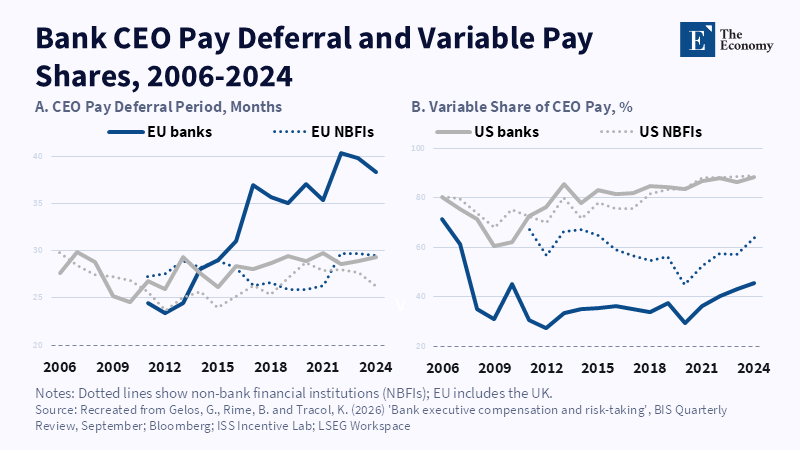
When it comes to policy, regulators have not followed this research. In October of 2025, the PRA and FCA lowered the required deferral period for senior executives in the UK to 4 years from 7. All material risk takers are now subject to the same 4-year deferral period. In the US, the incentive pay rule mandated by section 956 of the Dodd-Frank Act was re-proposed in May 2024 by four regulatory bodies after failing to gain approval in 2011 and 2016. In 2025, it was placed on the long-term regulatory agenda. Many banks also aren't paying for the right things. ROE is the most common measure used in bank incentive plans. The BIS found that when a bank's ROE increased by 1percentage point, its compensation increased by about 4%. Metrics that are adjusted for risk have low and decreasing weights in incentive plans.
Two Failures at Two Different Speeds
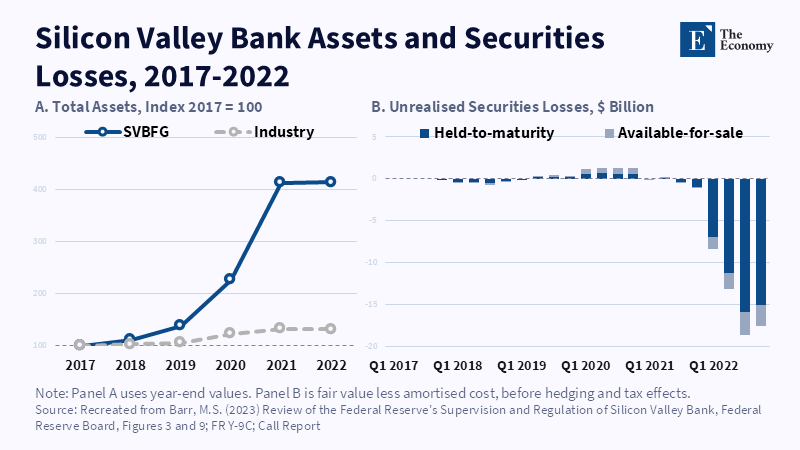
Many will point to Silicon Valley Bank when discussing technology and bank runs. In its April 2023 report, the Federal Reserve cited that social media may have played a role in how quickly a run can occur. They felt that social media, technology and a concentrated depositor base meant that customers were able to move money out of the bank very quickly. What the Fed was less lenient on was what led to the run. 94% of SVB's deposits were uninsured at the end of 2022 and it grew its assets by 271% from the end of 2018 to the end of 2021 compared to an industry average of 29%. The bank had been breaching its long-term interest rate risk limits since 2017 and was unhedging its portfolio as interest rates were rising. The bank stopped having a Chief Risk Officer perform their job in April of 2022 and didn't replace them until December. Executive compensation was paid on short-term profits and stock returns and did not contain any risk metrics.
Credit Suisse saw its customers pull money out of the bank at a slower pace. Customers withdrew CHF 110.5 billion in net assets in Q4 2022, with roughly 2/3 of that occurring in October when social media started talking about the bank's insolvency. On March 15, 2023, customers withdrew CHF 13.2 billion in deposits from Credit Suisse in one day. FINMA found that the bank was meeting its regulatory requirements for liquidity and had a good amount of buffers in the summer of 2022. The bank's compensation packages weren't as defensible as its liquidity ratios. Over the past 10 years of financial data, FINMA found that Credit Suisse had net losses of CHF 2.1 billion but paid out over CHF 33 billion in variable compensation. From 2015 to 2017, bonuses exceeded CHF 3 billion each year while the bank was racking up large losses.
There was plenty of machinery in place to prevent these outcomes. Credit Suisse deferred roughly half of variable pay for 5 years with 3 years of performance conditions and a malus similar to other banks. They did not include goodwill impairments, restructuring, or litigation costs when calculating metrics for compensation. So profits were positive from 2015 to 2017 while the bank was taking losses. Deferring bonuses isn't going to help if the bonuses are being calculated incorrectly. At both banks, the issues were with how boards were allowing bonuses to be calculated. The BIS believes that both of these failures were due to poor governance and not because of outliers in compensation plans.
Separating the Trigger from the Vulnerability
This leads to the question of whether executives should be blamed for these types of losses. If depositors are able to coordinate through social media and group chats faster than banks are able to move money to the discount window, then there is a chance that a bank can be run on that has sufficient assets to weather a run. Should executives be punished for these losses? There is conflicting research on this topic. One study published in 2023 by J. Anthony Cookson et al. looked at 5.4 million tweets and stock prices of 428 banks. They found that when banks were in the top third of pre-run Twitter chatter, they lost 6.66 percentage points more in stock value during the March run. The Federal Reserve recently published its initial findings from a review conducted by Starling Advisory Group in September 2026. One of the conclusions from that review was that social media did not cause the bank run at Silicon Valley Bank or make it happen faster. 96% of online discussion about the run occurred after SVB's failure was already inevitable. The lead Democrat on the Senate Banking Committee called the review an attempt to rewrite history.
Both of these conclusions can be true. Cookson et al. found that the effect of Twitter was larger on banks that had higher levels of mark-to-market losses and uninsured deposits. If a bank was one standard deviation above the average for both of these metrics, it saw a 3 percentage point decrease in returns during a run. This shows that social media can have an impact, but only if there is underlying risk in the bank's portfolio. The St. Louis Fed attributed most of the speed of the run at SVB to its customer base being connected to one another. There may have been some truth to the phone's theory, but there were also many customers who were able to move money out of the bank because they knew each other. If a bank had built its customer base around tech companies, they all had a reason to leave the bank at the same time.
One could argue that this is not a compensation issue. Bank runs should be addressed by regulators and deposit insurance. Bankers should not be expected to protect the system from this. However, banks have ignored their own risk limits and Credit Suisse was meeting all of its liquidity requirements until it was too late. Regulators set a minimum and both of these banks fell short of what executives felt was prudent. When Silicon Valley Bank failed, Signature Bank lost 20% of its deposits in about a day and First Republic lost 57% of its deposits in 1 to 2 weeks. Most other banks in the U.S. saw little to no outflow of deposits despite rising interest rates. This shows that there is a difference between banks that are vulnerable to runs and ones that are not.
Paying Executives for Measured Resilience
Using Relative Performance Evaluation to measure bank executives may solve this issue. In a 2019 working paper by the Federal Reserve Bank of Cleveland, Edward Simpson Prescott and Arantxa Jarque showed that relative performance is optimal when creating incentive contracts. They also suggest using a base salary and bonuses based on the relative performance of both the individual and the firm. One caveat to this paper is that pay for performance and bank risk are dependent on how correlated the returns are. So relative performance may reward banks for taking on risky assets that others are also taking on. In 2022, banks may have seen that SVB was taking on risk that others were not. If all banks were taking on similar levels of risk, this measure would have been useless.
Relative performance can be combined with other metrics that measure the resiliency of a bank. These include what % of a bank's deposits are uninsured and whether those deposits are from the same group of customers. It is also possible to measure how much a bank's economic value of equity changes when interest rates move a certain amount. How much of a bank's securities are hedged and how long the bank can withstand a run at the speed of Silicon Valley Bank. Bonuses would then vest based on these metrics, with a malus if a bank fails due to not meeting these metrics. Bonuses should not be clawed back if the bank fails because of factors outside of its control. Deferral should be long enough to capture losses that occur over multiple years. SVB purchased many of the securities that failed in 2020 and 2021 and saw losses in 2022. This would be captured in a 4-year deferral period.
There is a cost to holding executives accountable for losses that occur to the banking system. Executives may choose to hold more cash and make fewer loans, which will harm consumers who need those loans. If systemic losses are removed from the equation, there is a risk of executives hiding risk that isn't measured by the compensation committee. A balance is needed between measuring the risk that a bank is exposed to and the actual losses that occur.
Who Should Carry the Cost of a Run
There is some risk that should not be measured when paying bank executives. Interest rates rising and the effect that had on other banks losing deposits. These should be measured by regulators and the government, which has the ability to bail out banks if they fail. When Credit Suisse failed, Switzerland spread the losses across its employees. The Federal Council removed all variable pay that was owed to the Executive Board and lowered it for the next two tiers of management. Employees who had deferred compensation of CHF 2.76 billion were left with around CHF 635 million due to the decline in stock price. Losses fell on many employees, which did not cause the bank to fail.
This is why bank executive compensation should be examined before a run occurs and not after. If a bank can lose 25% of its deposits in a matter of hours, there isn't much that can be done to stop the run. Executives need to be paid for keeping the bank resilient to runs. Deferral of bonuses seems to be the only way to ensure that losses are captured over a long enough period of time. Deferral periods are being lowered in the UK and the U.S. has not yet implemented any rules. It remains to be seen whether regulators require banks to start measuring these metrics in their compensation plans. Banks themselves are unlikely to do this without being told. SVB's short-term incentive plan paid above target in 2022 while they were losing money on securities and unhedging their portfolio.
The views expressed in this article are those of the author and do not necessarily reflect the views of The Economy, its Editorial Board, or any affiliated institution.
References
Barr, M.S. (2023) Review of the Federal Reserve’s Supervision and Regulation of Silicon Valley Bank. Washington, DC: Board of Governors of the Federal Reserve System.
Bowman, M.W. (2026) ‘Initial findings from independent review of Silicon Valley Bank’, speech, Mansion House, London, 18 September. Washington, DC: Board of Governors of the Federal Reserve System.
Cookson, J.A., Fox, C., Gil-Bazo, J., Imbet, J.F. and Schiller, C. (2023) Social Media as a Bank Run Catalyst. Working paper, April.
Credit Suisse Group AG (2023) Fourth Quarter and Full Year 2022 Results. Zurich: Credit Suisse, 9 February.
FINMA (2023) FINMA Report: Lessons Learned from the CS Crisis. Bern: Swiss Financial Market Supervisory Authority, 19 December.
Gelos, G., Rime, B. and Tracol, K. (2026) ‘Bank executive compensation and risk-taking’, BIS Quarterly Review, September. Basel: Bank for International Settlements.
Prescott, E.S. and Jarque, A. (2019) Banker Compensation, Relative Performance, and Bank Risk. Working Paper 19-20. Cleveland: Federal Reserve Bank of Cleveland.
Prudential Regulation Authority and Financial Conduct Authority (2025) Remuneration Reform. Policy Statement PS21/25 and PS25/15. London, 15 October.
Rose, J. (2023) ‘Understanding the speed and size of bank runs in historical comparison’, On the Economy. St. Louis: Federal Reserve Bank of St. Louis, 26 May.
Swiss Federal Council (2023) Press release on variable remuneration at Credit Suisse. Bern: Federal Department of Finance, 5 April.
Wenger, S., Vu, M. and Zagoroff, D. (2024) ‘Corporate governance, board oversight and the 2023 banking crisis’, Harvard Law School Forum on Corporate Governance, 14 May.
Working across research, policy, and data-driven analysis, the Editorial Board ensures that published pieces reflect a consistent institutional perspective grounded in quantitative reasoning and long-term structural assessment.