The Renminbi's Internationalization Dilemma: Why China Cannot Easily Open Its Financial Markets

Working across research, policy, and data-driven analysis, the Editorial Board ensures that published pieces reflect a consistent institutional perspective grounded in quantitative reasoning and long-term structural assessment.
Authored On
Modified
Renminbi trade settlement nearly doubled, but reserve share fell
Fragile banks and LGFV debt make capital-account opening risky
Memories of 2015-2016 capital flight keep Beijing’s controls in place

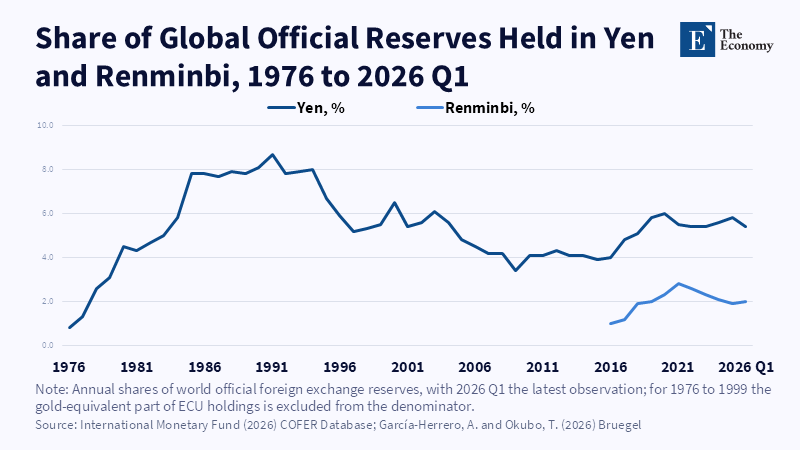
Trade denominated in the renminbi now makes up around 35% of China's total trade, according to the Reserve Bank of Australia. This is nearly double the share of trade in the currency in 2021. During this time, the renminbi's share of global currency reserves has actually decreased from a high of 2.8% at the start of 2022 to 1.95% at the end of 2025, according to the International Monetary Fund's COFER. These figures show why renminbi internationalization hasn't progressed as quickly as the de-dollarisation summits suggest. Countries can be convinced to use the currency when buying from China. However, a central bank holding reserves will want to be able to exit from the currency and know that there is a market to do this in and the rule of law to ensure its assets are treated like those of domestic creditors. China has done a great job creating demand from trade but has avoided building demand from a marketable currency and there are good reasons for this.
Where Renminbi Internationalisation Works: Trade Settlement
Cross-border renminbi receipts and payments done by banks for clients reached 64.1 trillion yuan in 2024. This is 22.6% higher than the previous year. The PBOC stated that trade goods settled in renminbi were 12.4 trillion yuan, growing 3 times faster than China's total imports and exports. For the first half of 2025, the renminbi was used for 28.1% of cross-border trade goods, according to a narrower metric from the central bank. This would have been hard to imagine 10 years ago when the renminbi was still recovering from the August 2015 devaluation. Sanctions on Russia played a role in increasing this figure after the West banned major Russian banks from using SWIFT in February 2022 and froze Russian central bank reserves. By August 2024, Russia's Prime Minister stated that over 95% of trade was settled in rubles and yuan when meeting with China's Premier Li Qiang.
Sanctions provided the demand, but China provided the reason why companies want to keep using the currency. Once a company is paid in renminbi from selling oil to China, they will most likely purchase goods from China. Machinery, cars and technology can all be sourced in China, so there is no need to convert the funds to U.S. dollars and send them to a New York bank. When Japan tried to internationalize the yen in the 1980s, it didn't have this advantage. Japan's trading partners had no reason to use the yen over the dollar. So if the currency wasn't more attractive from a financial perspective, they wouldn't adopt it. China lives in a world where many countries want to trade in a currency that isn't controlled by the U.S.
Looking at global payments outside of China's trade, the story changes. The renminbi only made up 3.17% of global payments in September 2025. Down from 4.74% in December 2023, according to SWIFT data. The RBA also found little evidence that the renminbi was being used for trade that doesn't include China. A currency mostly used to trade with one country is the regional currency of a large country. This is helpful for China but not enough to be a reserve currency.
Why Trade Settlement Falls Short of Reserve Status
Currencies are usually looked at by their ability to settle trade, cross-border debt and hold value as an asset. China has done well in settling trade and has made some gains in cross-border debt. Through the use of Panda bonds, foreign issuers raised 194.8 billion yuan onshore in 2024. It has done poorly in allowing its currency to be used as an asset. It is hard to get countries to hold reserves in a currency that has capital controls. As Joshua Brown from the Reserve Bank of Australia mentioned, there are limited financial markets when compared to other reserve currencies and China's return on assets hasn't been high. Since 2022, there have been minimal capital flows into China. This indicates that capital hasn't flowed into China to take advantage of these geopolitical headwinds.
China's Cross-Border Interbank Payment System has seen usage increase by over 400% since 2020. However, the RBA believes that CHIPS still processes over 20 times the amount of payments as CIPS. Japan had similar struggles when it decided to liberalise its capital account in the 1980s. Japan opened its capital account in December 1980 when it changed its foreign exchange law. Then it liberalised its financial markets in 1984 after the U.S. pressured it through the Yen Dollar Committee. The yen never came close to the dollar as a reserve currency and fell in share of global reserves for most of the 1990s. So liberalising the capital account is a must to internationalize a currency, but not enough. If Japan, which liberalised and had a robust financial market, couldn’t challenge the dollar, then China, which hasn’t liberalised, will have a harder time which leads to the internationalization of the renminbi coming from trade and trade only.
Fragile Balance Sheets Make Opening Risky
China has shown reluctance to liberalise its capital account due to political reasons. Another factor is that its financial markets are not ready to be opened up. When the IMF did its Financial System Stability Assessment in 2025, it said that risks are higher than in 2017 due to China's housing crisis and local government financing vehicles. The IMF stated that losses may be deferred and are not transparent. It found that progress on supervision since 2017 has been uneven. They also found that there are not enough tools in place to deal with a systemic crisis. The Bank of Finland stated that, many times, the IMF didn't have the data to assess the banking system, including banks' exposure to local government financing vehicles. There were 33 recommendations at the end of the assessment and the smaller banks were singled out as the weak point, as they don't have enough capital and will have to pay more for funds.
Local Government Financing Vehicles are also going to be an issue. The IMF stated that China's government debt, including LGFVs, was 126.6% of GDP in 2025 and expected to grow to 150% by 2029. The IMF's board members recommended that LGFV debt that is unsustainable should be restructured and that there are risks to those who are lending to them. China's financial market is propped up by citizens who have no other option to invest their money. If China liberalised its capital account, its banks would have to compete with Singapore's deposit rates and U.S. Treasury yields. Banks would also have to show losses that they have been deferring for the past few years.
When South Korea liberalised its capital account in the 1990s, it learned this the hard way. South Korea joined the OECD in December 1996 and liberalised its capital account. It allowed banks and merchant banks to borrow foreign currency in the short term. However, they did not allow capital to come in over the long term. After one year, many of South Korea's merchant banks failed. Large companies failed, including Hanbo Steel and Kia. South Korea had only about 6 billion dollars of usable foreign reserves at the end of November 1997. They received a bailout of 57 billion dollars, including 21 billion from the IMF. South Korea had capital flight from foreign lenders who didn't want to continue lending to South Korea. However, poor supervision, corporate debt and liberalising the capital account in the wrong order caused capital flight.
Capital Flight Keeps the Controls in Place
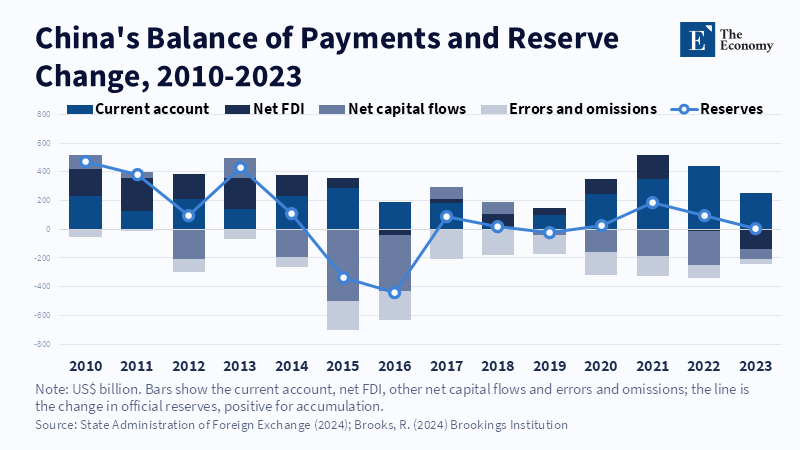
One reason that people say China can liberalise its capital account is that it has the highest foreign reserves of any country. During 2015-2016, China showed that it can lose a significant amount of its foreign reserves. In June 2014, China's foreign reserves peaked at 3.99 trillion dollars. After the PBOC devalued the yuan by 3% over a few days, on August 11th 2015, Chinese citizens began converting their money to U.S. dollars. By January 2017, China's foreign reserves had decreased to 2.998 trillion dollars. This was a loss of almost 1 trillion dollars over 2.5 years while having capital controls in place.
The Reserve Bank of Australia stated that there were close to 1 trillion dollars of private capital out of China between mid 2014 and early 2017. Many of these outflows were from banks. Chinese companies paid off their U.S. dollar debt early due to depreciation of the yuan. The PBOC also sold close to 800 billion dollars in foreign reserves to prop up the currency. China tried to limit capital outflows by reducing the amount of U.S. dollars that could be taken out of China with UnionPay. They also reduced the amount that could be spent on insurance policies that saved U.S. dollars in 2016. In 2017, they put more restrictions in place when purchasing 50k U.S. dollars a year per person. Robin Brooks from the Brookings Institution believes that when citizens believe their currency will depreciate, they will pull their money out of the country. When the yuan lost about 10% against the U.S. dollar in 2018 during the tariff war, there was not as much capital flight. Citizens may have gotten used to the yuan fluctuating more against the U.S. dollar. However, if China liberalised its capital account, the controls that slowed outflows would be gone and people would still have the desire to hold foreign currency.
Hong Kong is China's solution to this issue. At the end of 2025, there were 960.1 billion yuan in offshore renminbi deposits in Hong Kong, according to the HKMA. The Reserve Bank of Australia estimates that around two-thirds of offshore renminbi is held in Hong Kong. This allows foreign companies to use the renminbi and convert it freely but China can still restrict the amount of currency that leaves its borders. This will help with domestic financial stability and monetary policy but limits how far the renminbi can go as a reserve currency. There are not many offshore renminbi for central banks to hold as an asset.
What a Closed Capital Account Means for Reserve Status
For central banks, the renminbi will be used to diversify their holdings and hedge against political risk. It will make up a small single-digit percentage of their reserves. Most of it will be held in Chinese government bonds and supported by swap lines with the PBOC. Companies that do business in Russia, Central Asia and parts of Africa may see benefits from holding renminbi. They can use it to buy Chinese products and avoid the U.S. dollar. But will have to hold their currency in one country and rely on China to continue using the renminbi for trade.
China will have to make changes if it wants its currency to become a reserve currency. The IMF has stated that China should allow more flexibility with its exchange rate. Recognise losses earlier and have prices determined by the market. All of which would expose the losses in its housing market and LGFV's. They would also allow Chinese citizens to leave the country with their money at a time when the IMF states that private demand is weak and deflation is occurring. If China wants to internationalize its currency, it needs to follow the path that South Korea learned from. Liberalise its capital account after its financial markets are ready, which will take time and will have to come at a cost.
China will likely continue to see its trade denominated in the renminbi increase but its share of global reserves will remain stagnant until China liberalises its capital account, which could cost it close to 1 trillion dollars, as they saw in 2015-2016. If their augmented government debt is at 126.6% of GDP and the IMF doesn't have data on their banks' holdings of LGFV debt, it will be even more costly the next time.
The views expressed in this article are those of the author and do not necessarily reflect the views of The Economy, its Editorial Board, or any affiliated institution.
References
Bank of Finland Institute for Emerging Economies (2025) ‘IMF sees China’s financial sector risks elevated and still rising’, BOFIT Weekly Review, 20/2025. Helsinki: Bank of Finland.
Brooks, R. (2024) China’s Achilles’ heel: capital flight. Washington, DC: Brookings Institution.
Brown, J. (2026) ‘Developments in RMB internationalisation’, Reserve Bank of Australia Bulletin, August. Sydney: Reserve Bank of Australia.
García-Herrero, A. and Okubo, T. (2026) Lessons for the renminbi from the yen internationalisation story. Bruegel Analysis 34/2026. Brussels: Bruegel.
Hong Kong Monetary Authority (2026) Monetary statistics for December 2025. Hong Kong: Hong Kong Monetary Authority.
International Monetary Fund (1997) IMF approves SDR 15.5 billion stand-by credit for Korea. Press Release No. 97/55. Washington, DC: International Monetary Fund.
International Monetary Fund (2017) ‘China’s capital account liberalization and capital flows’, in People’s Republic of China: Selected Issues. IMF Country Report No. 17/248. Washington, DC: International Monetary Fund.
International Monetary Fund (2025) People’s Republic of China: Financial System Stability Assessment. IMF Country Report No. 25/100. Washington, DC: International Monetary Fund.
International Monetary Fund (2026) People’s Republic of China: 2025 Article IV Consultation. IMF Country Report No. 26/44. Washington, DC: International Monetary Fund.
McCowage, M. (2018) ‘Trends in China’s capital account’, Reserve Bank of Australia Bulletin, June. Sydney: Reserve Bank of Australia.
Ministry of Foreign Affairs of the Republic of Korea (n.d.) History of Korea in the OECD. Paris: Permanent Delegation of the Republic of Korea to the OECD.
Nephew, E., Vu, H.L. and Wei, H. (2026) Currency Composition of Official Foreign Exchange Reserves, Fourth Quarter of 2025. IMF Data Brief. Washington, DC: International Monetary Fund.
People’s Bank of China (2025) RMB Internationalization Report 2025. Beijing: People’s Bank of China.
Swift (2025) RMB Tracker, October 2025. La Hulpe: S.W.I.F.T. SC.
Working across research, policy, and data-driven analysis, the Editorial Board ensures that published pieces reflect a consistent institutional perspective grounded in quantitative reasoning and long-term structural assessment.