Stablecoin Dollarization Is Widening the Dollar’s Lead Over China’s e-CNY

Working across research, policy, and data-driven analysis, the Editorial Board ensures that published pieces reflect a consistent institutional perspective grounded in quantitative reasoning and long-term structural assessment.
Authored On
Modified
Emerging economies hold about three quarters of stablecoins
Crises and capital controls push savers into digital dollars
China’s e-CNY scales at home but lacks foreign demand

Between 2018 and 2025, an estimated $21.4 trillion in stablecoins moved across borders and the money did not flow to the obvious places. A recent IMF working paper, which estimated the location of stablecoin wallets across 188 countries from public blockchain data, showed that emerging market and developing countries take part in 86 percent of cross-border stablecoin flows and hold about 75 percent of all stablecoins. Nearly 99 percent of stablecoins are denominated in U.S. dollars. This is stablecoin dollarization, and it accumulates where trust in the local currency is lacking. Countries that restrict capital outflows see stablecoin activity increase by about 30 percent over the next 6 months and it stays there when the controls are lifted. Currency crises see holdings increase by about 75 percent within 1 year and stay that way. The suspicion that digital tokens were being used to circumvent capital controls has now been backed up with country-level data. The same data reframes the currency contest with China.
Stablecoin Dollarization Follows Holdings, Not Flows
Marco Reuter, the paper's author, estimates each wallet's location from its on-chain behavior and aggregates flows and holdings by country. In a previous version of this methodology, using only 2024 data, North America was estimated to be the largest at $633 billion in gross flows, followed by Asia Pacific at $519 billion. That fits the location of exchanges, market makers and trading desks. But holdings are a different story. Flow is a measure of how much money is flowing through a country, and holdings are who is choosing to hold that money. Many holders of dollar stablecoins do not live in advanced countries. A desk in Singapore probably flips that balance in a matter of hours. But a person in Lagos or Buenos Aires holding USDT is making a decision probably after a long time, and after their currency failed them at least once.
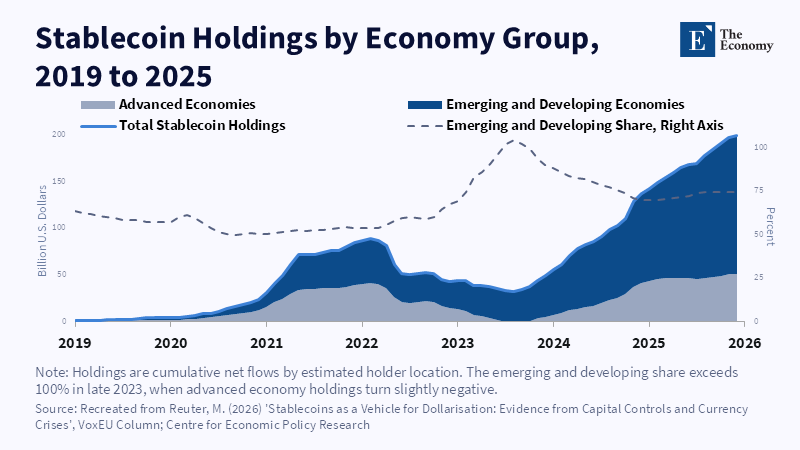
Chainalysis data supports this as well. Sub-Saharan Africa saw over $205 billion in crypto value on-chain from July 2024 to June 2025. That's a 52 percent increase year over year, with Asia Pacific and Latin America seeing even bigger increases. Nigeria accounted for $92.1 billion in that time, which is nearly three times what South Africa saw. Countries like Argentina and Venezuela have had their citizens hold dollars for the past 2 generations. Now it's just on their phones. South Africa is the exception so far: Dan Katz, the IMF's First Deputy Managing Director, said at the University of Cape Town in August that dollar stablecoins have gained limited traction there and rand-linked tokens even less.
No Bank Required
Dollarization is not new. Many households in Latin America, Eastern Europe and Africa hold dollars. Studies on deposit dollarization have shown that after a crisis causes someone to convert to dollars, they rarely go back. The Reuters paper shows that conversion no longer needs a bank. Comparing 21 currency crises with 86 matched emerging market and developing countries, the paper found that after a crisis, people hold approximately 75 percent more stablecoins and don't go back down. This will be a major talking point for policymakers because not only do countries see an increase in stablecoin usage when they tighten outflow controls, but it does not go down after the fact. People learned how to get dollars and will continue to do so.
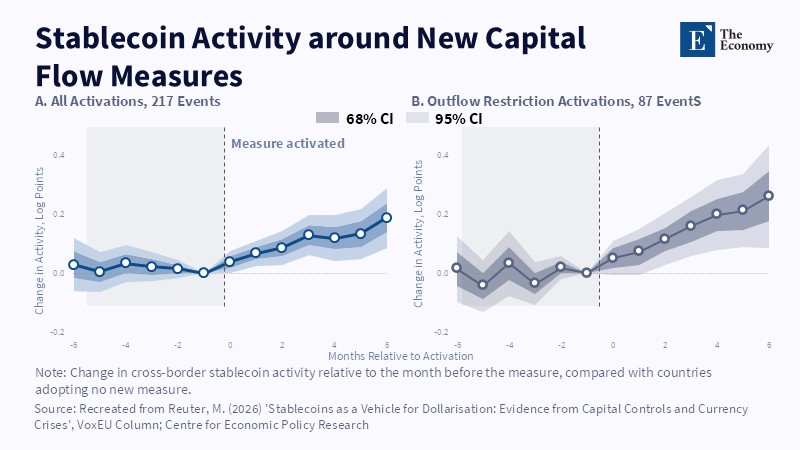
Katz made the same point in Cape Town. Stablecoins can exacerbate current drivers of dollarization such as inflation and exchange rate volatility. They can do it faster because access takes a phone and a messaging app, not a bank. Controls that limit capital outflows are designed for banks and licensed FX brokers. A self-hosted wallet is neither of those. And for the time being, three-quarters of all stablecoins sit in emerging market and developing economies, many of which have lost the trust of their own savers.
Domestic e-CNY Volume Is Not Global Demand
China's digital currency looks good on paper, but it's not moving internationally. By the end of November 2025, the e-CNY had processed over 3.4 billion transactions totaling around 16.7 trillion yuan, or about $2.3 trillion, up 800 percent from 2023, according to the Atlantic Council. Since the start of 2026, balances have started accruing interest at deposit rates, which is something no other major central bank has done. Much of the volume comes from tax rebates, government disbursements and controlled commercial use in mainland China. The Atlantic Council believes that after 5 years, the e-CNY has not displaced Alipay or WeChat Pay. That helps domestic adoption in the public sector. It does not show that someone in Accra or Caracas will want to hold renminbi.
International usage can show how different these numbers can be. The renminbi accounted for nearly 2 percent of global foreign reserve currency as of the end of 2025, according to the ECB. In SWIFT messages in 2025, the dollar stood at around 48 percent and the renminbi stood at around 4 percent, according to the ECB. The IMF cited estimates that stablecoin volume exceeded $30 trillion in 2025, with roughly $6.1 trillion moving across borders. Getting citizens to use a domestic CBDC and getting a currency used internationally are two very different things. One can be built and pushed through state banks and institutions. The other depends on what users beyond the state's control choose to hold. And mBridge is made up of 5 central banks. All know who is on the network, and Chinese capital controls shape who can convert and how much, which limits its ability to grow.
mBridge Grows Fast From a Very Small Base
China's biggest advantage may not be in retail transactions but in wholesale settlement. Project mBridge has seen over 4,000 transactions between mainland China, Hong Kong, Thailand, UAE and Saudi Arabia since it began. The Atlantic Council reported that the total amount of transactions has reached $55.49 billion. That is a roughly 2,500-fold increase in value from its 164 transactions worth $22 million in 2022. The e-CNY accounts for about 95.3 percent of that volume. The BIS exited the project in October of 2024, allowing the participating countries to govern the network. Settlement through China's Cross-Border Interbank Payment System also increased by about one-third in March 2026, after war broke out in the Middle East.
These numbers are large but need context. mBridge's cumulative total since 2022 is still less than 1 percent of the estimated cross-border stablecoin volume for 2025 alone, although much of that stablecoin volume is crypto trading rather than payments. And it is a network of 5 central banks that know each other, led by China. A dollar stablecoin can reach a Nigerian saver without any central bank agreeing to it. That's the new frontier of the dollar. No one had to agree to it or allow it to happen. It just grew wallet by wallet in countries that lost trust in their currency. But participation in the Cross Border Interbank Payment System remains mostly limited to Chinese banks and their subsidiaries abroad. Pipes move renminbi; they do not make savers abroad want it.
Why a Turning Point Still Looks Distant
Anyone doubting that this trend will last can point to the fact that the interest-bearing e-CNY is only 10 months old, and that its volume is increasing at a rapid rate. Other assets are also growing alongside the dollar, such as gold. Central banks added about 850 tonnes in 2025. And Beijing keeps foreign exchange inside tightly policed channels, having barred unauthorized offshore renminbi-pegged stablecoins in February 2026. The issue is that if people believe they need to hold dollars, it doesn't matter if they come from their government or the US. They will find a way to hold them at home. The Reuters estimates point the same way: dollarization now advances through individual savers' decisions rather than government agreements, and those decisions may reinforce American monetary dominance more effectively than currency diplomacy. Unless renminbi assets become something foreigners choose to hold, it is hard to see what reverses that network.
The views expressed in this article are those of the author and do not necessarily reflect the views of The Economy, its Editorial Board, or any affiliated institution.
References
Chainalysis (2025) The 2025 Geography of Cryptocurrency Report. New York: Chainalysis.
Chhangani, A. (2026) ‘What to watch as China prepares its digital yuan for prime time’, Atlantic Council, 15 January.
European Central Bank (2026) The International Role of the Euro, June 2026. Frankfurt am Main: European Central Bank.
Katz, D. (2026) ‘Stablecoins: Promise, Risks, and Policy Choices for Emerging Markets’, remarks at the University of Cape Town, 7 August. Washington, DC: International Monetary Fund.
Lee, K. (2025) ‘Incentives, Not Ideology, Will Decide the Dollar–Renminbi Digital Race’, The Economy, August.
Reuter, M. (2025) Decrypting Crypto: How to Estimate International Stablecoin Flows. IMF Working Paper 2025/141. Washington, DC: International Monetary Fund.
Reuter, M. (2026a) International Stablecoin Flows, Capital Controls and Currency Crises. IMF Working Paper 2026/211. Washington, DC: International Monetary Fund.
Reuter, M. (2026b) ‘Stablecoins as a vehicle for dollarisation: Evidence from capital controls and currency crises’, VoxEU/CEPR, 31 October.
The Economy Research Editorial (2026) ‘China’s Stablecoin Retreat Is a Victory for Dollar Stablecoins’, The Economy, 19 May.
‘The political economy of China’s e-CNY reform’ (2026) East Asia Forum, 31 Octobe
Working across research, policy, and data-driven analysis, the Editorial Board ensures that published pieces reflect a consistent institutional perspective grounded in quantitative reasoning and long-term structural assessment.