[Offshore Finance] Is the Cayman Islands Still a Tax Haven? The Changing Economics of Offshore Finance

Working across research, policy, and data-driven analysis, the Editorial Board ensures that published pieces reflect a consistent institutional perspective grounded in quantitative reasoning and long-term structural assessment.
Authored On
Modified
Cayman shares tax data but still levies zero tax
Fund numbers rose as compliance costs shrank administrator ranks
Neutrality holds only where home countries tax offshore income

In 2024, the Cayman Islands tax agency transmitted, according to Cayman Finance, data on 1,640,000 financial accounts to more than 120 tax authorities, including the State Taxation Administration of China, covering balances, shareholdings and taxpayer details. In December 2025, the Tax Justice Network ranked the same jurisdiction in second place worldwide in the Corporate Tax Haven Index, behind the British Virgin Islands, with a haven score of 100 out of 100. Both figures are accurate. The apparent contradiction over whether the Cayman Islands is a tax haven is not solved by choosing which of the two to believe, because the term packs together four different things: zero or low taxation, financial secrecy, regulatory compliance, and real economic activity. The Caymans have largely dismantled the second and kept the first intact, and for the other two the answer depends on who is counting and how.
How Cayman Built a Fund Centre Without Income Tax
It began in the 1960s, when the colonial government enacted a Companies Law, a Trusts Law, and regulations for banks and trust companies, without imposing income tax, capital gains tax, or withholding tax. The model was simple and, for its time, it worked: a legal infrastructure of English law, political stability under the British crown, and a tax regime that added nothing to the taxation of the countries where investors lived. The Mutual Funds Law of 1993 first brought hedge funds under regulation, and the Cayman Islands Monetary Authority, CIMA, was established in the late 1990s as a single supervisory body.
From there, growth followed the master-feeder structure that prevailed in international fund management. A U.S. fund manager looking to raise money from tax-paying U.S. investors, tax-exempt U.S. pension funds, and foreign institutional investors finds in the Caymans a neutral meeting point where none of them pay tax twice, and no one has to invoke double taxation treaties. U.S. Securities and Exchange Commission data for the first quarter of 2024 shows that Cayman-based funds accounted for 31.6% of the net assets of all private funds reported to the SEC and 53.6% of the net assets of qualifying hedge funds. In this usage, the argument of tax neutrality, which Cayman Finance puts forward as the core of the activity, has a substantial basis, though it has limits, and the people who invoke it rarely spell them out.
Four Characteristics the Term Tax Haven Confuses
Low or zero taxation is the most visible and least disputed feature. The Cayman Islands do not tax corporate profits, nor capital gains, nor dividends paid out. Secrecy is a different matter: it is about whether a tax or prosecuting authority can find out who is behind a company or an account. Regulatory compliance is about whether the jurisdiction applies the international standards agreed upon in the FATF, the OECD Global Forum, and the European Union. Economic substance, finally, asks whether the profits recorded there correspond to people, offices, and decisions made on the ground, or whether they were simply moved there on paper. The classic picture of the tax haven, as it took shape from the 1970s onwards, assumed that the four go together, and for a long time this was true in several jurisdictions.
Table 1. The Four Characteristics of the Tax Haven and the Position of the Cayman Islands, 2026
| Feature | What is it looking at? | Caymans' position | Key Indication |
|---|---|---|---|
| Zero or low taxation | Corporate Income, Capital Gains and Withholding Tax | Unchanged | Score of 100 out of 100 on the Tax Justice Network's Haven Score, December 2025 |
| Financial secrecy | Access by authorities to beneficial ownership and account details | Strongly reduced | Register of beneficial owners since 2017, CRS data for 1,640,000 accounts in 2024 |
| Regulatory Compliance | Implementation of FATF, OECD and EU standards | High in the legal framework, uneven in practice | Exit from FATF enhanced monitoring, October 2023, but only 23% of information requests were answered within 90 days |
| Economic substance | Matching earnings with actual activity | Disputed | Economic Substance Act since 2019, incoming and outgoing direct investment of about $1.1 trillion each |
Read this way, the table explains why the two sides of the dispute often talk past each other. Cayman Finance responds to the charge of secrecy, which has indeed been largely answered. Critics measure taxation and substance, which have not changed in the same way, and the word they use still carries the moral weight of secrecy. Cayman Finance itself notes that there is no agreed definition of tax haven and that the term is usually used derogatorily, to imply secrecy or lax oversight, and on this point it is right, since neither the OECD nor the EU now uses the word in their official lists, which speak instead of non-cooperative jurisdictions. The absence of a definition cuts the other way too, though, because it leaves room for each side to choose the characteristic that favors it.
Transparency Passed Review, Response Times Did Not
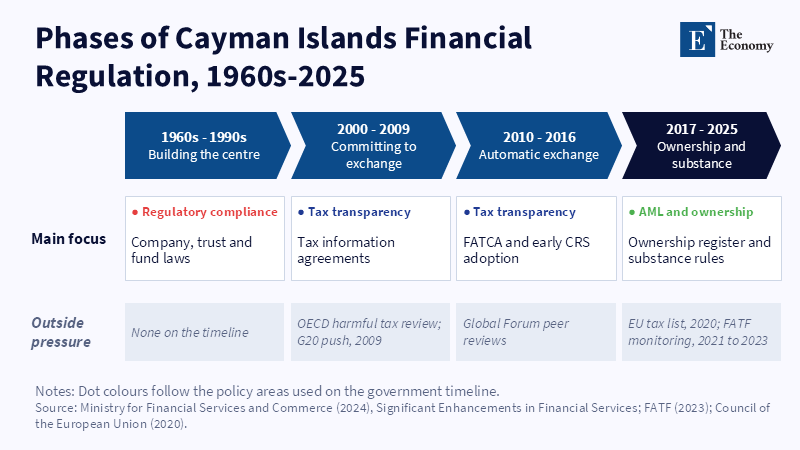
The timeline published in 2024 by the Cayman Ministry of Financial Services and Commerce records 97 milestones from the 1960s to 2025, and 59 of them are placed after 2010, which is in line with Cayman Finance's claim that since 2010 more than 50 new laws and regulations have been enacted. The composition changes over time, which is more interesting than the total: in the decade 2010 to 2019, tax transparency measures dominate, such as information exchange agreements, the early adoption of the Common Reporting Standard and the first exchanges in 2017, while after 2020 the focus shifts to anti-money laundering and beneficial ownership.
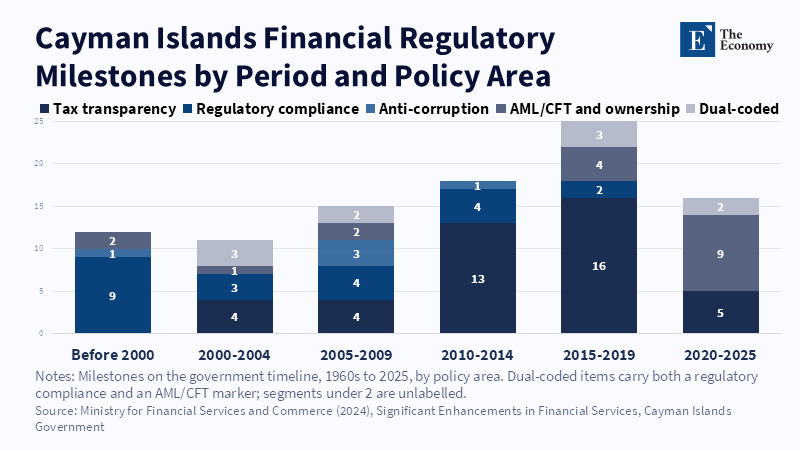
The shift was made under pressure. In February 2021, the FATF placed the Caymans under enhanced monitoring for three specific weaknesses: sanctions that were not dissuasive, weak penalties for those who did not declare accurate beneficial ownership details, and few money laundering prosecutions in relation to the risk profile. The exit from enhanced monitoring came on October 27, 2023, after the FATF determined that all three had been addressed. On taxation, the OECD's Global Forum rated the implementation of the automatic exchange of account information in 2022 as "On Track", the highest grade, and confirmed in subsequent reviews that the legal framework meets the standard. On the EU list, the Caymans had been placed in Annex I in February 2020 because the Private Funds Law was passed on February 7, a few days after the relevant group meeting, and were removed in October of the same year. In the October 2026 revision, they are classified as a cooperative jurisdiction with no outstanding commitments, while the British Virgin Islands remain in Annex II.
Cayman Finance leaves two points out of this picture. The Global Forum's enhanced monitoring report, in June 2026, finds backsliding in the timeliness of responses to information requests: of the 230 requests received by the Caymans, 94.8% were fully answered, but only 23% within 90 days, 53% within 180 days, and 70% within a year, a performance worse than that of the 2017 evaluation, while five of the ten partners who submitted comments complained of delays or missing status updates for a tax authority investigating a specific case, a response that arrives after a year is worth far less than one that arrives in three months. The second point concerns the register of beneficial owners. Since 28 February 2025, journalists, academic researchers and civil society organizations can request access if they demonstrate a legitimate interest linked to the prevention of financial crime, but there is no public access. Progress compared to 2017 is real, but it is a far cry from the open register the British Parliament voted for in 2018 for all overseas territories with a deadline of December 2020, an obligation that has gone more or less unimplemented since the EU Court of Justice's November 2022 ruling on public registers.
Compliance Increased Costs Without Reducing Demand
If the pressure from international organizations was aimed at reducing the importance of the Cayman Islands, CIMA's data does not show such an effect. At the end of 2019, there were 10,857 registered mutual funds. In September 2026, there were 13,187, an increase of 21.5%, and alongside them were 18,360 closed-end private funds, a category that was not recorded before 2020. The private fund figure needs care, because the 12,695 in 2020 were mainly existing schemes that were first forced to register, so the right measure is the 44.6% increase from then on, which Cayman Finance links to the demand for private credit and continuation vehicles.
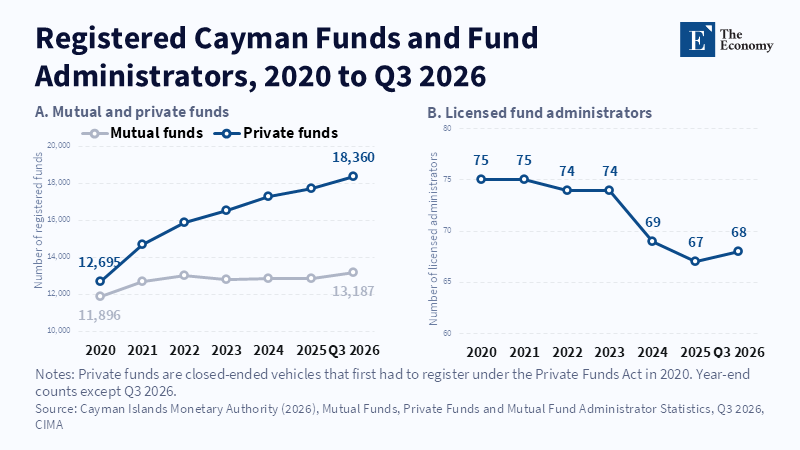
Compliance has left its mark on the service side. Licensed fund administrators fell from 97 in 2017 to 81 in 2019 and to 68 in September 2026, while registered funds, along with private funds, nearly tripled, the kind of concentration seen in a market where the fixed cost of regulatory obligation, such as CRS audits and beneficial owner declarations, favors large providers and drives out small ones. The conclusion for fund managers is practical. Transparency has turned part of the advantage of the neutral domicile into operating costs, which are more easily absorbed by large capital, while the expertise of law firms and fund administrators, and institutional investors' familiarity with the structure, keep demand going. Competition now comes from Hong Kong, which proposes zero tax on carried interest and which, according to Boston Consulting Group, became the largest cross-border wealth center in 2026, surpassing Switzerland.
What Transparency Doesn't Solve in a Tax Haven
The Caymans' strongest defense is that of tax neutrality: funds do not pay tax there so as not to be taxed twice, while investors are taxed in their country of residence and the underlying investments in the country where they are made. For a pension fund in Ontario or a taxable investor in Frankfurt, the argument stands. Up to that point it is lawful tax efficiency; avoidance begins when profits are booked where nothing happens, and evasion when income is hidden from the country of residence, which CRS exchange now makes far harder. Recent Chinese experience shows where the argument stops. Until Announcement No. 21 of July 2026 introduced a 20% tax on gains on transfers to offshore trusts and on their income, Chinese law, according to Morgan Lewis, had no specific attribution and timing rules for trusts, so income accumulated in a zero-tax structure could remain untaxed for years. Neutrality is only neutral where the country of residence has rules to tax.
The second objection concerns substance and corporate taxation, which is what the Corporate Tax Haven Index measures. The Tax Justice Network estimates that incoming and outgoing foreign direct investment of about $1.1 trillion each passes through the Caymans, a figure that corresponds to 2.1% of the global activity of multinationals and, with a score of 100, to 6.7% of the total index, amounts that cannot be explained by the productive base of an island state. The Economic Substance Act, in force since January 2019 and extended to partnerships in 2021, requires an adequate presence for certain activities, but investment funds are excluded, and the requirements measure management and expenses, not profits. Cayman Finance has previously challenged the Tax Justice Network's methodology, with some success: when the jurisdiction submitted revised balance of payments data to the IMF, the 2022 Financial Secrecy Index lowered it from first place in 2020 to fourteenth.
The Corporate Tax Haven Index, though, scores laws in force, and the Caymans get 100 in all five of its index groups, including the lowest available rate, exemptions, transparency gaps and the absence of anti-abuse rules, which shows that the corporate transparency measured by the Tax Justice Network is different from the transparency of accounts reviewed by the OECD. Pillar Two's global minimum tax of 15% could change that equation for large groups, but PwC's tracker has not yet recorded any Cayman public announcement of a domestic top-up tax, meaning that any top-up tax due will be collected by other countries.
The practical consequences differ by audience. For tax authorities, access to information has ceased to be the main obstacle; what remains is the existence of domestic rules that convert it into a tax, as Beijing has now done, and the speed with which responses to specific requests arrive. Managers face a risk that is shifting from reputation to compliance, at a time when the US is tightening anti-money laundering measures with security in mind, and China with the aim of preventing capital outflow. For the public debate, calling a place a tax haven without qualification confuses a zero-tax jurisdiction that exchanges information with a jurisdiction that hides it, and says nothing about whether the outflow of wealth from London after the end of the non-dom regime ends up there or elsewhere.
The paradox from the opening remains. The 1,640,000 accounts that the Caymans reported in 2024 are exactly the kind of information that China's State Taxation Administration can use to cross-check declarations, now that it is asking for a 20% tax from its residents with trusts in the Caribbean. The jurisdiction where information once stopped is now where it starts. The tax rate, however, remains zero, and the Corporate Tax Haven Index measures it in the same way it did before the 97 reforms. Whether the word haven should describe the rate or the flow of information will be settled by neither the FATF nor the Tax Justice Network. The next specific milestone is more prosaic: by March 31, 2027, the Caymans must submit a timetable to the Global Forum for answering requests for information on time.
The views expressed in this article are those of the author(s) and do not necessarily reflect the official position of The Economy or its affiliates.
References
Boston Consulting Group (2026) Global Wealth Report 2026. Boston: Boston Consulting Group.
Cayman Islands Monetary Authority (2026) Mutual Funds, Private Funds and Mutual Fund Administrator Statistics, Q3 2026. George Town: Cayman Islands Monetary Authority.
Council of the European Union (2026) EU list of non-cooperative jurisdictions for tax purposes: October 2026 revision. Brussels: Council of the European Union.
Financial Action Task Force (2023) Jurisdictions under Increased Monitoring, 27 October 2023. Paris: FATF.
Global Forum on Transparency and Exchange of Information for Tax Purposes (2026) Enhanced Monitoring Report on the Implementation of the Standard on Transparency and
Exchange of Information on Request 2026 Update, June: Cayman Islands. Paris: OECD Publishing.
Ministry for Financial Services and Commerce (2024) Significant Enhancements in Financial Services. George Town: Cayman Islands Government.
Morgan, Lewis & Bockius LLP (2026) China Establishes New Individual Income Tax Rules for Offshore Trusts. 28 July. Philadelphia: Morgan, Lewis & Bockius LLP.
Tax Justice Network (2022) Financial Secrecy Index 2022. London: Tax Justice Network.
Tax Justice Network (2025) Corporate Tax Haven Index 2025: Cayman Islands country profile. Bristol: Tax Justice Network.
U.S. Securities and Exchange Commission, Division of Investment Management Analytics Office (2024) Private Funds Statistics: First Calendar Quarter 2024. Washington, DC: U.S. Securities and Exchange Commission.
Working across research, policy, and data-driven analysis, the Editorial Board ensures that published pieces reflect a consistent institutional perspective grounded in quantitative reasoning and long-term structural assessment.