[Arctic Maritime Strategy] The Economics of North Atlantic Security: Energy, Infrastructure and Defense Investment

Working across research, policy, and data-driven analysis, the Editorial Board ensures that published pieces reflect a consistent institutional perspective grounded in quantitative reasoning and long-term structural assessment.
Authored On
Modified
Europe mostly protects gas and data revenue it already earns
Frigates get billions; cable repair gets tens of millions
Accidents, not sabotage, cause most seabed damage so far

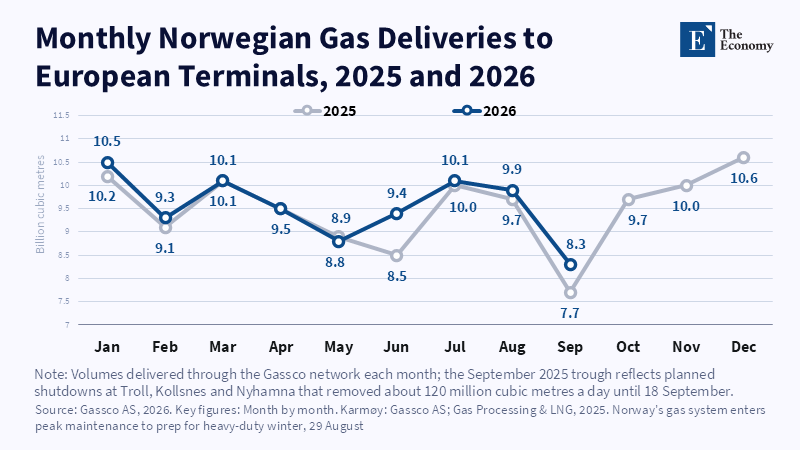
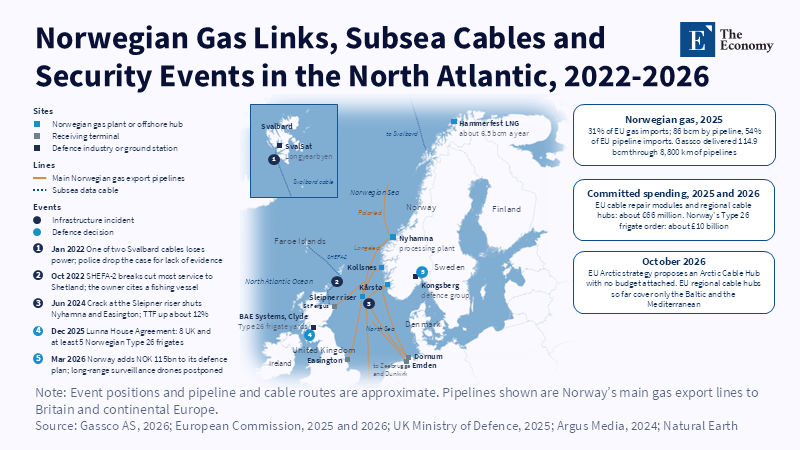
According to figures from the European Commission, Norway accounted for 31% of natural gas imports to the EU in 2025. This number has been steadily increasing from 24% in 2021 and positions Norway as the biggest natural gas exporter to the EU from outside the union. The majority of this gas is transported via pipeline. In 2025, 86 billion cubic metres were sent to EU customers via Norwegian pipelines. That represents 54% of all natural gas sent by pipeline to the EU. Gassco, the state-owned pipeline operator for the 8,800 kilometres of pipeline running across the North Sea, sent a combined total of 114.9 billion cubic metres to Germany, the UK, Belgium, France and Denmark. There is a clear distinction between the debate over North Atlantic security and that of the Bering Strait. The commercial benefit of the Bering Strait comes from increased trade in the Arctic. Right now, that is just speculation. Whereas the benefit to the North Atlantic between Norway and the UK is already built and in use on the ocean floor.
There is an implication that if money is spent on defence in these areas, most of that money is going towards assets that would earn money regardless. The question becomes: is it lowering the expected costs of not making that money by more than what is spent on defence? When talking about defence spending in these areas, there are many numbers being mixed together. First are actual amounts that are being spent. For example, Norway recently placed a £10 billion order with the UK for Type 26 Frigates. Next are plans that have no attached cost. The EU recently released its Arctic Strategy on the 20th of October 2026. Much of that plan fits this description. The last number is how much would be lost if a certain event occurred. With these three numbers in mind, Europe is spending more money on ships and less money on the ability to fix things when they break.
Norwegian Gas Is Something Europe Cannot Replace
Not only is Europe dependent on Norway for gas. Norway is also dependent on Europe. Crude oil, natural gas, natural gas liquids and condensate made up 1,000 billion NOK of Norwegian exports in 2025, according to information released by the Ministry of Energy and the Norwegian Offshore Directorate. This represented 57% of the total amount of goods exported from Norway. Gas brought in more than oil. Almost all of this gas travels through a few key points. The refining facilities in Kollsnes, Kårstø and Nyhamna. Various pipes travel through the North Sea. And the ports in the UK and Germany. The addition of the Arctic has allowed for gas to be shipped to ports by tanker from Hammerfest. Around 6.5 billion cubic meters are shipped from here each year. This is efficient when everything is working but can be devastating if one of these points fails. No matter what causes the issue (which is likely to be a mechanical failure).
Europe has already seen the impact that one of these failures can have. At the beginning of June 2024, Gassco announced that a pipe had cracked on the Sleipner riser platform. This caused Nyhamna and Easington to shut down production. This removed 56 million cubic metres of gas from production that day. According to Argus Media, the Dutch TTF future price for gas to be delivered in July jumped from 34.43 euros per megawatt hour to 38.60 euros at one point that day. That is an increase of 12% because of a cracked pipe. No bad actor was involved. This can be extrapolated to what Europe would lose if a large gas supplier stopped sending gas to Europe. A good comparable would be the loss of Russia from the equation. After Russia stopped sending gas to Europe, governments across Europe allocated approximately 651 billion euros to protect their citizens from rising prices, according to Bruegel's fiscal response tracker. Norway has many more fail-safes in its pipeline network. So this is a high estimate of what Europe would lose if Norway stopped sending gas.
Data Cables Carry Risks Insurers Will No Longer Cover
There is less information available on the costs of failing data cables. They are just as vulnerable as the pipelines. The European Commission released its Action Plan on Cable Security in February 2025. It states that 99% of all trans-oceanic internet traffic travels through undersea cables. Many of these travel to and from Ireland, the UK, Iceland, the Faroe Islands and Norway. Information on undersea cables in the Arctic is limited. On the 7th of January 2022, one of the two cables that ran from mainland Norway to Svalbard lost power. This cable also serves the SvalSat ground station. It houses over 100 antennas to receive satellite information. Norwegian police stated that they found evidence that humans may have been involved but later dropped the case. The other cable continued to send traffic during this time. About nine months later, the SHEFA-2 cable that goes around Shetland lost power on both ends. Leaving many on the island without phone and internet. It took until the 23rd of October to repair. The cable company Faroese Telecom believes that a fishing boat caused the damage.
While both of these could have been the work of a state, it is unlikely that every time a cable breaks, it's because of the Russians. By labeling these attacks, governments funnel money towards deterrence. The last two incidents in the Arctic could have easily been caused by fishing boats. Attribution no longer matters to one group of people. On the 6th of July 2026, the High Court in London ruled that Nord Stream AG would not be able to collect the 580 million euros it claimed from Lloyd's Insurance Company and Arch Insurance. They determined that the explosion that occurred in 2022 was covered under the policy's war exclusion. The court did not have to determine who was responsible for the attack. Companies that provide insurance for fixed structures that are on the ocean floor may not offer coverage for sabotage in the future. Gallagher Re warned of this in 2025. If a structure breaks in the Norwegian Sea, the owner may not be able to prove who did it or get reimbursed for the damage. This leaves companies and the public to pay for these losses.
Repair Ships Are the Weak Point in North Atlantic Security
If a cable breaks, a ship is needed to fix it. There will not be enough ships in 10-15 years, according to a study commissioned by the SubOptic Association in 2025. TeleGeography calculated that two-thirds of the ships that repair cables will reach the end of their lifespan by 2040. Maintaining current repair times would cost around $3 billion to build 15 new ships. And have another 5 as backups. Europe is spending very little on the ability to repair its cables. In the spring of 2026, the EU opened a 20 million euro project to develop modules to repair cables in the Baltic Sea. Then in June opened another call for proposals worth 40 million euros. To develop modules that can be used to repair cables in the Atlantic, Mediterranean and other seas. They also committed 5.8 million euros to two cable hubs. One in the Baltic and one in the Mediterranean. According to The Brussels Times. No cable hub yet covers the Norwegian Sea. Or off the coast of Shetland. The new Arctic Strategy mentions the development of an Arctic Cable Hub that can be used to monitor, defend, and help repair undersea cables in the North Atlantic and Arctic. But the document did not mention how much they would spend on any of these.
The EU has committed 66 million euros so far to help repair cables. Norway is spending £10 billion on frigates. The EU has committed 533 million euros to help with submarine cables for 2024-2027. They have awarded 186 million to 25 projects so far. It would only pay for a fraction of one frigate. Defence planners argue that the ships will be there to deter attacks on infrastructure. That is true. But the evidence shows that most damage will likely come from fishing boats or old pipes. Deterrence will not help. The Centre for Eastern Studies said that Norway will receive its first Type 26 in 2030. That leaves a few years where, if something breaks off the coast of Scotland, it will be in line with the rest of the world's aging repair ships.
The Defense Market Rewards Platforms Over Repair
With the signing of the Lunna House Agreement on the 4th of December 2025. The UK and Norway will share a fleet of 8 British Type 26 Frigates and at least 5 Norwegian Type 26s. These ships will be able to work together. The UK Ministry of Defence stated that the Norwegian order will create over 4000 jobs in the UK. Norway will also receive a promise that Norwegian companies will receive industry benefits equal to the amount spent on frigates. This agreement also allows for the UK to work with Norway on building ships that can house autonomous mine-hunting and underwater warfare vehicles. These two nations will also lead NATO in the development of autonomous systems. This will open up a market for these types of technology. Companies from Norway and the UK are sure to benefit from this.
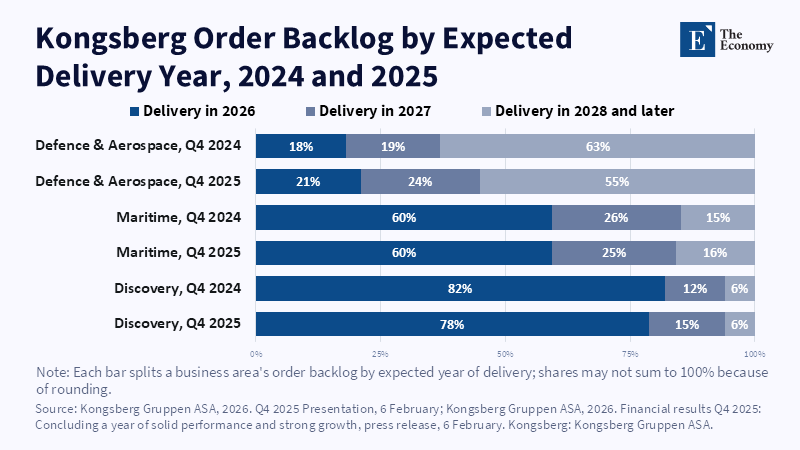
Kongsberg ended 2025 with a record order backlog of 157 billion NOK. They made 58.6 billion NOK in revenue. They stated that the increase is due to their missile and air defense technology. They are also seeing an increase in sales of their subsea and sensor products. They plan to separate their non-military division, Kongsberg Maritime, in 2026. Norway recently voted to spend 1,635 billion NOK on defense from 2025-2036. In March of 2026, the Norwegian Government added another 115 billion. Reuters stated that Norway will not be purchasing long-range maritime surveillance drones due to the high cost and rate of advancement in this area. This shows that money will continue to be spent on larger defense platforms. And that there will be a lack of sensors and the ability to monitor the seabed.
The new NATO spending guidelines from the Hague Summit in June 2025. Could allow for more money to be spent on monitoring infrastructure. Countries will have to spend 5% of their GDP on defense. Up to 1.5% can be spent on critical infrastructure, networks, civil defense, and the defense industrial base. Countries can choose to spend this money on ships and sensors that can help fix cables and pipelines. Or they can just rename money they are already spending and claim they are meeting the goal.
Prevention Costs Are Known, Disruption Costs Are Not
Europe is spending money on prevention but does not know how much money it will lose if its infrastructure is damaged. Of course, some amount of spending will make sense. Norway is only spending the equivalent of two years of petroleum exports on its defense budget. Including the extra 115 billion they added in 2026. So it is possible to protect Norway's oil and gas. The question is how much of that money is going towards the things that will save the most money. It doesn't look like much is being spent on things that will help if a cable or pipeline breaks. Insurance does not cover these incidents and the EU is doing little to help repair the cables.
There are steps that can be taken by those who control the money. Energy departments and Gassco could look into spending money to make sure that if one pipe breaks, gas can still reach customers. Those who own cables can look into getting insurance. Or ask the government to create a program similar to Pool Re in the UK. That provides insurance for buildings that may be attacked. Those looking to spend money towards the new 1.5% category can spend it on ships that can fix cables and sensors that can monitor the seabed. Norway could also use its industry benefits to build ships that can help repair the infrastructure. All of these would cost less than building a new frigate.
Europe is spending money to protect things it already has. The 31% of natural gas Europe receives from Norway was flowing before this debate began. As is the data that travels through undersea cables. By building more ships, Europe is helping protect the money it is already making. There is a new market for ships and sensors. But it will take time to grow and will mainly benefit a few companies. It is unclear whether Europe is spending too much or too little on defense. It is unclear what would be lost if the infrastructure failed. But it is clear that Europe is not spending as much on fixing its cables as it is on building ships.
The views expressed in this article are those of the author(s) and do not necessarily reflect the official position of The Economy or its affiliates.
References
Argus Media (2024) ‘Unplanned Sleipner gas works boost European prices’, Argus Media, 3 June.
Brussels Times (2026) ‘EU goes for €46m push to secure undersea cables amid growing vulnerabilities’, The Brussels Times, 23 June.
Centre for Eastern Studies (2025) ‘Norway steps up cooperation with the United Kingdom’, OSW Analyses, 3 September. Warsaw: Centre for Eastern Studies.
European Commission (2025) EU Action Plan on Cable Security. Joint Communication, 21 February. Brussels: European Commission.
European Commission (2026a) EU-Norway Energy Cooperation. Brussels: Directorate-General for Energy.
European Commission (2026b) ‘EU sets out a new Strategy for the Arctic’, press release, 20 October. Brussels: European Commission.
Gallagher Re (2025) Subsea Sabotage: How Is the Reinsurance Market Responding? London: Gallagher Re.
Gassco AS (2026) Annual Report 2025. Karmøy: Gassco AS.
High Court of Justice (2026) Nord Stream AG v Lloyd’s Insurance Company S.A. and Arch Insurance (EU) DAC, Commercial Court, judgment of 6 July. London: High Court of Justice.
Kongsberg Gruppen ASA (2026) Annual Report 2025. Kongsberg: Kongsberg Gruppen ASA.
Norwegian Ministry of Energy and Norwegian Offshore Directorate (2026) ‘Exports of oil and gas’, Norsk Petroleum. Oslo: Ministry of Energy.
Reuters (2026) ‘Norway to reach target of 3.5% of GDP on defence with new spending boost’, Reuters, 27 March.
Sgaravatti, G., Tagliapietra, S., Trasi, C. and Zachmann, G. (2023) National Fiscal Policy Responses to the Energy Crisis. Brussels: Bruegel.
TeleGeography (2025) The Future of Submarine Cable Maintenance: Trends, Challenges, and Strategies. Commissioned by the SubOptic Association. Washington, DC: TeleGeography.
Working across research, policy, and data-driven analysis, the Editorial Board ensures that published pieces reflect a consistent institutional perspective grounded in quantitative reasoning and long-term structural assessment.