[Arctic Maritime Strategy] Canada’s Northwest Passage: Sovereignty, Surveillance and the Limits of Arctic Defense

Working across research, policy, and data-driven analysis, the Editorial Board ensures that published pieces reflect a consistent institutional perspective grounded in quantitative reasoning and long-term structural assessment.
Authored On
Modified
Canada’s six patrol ships cover only summer and autumn
Heavy icebreakers, patrol aircraft and northern ports remain years away
Incomplete hydrographic surveys still limit where Canadian ships operate
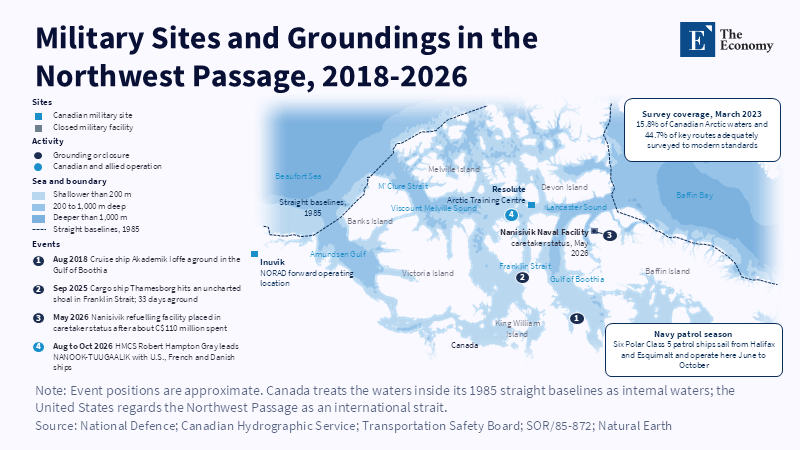
In September 2025, a Dutch general cargo ship, Thamesborg, bound for Baie Comeau, Canada, from China with 17 people on board, hit an uncharted shoal in Franklin Strait. She rested on the ocean floor for 33 days as salvage crews worked to lighten her, and the Canadian Coast Guard counted the days until autumn ice took hold of that section of the Northwest Passage. No one was injured, and nothing leaked, so the story could be easily written off. This incident should raise some questions. Canada considers the Northwest Passage its internal waters. However, according to the Canadian Hydrographic Service, only 15.8% of Canadian Arctic waters and 44.7% of the key shipping corridors had been adequately surveyed to modern standards as of March 2023.
There are many ways to interpret these statistics. All of Canada's Arctic waters have been charted according to the Canadian Hydrographic Service. This means there are charts for every part of the Northwest Passage, though not always at a high resolution. Many charts consist of a few scattered depth soundings and/or one or two lines of a previous ship’s transit. Many have outdated coastlines determined by old astronomical surveying, which can put features miles away from where a satellite would place them. A ship in Franklin Strait will have a chart. What that chart may not show is the depth over the one rock that matters. This leads to the core question of Canadian sovereignty in the Northwest Passage. Does Canada have the capability to survey and monitor its Arctic waters? Canada can currently monitor the Northwest Passage better than it could ten years ago. However, there are still many deficiencies that prevent Canada from year-round presence and defense in heavy ice.
What Northwest Passage Charts Can and Cannot Show
The Canadian waters statistic refers to all waters within Canada's northern traffic zone. Corridor refers to the surveyed waters of the primary and secondary low-impact shipping corridors. Canada is making progress, but slowly. In a report to the Arctic Regional Hydrographic Commission, the Canadian Hydrographic Service stated that the corridors were 42.6% surveyed as of April 2022. In the span of a year, there was only a two-point improvement. No more recent statistics were published as of October 2026. In a 2026 paper for the Naval Association of Canada, David H. Gray, who spent 34 years at the Canadian Hydrographic Service, noted that the annual Notices to Mariners still put modern survey coverage at about 15%. Canada is limited to surveying the Arctic Archipelago for approximately 2 months, from mid-July to mid-September. All fuel and equipment must be transported north to begin this task.
In this paper, Mr. Gray highlights a shortcoming of corridors. These corridors can help ships that travel through the Northwest Passage. They will not help military assets operate outside them. If a warship is monitoring another vessel in Canadian waters, it will not stay within the corridor. If Canada were to operate submarines in Canadian Arctic waters, it would need to know what the bottom looks like. Canada has had 8 incidents of ships running aground in Canadian Arctic waters from 1991 to 2025. That may not seem like a considerable number, but two of those were in 2025. The Akademik Ioffe ran aground in 2018. When a commander is deciding where to operate an Arctic and Offshore Patrol Ship in the Arctic, the charts for the low-impact corridors will not cover much of the water he may need.
Patrol Vessels Are Not Icebreakers
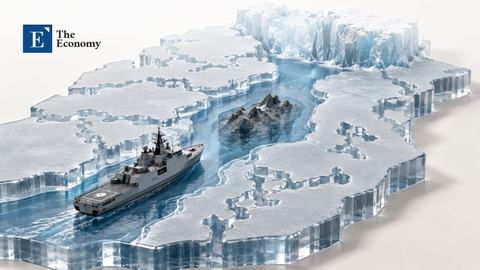
With the delivery of HMCS Robert Hampton Gray on August 21st, 2025, Canada now has all six Harry DeWolf-class ships. These ships are the first new class of ships delivered to the navy in over 25 years. The DeWolf-class ships are rated at Polar Class 5. This allows the ships to navigate through first-year ice up to 120 cm. With adequate resupply, the ships can operate for up to 4 months. Canada has deployed these ships to the Arctic between June and October every year since 2021. This is more than what Canada had when it originally proposed patrol ships for the Arctic in 2007. It still gives Canada only a few months a year. A study led by Alison Cook and Jackie Dawson in 2024 showed that thicker multi-year ice coming from the high Arctic has been pushing down into the Northwest Passage, reducing the navigable season along the Northwest Passage since 2007. That is ice the DeWolf-class ships are not designed to break.
The Canadian Coast Guard does the heavy icebreaking. As of September 2nd, 2025, the Coast Guard moved into the Department of National Defense. It remains a civilian special operating agency with its mandate unchanged. Canada's most powerful icebreaker is still the CCGS Louis S. St-Laurent, in service since 1969. Canada currently has 2 polar icebreakers under contract. One will be built by Davie for $3.25 billion and is expected by 2030; the other, by Seaspan for $3.15 billion, is now expected in 2032. Canada is also building 2 versions of the DeWolf class for the Coast Guard, scheduled to be ready in 2026 and 2027. Once these ships are completed, Canada will have more icebreaking capability, but none of them is in service yet.
Air Surveillance Over the Northwest Passage
Canada has had a wide gap between when it said it would have certain assets and when it got them. Canada's current fleet of maritime patrol aircraft is the CP-140 Aurora. They were purchased in 1980 and are expected to be retired in 2030. In November 2023, Canada agreed to purchase 14 P-8A Poseidon aircraft and has an option on 2 more. They were expected to arrive in 2026. According to the federal project page, they will now arrive in 2027. Full operational capability for these aircraft is estimated for 2033. These aircraft will be stationed in Greenwood, Nova Scotia and Comox, British Columbia, which are both extremely far from Canada's Arctic. Forward operating locations and air-to-air refueling will matter as much as the aircraft themselves. Canada currently has 14 CP-140s.
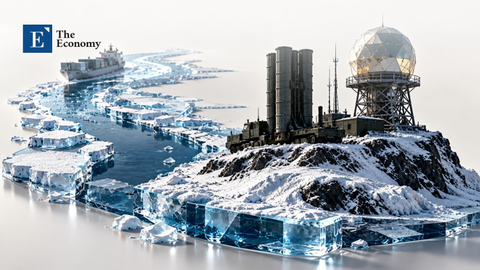
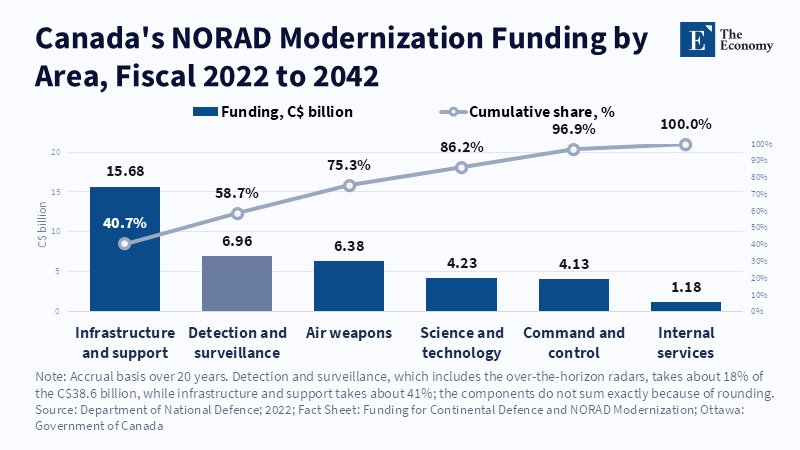
Canada has also committed $38.6 billion over 20 years to modernize its NORAD contribution. This will include radar for the Arctic and polar regions. National Defense announced that it had picked its first transmit and receive sites in July 2025. These will use Australian radar technology. Because NORAD is binational, American assets will also be working over the Arctic. NANOOK-TUUGAALIK 2026 had the U.S., France and Denmark operating in Canadian Arctic waters along with HMCS Robert Hampton Gray from August to October 2026.
Without a Northern Port, Presence Stays Seasonal
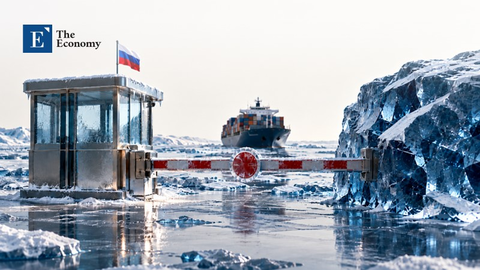
Canada does not have a naval facility in the Northwest Passage where its ships can stay. When Canada first announced in 2007 that it would build a facility at Nanisivik, it was seen as a gesture of sovereignty. In May 2026, National Defense announced that Nanisivik would be placed in caretaker status. It had spent about $110 million on the facility and said it would need $200 million more to make it fully operational. The Auditor General pointed out in 2022 that the facility's unheated fuel tanks would limit it to about four weeks of use a year. Ryan Dean and P. Whitney Lackenbauer published a policy primer about this in December 2025. Canada had postponed the opening of Nanisivik from 2012 to 2018, 2022, 2023, 2024 and 2025.
National Defense said that the navy can continue to operate in the Northwest Passage without Nanisivik, which is true on a narrow reading. Staying there is a different matter. As mentioned, the DeWolf-class ships can operate for up to 4 months in Canadian waters. However, if they need supplies such as food, fuel, or crew changes, they will have to return to their home ports. If something breaks down, they will have to return to their home ports to repair it. Having the ability to stay in the Northwest Passage is important for Canada. Our North, Strong and Free stated that the government will spend $218 million over 20 years on Northern Operational Support Hubs. This averages out to less than $11 million a year, enough for upgrades to airports and warehouse space but not for a port.
Northwest Passage Sovereignty and Search and Rescue
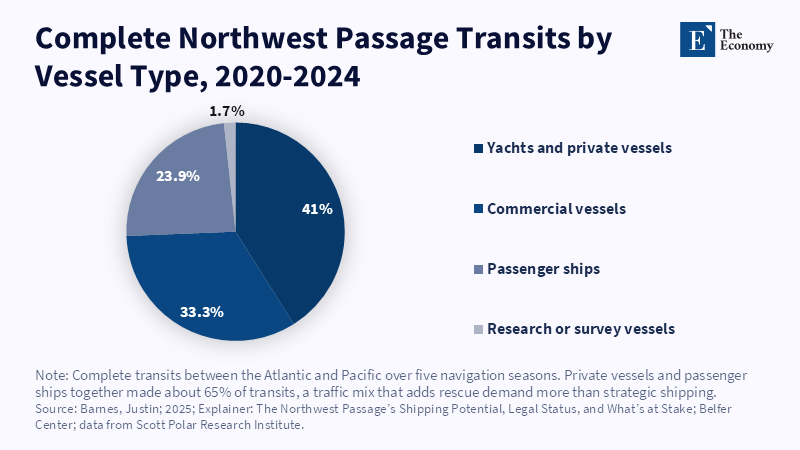
There has been an increase in traffic through the Northwest Passage. According to the Scott Polar Research Institute, there were 41 full transits of the Northwest Passage in 2023 and 38 in 2024, both were record highs. According to Justin Barnes of Harvard's Belfer Center, there were 117 full transits of the Northwest Passage from 2020 to 2024. Of these, 48 were yachts or other private vessels. There is also traffic heading to Canada's mines and settlements. Between 1990 and 2019, voyages in Canadian Arctic waters more than tripled. Canada will have to continue to protect the safety of those traveling in its waters as well as defend its territory.
Canada's Rangers can patrol sizable portions of the Arctic. There are approximately 5000 Rangers serving in more than 220 communities. During NANOOK-TAKUNIQ 2026, there were several air and land exercises with Rangers. The Rangers can reach most of the North, but if something were to happen on the Northwest Passage, they would have to rely on air and naval assets. Canada will have to find ways to expand its surveillance in the Northwest Passage. Working with Inuit can also help with this. When Canada builds these facilities, they can also help with transport, search, and rescue. This could help ensure that they are built.
When the Transportation Safety Board investigated the Thamesborg, it found that she ran aground on an uncharted shoal. That one word, uncharted, describes Canada's sovereignty in the Northwest Passage. Canada now has 6 patrol ships that can travel through the Arctic from June to October. The Canadian Coast Guard now sits within the defense portfolio. Canada will be getting new maritime patrol aircraft and polar icebreakers in the next few years. It does not yet have a heavy icebreaker newer than 1969 or a facility to keep its ships in the Northwest Passage. Survey coverage of the key corridors stood at 44.7% when last reported. The next survey figure will show how fast that number can grow.
The views expressed in this article are those of the author(s) and do not necessarily reflect the official position of The Economy or its affiliates.
References
Barnes, Justin (2025) Explainer: The Northwest Passage’s Shipping Potential, Legal Status, and What’s at Stake. Cambridge, MA: Belfer Center for Science and International Affairs.
Canadian Hydrographic Service (2022) National Report of Canada to the 12th Arctic Regional Hydrographic Commission. Monaco: International Hydrographic Organization.
Canadian Hydrographic Service (2023) Arctic Charting. Ottawa: Fisheries and Oceans Canada.
Cook, Alison J., Dawson, Jackie, Howell, Stephen E. L., Holloway, Jean E. and Brady, Mike (2024) ‘Sea ice choke points reduce the length of the shipping season in the Northwest Passage’, Communications Earth & Environment, 5, 362.
Dean, Ryan and Lackenbauer, P. Whitney (2025) The Ongoing Saga of the Nanisivik Naval Facility, 2005-2025. Peterborough, ON: North American and Arctic Defence and Security Network.
Department of National Defence (2023) Canada Purchasing up to 16 P-8A Poseidon Multi Mission Aircraft for the Royal Canadian Air Force. Ottawa: Government of Canada.
Department of National Defence (2024) Our North, Strong and Free: A Renewed Vision for Canada’s Defence. Ottawa: Government of Canada.
Department of National Defence (2025) Royal Canadian Navy Accepts the Sixth Arctic and Offshore Patrol Vessel. Halifax: Government of Canada.
Department of National Defence (2026a) Department of National Defence to Transition Nanisivik Naval Facility out of Operational Use. Ottawa: Government of Canada.
Department of National Defence (2026b) Canadian Armed Forces Launch Operation NANOOK-TUUGAALIK in Canada’s Arctic. Ottawa: Government of Canada.
Gray, David H. (2026) Navigating the Arctic: A Call for Better Charting of Canada’s Arctic Waters. Niobe Papers No. 25. Ottawa: Naval Association of Canada.
Hogan, Karen (2022) Report 6: Arctic Waters Surveillance. Ottawa: Office of the Auditor General of Canada.
Public Services and Procurement Canada (2025) Construction of New Polar Icebreakers for the Canadian Coast Guard. Ottawa: Government of Canada.
Transportation Safety Board of Canada (2025) Marine Transportation Safety Investigation M25C0241: Grounding, Thamesborg, Franklin Strait, Nunavut. Gatineau: Transportation Safety Board of Canada.
Working across research, policy, and data-driven analysis, the Editorial Board ensures that published pieces reflect a consistent institutional perspective grounded in quantitative reasoning and long-term structural assessment.