[Arctic Maritime Strategy] The Economics of the Bering Strait: Arctic Shipping, Infrastructure and Geopolitical Risk

Working across research, policy, and data-driven analysis, the Editorial Board ensures that published pieces reflect a consistent institutional perspective grounded in quantitative reasoning and long-term structural assessment.
Authored On
Modified
Arctic traffic rose 40 percent, yet Bering Strait transits stayed modest
Northern Sea Route savings shrink once ice and insurance count
Russia profits from the route; U.S. gains stay mostly public

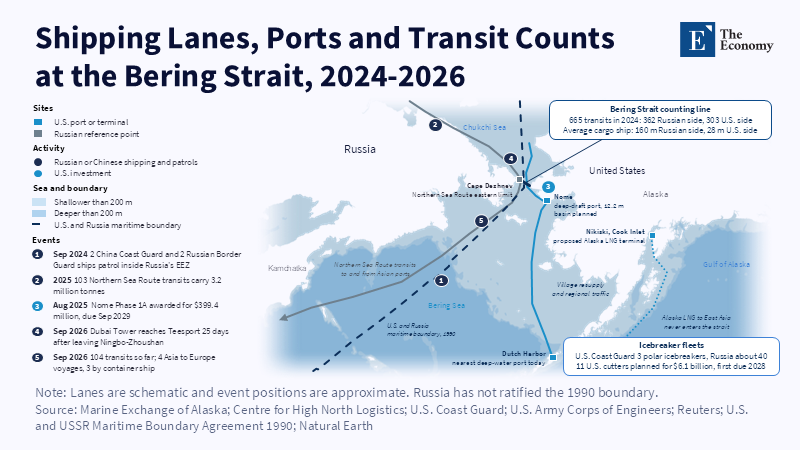
PAME, the Arctic Council Working Group on Protection of the Arctic Marine Environment, reported 1,812 different ships that entered the Polar Code region in 2025. This is an increase of 40% over 2013. The miles those ships transited also increased by 95% to 11.9 million nautical miles. These numbers suggest that Bering Strait shipping could soon act as a trade route between Asia and Europe. The number of ships actually crossing the Bering Strait is far smaller. The Marine Exchange of Alaska has logged 665 transits across the line between the two land masses in 2024. Most cargo vessels crossing the line on the U.S. side of the border were regional landing craft averaging 28 meters. Fishing vessels make up 40% of the total number of vessels traveling in the Arctic. There is a lot of Russian product moving through the Bering Strait along with resupply to villages in Alaska and ships moving to new areas. If there is trade through the Bering Strait, it will happen one ship at a time. And that will come at a premium over what a straight-line distance would imply.
What Actually Crosses the Bering Strait
The Marine Exchange of Alaska has been monitoring ships that cross a digital line between the two continents since 2009. Their data shows 665 transits across that line in 2024, up from 242 in 2010. While the numbers have almost tripled, it's important to look at what was crossing. There were 362 transits on the Russian side of the line and 303 on the U.S. side. On the Russian side of the line, tankers were the highest volume of traffic. Most of that traffic was Russian LNG and oil traveling to Asia. On the U.S. side, tugs were the highest volume. Cargo ships that crossed on the Russian side of the line averaged 160 meters. This is compared to the 28-meter landing craft that work the Alaskan coast. It also appears that once the season closes, it closes. The exchange did not log any ships crossing in the first few months of 2025. This is different than the last 3 seasons, when ships were crossing into January and February.
The PAME numbers also show some of what is driving the 40% increase. PAME believes that resource extraction is driving most of this increase. They call out the Mary River mine in Baffin Island and Russia's LNG efforts as drivers. They also state that crude oil tankers increased by 396% from 2013 to 2025. There were 40 gas tankers in the region in 2025. There were very few gas tankers traveling through the Polar Code region before 2018. Much of the Mary River ore travels through Baffin Bay and on to the Atlantic. It does not cross the Bering Strait. Much of Russia's LNG has traveled to Europe. With the EU banning Russian LNG starting in early 2027, it will start to move east. The number of ships that travel in the Arctic shows that the Arctic is busier. How many ships are traveling between the Pacific and Atlantic is a different story.
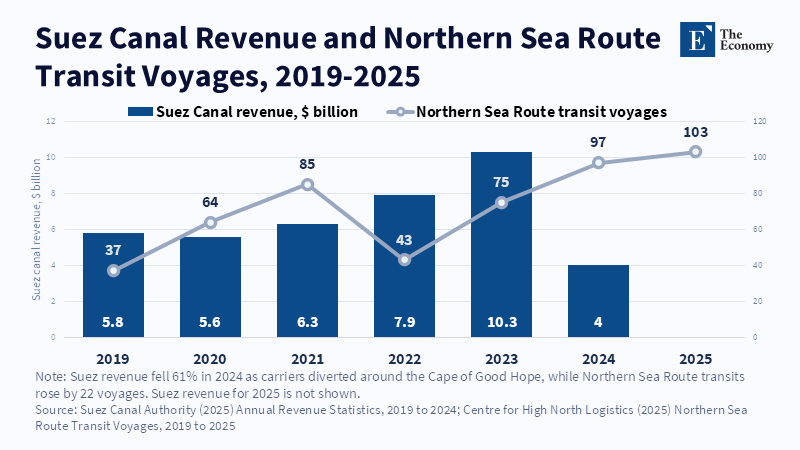
The number of ships traveling as a transit is something Norway's Centre for High North Logistics (CHNL) tracks. They counted 103 transit voyages on the Northern Sea Route in 2025. There were 88 individual ships and an estimated 3.2 million tons of cargo. That's an increase of about 6% in transits and 3% in cargo from 2024. 1.83 million tons of that cargo was oil. There was a record number of container ships that traveled the Northern Sea Route. There were 15 container transits. Rosatom reported that there were around 400,000 tons of cargo on container ships. CHNL puts the number at around 287,000. Danish Shipping states that the record for 2025 was about 1.5 days' worth of ships traveling around the Cape of Good Hope. There are over 2,000 cargo ships that round the Cape of Good Hope each month. Planned Alaska LNG exports to Asia would not cross the Bering Strait. They would travel across the North Pacific to Asian buyers.
A Shorter Route That Rarely Pays
The Northern Sea Route is shorter. Russian officials state that it's 30% shorter than going through Suez. Rosatom has stated that it takes around 18 days to get from Murmansk to Japan. Versus about 37 days going through Suez. The Dubai Tower, a container ship, left Ningbo-Zhoushan in China on August 15, 2026, and arrived in Teesport, England, on September 9. It took the ship 25 days to get there. The logistics company Geis puts a comparable China-to-Europe trip at about 40 days through Suez and 50+ days going around the Cape of Good Hope. While there are time savings with the Northern Sea Route, there are many factors that ship owners consider.
A paper written by Henrik Ringsberg and Zhiyuan Li from Chalmers University of Technology found that traveling through the Arctic could save 11.5% to 14.7% in transit time. It could also save 15.7% in voyage cost. However, the same study found that it's not practical to ship containerized freight on the Northern Sea Route. They factored in higher operating costs, insurance costs and regulations, as well as the changing political landscape. It costs more to build an ice-strengthened hull. Those vessels are then going to be carrying more weight the rest of the year in non-frozen waters. Escorting by Rosatom's nuclear icebreakers is an added cost. Their icebreakers escorted ships 976 times in 2024. If a carrier has ice-strengthened hulls, it has to find work for them during the non-frozen months.
One of the biggest issues is seasonality. CHNL reported that the route had no more than 2 weeks of open water in 2025. That was at the end of September and the start of October. They describe the route as something to be used occasionally during the summer and fall navigation season. Many of the dry bulk carriers going west were not ice class. Meaning that those trips were one-off. Some of the transits were repositioning voyages as well. 2026 is looking better than 2025. CHNL reported that there have been 104 transits through the Northern Sea Route as of September 30th. They predict there could be up to 150 transits this year with over 4.5 million tons of cargo. Only 4 of those voyages were international transits between Asia and Europe, 3 of them by container ships.
The one positive for Bering Strait shipping is that the Houthis have reduced the number of ships going through Suez. There were 26,434 ships that traveled through the Suez Canal in 2023. That number dropped to 13,213 in 2024. The Suez Canal Authority has reported that it has lost 61% of its revenue. From $10.25 billion down to $3.991 billion. 2024 and 2025 should have brought a large increase in Northern Sea Route traffic. Instead, transits only rose from 75 in 2023 to 97 in 2024 and 103 in 2025, while Suez lost more than 13,000 ships. Companies would rather take 50+ days around Africa than take the Northern Sea Route. That shows how they weigh reliability against distance.
Russia Builds the Corridor While China Hedges
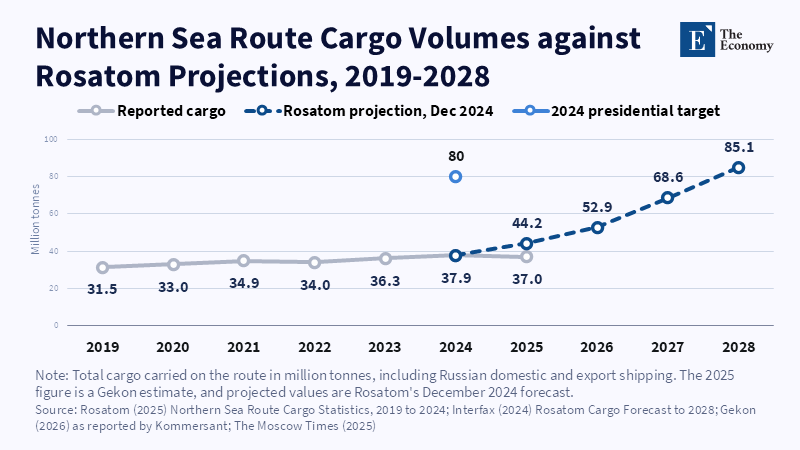
There are many reasons why Russia would want to develop the Northern Sea Route. It makes sense to invest money in a national export corridor. In August of 2022, Prime Minister Mishustin approved a development plan for 2035. This plan contains over 150 initiatives and will cost close to 1.8 trillion rubles. The plan includes an LNG and condensate terminal in Utrenny. An Oil terminal in Sever Bay. A coal terminal on the Yenisei. 46 rescue ships. A Leader-class nuclear icebreaker and a satellite system to aid with navigation in the Arctic. The Northern Sea Route will primarily be used by Russian products. LNG and oil/condensate from the Yamal Peninsula and the Gulf of Ob account for over 80% of the cargo. In 2024, the Northern Sea Route moved a record 37.9 million tons, which fell short of the 80 million-ton goal that President Putin set for 2024. The consultancy Gekon estimates that 2025 cargo fell 2.3% to 37 million tons, the first decline since 2022.
China has an interest in using the Northern Sea Route as well. In 2018, China's State Council released a white paper on its Arctic policy. They describe themselves as a near-Arctic state and plans to use shipping in the Arctic as part of the Belt and Road Initiative. They call it the Polar Silk Road. Since that release, large Chinese state firms have stayed cautious on the Northern Sea Route. COSCO made 42 trips on the Northern Sea Route from 2013 to 2021. They did not make any trips in 2022. Most containerized cargo is moved by smaller Chinese companies like NewNew Shipping and Sea Legend. Chinese companies CNPC and CNOOC each own 10% of Arctic LNG 2. They are believed to have pulled out of the project after the U.S. sanctioned the project in November 2023. Since China has a lot of dollars in play, they are keeping away from Russian Arctic efforts. Chinese ships will likely keep using the Northern Sea Route, mostly through smaller firms.
Limited U.S. Returns from Bering Strait Shipping
It's hard to say if there is a reason for the U.S. to develop the Bering Strait as a major shipping lane. A ship traveling from China to Europe pays its fees and escort costs in Russia. There is not much that the U.S. stands to gain from ships crossing the Bering Strait. Its gains are search and rescue and help for ships in distress, which a federal budget pays for. If the U.S. doesn't stand to profit from the traffic, they are not going to develop it. That being said, if the traffic increases, the U.S. may have to get involved. The main U.S. project is the Port of Nome expansion. In August 2025, the Army Corps of Engineers awarded Kiewit a $399.4 million contract for Phase 1A, a 1,200-foot causeway extension due in September 2029, after the first round of bids ran over cost limits. The city justifies the port on safety and village supply, not on Asia-to-Europe transit. Much of the gap with Russia comes down to geography. Russia owns the ports, the icebreakers and the permits along the Northern Sea Route, so every voyage earns it money, while the U.S. side of the strait has no export cargo base like Yamal behind it.
While there may not be much that can be done to help with Bering Strait shipping, there are some opportunities. The Finns built most of the world's icebreakers. Around 80% of icebreakers are designed by Finnish companies. About 60% of icebreakers are built in Finnish shipyards. In October 2025, the U.S. agreed to acquire up to 11 icebreakers for about $6.1 billion. 4 of those will be built in Finland. The rest will be built in the U.S. with the help of Finland. This will create business for Finnish companies. The Marine Exchange of Alaska is expanding its monitoring of the Bering Strait. It plans VHF radio sites at Tin City, Wales, Nome and Stebbins. Russia also has plans to install a satellite constellation that will help with navigation and forecasting ice. Insurance companies, tow companies that can operate in the Arctic and port facilities that can service ships there will all stand to profit from the increased traffic.
Geopolitical Risk Keeps Large Investors Cautious
Large Chinese firms have shown that they will not risk Western sanctions to help Russia in the Arctic. Now that Europe is banning Russian LNG, more cargoes will move east, through the Bering Strait and past Alaska. Russia and China created a subcommittee for the Northern Sea Route in 2024. They also ran joint coast guard patrols in the Bering Sea. If Denmark's Defence Intelligence Service is correct that Russia may have to grant China wider Arctic access, even more Chinese ships will pass through the Bering Strait. Which again does nothing for Alaska.
The numbers that PAME reported are correct. There are 40% more ships traveling through the Arctic. But how many of those ships are going to be traveling through the Bering Strait? As of September 30th 2026, 4 ships, 3 of them container ships, have traveled between Asia and Europe without going to or from Russia. In 2025, there was only 1. The Suez Canal had 26,434 ships travel through it in 2023. Phase 1A of the Port of Nome expansion is not expected to be finished until September 2029. The first 2 Finnish built Ice Breakers are expected in 2028. Rosatom has so far missed its cargo goals. Maybe 40 container ships will travel the Northern Sea Route. But that's a big maybe. The Northern Sea Route only had 2 weeks of open water in 2025. Every voyage also needs permission from Russia. The next 3 seasons will show how much of that changes.
The views expressed in this article are those of the author(s) and do not necessarily reflect the official position of The Economy or its affiliates.
References
Centre for High North Logistics (2025) Main Results of NSR Transit Navigation in 2025. Bodø: Centre for High North Logistics.
Centre for High North Logistics (2026) Overview of NSR Transit Voyages as of September 30, 2026. Bodø: Centre for High North Logistics.
City of Nome (2026) Port of Nome: The Nation’s Arctic Port. Nome: City of Nome.
Cook, J. (2026) ‘Arctic Shipping Update: 40% Increase in Ships in the Arctic’, Arctic Council Secretariat, 12 February. Tromsø: Arctic Council.
Danish Shipping (2026) Record Year on the Northeast Passage but Arctic Shipping Remains Very Limited. Copenhagen: Danish Shipping.
Egypt Today (2025) ‘Egypt’s Suez Canal revenues go down by 61% to $3.9 billion in 2024 due to Red Sea tensions’, Egypt Today, 17 April.
Euromaidan Press (2026) ‘37 million tons instead of 80 million: Russia’s Arctic shipping dream hits reverse’, Euromaidan Press, 10 February.
Interfax (2022) ‘Russian PM approves development plan for Northern Sea Route to 2035’, Interfax, 4 August.
Marine Exchange of Alaska (2025) Bering Strait and Arctic Transits: Data Including 2024. Juneau: Marine Exchange of Alaska.
Nicholson, A.-M. (2026) ‘U.S. Warship Calls at Alaska’s Port of Whittier for First Time in 80 Years as Washington Bolsters Arctic Defenses Against Joint Chinese-Russian Patrols’, The Economy, 8 October.
Reuters (2025) ‘Trump and Finland’s Stubb approve deal for icebreaker ships’, Reuters, 9 October.
Ringsberg, H. and Li, Z. (2022) ‘Container Shipping via the North Sea Route: Opportunities and Challenges’, 34th NOFOMA Conference, Reykjavik.
Times of Defence (2026) ‘The Northern Sea Route: Russia and China’s Arctic Strategy Poses a New Challenge for the West’, Times of Defence, 13 October.
World Nuclear News (2025) ‘Northern Sea Route cargo set new record in 2024’, World Nuclear News, January.
Working across research, policy, and data-driven analysis, the Editorial Board ensures that published pieces reflect a consistent institutional perspective grounded in quantitative reasoning and long-term structural assessment.