[Arctic Maritime Strategy] Bering Strait Military Competition: The U.S. Answers China and Russia on a 2033 Timeline

Working across research, policy, and data-driven analysis, the Editorial Board ensures that published pieces reflect a consistent institutional perspective grounded in quantitative reasoning and long-term structural assessment.
Authored On
Modified
Chinese and Russian moves near Alaska mostly stay lawful
The real U.S. weakness is too few icebreakers
New cutters arrive from 2028; heavy icebreaker in 2033

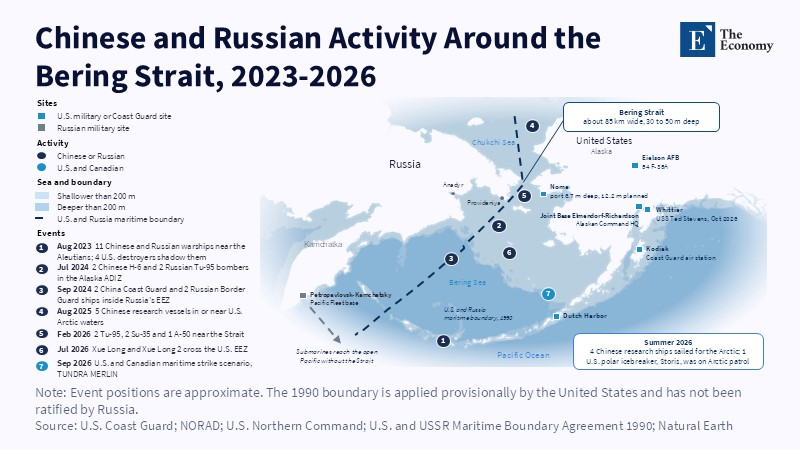
In 2026, during the summer, China dispatched four of its state-owned ships to make its 16th voyage to the Arctic, three of which are icebreakers. They departed on July 3 from Dalian, two of the ships made it past the U.S. exclusive economic zone and across the massive American continental shelf in the Bering Sea. The Healy, the largest Icebreaker in the US, was being towed to Seattle on July 13th that same week after major breakdowns. With the Polar Star, since 1976, being repaired as well, only the Storis remained, which became a part of the fleet in August of 2025 as a Merchant vessel in the Arctic Ocean. The contrast between four Chinese vessels operating in the region and limited U.S. icebreaker availability illustrates a potential gap in sustained ice-capable surface presence, although these vessels have different missions and capabilities. It will take hulls and hours of presence in that region first and allied institutions second, while American assets will reach the area between 2028 and 2039.
Data from the Bering Strait
July 24th, 2024, marked the day that started the conversation. China flew two H-6s, with Russia flying two Tu-95s into the Alaskan air defense identification zone. U.S. F-16s and F-35s and Canadian CF-18s scrambled to meet them. NORAD stated that the aircraft stayed in international airspace and it wasn't considered hostile. The identification zone begins where sovereign airspace ends and Russian planes are frequently in these zones, as NORAD continues to mention in its press releases. Nothing was violated on any of these flights. What they do provide Moscow and Beijing is a message and experience for their aircrew and staff to fly further from home.
There are more grey areas when it comes to ships at sea. China and Russia sailed eleven warships in close proximity to the Aleutian Islands in August 2023. The U.S. Navy responded by sending four destroyers and P-8 aircraft to track them. On September 28th 2024, the Coast Guard flew an HC-130J out of Kodiak and found two Chinese Coast Guard and two Russian border guard vessels traveling in formation. They were approximately 440 miles southwest of St. Lawrence Island and 5 miles inside Russia's exclusive economic zone. At the beginning of October, China announced that it had entered the Arctic Ocean. Coast Guards mainly carry a claim of jurisdiction. China has called itself a "near-Arctic state" since its 2018 White Paper and is testing that claim where Russia is giving it the opportunity.
Research ships have been the most common type of ship coming from China and are hard to analyze. The Coast Guard found three Chinese research vessels above the Bering Strait in 2024 and five in 2025. One is the Shen Hai Yi Hao, which is built to house a deep-sea sub. Marine scientific research within a coastal state's exclusive economic zone or on its continental shelf generally requires consent under the UNCLOS framework. However, the legal treatment of hydrographic and military surveys is contested, and requirements depend on the activity and its location. Ocean floor, temperatures, salinity and sound can all help a submarine navigate and hide. In September 2026 two Russian researchers boarded the Xue Long 2 to help observe sea ice with China. This data will help create ice ships and help determine if the routes are passable, which can also be used for shipping lines.
| Date | Actors | What happened | Category | Legal context |
|---|---|---|---|---|
| July 2026 | China | Xue Long and Xue Long 2 crossed the US EEZ in the Bering Sea | Research and transit | Legal transit, research requires US permission |
| March 2026 | Russia | Two Tu-142s in the air defense identification zones of Alaska and Canada | Naval aerial surveillance | International airspace |
| February 2026 | Russia | Two Tu-95s, two Su-35s and one A-50 near the Strait | Military flight and signal | International airspace |
| August 2025 | China | Five research vessels in or near U.S. Arctic waters | Research with possible dual use | Legal navigation, research requires permission |
| September 2024 | China and Russia | Two Chinese coast guard vessels and two Russian border guard vessels in formation | Paramilitary patrol | Within the Russian EEZ |
| July 2024 | China and Russia | Two H-6s and two Tu-95s in the Alaska air defense identification zone | Joint strategic patrol | International airspace |
| August 2023 | China and Russia | Eleven warships near the Aleutian Islands | Naval patrol | International waters |
No Second GIUK for the Bering Strait
In the Atlantic, the West has spent the last few decades surrounding the GIUK gap with NATO states, allowing it to monitor the Russian Northern Fleet's subs that need to travel through the gap to reach the North Atlantic. Seven out of the eight Arctic states are now part of NATO and Standing NATO Maritime Group 1 is constantly traveling through this gap. On the other side of the world, the U.S. has nothing comparable. U.S. and Canada have been working through NORAD, which is only used to alert to aircraft and not to have naval control. There isn't a constant ally that is sailing in the Bering Sea.
There is a pushback to those who believe the U.S. is falling behind militarily in this region. The Bering Strait is roughly 85 kilometers wide at its thinnest point and usually 30-50 meters deep and covered in ice for most of the year. If a nuclear submarine wanted to cross, it wouldn't have much water beneath it. Russia has many subs that are based out of Kamchatka and travel straight out into the open ocean; they don't need to go through the Bering Strait. Having a sub defensive wall like the one in the GIUK gap would be pointless, as they aren't using this path often. There is a disparity between the Atlantic and the Pacific and putting the European model in Alaska may not be spending U.S. money where it's needed.
However, this is only half of the story. The table above shows most of the traffic that is around the Bering Strait is surface and air. This would require more vessels that can travel in ice, ports that can service those vessels and personnel that can lead those operations. The Coast Guard's operation Frontier Sentinel states that they are a presence that can respond to presence. That won't work if the only U.S. icebreaker is trying to stand against four Chinese ships. The Coast Guard came up with a fleet analysis in 2023 that they need 8-9 polar Icebreakers. The Coast Guard currently has three, one being repaired and one that has been sailing for almost 50 years. The U.S. decided that Nome would be their first deep-water Arctic port, which has a depth of 6.7 meters at its outermost part. Any ship that has a draft deeper than 5.5 meters can't enter that port safely, meaning no large icebreaker or destroyer can pull alongside the port at this time. There is a deficit but just not measured the same as in the Atlantic.
Collaboration Around The Bering Sea
Anyone charting who does what around the Bering Strait would find at least 4 different commands that could take over a situation, depending on what type of vessel or aircraft is involved. The Alaskan Command, or ALCOM, has been under U.S. Northern Command since 2014 and is in charge of defending the Alaska theater. The Navy's warships that are in the North Pacific are under the command of the Pacific Fleet or PACFLT who reports to Indo-Pacific Command. The Coast Guard has an Arctic region, formerly known as the 17th district, that is the only U.S. tactical presence at sea. ALCOM has proven that it can bring everyone together when they put it on paper. In 2025, they simulated a naval strike in the Alaskan Gulf using two B-52s and the cutter Kimball, bringing assets from U.S. Northern Command, Strategic Command and Indo-Pacific Command.
Similar activity took place in September 2026 during Operation TUNDRA MERLIN. From September 18th-22nd, the Canadian Aurora and HMCS Corner Brook submarine found the Cutter Aspen north of Dutch Harbor and fed targeting information for a simulated strike. The Stratton helped HMCS Ottawa simulate strikes with a F-35A out of Alaska, along with an E-3 and KC-135 from the Alaska National Guard. ALCOM made clear that TUNDRA MERLIN is a continued operation to defend North America and that the ships that were deployed in September were a Flexible Deterrence Option and were not reacting to a hostile. The USS Ted Stevens was commissioned at Whittier on October 3rd, becoming the first U.S. Destroyer to make port there in approximately 80 years. All of this was happening while the U.S. and Canada were trading tariffs.
Canada has helped but will mostly be providing air power. They have stated that they will be modernizing NORAD by spending 38.6 billion Canadian dollars over the next 20 years. On March 12th 2026, Canadian PM Mark Carney announced that they would be spending 32 billion on Arctic infrastructure, creating new hubs in Whitehorse and Resolute to be able to accept F-35's. Canada anticipates an initial Arctic over-the-horizon radar capability by December 2029, with full implementation scheduled later; the polar over-the-horizon radar is projected to reach full capability in 2033. Polar satellite communications will not be fully operational until 2040.
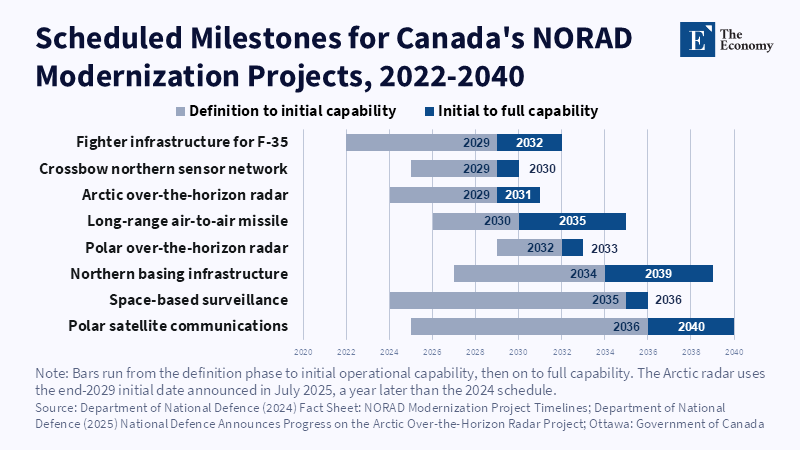
With this information, ALCOM and PACFLT can expect to see more aircraft and sensors from Canada in the Bering Sea by 2030 and fewer ships. The September activity was able to feed target information from a Canadian plane to a U.S. fighter. How often that will happen is still unknown. The open question is whether the Navy's portion of TUNDRA MERLIN will have a schedule that lines up with when Chinese ships will be crossing the Bering Strait July-October and whether a constant Navy Commander will oversee the Alaskan Theater. Flying more P-8's and Drones can help give the U.S. more eyes on the Bering Strait until the new Icebreakers arrive.
The Bering Strait Has Fallen Behind on Investments
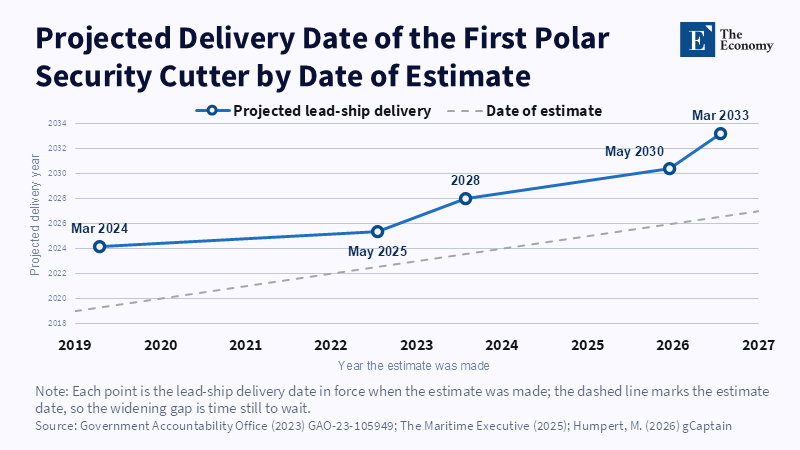
The Polar Security Cutter, which is going to consist of three large icebreakers, is going to replace the Polar Star. It was originally supposed to be delivered in March of 2024 when it was awarded to VT Halter Marine. In April 2023, the Government Accountability Office, or GAO, said that it would not be delivered by May 2025. The GAO estimated that it would be delivered in 2028 in July of that year. By the end of 2025, they expected it to be delivered in May of 2030. The GAO stated that it will be delivered in March of 2033, costing around $3.4 billion for the first ship and all three will be operational in March of 2039.
The medium-sized Icebreakers are coming in faster. After learning that they fell behind on the large Icebreakers, the U.S. signed a Memorandum with Finnish President Alexander Stubb and Donald Trump in October 2025. As part of the ICE deal with Canada, the U.S. finalized a $2.2 billion contract with Bollinger to build four Arctic Security Cutters and Finland will build two more for $1.1 billion through their company Rauma Marine Constructions. These ships will be delivered between 2028 and 2031. There will also be five more through Davie and the Helsinki Yards that will be delivered by 2035. The U.S. is pursuing a planned fleet of up to eleven Arctic Security Cutters, with delivery schedules and procurement commitments varying across the program. Back at the Port of Nome, the Army Corps of Engineers signed a $399.4 million contract with Kiewit to begin construction. They will need to dredge the port to a depth of 12.2 meters to allow Icebreakers to pull alongside which will be done in a later stage. There is a plan in place for the Bering Strait. The Pentagon released its Arctic strategy in 2024 and listed that China and Russia are working together to expand their operations in the region as a threat to U.S. soil.
How fast will they be? Russia plans to have seventeen Icebreakers ready to travel through its Northern Sea Route by 2030. China had seven ships approved to travel to Europe through that route in August of 2026. On October 8th Russia's Patrushev traveled to Shanghai to discuss making Icebreakers together with China. There are two more summers of Chinese ships traveling to the Bering Strait before the first Arctic Security Cutter is delivered in 2028. They will be met with three U.S. ships if the Healy is fixed in time. Purchasing the Storis showed that the U.S. can buy a ship that is already finished and put it in service. Buying or leasing another merchant ship and paying for Nome to be dredged before they finish phase one could help in the short term.
Having four Chinese research ships face off with one American Icebreaker is not because of something that Russia and China did overnight. They have been flying and sailing within international law for most of their operations near Alaska. It's because U.S. Icebreakers are nine years behind where they should be and the Healy broke down after repairs. Washington has a plan in place to help secure the Bering Strait. The U.S. is pursuing a planned fleet of up to eleven Arctic Security Cutters and a deep-water port expansion at Nome. The U.S. is working with Canada to secure the Bering Strait and that model fits the region. The coming years will provide an early test of whether existing U.S. assets and allied coordination can sustain an adequate Arctic presence as new vessels and infrastructure are developed; the larger test will extend into the 2030s. The first Arctic Security Cutter will not be delivered until 2028 and the first large one in 2033.
The views expressed in this article are those of the author(s) and do not necessarily reflect the official position of The Economy or its affiliates.
References
Alaskan Command (2025) Alaskan Command Integrates with USCG Kimball and B-52s in the Gulf of Alaska. Joint Base Elmendorf-Richardson: Alaskan Command Public Affairs.
Baxter, D. (2026) 'Carney announces $32B for northern defence and infrastructure projects', The Canadian Press, 12 March.
Delaney, S. (2026) '"Divided by Tariffs, United in the Arctic": U.S. and Canada Conduct Bering Sea Maritime Strike Scenario', The Economy, 22 September.
Department of Defense (2024) 2024 Arctic Strategy. Washington, DC: U.S. Department of Defense.
Department of Homeland Security (2026) Coast Guard Finalizes Contracts for Six Arctic Security Cutters. Washington, DC: U.S. Department of Homeland Security, 2 July.
Government Accountability Office (2023) Coast Guard Acquisitions: Polar Security Cutter Needs to Stabilize Design Before Starting Construction and Improve Schedule Oversight, GAO-23-105949. Washington, DC: U.S. Government Accountability Office.
Humpert, M. (2026) 'U.S. Polar Security Cutter Delayed to 2033 as Costs Top $6 Billion, GAO Warns', gCaptain, 22 July.
Nicholson, A.-M. (2026) 'U.S. Warship Calls at Alaska's Port of Whittier for First Time in 80 Years as Washington Bolsters Arctic Defenses Against Joint Chinese-Russian Patrols', The Economy, 8 October.
North American Aerospace Defense Command (2024) NORAD Detects, Tracks and Intercepts Russian and PRC Aircraft Operating in the Alaska ADIZ. Peterson Space Force Base: NORAD, 24 July.
Reuter, M. (2026) 'China, Invited by Russia's Icebreaker "Love Call," May Open the Market Blocked for Korea', The Economy, 13 October.
United States Coast Guard (2024) U.S. Coast Guard Encounters Joint Chinese Coast Guard, Russian Border Guard Patrol in Bering Sea. Juneau: U.S. Coast Guard.
United States Coast Guard (2025) Coast Guard Responds to Increased Chinese Research Vessel Activity in U.S. Arctic. Juneau: U.S. Coast Guard, 8 August.
United States Coast Guard (2026a) Coast Guard Secures the U.S. Arctic as Chinese Research Vessels Arrive in the Bering Sea. Juneau: U.S. Coast Guard, 17 July.
United States Coast Guard (2026b) Coast Guard Cutter Healy Experiences Engineering Casualty. Washington, DC: U.S. Coast Guard, 24 July.
Working across research, policy, and data-driven analysis, the Editorial Board ensures that published pieces reflect a consistent institutional perspective grounded in quantitative reasoning and long-term structural assessment.