Why the Semiconductor Industry Cannot Be a Regional Development Fund

Working across research, policy, and data-driven analysis, the Editorial Board ensures that published pieces reflect a consistent institutional perspective grounded in quantitative reasoning and long-term structural assessment.
Authored On
Modified
Chipmakers face competition too fierce to carry regional development duties
Rapidus needs high-volume customers more than local supplier quotas
Korea’s Honam cluster tracks votes while power lines lag

In the late 1980s, Japanese manufacturers held nearly 50% of the global semiconductor market, while in recent years their share has hovered around 10%, according to data cited by the Brookings Institution. Japan lost most of its chip market share in a generation and now it wants back in at the cutting edge and at the same time is being asked to act as a regional policy tool. The Development Bank of Japan recorded in January 2026 that local businesses in Kyushu did not see the volume of work they expected from TSMC's plant in Kumamoto and the finding is now being used as an argument for Rapidus to tie up with the Hokkaido economy before it even released the first commercial chip. In South Korea, President Lee Jae-myung sided with Samsung Electronics and SK hynix to announce an 800 trillion won plan in Gwangju and South Jeolla, a region with minimal semiconductor industrial infrastructure. There is one question both countries seem to be avoiding: who bears the costs when a factory is a quarter late in a market that expects no one.
The Semiconductor Industry Counts Every Delay in Market Share
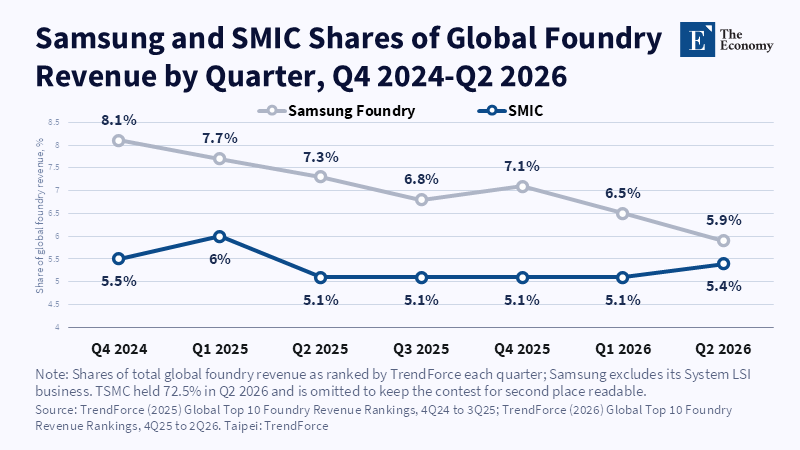
TrendForce's second-quarter figures show just how little time chipmakers have to spare. TSMC collected 72.5% of the revenue of the ten largest foundries, with revenue close to $40.2 billion and a quarterly increase of 12.1%. Samsung remained second, but its share fell from 6.5% to 5.9% in three months because its revenue grew just 1.8% in a market that grew 11.5% overall. Just below is China's SMIC with 5.4% and a 20% increase in revenue in the quarter, despite operating without EUV lithography machines due to equipment export restrictions. The gap between the second- and third-place chipmakers is now half a percentage point and the third-place company is powered by the Chinese electronics chain, which bought upfront for PCs and laptops in the same quarter.
Memory chips tell much the same story, Korea looked untouchable here for years, but that lead is being tested. Counterpoint Research estimated that China's CXMT's DRAM revenue grew by over 700% year-on-year in the first quarter of 2026 and that its share more than doubled to 8%, in a quarter where the total DRAM market reached a record $97 billion. Samsung holds the top spot with 38%, yet the rise of a fourth supplier backed by strong domestic demand and rapid capacity expansion makes every HBM line opened on time more valuable than ever and every late line more expensive. SK hynix surpassed Samsung in market value in June for the first time in over 25 years thanks to its lead in HBM, a lead built on investment decisions made earlier than its competitors.
The timing problem is even clearer in advanced logic chips. TSMC started mass production at the 2-nanometer node at Kaohsiung's Fab 22 in the fourth quarter of 2025, as confirmed by the company itself and is preparing the N2P and A16 versions for the second half of 2026. Rapidus is targeting the second half of fiscal year 2027 for the IIM-1 plant in Chitose, which, according to Tom's Hardware's analysis, places it about two years behind both TSMC and Samsung, in a hub where customers can already buy elsewhere with proven performance.
Rapidus Needs Customers Before It Needs Local Suppliers
The Japanese government has already committed to Rapidus 2,6 trillion yen in fees and investments by the end of the fiscal year ending in March 2027, according to Bloomberg calculations based on an announcement by the relevant ministry. On April 11, 2026, the Ministry of Economy, Trade and Industry approved an additional support of 631,5 billion yen, bringing total state aid for research and development to 2,354 trillion yen, according to Reuters. On top of them came two capital injections from the state-owned IPA, 100 billion yen in February and 150 billion in June, as well as 167,6 billion from 32 private companies, including Canon, Fujitsu, NTT, SoftBank and Sony. These funds are used to pay lithography tools, clean spaces and engineer salaries, while demand for the company's chips is still the open issue. The CEO has named, as TrendForce conveyed by Hokkaido Shimbun, IBM and startup Tenstorrent as the most likely customers, Bloomberg reported that the April approval is intended for work on behalf of Fujitsu and during the analysis of Tom's Hardware no high-volume customers have yet been committed.
That is where the proposal to tie future aid to local suppliers comes in, including the certification of suppliers from Hokkaido and long-term local supply contracts, which may sound reasonable to regional officials but also shifts additional costs onto Rapidus, costs that don't really appear anywhere in the public budget. Certifying a chemical or spare parts supplier for a production line at 2 nanometers requires months of testing and a purity problem in a single material is enough to bring down the performance of an entire batch of tiles. Japan already has world-class suppliers, as according to the Brookings Institution it owns 88% of the coating and display device market through Tokyo Electron and Screen, 53% of silicon wafers through Shin-Etsu and Sumco and 50% of photoresist materials, so a term that favors the supplier's origin from a particular island over its quality takes options away from a company that has a single factory and no alternative location if the hub doesn't go ahead. The American design firms that Rapidus hopes to win will compare yields and delivery times with TSMC and none will ask how many of its suppliers are based in Hokkaido.
Some of this is already happening without the government stepping in anyway and in Kumamoto, TSMC had attracted additional investment from 44 companies by 2024, according to Taiwanese sources cited by the Brookings Institution, without being obliged by any procurement conditions. Suppliers follow the customer when they think there will be volume and will come in greater numbers if Rapidus shows returns that stand up to Taiwanese ones. If it fails, local businesses that have invested in machinery and personnel under a state-guaranteed contract will find themselves tied to a customer with no customers and the risk will have simply been transferred from Tokyo to the island's small and medium-sized companies.
Kumamoto Shows That Infrastructure Is the State’s Job
Kumamoto offers perhaps the best argument for the other side, as JASM, the subsidiary of TSMC with a minority stake in Sony, Denso and Toyota, started mass production at its first factory in Kikuyo in late 2024 and a few months later the start of construction of the second plant, scheduled for the first quarter of 2025, was postponed. TSMC CEO Shi Shi Wei publicly attributed the delay to the traffic jam caused by the first plant and the protests of residents, as recorded by TrendForce. The Development Bank of Japan, in its study of the Kyushu semiconductor industry, noted that along with rising land prices and investment in equipment, local businesses did not see the increase in jobs they expected. Those who ask companies to integrate into local economies read in this evidence that a factory without a local fabric ends up stumbling upon the very area that hosts it.
The roads around Kikuyo, water and housing for workers are public infrastructure and their inability to follow the investment is a planning failure of the state and prefecture, for which TSMC had neither the competence nor the tools. The cost was paid first by the company itself and its customers, who were waiting for the new capacity and were informed of the postponement. The Development Bank's study additionally identifies as a key obstacle the lack of semiconductor end-users in the region, i.e. a demand problem that no local procurement obligation solves and Taiwan's Economic Daily News had already written that few Japanese customers needed the advanced nodes originally planned for the second plant. JASM had already set a 60% local procurement target at its 2024 inauguration, according to the Brookings Institution and this goal did not change the basic market equation.
TSMC responded to low local demand by upgrading the hub instead, which makes sense really. On March 31, 2026, Taiwan's Ministry of Economic Affairs approved the installation of the 3-nanometer process at Kumamoto's second plant, starting in 2028 and having a capacity of 15,000 12-inch tiles per month, in place of the original plan for nodes from 6 to 12 nanometers. Shi Shi Wei had explained to Premier Sanae Takaichi in February that the change responds to the explosive global demand for artificial intelligence and Nikkei has noted that most of TSMC's peak customers are American companies. What keeps the Kumamoto project viable, though, is global demand. Not demand from Kyushu alone.
For the Japanese Ministry of Economy, Trade and Industry and for the Hokkaido Prefecture, the practical lesson is to link public money to landmarks controlled by the public sector itself, i.e. kilometers of road, cubic meters of water, megawatts of grid connection and homes ready before the first shifts arrive and not to local procurement rates that a company with a factory and without a high-volume committed customer will have to fulfill. A public sector that has not delivered its own projects in Kumamoto on time can hardly ask Rapidus to undertake additional shipments in Chitose, especially when the country's own semiconductor industry has yet to prove that it can produce at 2 nanometers on commercial terms.
In South Korea, the Fab Map Mirrors the Electoral Map
On June 29, 2026, Lee Jae-myung presented at the presidential palace, next to Samsung Electronics Chairman Lee Jae-yong and SK Group Chairman Sei Te Won, a program of 800 trillion won, about $520 billion, for four new memory factories in the Honam region, two for each company. The next day, at an event in Gwangju, the two companies presented their plans without giving a timeline for when the investments will be made or when construction will begin, as recorded by the Korea Times, keeping room for adjustment until the long-term memory cycle is clear. On the same tour, the president described the project as a "historic and national reparation" for a region that suffered discrimination while defending democracy and at a later cabinet meeting recalled that Yongnam has 13 million inhabitants compared to 5 million in Honnam, speaking of indisputable discrimination between the two regions.
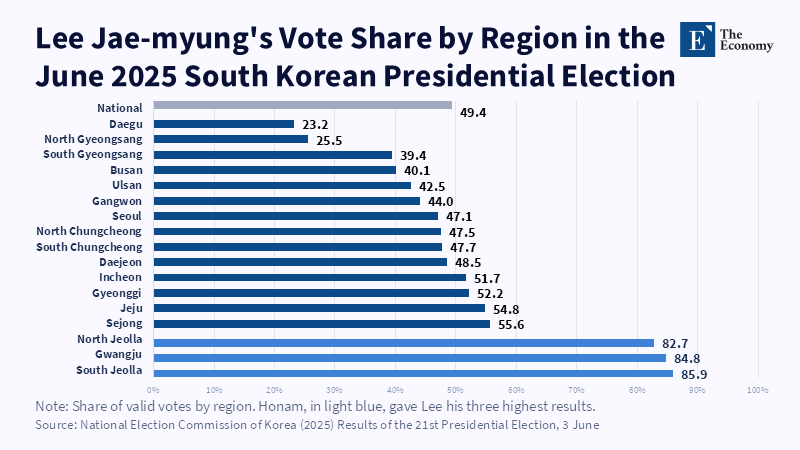
The election results help explain why the whole plan has raised political suspicions. In the June 3, 2025, presidential election, Li got 84.8% in Gwangju, 85.9% in South Jeola and 82.7% in North Jeolla, according to National Election Commission data, while his nationwide share was 49.4%. The People's Power Party demanded that it be proven that the choice of location was made through a transparent process based on the companies' own judgment, while a citizens' organization filed lawsuits against the president and his policy chief for abuse of power and coercion. The presidency responded that global companies invest where they see the greatest future value. If that's the case, it's not easy to explain whythe mayor of the newly established Jeonnam-Gwangju Integrated Special City, gave his first order to complete the factories so that production could start within Lee's term, a timeline set by the election calendar rather than the DRAM price cycle.
The Ministry of Climate, Energy and Environment has pledged 6.3 gigawatts of capacity and 650,000 tons of water per day and electrification requires a new 345-kilovolt transmission line from the Hanbit nuclear power plant to Gwangju military airport, a project that usually takes five to ten years and that the government promises to complete by the end of 2029, with enough power for a single plant from each company. Korea JoongAng Daily recalled in an editorial that out of the 54 major transmission and substation projects of the 11th Basic Power Plan, 20 are delayed due to resident reactions and permits, that the daily need of new factories for industrial water exceeds the domestic consumption of the whole of Gwangju and that the use of the airport requires consultations with the United States. The vice president of Samsung Electronics, at the same event where he announced an investment of 400 trillion won, said that stable power supply counts more than anything else.
The government replies that the decision is based on economic criteria, the Seoul metropolitan area has difficulty providing additional electricity and water and the argument is valid, but the Yongin complex, where the two companies plan investments of up to 1.600 trillion won, needs 15 gigawatts on its own and the Korea JoongAng Daily wrote that the companies seem to put Yongin first, while the government imagines the two projects moving forward in parallel. Two simultaneous infrastructure projects of this scale, in a network where more than a third of major projects are already delayed, are competing for the same crews, the same permits and the same administrative attention, while Samsung's largest union has already announced that it will put Hong's project to collective bargaining in 2027. The most likely scenario is two clusters that are slow together, while CXMT, which Counterpoint Research describes as the fastest-growing DRAM supplier in the world, continues to expand its capacity.
A Lost Quarter Cannot Be Made Up With Regional Policy
The Japanese semiconductor industry did not lose the position it held in the late 1980s because its factories were cut off from local communities, rather the decline, as described by the Brookings Institution, followed the 1986 U.S.-Japan semiconductor agreement and the 100 percent tariffs imposed by the Reagan administration on Japanese memory chips and deepened when Japanese companies missed the switch to FinFET transistors in the 2010s, even though Hitachi had been ahead of the research. They were failures of timing and technological choices, the kind of mistake that costs generations and cannot be corrected by localization programs.
The same risk weighs on both countries today. Samsung lost 0.6 percentage points in the foundry market in the first quarter of 2026, while SMIC gained 0.3, Rapidus has a factory, a deadline in 2027 and no high-volume committed customers and in Honnam the date counting is the end of 2029, when the 345-kilovolt line should have reached Gwangju airport. The two Korean companies have not committed to a timeline and will then decide whether Honam is ahead of Yongin or awaits its turn.
The views expressed in this article are those of the author(s) and do not necessarily reflect the official position of The Economy or its affiliates.
References
Bloomberg News (2026) ‘Japan bets $16 billion to propel Rapidus in global AI chip race’, Bloomberg, 11 April.
Counterpoint Research (2026) Global DRAM revenue surges to near $100-billion mark in Q1 2026 driven by AI data center boom. Seoul: Counterpoint Research, 26 May.
Development Bank of Japan (2026) Kyūshū handōtai sangyō no keizai hakyū kōka no saidaika ni mukete: shirikon airando no rekishi to Taiwan kara no shisa. Tokyo: Development Bank of Japan, 30 January.
Focus Taiwan (2026) ‘Taiwan government approves TSMC’s 3nm upgrade for second Japan fab’, Focus Taiwan, Central News Agency, 31 March.
Jo, Mi-dup and Lee, Ye-seul (2025) ‘Lee Jae-myung sweeps Seoul and key battlegrounds in capital and Chungcheong regions in election’, Kyunghyang Shinmun, 5 June.
Korea JoongAng Daily (2026) ‘Build infrastructure first for Honam chip fabs’, editorial, Korea JoongAng Daily, July.
Korea Times (2026) ‘Samsung, SK chip investment timelines leave room for adjustment’, The Korea Times, 30 June.
Lee, Tae-hyung (2026) ‘Minister Kim: power and water infrastructure for 2 Honam semiconductor fabs to be ready by end of 2029’, The Korea Herald.
Solís, Mireya and Duchâtel, Mathieu (2024) ‘The renaissance of the Japanese semiconductor industry’, Brookings Institution, 3 June.
Tom’s Hardware (2026) ‘Rapidus fab roadmap examined’, Tom’s Hardware.
TrendForce (2026) Global foundry revenue approaches US$53.49 billion in 2Q26 as SMIC narrows market share gap with Samsung. Taipei: TrendForce, 9 September.
Uranaka, Miho and Kaneko, Kaori (2026) ‘Japan approves additional $4 bln for chipmaker Rapidus’, Reuters, 11 April.
Working across research, policy, and data-driven analysis, the Editorial Board ensures that published pieces reflect a consistent institutional perspective grounded in quantitative reasoning and long-term structural assessment.