AI and the Market for Research Work: Why Economists Gain

Working across research, policy, and data-driven analysis, the Editorial Board ensures that published pieces reflect a consistent institutional perspective grounded in quantitative reasoning and long-term structural assessment.
Authored On
Modified
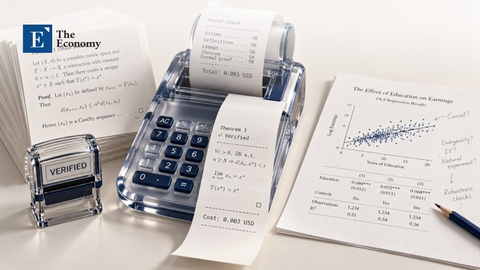
Machine-checked proofs push theorem prices toward compute costs
Economists gain because identification has no automatic checker
Employers need fewer coders and more design checkers
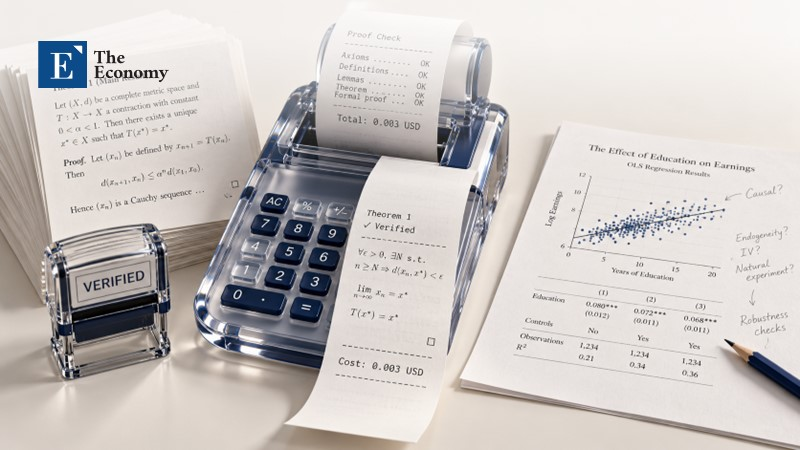
In August 2026, three PhD candidates from MIT's mathematics department asked their colleagues how they view their position in the field in the face of artificial intelligence and 45 out of 120 graduate students responded. Three out of four said they fear that AI will make it difficult to access a permanent academic advancement position and 71 percent said that their chances of continuing in academic mathematics have decreased. The results were presented at a department meeting on September 10, two days after OpenAI announced a solution to the Navier-Stokes problem and about four weeks before the same company published proofs for nearly 400 more open problems. The market for research work is redistributed around a criterion that few had predicted, how easily its product is mechanically controlled and with this criterion economists and those who work with the softer mathematics of empirical research are suddenly in a better position than many pure mathematicians.
The Price of a Proof Falls Toward the Cost of Compute
The solution for the Navier-Stokes equations required about 10,000 agents, 88 hours of operation and about 130 billion output tokens, with a computation cost that the BBC estimated, based on OpenAI's published price list, at around US$10 million. The amount is ten times the $1 million prize that comes with each Millennium Problem, which OpenAI said it would not claim, but it corresponds to a question that had remained unanswered for about ninety years despite the work of generations of experts. The field already runs differently day to day. Since October 1, arXiv has limited authors to two submissions a month, amid a flood of papers with AI-generated or AI-assisted results that no one has time to review and Quanta Magazine reports that OpenAI has announced that it keeps more than 100 important results secret, which discourages researchers from asking questions that may have already been answered.
The calculator analogy is more literal than it sounds. When a tool performs a type of work more cheaply and with guaranteed correctness, the market value of human performance of the same task converges towards the cost of the tool and for decades the math calculator stopped at arithmetic calculations and simulation, leaving the proof to humans, who certified it through time-consuming peer review that often took years. With standard verification in the Lean language, which for the Navier-Stokes solution took 17 hours, the correctness of a proof is now mechanically checked and the same system covers production and control. The quality of the calculator has reached a point where a theorem with a mechanical certificate can be purchased with computing power and its price now tracks the cost of compute far more than the hours of a trained mathematician.
Proof-Focused Mathematicians Are Exposed First
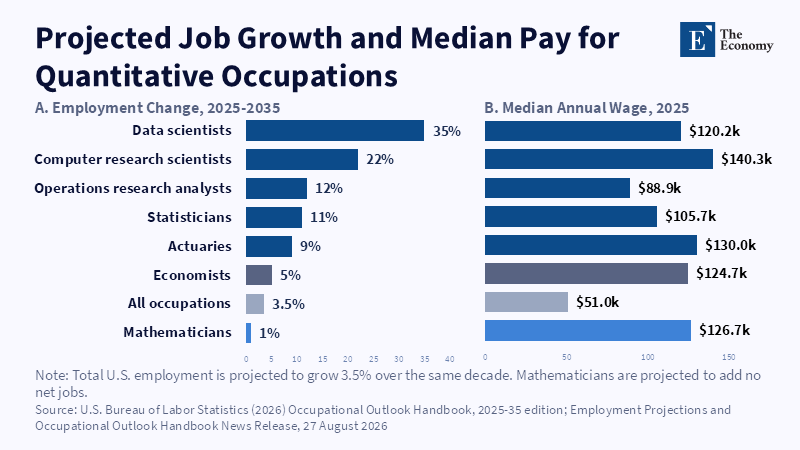
The figures show how narrow the occupation is in the first wave. According to the US Bureau of Labor Statistics, mathematicians held about 2,200 jobs in 2025, with a median annual salary of $126,710 and their employment is projected to grow by just 1 percent by 2035, without a single net new job, while statisticians, with 31,300 positions, are expected to increase by 11 percent and total employment by 3.5 percent. These predictions were published on August 27, 2026, twelve days before the Navier-Stokes announcement and do not incorporate it, so they describe a profession that had already stopped growing before the competitor appeared that produces proofs in hours, while statisticians, who work with data and uncertainty, were moving in the opposite direction. The pressure is even more intense in academic mathematics, where recruitment, permanence and recognition are evaluated almost exclusively based on the theorems one proves and where an MIT professor described to the Boston Globe the role of the mathematician shifting from a technician who produces proofs to a translator who interprets and explains them to others.
The exposure is uneven and it lands first on those who are those who base their value on technical power within a closed formal system, the mathematical geniuses who stand out because they traverse a proof a hundred pages faster than anyone else, because their work has exactly the trait that makes automation efficient, a reviewer who answers with yes or no. Two days after OpenAI's announcement, in a speech at the University of California, Berkeley, a mathematician who has been licensed to work at the startup Axiom Math warned about 150 students, postdocs and professors that they might graduate into a profession that doesn't exist or is unrecognizable. The discussion, scheduled for 50 minutes, lasted more than two hours. A Caltech PhD candidate told Quanta Magazine that a world where problem-solving is easy while understanding solutions remains difficult breaks the industry's incentive system, built entirely around problem-solving.
Economists' Advantage Lies Where the Verifier Is Missing
Things look different once the same tools are pointed at empirical economics. In an experiment of 40 econometric tasks published by CEPR in October 2026, agents who wrote, executed and debugged code in Stata, R and Python gave a correct result 97 percent of the time, compared to 79 percent when they simply wrote code in a chat window. For one of the two models, each additional correct result cost about $0.54, which with research assistant fees of $15 to $50 per hour corresponds to 0.6 to 2.2 minutes of work. The layer of research that converts a set of data and a method into a number, the classic research assistant job, is therefore under the same pressure as theorem proving. The bugs that were left were all silent, scripts that ran normally and typed the wrong numbers, mostly due to a wrong pointer or term within an otherwise correct method. Rerunning the code would not have caught any of them.
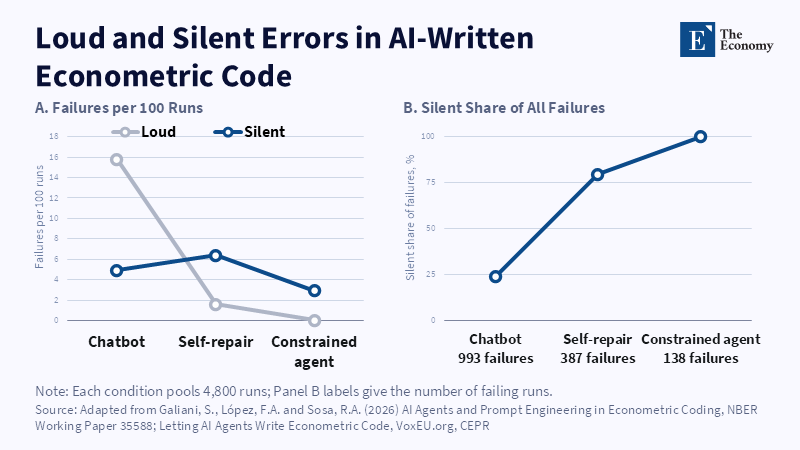
The design of the experiment says more since each task provided the method, the data and the reference result ready, so the faithful implementation of a process was measured and whether the process gives a reliable causal estimate was left out of the measurement. A properly programmed regression with auxiliary variables does not prove that the tool satisfies the exclusion constraint and a perfectly implemented difference estimator in differences does not prove parallel trends, since both claims concern the world outside the data, which no compiler or proof-checker can attest. That is where lies the distinct advantage of the economist over the mathematician of pure proofs. The judgment on the credibility of a research design is work without a mechanical reviewer and therefore without the feedback loop that made proofs cheap. The Bureau of Labor Statistics lists about 18,600 economists in 2025, with a median salary of $124,720 and about 1,100 vacancies a year on average until 2035, a profession more than eight times larger than that of mathematics.
The Weak Market Counter-Argument for Economists
The objection is that the market for economists is not showing any boom. The Bureau of Labor Statistics predicts a 5 percent increase in their employment from 2025 to 2035, which is about 900 positions in a decade, just above the 3.5 percent for the whole economy and the recruitment platform INOMICS describes for 2026 an academic market with fewer publicly posted positions, too many candidates for the available positions and applications arriving en masse, optimized with artificial intelligence, to committees that have difficulty distinguishing the competent candidate from the noise. The same technology that writes the applications now also writes the code of the empirical chapters of a dissertation, so a young economist no longer stands out because he simply knows how to program in Stata. A second version of the objection argues that the identification crisis will follow the proof of theorems with a delay of a few years, since the open problems of mathematics were considered unassailable until the summer of 2026, when the advantage of economists will prove to be temporary.
The forecast for economists is modest but above average, while for mathematicians it is essentially zero, 2,200 positions in 2025 and 2,200 in 2035, even before the autumn events are incorporated and the laxity of the academic economics market is about the number of positions, not the automation of the core work. The second version runs into a technical hurdle. OpenAI reports that the model that solved Navier-Stokes was developed with large-scale reinforcement learning, a method that needs a reward signal and in mathematics this signal is given by the proof checker. In a real dataset there is no reference number to compare a causal estimate and the only real test for an identification hypothesis is a new experiment in the world, costing time and money and not repeating itself millions of times in 88 hours. A system that learns from a reward has nowhere to learn when the reward cannot be calculated.
What Changes in the Research Job Market for Employers
For central banks, research institutes and consulting firms employing economists, the practical consequence is more about reallocating hours than eliminating positions. The hours that used to go into writing and proofreading estimates are shrinking, while the need for people to check whether the agent implemented the requested specification and whether their numbers stand up grows. Human verification doesn't start from a clean registry; an audit of 110 studies recently published in leading economics and political science journals, published in Nature in 2026, found programming errors in about one in four, even when the posted code exactly replicated the published numbers. An employer who replaces the research assistant with an agent without reinforcing the audit will have fewer errors overall but a larger share of errors that no one sees and the hiring criteria will shift towards candidates who can defend why a tool is valid, how trends might diverge and what would shatter the assessment.
The redistribution also reaches the employers of mathematics, but in a different direction. According to Quanta Magazine, companies such as OpenAI and Anthropic compete directly with mathematicians in proving theorems and at the same time hire many of them, which means that the demand for mathematical ability is concentrated in a few buyers who need people to define problems, check formats in Lean and judge which results are worth publishing. Mathematics departments, which have been hiring for decades based on the list of proven theorems, are already experimenting, according to the same journal, with the requirement that each publication be accompanied by an oral presentation, a first attempt to measure comprehension rather than output. The mathematician who survives in this market is more and more like the economist, someone who judges what a result means and what question it matters for and less and less like the fastest proofreader in the room.
The MIT survey percentages, 71 percent and three out of four, reflect a market for research work that is adjusting faster than the official forecasts of the Bureau of Labor Statistics have time to update. In the fall of 2026, proof of theorems gained value in computational power and the work of mathematics that is identified with the production of proofs found itself competing with a calculator of excellent quality, while the question of whether a tool meets the exclusion constraint remained in the same place, without any tester judging it. Whether that still holds in five years, nobody can say yet. However, on the MIT campus signs aimed at graduate students without a plan B suggested a six-month immersion program in OpenAI, the same company that made the proof cheap.
The views expressed in this article are those of the author(s) and do not necessarily reflect the official position of The Economy or its affiliates.
References
BBC News (2026) 'OpenAI says it cracked 90-year-old maths problem in 88 hours', BBC News, September.
Brodeur, A., Mikola, D., Cook, N., Fiala, L., Brailey, T., Briggs, R., de Gendre, A., Dupraz, Y., Gabani, J., Gauriot, R. et al. (2026) 'Reproducibility and robustness of economics and political science research', Nature, 652(8108), pp. 151-156.
Bureau of Labor Statistics (2026a) Occupational Outlook Handbook, 2025-35 edition. Washington, DC: U.S. Department of Labor.
Bureau of Labor Statistics (2026b) Employment Projections and Occupational Outlook Handbook News Release, 27 August. Washington, DC: U.S. Department of Labor.
Cepelewicz, J. (2026) 'Is AI the end of math as we know it?', Quanta Magazine, 5 October.
Galiani, S., López, F.A. and Sosa, R.A. (2026) 'Letting AI agents write econometric code', VoxEU.org, 18 October. London: Centre for Economic Policy Research.
INOMICS (2026) 'The 2026 econ recruitment landscape and challenges for academic recruiters', INOMICS.
OpenAI (2026) On the Navier-Stokes Millennium Prize Problem. San Francisco: OpenAI, 8 September.
Towfighi, M. (2026) 'What's the point of MIT? OpenAI's math proofs have thrown students and researchers into chaos', The Boston Globe, 15 October.
Working across research, policy, and data-driven analysis, the Editorial Board ensures that published pieces reflect a consistent institutional perspective grounded in quantitative reasoning and long-term structural assessment.
Similar Post