Tokenization and Market Plumbing: Is the Efficiency Gain Worth the Cost?

Working across research, policy, and data-driven analysis, the Editorial Board ensures that published pieces reflect a consistent institutional perspective grounded in quantitative reasoning and long-term structural assessment.
Authored On
Modified
Tokenized repo volume has flattened near $360 billion daily
Instant settlement removes netting and raises pre-funding needs
Pontes helps, but the net efficiency gain remains unproven

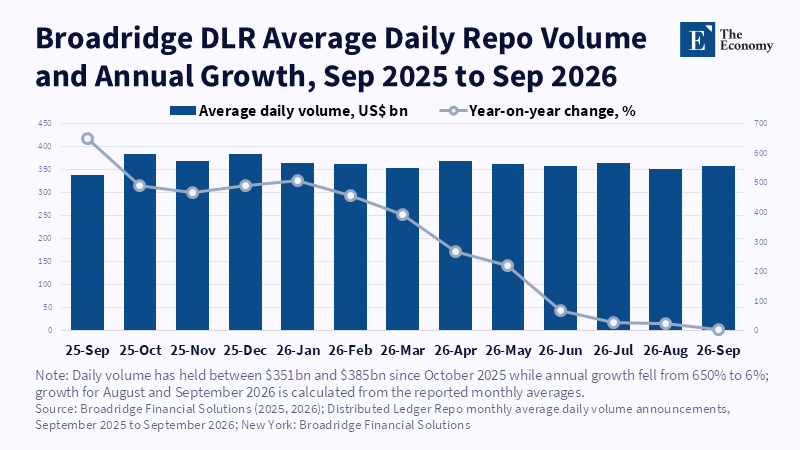
In December 2025, Broadridge’s Distributed Ledger Repo platform was processing an average of $384 billion of repurchase agreements per day, nearly $9 trillion in a month, up 490 percent from a year earlier. In July 2026, the daily average was $365 billion and the year-on-year increase had fallen to 28 percent, with the curve flattening as if the market had already covered the use for which the platform was designed. The tokenization of financial instruments has now reached the core of the money market and almost no one seriously disputes that. Less clear is whether the efficiency gain from instant settlement on distributed ledgers is large enough to foot the bill for a transition that will likely first increase market fragmentation and the need for pre-funded liquidity, while at the same time complicating the work of central banks trying to steer short-term interest rates.
Tokenization Has Already Moved Beyond Cryptocurrency
For years, the word tokenization referred to Bitcoin speculation and decentralized finance protocols that operated on the margins of the regulated market. The picture of 2026 is quite different. According to CoinGecko, the value of tokenized U.S. Treasury securities rose from $4.00 billion at the beginning of 2025 to $12.99 billion at the end of March 2026, with BlackRock’s BUIDL and Franklin Templeton’s BENJI among the largest products. In repurchase agreements, the shift is more pronounced. The International Capital Market Association recorded 34 publicized cases of repo on distributed ledger technology between 2017 and 2025, most in 2024 and found that these were typically trials and pilots, with substantial commercial use mainly on Broadridge’s DLR and JPMorgan’s Kinexys. According to the same association, the daily turnover of repo on DLT had reached about $370 billion in the last months of 2025, i.e. activity has been concentrated on very few platforms, which will be relevant later.
The change also affects the public sector. As of 30 March 2026, the Eurosystem has been accepting marketable securities issued in central securities depositories using DLT as collateral in its credit operations, provided that these securities are settled through T2S, while securities issued and settled exclusively on DLT networks remain outside, while the ECB considers whether and on what criteria they will be accepted. On 21 September, the European Central Bank announced further preparatory work to invest a small part of its own funds in tokenized securities, mainly euro area central government bonds. A tokenized bond that enters the same collateral portfolio as a conventional one brings with it the frictions of its platform and these frictions no longer stay in the world of cryptocurrencies. The interconnection works in the other direction as well, since stablecoin issuers, whose market capitalization reached $301.65 billion at the end of March 2026 according to CoinGecko, now own a significant volume of U.S. Treasury bills and the Bank for International Settlements has found a measurable effect of their flows on the yields of these bills, which means that turmoil in a digital token market can end up in the price of one of the most widely used safe short-term securities.
Instant Settlement Saves Time but Gives Up Netting
The benefits of settling on a distributed ledger are easy to describe and most are real. When the securities leg and the cash leg are executed atomically, i.e. both are completed together or neither is, the risk of the security being delivered without the payment being collected disappears. A repo transaction that closes within seconds, at any time and on any day, allows a treasury department to move collateral between time zones without waiting for Fedwire to open on Monday or TARGET in the morning. ICMA identifies the technology’s most tangible utility in collateral and margin management, as well as in precisely timed intraday repo, where a bank borrows cash for a few hours instead of overnight. Hence, the main argument of the proponents is that institutions will be able to hold smaller liquidity reserves for precautionary reasons, since they will find liquidity exactly when they need it.
The same feature that makes settlement fast also makes it expensive in liquidity. DTCC’s National Securities Clearing Corporation netted in 2024 an average of $2.2 trillion of daily trading activity down to $33.5 billion of final cash settlement, a netting efficiency of 98 percent. A system that settles each transaction gross and immediately would need to move about 65 times more cash for the same volume and DTCC itself has publicly argued that real-time settlement removes the benefit of netting and forces trillions in cash and securities to circulate continuously throughout the day. In practice, this means pre-funding, with cash and collateral having to be on the platform before the transaction.
The consequence goes against the usual narrative about tokenization. The most plausible scenario for the transition phase is for banks’ demand for central bank reserves to increase, as long as fragmentation and the need for pre-funding prevail and to decrease only when interoperability and programmable reuse of liquidity start to pay off. Programmable reuse is a real possibility, since smart contracts can chain successive transactions so that the same liquidity unit serves multiple payments during the day, but it requires that counterparties are on the same ledger or on ledgers that communicate reliably with each other, which is currently only true to a limited extent. For the treasury manager of a European bank, the practical question is how much extra reserves the bank will commit to gain speed in a part of its operations that may remain small for years.
The Fragmentation of Tokenized Markets Has Structural Causes
In a Eurosystem questionnaire to the Bond Market Contact Group, banks, institutional investors and sovereign debt management agencies replied that they expect five to ten years before tokenized solutions become dominant in the issuance, settlement and trading of securities. This is a long horizon for a technology that presents itself as cheaper from day one. The obstacles that explain it feed into each other: there is still no widely accepted tokenized cash settlement instrument, the transfer of funds from conventional infrastructures to DLT platforms and back is expensive, the secondary liquidity of tokenized bonds remains weak, platforms are poorly linked and on top of all there is legal uncertainty and a gap in international standards. As long as each platform holds its own liquidity pool, the prices of the same underlying security can diverge from ledger to ledger without the gap closing quickly and violations of no-arbitrage conditions become commonplace.
A Bank for International Settlements study published in March 2026 argues that, at least on public ledgers without access restrictions, fragmentation is a consequence of the decentralized consensus mechanism itself and is not going to disappear as the market matures. Validators who maintain a ledger must be rewarded; the required reward grows the stricter the consensus threshold is and the costs are passed on to users through congestion fees, so those who are displaced by expensive ledgers move to newer ones with looser rules and the market fragments rather than consolidates, with stablecoins inheriting the fragmentation of the chains where they circulate. The permissioned ledgers used by large banks escape part of this dynamic and create their own version of the problem, since each consortium and each provider sets up a network with its own rules. A trader operating on two platforms must hold cash and collateral on both, exactly doubling the reserves that the technology promised to shrink and this doubling is not reflected in the monthly volume reports, which record how much money moved, not how much had to sit idle for it to move.
Unanchored DeFi Rates Threaten Monetary Policy Transmission
Monetary policy relies on a central bank’s ability to drive a wide range of short-term interest rates close to its policy rate. The European MiCA regulation and the U.S. GENIUS Act prohibit stablecoin issuers from paying interest directly to holders; however, the tokenized world offers other avenues of return, such as rewards, staking, or shares of tokenized money market funds. The yields of these funds and of the tokenized versions of existing bonds generally follow money market rates. Stablecoin lending rates in decentralized finance protocols, where stablecoins are borrowed against collateral in crypto-assets, do not have such an anchor. A 2026 ECB working paper shows that over the past five years these interest rates for dollar-pegged stablecoins have been highly volatile and have repeatedly been sometimes well above and sometimes well below the Federal Reserve’s policy rate. For Circle’s EURC, which entered the Aave protocol in July 2025, the deviation from the ECB deposit facility rate followed much the same pattern.
The divergence has specific causes, which time alone does not cure. The transfer of funds between decentralized protocols and the traditional money market is expensive, comes with tax obligations and customer identification checks and stablecoins are not convertible at par into central bank reserves. When borrowers use the protocols to leverage positions in crypto-assets, interest rates follow the cycle of risk appetite in that market, which has little to do with the decisions taken in Frankfurt or Washington. Decentralized finance remains small compared to conventional money markets and this is the strongest argument of those who consider the risk theoretical, although the argument concerns the current size and leaves the mechanism untouched. If a significant part of wholesale repo moves to ledgers where access to reserves is limited and arbitrage with conventional markets is expensive, there will be two short-term interest rate curves and the policy rate will reliably direct only one. For central bank market operations directorates, the consequence is practical, since standing facilities and collateral frameworks should treat the same security in the same way whether it is on DLT or on a traditional infrastructure and the Eurosystem, as the T2S condition in its collateral decision shows, is still far from that point.
Pontes Anchors Tokenized Settlement but Leaves the Cost Question Open
The Eurosystem’s response to these risks is to bring central bank money into the tokenized world. On 21 September 2026 it launched Pontes, which allows wholesale transactions in tokenized assets to be settled in central bank money and builds on the 2024 trials, when public and private operators had said that access to a risk-free settlement asset is critical to wider adoption of the technology. On the first day, thirteen institutions had completed the connection, including Deutsche Bank, Santander, Société Générale, KfW and the European Investment Bank, as well as the Deutsche Bundesbank, along with four DLT platform operators, Axiology, Cashlink, Clearstream and SWIAT. The ECB has announced that longer operating hours and additional capabilities will come gradually, with full implementation by 2028, while the Appia initiative, in which Danmarks Nationalbank participates, will deliver by the same year a blueprint for a single European ecosystem where tokenized securities will be settled in central bank money. The direction is right, as a common settlement asset is the most direct way to limit fragmentation between platforms.
Proponents of a fast transition make an argument that sounds decisive: the market has already voted and the hundreds of billions of dollars in daily repo on DLT prove that the benefit is enough for banks to pay the costs themselves. Broadridge’s own data reads differently. The average daily volume on DLR was $368 billion in April 2026, $362 billion in May, $357 billion in June and $365 billion in July, below the $384 billion of December 2025 in every month, while the year-on-year increase fell from 268 percent in April to 28 percent in July. A platform that brings together the activity of large traders can be extremely efficient for them without this saying much about the net benefit to the system, because the gains remain with the participants while part of the costs, such as additional reserves and looser control over interest rates, are transferred to the balance sheet of the central bank and to the market as a whole.
The second objection says that the costs of the transition are temporary. The five-to-ten-year estimate by market participants themselves is not a short period for a central bank that will have to adjust its reserves in a two-speed system and since the extended hours of Pontes will come gradually until 2028, round-the-clock settlement in central bank euro is not yet available. For sovereign debt management agencies, bank treasury officers and Eurosystem market operations directorates, a useful measure would be to publish, next to each volume figure, the liquidity that had to be pre-funded to achieve it, because without this comparison the efficiency debate counts only one side of the equation.
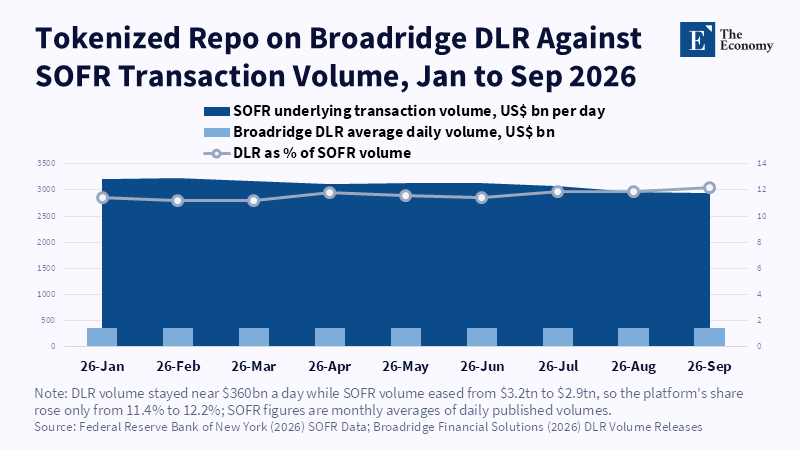
The $365 billion of daily repo on DLT in July 2026 seems like a huge amount until it is placed next to the transactions on which the Federal Reserve Bank of New York calculates SOFR, which in the same months hovered around $3.1 trillion per day. The two figures do not measure the same thing, since one includes intraday trading and the other only overnight repo backed by U.S. Treasury securities; the order of magnitude, however, is indicative, with the largest tokenized repo platform reaching just over a tenth of a single market and its growth having braked abruptly. On the other side stands a clearing mechanism that every day reduces by 98 percent the cash that has to change hands in the U.S. stock market. Tokenization will need to show something equivalent in liquidity savings, beyond speed, before its gain can be considered greater than the cost of the transition. Pontes, with the thirteen institutions and the Bundesbank connected on 21 September, is the first place where this comparison can be made in euros and in central bank money and the first data on the reserves that each participant ties up have not yet been published.
The views expressed in this article are those of the author(s) and do not necessarily reflect the official position of The Economy or its affiliates.
References
Ahmed, Rashad and Aldasoro, Iñaki (2025) Stablecoins and safe asset prices. BIS Working Papers No. 1270. Basel: Bank for International Settlements.
Barbon, Andrea, Barthélemy, Jean and Nguyen, Benoît (2026) DeFi-ying the Fed? Monetary policy transmission to stablecoin rates. ECB Working Paper No. 3280. Frankfurt am Main: European Central Bank.
Broadridge Financial Solutions (2026) Distributed Ledger Repo monthly volume press releases, January to October 2026. New York: Broadridge Financial Solutions.
CoinGecko (2026) RWA 2026 Report. Singapore: CoinGecko.
Comotto, Richard (2026) DLT and repo, Part I. Zurich: International Capital Market Association.
Depository Trust & Clearing Corporation (2021) Advancing Together: Leading the Industry to Accelerated Settlement. New York: Depository Trust & Clearing Corporation.
Depository Trust & Clearing Corporation (2025) 2024 Annual Report. New York: Depository Trust & Clearing Corporation.
European Central Bank (2026a) ECB paves way for acceptance of DLT-based assets as eligible Eurosystem collateral. Press release, 27 January. Frankfurt am Main: European Central Bank.
European Central Bank (2026b) Eurosystem brings central bank money to tokenised finance. Press release, 21 September. Frankfurt am Main: European Central Bank.
European Central Bank (2026c) ECB to invest part of own funds in tokenised securities, with settlement via Pontes. Press release, 21 September. Frankfurt am Main: European Central Bank.
European Central Bank Bond Market Contact Group (2026) Insights from the Eurosystem ad hoc questionnaire on tokenised finance. Frankfurt am Main: European Central Bank.
Federal Reserve Bank of New York (2026) Secured Overnight Financing Rate data. New York: Federal Reserve Bank of New York.
Shin, Hyun Song (2026) Tokenomics and blockchain fragmentation. BIS Working Papers No. 1335. Basel: Bank for International Settlements.
Working across research, policy, and data-driven analysis, the Editorial Board ensures that published pieces reflect a consistent institutional perspective grounded in quantitative reasoning and long-term structural assessment.