The Collateral Channel Problem: Why Rate Hikes Keep Choking Bank Lending

Working across research, policy, and data-driven analysis, the Editorial Board ensures that published pieces reflect a consistent institutional perspective grounded in quantitative reasoning and long-term structural assessment.
Authored On
Modified
Foreign exporters absorbed nearly half of 2025's tariff shock
Toyota cut export prices instead of raising American sticker prices
Currency depreciation added a second, quiet discount on top

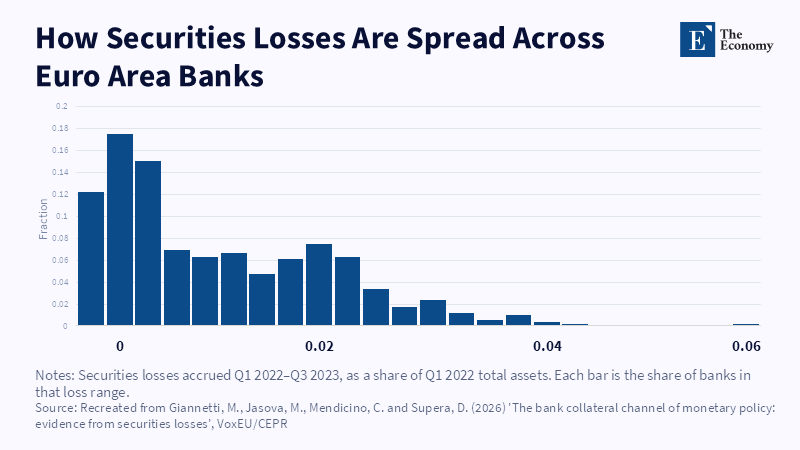
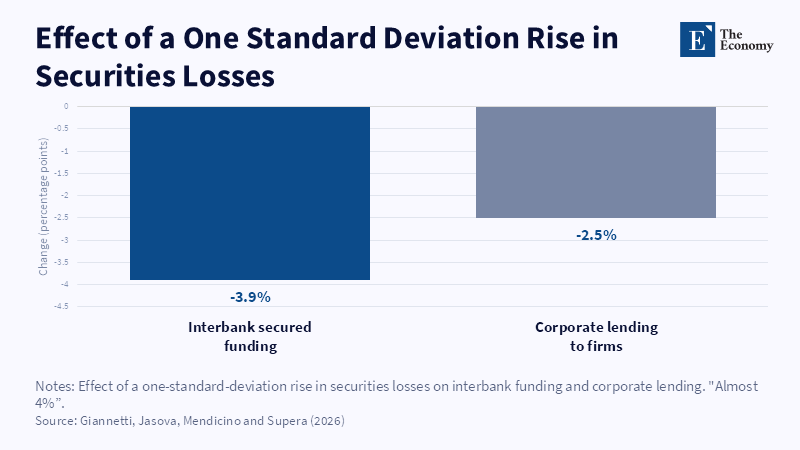
By the third quarter of 2023, euro area banks had lost about twelve percent of their equity on paper. The cause was simple. Bond prices fell as rates climbed at the fastest pace the currency bloc had seen in decades. That number does not often make headlines beside inflation data or jobs reports but it should. A one standard deviation jump in those losses cut interbank borrowing by nearly four percent. It cut corporate lending by two and a half percent. This happened even at banks that stayed well capitalized. The losses did not need to threaten solvency to choke lending. They only needed to shrink the collateral banks pledge for funding. This is what economists call the collateral channel. It sat quietly beneath the louder drama of the 2022 to 2024 rate hikes and it never really left. It still shapes how banks react to every rate move today, including the ones now coming from a Federal Reserve that has chosen to say less, not more.
Rate Hikes Never Just Raise Rates
Central bankers tend to treat rate policy as a simple chain of events. Raise the policy rate and funding gets pricier. Credit costs more. Demand cools. Inflation eases. That story skips another, quieter step. Banks hold large piles of government bonds. They pledge those bonds as collateral to borrow from each other and from the central bank. When rates rise, bond prices fall. The collateral pool shrinks with them. The bank does not even have to sell the bond to feel it. It only needs to try to borrow against one.
Something close to this happened across the euro area between early 2022 and late 2023. Researchers tied to the European Central Bank tracked it in fine detail. Banks that lost more collateral value got less secured funding from other banks. The effect hit hardest at banks that leaned most on securities as collateral before rates began to climb. The pattern held no matter how strong a bank’s capital position was. Weaker banks did not cut lending harder than stronger ones. Losses on bonds held to maturity, which never touch capital ratios at all, produced the same lending pullback as losses on bonds marked to market. Capital was not the binding constraint but collateral was.
The same period brought a sharper warning in the United States. Silicon Valley Bank collapsed in March 2023 after a run driven partly by unrealized bond losses. That failure pushed regulators and researchers to study liquidity risk, credit risk and market risk far more closely as rates rose. It left banks everywhere with a lesson they have not forgotten. A balance sheet can look solvent on paper and still face a liquidity squeeze the moment its collateral loses value fast.
The Numbers Behind the Freeze
Euro area banks fund close to fourteen percent of their assets through interbank borrowing. That makes the collateral channel a real slice of total funding, not a side note. When securities losses hit that funding line, the effect on firms was direct. Banks with larger losses charged higher rates. They offered shorter loan terms. They cut loan volumes more than their peers. Firms could not simply borrow elsewhere because the pullback reflected a real drop in system-wide credit, not one bank’s private caution. Banking groups tried to soften the blow through internal transfers of cash to weaker units. That worked fairly well for domestic units. It barely helped foreign ones, whose lending fell almost as much as banks with no group support at all.
Other research on bank profits during high-rate periods adds a useful piece to this picture. Banks that write mostly flexible-rate loans see loan losses climb faster when rates rise, since borrowers on floating rates feel payment shocks sooner. That effect softens when regulators had already tightened borrower-based rules in the years before the hikes began, such as caps on loan-to-income ratios. The damage from a rate shock is not always the same. It depends on how ready the system was before the shock hit both on the credit side and on the collateral side. Neither channel alone explains the full 2022 to 2024 credit squeeze. Together, they explain a meaningful share of the tightening that plain funding-cost models miss.
A Fed That Refuses to Signal
This history matters again now because of a shift at the top of the Federal Reserve. Chair Kevin Warsh has pushed the central bank toward what he calls a smaller Fed. He wants the Fed to lean almost entirely on the policy rate. He wants it to pull back from both balance-sheet activism and detailed guidance about where rates are headed. He has criticized the Fed’s wide footprint, including its six-point-seven trillion-dollar balance sheet. He has resisted giving markets the kind of advance guidance traders had come to expect after more than a decade of central-bank hand-holding. At his press conferences, he has declined to preview future moves. His argument is that markets should price risk on their own, rather than wait for the Fed to spell it out.
Markets, at least initially, have not reacted calmly. It has been higher long-term yields. After a recent policy meeting, the thirty-year Treasury yield climbed to its highest level since 2007. The ten-year yield reached heights not seen since early last year. Removing forward guidance did not remove uncertainty. It moved that uncertainty into the bond market as a kind of risk premium, with investors demanding extra pay for not knowing which way the Fed will lean next. The federal funds rate has sat at three and a half to three and three-quarters percent since midyear. Three voting members of the rate-setting committee actually wanted a hike at the most recent meeting. Meanwhile, economists at Goldman Sachs argue that market bets on further hikes look too aggressive, given cooling retail sales, softer job growth and easing inflation. The gap between those hawkish bets and somewhat softer economic data is itself a symptom of a Fed that has chosen ambiguity as a stance.
What This Means for Bankers and Policymakers
For bank treasurers, the lesson from 2022 to 2024 is now built into how they manage liquidity. A Fed that offers fewer signals gives them less reason to relax. Banks that pulled back lending after securities losses were not acting out of panic. They were managing a real liquidity constraint. The collateral channel research shows that constraint bites hardest at banks with thin liquidity buffers or heavy reliance on securities as collateral. Supervisors reviewing bank health should treat collateral-eligible security values as a live variable to watch, sitting right next to capital ratios, not as an afterthought that only matters once a crisis starts.
For the Federal Reserve’s own task forces now reviewing its balance sheet and its communications, the euro area evidence offers a specific warning. A rate-hiking cycle moves through collateral values whether policymakers intend it to or not. Cutting forward guidance does not switch that channel off. It can make it worse because banks that cannot see the likely path of rates have less room to hedge duration risk on their bond books ahead of time. A central bank that wants markets to price risk on their own still owes the system enough clarity to let banks manage collateral risk with any real confidence. Staying quiet about where rates land is not the same as staying quiet about how the system works and mixing up the two risks repeats 2022 with even less warning.
Skeptics of this view will note that euro area banks entered the tightening cycle with strong capital and never faced a true solvency crisis. On that reading, the lending pullback looks like sound caution, not a policy failure worth fixing. That argument misses the point. Careful tightening by well-capitalized banks is exactly the channel in question and it happened at real scale without any solvency stress at all. A four percent drop in interbank funding and a two-and-a-half percent drop in corporate lending, concentrated at the banks least able to absorb it, is a real cost. It lands on firms and eventually on workers and households, whether or not a single bank came close to failing.
There is a second, related pushback worth naming. Some argue that macroprudential tools, not rate policy itself, should carry the burden of managing collateral risk, leaving the policy rate free to focus purely on inflation. That division of labor sounds tidy on paper. It runs into a practical problem. Borrower-based rules like loan-to-income caps blunt the credit-risk side of a rate shock, as the IMF research shows but they do nothing to stop a bond portfolio from losing value when yields rise. The collateral channel operates through the asset side of a bank’s balance sheet, not the borrower side, so a tool built for one will not fix the other. Rate policy and macroprudential policy need to work together here, not in separate lanes.
The Cost of Waiting for the Next Shock
The euro area data raises one more question worth facing directly. Some observers say constructive ambiguity, the approach Warsh has revived from the Greenspan years, is a feature and not a flaw. It forces market discipline. It prevents the moral hazard of an overly predictable central bank. There is a case for that view when conditions are calm. But the collateral channel evidence complicates it. Ambiguity works best when the financial system has slack to absorb a surprise. A banking sector still nursing 2022 to 2024 collateral losses has less slack than usual. A rate path that catches banks off guard on duration risk could reproduce the same lending pullback, only this time with less warning.
Twelve percent of equity, gone from bond markdowns alone, forced euro area banks into a lending retreat that had nothing to do with weak capital and everything to do with what they could pledge to borrow against. The collateral channel does not wait for a formal announcement before it starts working. Policymakers hoping to avoid a repeat of the 2022 to 2024 credit squeeze need to treat collateral values as a first input into rate decisions, not a side effect discovered after the fact. The next tightening cycle, whenever it lands, will show whether that lesson was truly learned or just written down.
This article reflects the analytical judgment of The Economy Editorial Board and does not constitute policy advice or the official position of any affiliated institution.
References
Bouis, R., Mirza, S. and Nier, E. (2025) How Do High Interest Rates Affect Banks: The Roles of Loan Losses and Macroprudential Policy. IMF Working Paper No. 2025/196. Washington, DC: International Monetary Fund.
Federal Reserve Board (2026) Federal Reserve Issues FOMC Statement, 29 July. Washington, DC: Board of Governors of the Federal Reserve System.
Giannetti, M., Jasova, M., Mendicino, C. and Supera, D. (2026) ‘The bank collateral channel of monetary policy: evidence from securities losses’, VoxEU/CEPR, 15 August.
Griffin, O. (2026) ‘[Warsh Fed] Amid Trump-Fueled Independence Controversy, Warsh Opts for a “Smaller Fed,” Curtailing Central Bank Intervention to Distance It From Markets and Politics’, The Economy, 12 August.
Li, J. (2024) ‘Risk assessment of banks when interest rate hikes’, SHS Web of Conferences, 193, 01024.
The Star (2026) ‘Markets too hawkish on betting Fed will hike rates’, 18 August.
Working across research, policy, and data-driven analysis, the Editorial Board ensures that published pieces reflect a consistent institutional perspective grounded in quantitative reasoning and long-term structural assessment.